GR49 (Verdon Regional Trail)
How would you rate GR49 (Verdon Regional Trail)?
Tap a star to share your experience and help other hikers.
GR49 (Verdon Regional Trail): Coast-to-Gorge Hiking Guide
HikeList Score
GR49 (Verdon Regional Trail) scored 89/100 on HikeList's trail-quality metrics.
See score breakdownHide breakdown
- Ideal length 93
- Balanced challenge 84
- Scenery & wildness 98
- Varied terrain 64
- Accommodation 92
- Food & support 88
- Path quality 98
- Season flexibility 89
Computed from length, challenge, scenery & wildness, terrain variety, accommodation, food & support, path quality and season flexibility.
The GR49 is a waymarked Grande Randonnée in south-eastern France, crossing Provence-Alpes-Côte d’Azur from Saint-Raphaël on the Mediterranean to Rougon above the Gorges du Verdon. Plan on about 100 km, usually 6 days, with roughly 4,000 m of ascent. It is a hard point-to-point hike: not technical, but demanding because of heat, climbing, sparse water and limited resupply. It suits fit hikers who want a quieter Provence traverse from red Esterel rock to limestone Verdon country.
Route Overview
The GR49 starts at Saint-Raphaël SNCF railway station in the Var and is traditionally walked south to north, though the red-and-white GR waymarks run both ways. The verified line goes via Les Adrets-de-l’Estérel, Lac de Saint-Cassien, Montauroux, Tourrettes, Fayence, Mons, La Bastide, Bargème, Comps-sur-Artuby / Jabron, Trigance and finishes at Rougon, not Castellane. It crosses the Massif de l’Estérel, Pays de Fayence, Parc naturel régional du Verdon and Préalpes de Castellane. The trail intersects the GR51 in the Estérel, the GR99 near Trigance and can link with the GR4 in the Verdon. For a flatter French long-distance option, compare the Canal du Midi Towpath; for another mountain GR segment, see the Chartreuse Trail.
Old Provençal Tracks and a Modern GR Line
The GR49 follows older paths through Provence, including former shepherds’ and transhumance routes and sections of ancient track, now formalised as a numbered Grande Randonnée in the FFRandonnée network. Its modern role is a coast-to-gorge traverse linking the Mediterranean, the Pays de Fayence and the Verdon Regional Nature Park. The line was modified around 2020 after access restrictions, with the current waymarked route running via Montauroux and the Gorges de la Siagne.
Notable highlights
- Massif de l’Estérel: The opening section crosses red volcanic rock above Saint-Raphaël, with Mediterranean views before the trail turns inland. Access can be restricted in high summer because of fire risk.
- Lac de Saint-Cassien: A large reservoir in the hills behind the coast, giving a greener, water-side break between the Estérel and the Pays de Fayence.
- Mons and the Pays de Fayence: Tourrettes, Fayence and Mons are perched Provençal villages on the northbound line. Mons sits high near the Gorges de la Siagnole and the Roman aqueduct route that once supplied Fréjus.
- Bargème: The highest village in the Var at about 1,097 m, set on a rocky ridge with castle ruins and ramparts.
- Trigance: A medieval village above the Jabron valley, dominated by a restored crenellated hilltop castle and marking the last main village before the Verdon.
- Gorges du Verdon and Rougon: The finale reaches Rougon near Point Sublime, with views into the Verdon Gorge’s limestone cliffs and turquoise river below.
Challenges to expect
The GR49 is non-technical, with no scrambling or exposed mountaineering terrain, but it is still hard. Expect around 4,000 m of cumulative ascent, rocky paths and forest tracks, hot exposed sections in summer, and limited water and resupply. Fire-risk closures can affect the Estérel in high summer. Older maps and traces may differ from the current line; check recent GR49 information before setting out. If you want a shorter mountain-based comparison, see the Cirque de Gavarnie Trails.
HikeList Score
GR49 (Verdon Regional Trail) scored 89/100 on HikeList's trail-quality metrics.
See score breakdownHide breakdown
- Ideal length 93
- Balanced challenge 84
- Scenery & wildness 98
- Varied terrain 64
- Accommodation 92
- Food & support 88
- Path quality 98
- Season flexibility 89
Computed from length, challenge, scenery & wildness, terrain variety, accommodation, food & support, path quality and season flexibility.
 France
Show more data Show less
- Mountainous
- Forest
- Dirt
- Rocky
- Hotels
- Hostels
- Campsites
- Wild Camping Spots
- Family Friendly
- Pet Friendly
- Restrooms
- Water Sources
- Campsites
- Picnic Areas
Download Our Full Guide to GR49 (Verdon Regional Trail) FREE!
Get our comprehensive guide to this hike for free. Save it for later reading or print out at home.
Photos from hikers
Taken on the trail by people who've reviewed GR49 (Verdon Regional Trail).
GR49 (Verdon Regional Trail): The Complete Guide
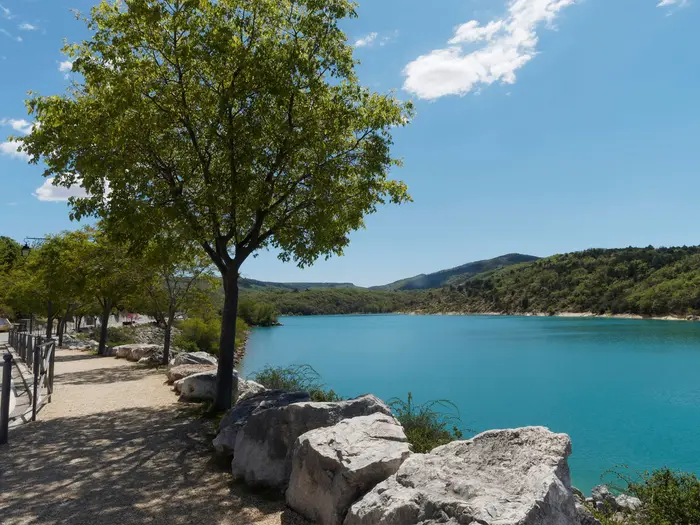 i
Image by Marc
i
Image by Marc The GR49 is a quiet, hard Provençal traverse from the Mediterranean at Saint-Raphaël to Rougon above the Gorges du Verdon. It suits fit, self-reliant walkers who want a waymarked long-distance route with real wildness, rather than a busy classic with services at every stop.
The opening days leave the Gare de Saint-Raphaël-Valescure and climb into the red volcanic rock and pine forest of the Massif de l'Estérel, then turn inland towards the Lac de Saint-Cassien. From there the route threads the Pays de Fayence, the Gorges de la Siagne and high perched villages such as Mons.
The second half is tougher and more exposed, crossing the limestone heights of the upper Var below Mont Lachens before passing Bargème, Comps-sur-Artuby and Trigance. The finish at Rougon is a proper finale: the GR49 meets the GR4 and Sentier Martel close to Point Sublime, above the Verdon Gorge.
This is not a technical trail, but it is not casual either. Heat, sparse water, limited resupply, thin accommodation and possible summer fire-risk closures in the Estérel make planning as important as fitness.
This guide covers the stages, best season, accommodation, food and water, transport, terrain and the common planning mistakes on the GR49.
Stage-by-Stage Guide
The stage distances below follow the standard 6-day south-to-north itinerary. Exact distances, water points and overnight availability should be checked against a current FFRandonnée topo-guide, recent GPX and the on-the-ground red-and-white GR waymarks, especially on the re-routed middle section via Montauroux and the Gorges de la Siagne.
Stage 1: Saint-Raphaël (gare) to Les Esterets-du-Lac — about 21 km
The GR49 starts directly from the Gare de Saint-Raphaël-Valescure, making this the easiest stage to access by public transport. From the town the waymarks lead inland away from the seafront and into the Massif de l'Estérel, where the route changes quickly from urban edge to dry Mediterranean hill country.
Expect stony tracks and rocky paths through pine forest and red volcanic terrain. The opening section gives the clearest sense of the coast-to-inland transition, with sea views before the trail turns towards the interior.
The key landmark is the Massif de l'Estérel itself, with the route crossing the GR51 near the foot of Mont Vinaigre. Les Adrets-de-l'Estérel sits on the line of travel before the route continues towards the Lac de Saint-Cassien and Les Esterets-du-Lac.
Food and water need planning from the first day. Do not treat the Estérel as a place where water can be picked up casually; start with enough for a hot, dry stage and check any intended refills before setting off.
Accommodation at or near Les Esterets-du-Lac and the Lac de Saint-Cassien area is limited compared with the coast, so overnight arrangements should be booked ahead. If accommodation is not available exactly at the stage end, transfer logistics should be arranged in advance rather than improvised late in the day.
Public transport is strong at the start thanks to Saint-Raphaël-Valescure station, which is on the Marseille–Nice/Ventimiglia rail corridor and is also a TGV stop. Road access exists around the lake settlements, but onward bus or taxi options from Les Esterets-du-Lac should be checked before travelling.
The main warning on this stage is seasonal fire risk. Access to the Massif de l'Estérel can be restricted or closed in high summer, and the daily access status should be checked before committing to the stage. Heat is also a serious factor: the route is not technical, but it can feel much harder than the distance suggests in exposed, dry conditions.
Stage 2: Les Esterets-du-Lac to Tourrettes — about 22 km
This stage leaves the Lac de Saint-Cassien area and heads into the Pays de Fayence on the current waymarked line via Montauroux and the Gorges de la Siagne. It is one of the route’s most important navigation days because older maps and descriptions may show a different inland line.
The terrain is more varied than the first day: reservoir margins and wooded hill country give way to the shaded river environment of the Gorges de la Siagne, then to the perched-village landscape around Montauroux, Saint-Cézaire-sur-Siagne and Tourrettes. Underfoot, expect a mix of dirt tracks, rocky paths and dry Provençal trails.
The Gorges de la Siagne provide a cooler, greener interlude on an otherwise hot and dry route. This is a useful psychological break between the Estérel and the more open limestone country that becomes more dominant later in the walk.
Food and water should be planned around the named villages, not assumed in between. Natural water in gorge country should not be relied on as a safe drinking source without treatment, and opening hours in small settlements can be limited.
Tourrettes is the overnight target, with Fayence nearby. Accommodation in this part of the route can include small hotels, chambres d'hôtes and gîtes, but availability is not dense; book before starting the trail.
Road access is better here than in the high Var sections because the route passes through or near several settled places. Public transport for joining or leaving at Tourrettes, Montauroux or Fayence should be checked before travelling.
Navigation deserves attention on this stage. Follow the current red-and-white GR balisage and a recent map/GPX rather than an old direct line between the Lac de Saint-Cassien and Mons. If the markings and an older map disagree, the marked route on the ground is the safer planning reference, backed up by current FFRandonnée mapping.
Stage 3: Tourrettes to Mons — about 12 km
This is the shortest of the six standard stages, but it should not be dismissed as a rest day. The route continues through the Pays de Fayence towards Mons, a high perched village above the Gorges de la Siagnole, and the day can still feel demanding in heat.
The going is typical inland Provence: dry paths, tracks and stony ground, with less of the coastal softness of the first day. The stage climbs into higher village country, with broader views opening as Mons is approached.
Mons is the main highlight. It stands above the Gorges de la Siagnole and is associated with the Roman aqueduct at the Roche Taillée, which once supplied Fréjus. In clear weather, the village is known for far-reaching views towards the coast and the Îles de Lérins.
Because the stage is short, many walkers will be tempted to combine it with another day. That should only be done if water, accommodation and the following high-country stages have been properly arranged; the second half of the GR49 is where the cumulative ascent and sparse services become more serious.
Food and water should be secured in Tourrettes or nearby Fayence before departure, then again at Mons if services are open. Do not assume reliable intermediate resupply on a 12 km stage simply because the distance is modest.
Accommodation in Mons is limited and should be booked ahead. If Mons is full, alternatives may require road transfer, which should be arranged before setting out.
Road access exists at the village, but public transport for Mons should be checked before travelling. For section-hikers, this is not as straightforward a changeover point as Saint-Raphaël.
Navigation is generally about staying with the GR markings through village approaches, tracks and path junctions. This is still part of the re-routed middle section, so current mapping matters.
Stage 4: Mons to La Roque-Esclapon — about 17 km
Stage 4 marks the transition into the harder northern half of the GR49. The route leaves Mons and heads towards La Bastide and La Roque-Esclapon, entering the higher, barer limestone country below the Mont Lachens massif.
The terrain becomes more open, drier and more exposed. Expect stony tracks and rocky paths rather than technical walking; the challenge is the combination of height gain, heat, rough limestone underfoot and long stretches with few services.
This part of the walk forms the approach to the high Var traverse. The GR49 does not climb Mont Lachens itself, but it passes through the surrounding upper-Var heights, with the route’s high point of about 1,444 m lying in this wider La Bastide / La Roque-Esclapon / Bargème area.
Views become broader and more upland in character than on the earlier stages. The landscape is less shaded, so an overcast spring or autumn day can feel very different from the same section in summer sun.
Water is a key planning issue. Carry enough from Mons and identify any intended refill points before leaving; do not rely on finding water on the limestone plateau. Food availability is also sparse, so lunch and emergency food should be carried.
La Roque-Esclapon is the stage end, but accommodation should be considered limited and booked ahead. If beds are unavailable there, the logistics of continuing, diverting or transferring can become awkward.
Road access exists in the La Bastide and La Roque-Esclapon area, but public transport options should be checked before travelling. This is not a stage where a missed connection or full accommodation can be easily solved on foot.
Navigation is usually straightforward if the GR balisage is followed carefully, but open limestone country can make missed junctions costly in hot weather. Keep a current map or offline GPX available, and avoid starting late when the day is forecast to be hot.
Stage 5: La Roque-Esclapon to Trigance — about 24 km
This is the longest standard stage and one of the most demanding days of the GR49. It crosses the high Var landscape from La Roque-Esclapon towards Bargème, Comps-sur-Artuby / Jabron and Trigance, with substantial ascent and long dry sections.
The terrain is hard underfoot: rocky paths, stony tracks and exposed limestone rather than soft forest trail. The walking is not technical and there is no scrambling, but the distance, cumulative climb and sparse water make this a serious stage.
Bargème is the standout landmark, sitting at about 1,097 m and regarded as the highest village in the Var. Its ruined Château de Sabran de Pontevès, old ramparts and ridge-top position make it one of the most memorable settlements on the route.
The route then continues towards the Comps-sur-Artuby / Jabron area before reaching Trigance. Comps-sur-Artuby is notable for having a campsite option, but this should be checked and booked or planned in advance where necessary.
Food and water require conservative planning. Treat La Roque-Esclapon, Bargème, Comps-sur-Artuby / Jabron and Trigance as possible planning points, but verify current services and opening hours before relying on them. Carry enough water for a full exposed day if there is any doubt.
Trigance is the overnight target and the last main village before the Verdon finale. Accommodation is limited, so reserve early, particularly in busy walking periods and holiday weeks.
There is road access at the villages on or near this stage, including Bargème, Comps-sur-Artuby / Jabron and Trigance. Public transport should not be assumed; any section-hike exit, taxi or pick-up should be arranged in advance.
The main warnings are heat, distance and low margin for error. A late start, closed service or underestimated water carry can turn this into the hardest day of the route. In summer, this stage is best treated as an early-start day with a cautious pace and a realistic water load.
Stage 6: Trigance to Rougon — about 12 km
The final stage is shorter, but it finishes the route in big limestone gorge country rather than providing an easy lowland walk-out. From Trigance the GR49 heads towards Pont de Tusset and Rougon, reaching the edge of the Gorges du Verdon near Point Sublime.
The terrain remains dry and rocky, with paths and tracks through the Préalpes de Castellane landscape. The walking is not technically exposed, but the surroundings become more dramatic as the route approaches the Verdon cliffs and the cliff-top village of Rougon.
Pont de Tusset is the main named landmark before the finish. The reward is the arrival at Rougon above the Gorges du Verdon, where the GR49 meets the GR4 and the Sentier Martel close to the Point Sublime belvedere.
Water and food should still be planned carefully. The short distance can encourage under-preparation, but there should be no assumption of resupply between Trigance and Rougon. Carry enough from Trigance and check what is open at Rougon before relying on it after arrival.
Accommodation in Rougon is limited and should be booked ahead if staying at the finish. Some walkers will instead exit by bus towards Castellane, but the GR49 itself finishes at Rougon, not Castellane.
The practical exit is from the Point Sublime bus stop, under 1 km from the trail, served by regional coach Line 450 between Riez and Castellane and by the seasonal Navette Blanc-Martel. Timetables vary by season and should be checked before travelling, especially outside the main walking period.
Navigation at the finish is important because several major routes meet in the Verdon area. Follow the GR49 waymarks to Rougon and do not drift onto the GR4 or Sentier Martel unless that is part of a separate onward plan.
The final warning is logistical rather than technical: missing the limited bus or arriving without accommodation can be a problem at Rougon. Finish-day transport should be treated as part of the route plan, not as an afterthought.
Recommended Itinerary
The most workable plan for the GR49 is the standard 6-day south-to-north itinerary from the Gare de Saint-Raphaël-Valescure to Rougon. It keeps the first half manageable in hotter, lower country, then accepts longer and steeper days as the route crosses the upper Var limestone towards the Verdon.
Distances are approximate. Accommodation, water points and the current waymarked line should be checked against up-to-date mapping before booking, especially between the Lac de Saint-Cassien, Montauroux, the Gorges de la Siagne and Mons, where older maps may show a different GR49 alignment.
Standard 6-day itinerary
| Day | From | To | Approx. distance | Why this stage makes sense | Services/accommodation notes |
|---|---|---|---|---|---|
| 1 | Saint-Raphaël gare | Les Esterets-du-Lac / Lac de Saint-Cassien | 21 km | A logical first stage straight from the railway station, leaving the coast and crossing the Massif de l’Estérel towards the lake. The early section can be hot and exposed, and the Estérel may be subject to summer fire-risk access closures. | Saint-Raphaël has the strongest transport and service base on the route. Once inland, do not rely on frequent shops or water; check the day’s access status and carry enough water from the start. Book ahead around Les Esterets-du-Lac / Lac de Saint-Cassien. |
| 2 | Les Esterets-du-Lac | Tourrettes | 22 km | This stage moves from the lake into the Pays de Fayence area, using the current line via Montauroux and the Gorges de la Siagne before reaching Tourrettes. It is one of the key sections where current GR waymarking matters, as older route information may differ. | Services are village-based and not continuous. Montauroux and the wider Fayence/Tourrettes area are the main planning anchors, but exact accommodation and resupply points should be checked before committing to the day. |
| 3 | Tourrettes | Mons | 12 km | A deliberately shorter day, useful after two longer opening stages and before the harder upper-Var crossing begins. It also gives time to deal with heat, slow terrain or accommodation timing around the perched villages. | Mons is an important overnight target before the route becomes more remote. Book a bed in advance and check food and water availability, as onward options thin out. |
| 4 | Mons | La Roque-Esclapon | 17 km | The route climbs into higher, drier limestone country below the Mont Lachens massif. Although the distance is moderate, the terrain becomes more demanding and water planning becomes more important. | La Bastide and La Roque-Esclapon are the main planning points in this sector. Treat this as a sparse-services day: carry food and water, and confirm accommodation before leaving Mons. |
| 5 | La Roque-Esclapon | Trigance | 24 km | The hardest full stage for many walkers: long, high and remote, with the GR49 crossing the upper Var heights and passing the Bargème / Comps-sur-Artuby / Jabron sector before dropping towards Trigance. This is where the cumulative ascent of the route is most strongly felt. | Plan this day carefully. Accommodation is thin and should be booked ahead; Comps-sur-Artuby has occasional camping options, but availability and opening periods should be checked before relying on it. Carry enough water for long dry stretches. |
| 6 | Trigance | Rougon | 12 km | A shorter final stage to the Verdon, finishing in Rougon near Point Sublime, where the GR49 meets the GR4 and the Sentier Martel. The shorter distance is useful because onward transport from the finish can be limited and seasonal. | Rougon is not Castellane. The practical exit is usually from the Point Sublime bus stop, under 1 km from the trail, using regional coach Line 450 or the seasonal Navette Blanc-Martel where running. Timetables should be checked before travelling, especially outside the main season. |
Slower itinerary
A 7–8 day version suits walkers travelling in hot weather, those carrying camping gear, or anyone who wants more margin for sparse water and accommodation logistics. The most useful approach is to break one or more of the longer days rather than shorten the already moderate final day.
Possible places to investigate for extra nights include Les Adrets-de-l’Estérel, Montauroux, the Saint-Cézaire-sur-Siagne / Fayence area, La Bastide, Bargème and Comps-sur-Artuby. Do not assume each has suitable accommodation exactly on the GR49 or available on the required date; this should be checked before booking.
The slower option is particularly sensible if walking in late spring or early autumn during warm spells, or in summer when early starts and long midday breaks may be needed. It also gives more flexibility if fire-risk closures affect the Massif de l’Estérel.
Faster itinerary
A 5-day traverse is only suitable for very fit, self-reliant walkers who are comfortable with long dry days, limited resupply and bigger cumulative ascent. The most obvious compression is to combine the shorter middle stages, for example by walking from Tourrettes to La Roque-Esclapon via Mons in a single long day, but the exact distance and ascent should be checked on current official mapping before booking.
Compressing the final two days is less attractive: La Roque-Esclapon to Trigance is already a long and demanding stage, and pushing on to Rougon would create a very hard day with awkward transport timing at the finish. For most walkers, the 6-day itinerary is the best balance between distance, heat management and realistic overnight stops.
Planning the Route
How many days to allow
The standard GR49 itinerary is six walking days from Saint-Raphaël to Rougon. That is the best default for most fit walkers, because the overnight options and village spacing naturally shape the route: Les Esterets-du-Lac, Tourrettes, Mons, La Roque-Esclapon, Trigance and Rougon make a practical sequence.
Walking it faster is possible only for very strong hikers who are comfortable with long, hot, water-scarce days and have accommodation secured in the right places. The route is not technically difficult, but the second half carries much of the climbing and crosses dry limestone country where speed should not be the main planning priority.
Adding a day can make the walk more comfortable, especially in hot weather, but it is not always simple because beds, shops and water are thin between villages. Any slower itinerary needs to be built around actual accommodation availability rather than equal daily distances on a map.
| Day | Usual stage | Approx. distance | Planning note |
|---|---|---|---|
| 1 | Saint-Raphaël Gare → Les Esterets-du-Lac | 21 km | Starts directly from Gare de Saint-Raphaël-Valescure and crosses the Massif de l'Estérel; check summer fire-risk access before committing to this stage. |
| 2 | Les Esterets-du-Lac → Tourrettes | 22 km | Uses the current inland line via Lac de Saint-Cassien, Montauroux and the Gorges de la Siagne area; older route descriptions can differ. |
| 3 | Tourrettes → Mons | 12 km | A shorter day, useful for managing heat and the climb towards the higher perched villages. |
| 4 | Mons → La Roque-Esclapon | 17 km | The character becomes higher, drier and more exposed; water planning becomes increasingly important. |
| 5 | La Roque-Esclapon → Trigance | 24 km | The hardest planning day for many walkers: long, high and committing, crossing the upper-Var limestone country beneath Mont Lachens and passing Bargème before the descent towards Trigance. |
| 6 | Trigance → Rougon | 12 km | A shorter final stage to Rougon and the Verdon; onward transport from Point Sublime must be checked in advance. |
Exact day distances and overnight points should be checked against a current FFRandonnée topo-guide or recent GPX before booking, because the GR49 has had routing changes and some older maps or route notes do not match the current waymarked line.
Build the itinerary around villages, not mileage
The GR49 is not a route where accommodation and resupply appear at regular intervals. Planning should start with the overnight villages, then work backwards to food, water and transport.
Beds should be booked ahead. The route uses a mixed network of small hotels, chambres d'hôtes, gîtes and occasional campsites, with a campsite option noted around Comps-sur-Artuby, but there are not enough services to rely on turning up and improvising each evening.
Food resupply also needs forethought. Several stages have no shop or reliable water source, so each morning should begin with enough food for the day and a clear plan for the next dependable resupply point. This should be checked before travelling.
Water is a primary constraint
The GR49 crosses hot, dry Provence and water is one of the route’s main limiting factors. Do not plan water carries from the map alone: fountains, seasonal taps and small streams can be dry or unavailable, especially in summer and early autumn.
The Gorges de la Siagne section gives a cooler, shaded contrast, but much of the later route over the upper Var and towards the Verdon is exposed limestone. Start each stage with a conservative water load, and treat every uncertain water point as a bonus rather than part of the plan until checked locally.
Navigation and the current route
The GR49 is waymarked with red-and-white FFRandonnée GR balisage, and the marks run in both directions. The conventional direction is south to north, from Saint-Raphaël to Rougon, which also gives the strongest public-transport access at the start and leaves the Verdon finish for the end.
Navigation still needs care. The section between Lac de Saint-Cassien and Mons has been re-routed eastwards via Montauroux, the Gorges de la Siagne and the Saint-Cézaire-sur-Siagne area; older descriptions and maps may show a different line. Follow the on-the-ground GR waymarks, carry current IGN 1:25,000 mapping for the relevant sheets, and use a recent GPX or FFRandonnée topo-guide rather than relying on an old track.
Weather, season and access checks
Spring and autumn are the easiest seasons for most walkers. Summer brings serious heat, dry stages and possible access closures in the Massif de l'Estérel because of fire risk.
Before starting from Saint-Raphaël, check the current Var fire-risk access information for the Estérel. If the opening section is closed, do not assume there will be a simple legal workaround on the day; the itinerary may need to be delayed or re-planned.
In hot weather, start early, keep the shorter days short, and avoid treating the 12 km stages as rest-day padding. They are useful buffers in a route where heat, water and accommodation dictate the rhythm more than raw distance.
Shortening, extending and section hiking
The GR49 is not especially easy to shorten on foot because services and public transport are limited away from the coast and the main villages. Saint-Raphaël is straightforward by rail, but the finish at Rougon depends on the Point Sublime bus stop, regional coach Line 450 between Riez and Castellane, and the seasonal Navette Blanc-Martel; current timetables should be checked before travelling, especially outside the main season.
Section hiking is practical for walkers who are willing to arrange local transfers, accommodation and bus connections carefully, but it is not a hop-on, hop-off trail with frequent railway access. The most sensible section breaks are likely to be based on the named villages and available beds rather than on ideal walking distances.
Extending the walk is possible in route-planning terms because the GR49 meets the GR4 and the Sentier Martel near Rougon. Any extension into the Verdon should be planned separately, with its own accommodation, transport and seasonal access checks.
Towns, Villages and Overnight Stops
Accommodation on the GR49 is workable but thin. The standard six-day itinerary depends on a small number of villages, so beds should be booked before setting off and each day should be planned around water as much as distance.
Do not assume that every named place has a shop, café or reliable water point. Several sections cross hot, exposed limestone or dry forest tracks with little scope for improvising once accommodation is missed or full.
| Place | Practical role on the GR49 |
|---|---|
| Saint-Raphaël | Start point and strongest access point, with the Gare de Saint-Raphaël-Valescure on the rail network |
| Les Esterets-du-Lac / Lac de Saint-Cassien | Usual first overnight area on the six-day itinerary |
| Tourrettes | Usual second overnight stop, near Fayence |
| Mons | Usual third overnight stop and a key high village before the harder northern half |
| La Roque-Esclapon | Usual fourth overnight stop before the high Var traverse |
| Trigance | Usual fifth overnight stop and last main village before Rougon |
| Rougon | Finish village above the Gorges du Verdon, with exit transport from nearby Point Sublime |
Saint-Raphaël
Saint-Raphaël is the start of the GR49. The route begins at the Gare de Saint-Raphaël-Valescure SNCF/TER station, a few minutes from the seafront, before the red-and-white GR waymarks lead inland towards the Massif de l'Estérel.
This is the easiest place on the whole route for transport and pre-walk logistics. The station is on the Marseille–Nice/Ventimiglia rail corridor, with regional connections towards Cannes, Nice, Toulon and Marseille, and Saint-Raphaël is also a TGV stop.
It is the best place to arrive the day before starting, especially if walking in warm weather and aiming for an early departure into the Estérel. Accommodation and food planning are simpler here than later on the trail, but summer demand on the coast can be high, so book ahead.
Les Adrets-de-l'Estérel
Les Adrets-de-l'Estérel sits in the Estérel hills on the inland side of the opening section. It is relevant as a named settlement in the first part of the route, but the standard first stage continues towards Les Esterets-du-Lac and the Lac de Saint-Cassien area.
Use it as a planning reference rather than assuming it will solve accommodation or resupply. Services, water and any off-route options should be checked before travelling.
The key local issue on this part of the GR49 is summer access in the Massif de l'Estérel. Fire-risk restrictions can close or limit access to the massif, so the Var access maps and current local restrictions should be checked before setting out.
Lac de Saint-Cassien
The Lac de Saint-Cassien marks the transition from the red-rock Estérel opening into the inland Pays de Fayence section. It is not just a scenic interlude: for hikers, it is the broad area around which the first overnight is usually planned.
Do not treat the lake itself as a guaranteed resupply point. Accommodation and food options depend on the exact stopping place used around Les Esterets-du-Lac, and these should be booked and checked before travelling.
This is also where route accuracy starts to matter. The GR49 has been re-routed in this wider section and now runs towards Montauroux, the Gorges de la Siagne and Saint-Cézaire-sur-Siagne rather than following older direct lines shown on some mapping.
Les Esterets-du-Lac
Les Esterets-du-Lac, by the Lac de Saint-Cassien, is the usual end of day 1 on the six-day itinerary from Saint-Raphaël. The first stage is about 21 km, so arriving with accommodation already arranged is important.
This is a sensible overnight because it breaks the route after the Estérel crossing and before the longer inland stage towards Tourrettes. It also avoids trying to stretch the first day too far in heat.
Accommodation should be booked ahead and any food or breakfast arrangements clarified directly with the host. Do not rely on turning up and finding a bed at short notice on this route.
Montauroux
Montauroux lies on the current inland line after the Lac de Saint-Cassien, before the route drops into the Gorges de la Siagne area. It is one of the key wayfinding names to look for when checking that maps, GPX files and on-the-ground waymarks match the current GR49.
It can be useful for services, but exact shops, opening times, water points and accommodation should be checked before travelling. This is particularly important if using Montauroux to shorten or modify the standard stage between Les Esterets-du-Lac and Tourrettes.
Older mapping may show a different line in this part of the Var. Follow the red-and-white balisage on the ground and carry a current topo-guide or recent GPX.
Gorges de la Siagne
The Gorges de la Siagne section is a cooler, wooded river passage on the re-routed line between the Lac de Saint-Cassien and the Pays de Fayence. It is valuable for variety and shade, but it should not be treated as a guaranteed place to buy food or find accommodation.
Plan this as a walking section between settled places. Water availability, access restrictions and any practical crossing or path information should be checked before travelling.
Because the GR49 has changed line in this area, this is one of the sections where current waymarking matters most. Older routes and older digital tracks may not match the present waymarked GR.
Saint-Cézaire-sur-Siagne
Saint-Cézaire-sur-Siagne is near the current GR49 line through the Gorges de la Siagne area. It is an important place name for route planning, especially when checking the re-routed section east of the older direct line.
Whether it works as a practical stop depends on the exact itinerary and current mapped line being followed. Accommodation, food and any detour needed from the GR should be checked before travelling.
For most walkers on the standard six-day schedule, the main overnight target after Les Esterets-du-Lac is Tourrettes rather than Saint-Cézaire-sur-Siagne. Use it as a possible service or contingency point only if confirmed in advance.
Tourrettes
Tourrettes is the usual end of day 2, after the stage from Les Esterets-du-Lac. This is one of the more important overnight stops because the following day to Mons is shorter, giving some recovery before the harder northern half of the route.
Accommodation should still be booked ahead. The GR49 passes through a region of small perched villages rather than a continuous chain of service towns, so the practical question is not whether a village exists on the map, but whether it has an available bed, an evening meal and breakfast when needed.
Fayence is near this part of the route and may affect accommodation or resupply planning. Any off-route movement between Tourrettes and Fayence should be checked against current maps before booking.
Fayence
Fayence sits near the GR49 in the Pays de Fayence section, close to Tourrettes. It is useful to know about because it may broaden the range of practical options in this part of the itinerary, especially if Tourrettes accommodation is limited.
Do not assume it is a like-for-like on-route substitute without checking the exact route line, access and walking time. This should be checked before travelling.
If using Fayence for accommodation, confirm meal options and the route back to the GR before committing. A small diversion can be worthwhile on a sparse trail, but only if it does not create a harder following day than planned.
Mons
Mons is the usual end of day 3 and a key overnight stop before the route enters its higher, drier northern half. The standard stage from Tourrettes is about 12 km, deliberately shorter than several other days.
This is a good place to reset logistics: refill water, check food, and make sure the next accommodation is secured. The following sections towards La Bastide, La Roque-Esclapon and the limestone heights below Mont Lachens are more committing.
Mons is also one of the most memorable villages on the route, perched above the Gorges de la Siagnole and near the Roche Taillée Roman aqueduct. Practical needs still come first here: accommodation, meals and any shop opening times should be checked in advance.
La Bastide
La Bastide is part of the upper Var traverse beneath the Mont Lachens massif. The GR49 reaches its highest country in this broad area, with the trail high point around 1,444 m below Mont Lachens rather than on the summit itself.
It is not the standard overnight on the six-day schedule given here; that role falls to La Roque-Esclapon. La Bastide may still matter for route timing, water and possible services, but these should be checked before travelling.
This is where the GR49 starts to feel markedly more remote. Heat, exposure and lack of easy resupply become more important than the headline distance alone.
La Roque-Esclapon
La Roque-Esclapon is the usual end of day 4, after the stage from Mons. It is an important overnight because it positions walkers for the long and demanding next day to Trigance.
Book accommodation ahead and clarify food arrangements. If there is no guaranteed evening meal or breakfast where staying, carry enough food from the previous reliable opportunity.
This is also a sensible place to review water capacity for the next section. The route over the upper Var and towards Bargème, Comps-sur-Artuby and Trigance crosses dry limestone country where water is a limiting factor.
Bargème
Bargème is one of the standout villages of the northern half, set on a rocky ridge and known as the highest village in the Var at about 1,097 m. The GR49 passes through this high limestone country below Mont Lachens before continuing towards the Verdon.
It can be a useful place to plan a pause, but do not assume full walker services are available when needed. Accommodation, food, cafés and water should be checked before travelling, especially outside the main visitor season.
Because Bargème sits on the long day between La Roque-Esclapon and Trigance in the standard itinerary, timing matters. Leaving La Roque-Esclapon with enough food and water is safer than relying on an uncertain midday resupply.
Comps-sur-Artuby / Jabron
Comps-sur-Artuby and the Jabron area sit on the approach towards Trigance. This is a practical reference point on the long fifth stage, and Comps-sur-Artuby is notable because there is an occasional campsite option in this part of the route.
Any campsite, gîte or food option should be booked or checked before relying on it. Opening periods can change, and this section is too sparse for last-minute assumptions.
This area can also be useful for hikers wanting to split the longest stage, but that only works if accommodation and onward logistics are secured in advance. Otherwise, the standard plan continues to Trigance.
Trigance
Trigance is the usual end of day 5 and the last main village before the Verdon finish. It sits above the Jabron valley and is a critical overnight stop after the long stage from La Roque-Esclapon.
This is the place to arrive with a bed already reserved. It is also the last practical point to prepare for the final stage to Rougon, including water and onward transport from the finish.
The final day is shorter at about 12 km, but do not under-plan it. The route still crosses dry Provençal terrain before reaching the Gorges du Verdon area, and the transport out of Rougon is limited and seasonal.
Pont de Tusset
Pont de Tusset is a route landmark between Trigance and Rougon rather than an overnight stop. Treat it as part of the final walking stage, not as a place to find services.
There is no reason to plan accommodation or resupply around Pont de Tusset unless current local information specifically supports it. This should be checked before travelling.
Its main value is navigational: it helps mark progress on the approach to the Verdon and the final climb towards Rougon and Point Sublime.
Rougon
Rougon is the finish of the GR49. The trail ends in the cliff-top village above the Gorges du Verdon, close to Point Sublime, where the GR49 meets the GR4 and the Sentier Martel.
The GR49 does not finish at Castellane. Castellane is usually part of the onward transport plan rather than the end of the walk.
Accommodation in or around Rougon should be booked ahead if staying after the finish. If leaving the same day, build the final stage around the bus or shuttle timetable rather than assuming a frequent service.
The nearest practical transport point is the Point Sublime bus stop, under 1 km from the trail. It is served by regional coach Line 450 between Riez and Castellane and by the seasonal Navette Blanc-Martel; current timetables, operating dates and connections should be checked before travelling, especially outside the main season.
Getting to the Start
By train
The GR49 starts at Gare de Saint-Raphaël-Valescure, the SNCF/TER station in Saint-Raphaël. This is the simplest and most reliable way to reach the trailhead: the red-and-white GR waymarks leave from the station area and lead inland towards the Massif de l’Estérel.
Saint-Raphaël-Valescure sits on the Marseille–Nice/Ventimiglia rail line, with regional TER trains to and from Cannes, Nice, Toulon and Marseille. Saint-Raphaël is also a TGV stop, making it practical to arrive directly or with one change from larger French cities.
For most walkers, the best plan is to arrive the afternoon or evening before starting. The first stage heads straight into hot, exposed country and is not a good place to be losing time after a delayed train.
By bus
Bus is not the main way to reach the start of the GR49. Saint-Raphaël has strong rail access, so intercity journeys are normally easier by train than by regional bus.
Local buses may be useful if staying away from the station or elsewhere on the coast before starting, but routes and frequencies change. This should be checked before travelling.
By car
Driving to Saint-Raphaël is possible, but it creates a point-to-point problem: the walk finishes at Rougon, not back on the coast, and public transport away from the finish is limited and seasonal. Leaving a car in Saint-Raphaël only makes sense if a return journey from Rougon via Castellane and onward coach connections has been planned in advance.
No long-stay parking arrangement should be assumed at the station. If driving, ask accommodation in Saint-Raphaël about parking before booking, or check current municipal/station parking rules directly. This should be checked before travelling.
A taxi can be useful for short local transfers around Saint-Raphaël, but it is not a practical substitute for planning the end-to-end transport of the whole route. The difficult transport leg is usually getting away from Rougon / Point Sublime at the finish, not reaching Saint-Raphaël at the start.
From the nearest airport
For international walkers, the practical approach is to fly into an airport with straightforward rail access to the Marseille–Nice/Ventimiglia coastal line, then take the train to Saint-Raphaël-Valescure. Nice and Marseille are the usual gateway cities for this part of the coast, with onward rail connections towards Saint-Raphaël.
Check flight arrival times against the final train connection to Saint-Raphaël, especially if arriving late in the day. This should be checked before travelling.
Where to stay before starting
Stay in Saint-Raphaël the night before the walk if possible. The station is only a few minutes from the seafront, and starting from town avoids needing a morning transfer to the trailhead.
An overnight stop is especially sensible in summer, when an early start helps with heat on the opening stage through the Estérel. Before setting out, check current Massif de l’Estérel fire-risk access rules, as closures can affect the beginning of the route in high summer.
Book accommodation ahead rather than relying on arrival-day availability. The GR49 quickly leaves the coast for smaller villages and thinner services, so Saint-Raphaël is also the best place to make final food, water and equipment checks before starting.
Getting Home from the Finish
By train
Rougon has no railway station, and the GR49 does not finish at a railhead. The finish is in the cliff-top village of Rougon, close to Point Sublime above the Gorges du Verdon, so the first step is normally to leave by bus, shuttle, taxi or pre-arranged lift.
For rail connections, plan to reach a larger transport hub by coach first, most commonly via Castellane. Exact rail interchanges and same-day connections depend on the season and current regional timetables, so this should be checked before travelling.
By bus
The closest public transport stop to the finish is Point Sublime, under 1 km from the trail near Rougon. It is served by regional coach Line 450, running between Riez and Castellane, and by the seasonal Navette Blanc-Martel serving the Verdon area.
The usual exit is to take a bus or shuttle from Point Sublime towards Castellane, then continue by onward coach connections. Services are limited and seasonal patterns matter, especially outside the main Verdon walking season, so do not assume there will be a convenient bus after finishing the final stage.
As a rough guide, Line 450 and the Navette Blanc-Martel are low-cost local services, with fares often only a few euros. Current fares and timetables should be confirmed before booking accommodation or onward travel.
If aiming to leave the same day, check three things in advance:
- the last departure from Point Sublime;
- whether the service operates on the intended day of the week and season;
- whether there is a workable onward connection from Castellane.
By car/taxi
A private pickup is the simplest way to leave Rougon, especially if finishing late, walking out of season or travelling with a group. Arrange the pickup point clearly: Rougon village and Point Sublime are close, but they are not the same place.
Taxis should be booked ahead rather than relied on at the finish. This is a rural mountain area with limited public transport, and there is no reason to expect a taxi to be waiting at Rougon or Point Sublime. This should be checked before travelling.
If leaving a car for the end of the hike, remember that the GR49 is a point-to-point route from Saint-Raphaël to Rougon. A two-car plan, pre-booked transfer or taxi connection is more practical than trying to improvise a return to the coast after finishing.
From the nearest airport
Rougon is not an airport-accessible finish in any direct sense. If flying home after the hike, first plan the ground connection from Point Sublime/Rougon to Castellane, then use onward coach and rail links to reach the chosen airport.
Do not book a same-day flight unless the full chain of bus, coach and rail connections has been checked carefully. Out of season, or after a late finish, staying locally and travelling the next day is usually the safer plan.
Where to stay at the finish
Staying overnight at or near the finish is often the most robust option, particularly if bus timings are awkward. Rougon is a small village, so accommodation and food options should be booked ahead rather than treated as flexible walk-up services.
Castellane is the usual onward transport direction from the finish and can also work as a practical post-hike base if a pickup, taxi or bus connection is available. If finishing late in the day, arrange either a bed near Rougon/Point Sublime or a confirmed transfer before starting the final stage from Trigance.
Which Direction Should You Walk?
The GR49 is conventionally walked south to north, from Saint-Raphaël to Rougon. The red-and-white GR waymarks run both ways, so a reverse walk is possible, but the published six-day flow and the natural build of the route favour the standard direction.
Standard direction: Saint-Raphaël to Rougon
Starting at Gare de Saint-Raphaël-Valescure is the cleanest logistical option. The station is on the SNCF/TER rail network, with regional trains towards Cannes, Nice, Toulon and Marseille, and Saint-Raphaël is also a TGV stop.
The scenery also builds well this way. The route leaves the Mediterranean edge through the red rock and pine of the Massif de l'Estérel, passes the Lac de Saint-Cassien and the villages of the Pays de Fayence, then becomes progressively wilder and higher across the limestone country below Mont Lachens before finishing above the Gorges du Verdon at Rougon.
The drawback is that the harder walking comes later. The longest and steepest days sit in the second half, with the high traverse around La Bastide, La Roque-Esclapon, Bargème, Comps-sur-Artuby and Trigance before the final approach to the Verdon. That means tired legs, hotter inland terrain and sparse water all coincide near the end.
The finish is memorable, but transport away from Rougon needs planning. The usual exit is from the Point Sublime bus stop, under 1 km from the trail, using regional coach Line 450 or the seasonal Navette Blanc-Martel, then onward via Castellane. Current bus and shuttle timetables should be checked before travelling, especially outside the main season.
Reverse direction: Rougon to Saint-Raphaël
Walking north to south gives a much easier finish: Saint-Raphaël has excellent rail connections, so there is less pressure on the final day. It can also feel physically kinder overall because the route trends from the higher Verdon and upper Var country down towards the coast, although the GR49 is still undulating and should not be treated as a downhill walk.
The main disadvantage is getting to the start. Reaching Rougon depends on limited or seasonal public transport via Point Sublime, so a missed connection or out-of-season timetable can cause problems before the walk has even begun. This should be checked before travelling.
Reverse walkers also begin with some of the most remote and demanding terrain, including the Verdon end, Trigance, Comps-sur-Artuby, Bargème and the upper Var limestone stages. That front-loads the hardest logistics — water, food and thin accommodation — when the pack is likely to be at its heaviest.
The scenic progression is less satisfying in reverse for most hikers. The route starts with its grand Verdon finale and gradually works back towards lower, busier coastal country, rather than building from sea to gorge.
Accommodation and stage flow
Accommodation is limited in both directions and should be booked ahead. The standard six-day itinerary is better aligned with the usual south-to-north rhythm, with shorter early stages near the coast and the tougher, more exposed walking saved for later.
In reverse, the same villages can be used, but the harder stages come first. This is manageable for fit walkers, but it leaves less room to ease into the route and makes early water and resupply planning more critical.
Recommendation
For most hikers, the best direction is Saint-Raphaël to Rougon. It is the traditional direction, has the simplest start, gives the strongest landscape progression from Mediterranean coast to Verdon gorge, and ends with the most dramatic psychological finish.
Walk it in reverse only if the Point Sublime / Rougon transport works better for specific dates, or if finishing at a major rail station in Saint-Raphaël is more important than the classic coast-to-gorge build.
Accommodation Along the Route
Accommodation on the GR49 is workable, but it is one of the main planning constraints on the route. This is not a trail where walkers can reliably turn up in each village and find a bed; the accommodation mix is thin, with small hotels, chambres d’hôtes, gîtes, occasional camping and some bivouac potential rather than a dense chain of trail lodges.
The standard 6-day itinerary uses overnight stops at or near Les Esterets-du-Lac, Tourrettes, Mons, La Roque-Esclapon and Trigance, finishing at Rougon. These are small places, and several stages have little or no fallback accommodation between them. Book beds before committing to travel dates, especially in summer, at weekends and around the Verdon end of the route.
How to plan your overnights
Saint-Raphaël is the easiest place to arrange accommodation, with the practical advantage of the Gare de Saint-Raphaël-Valescure at the trailhead. Staying there the night before is sensible if starting early to avoid heat in the Massif de l’Estérel.
After the first day, accommodation becomes much more village-based. The Pays de Fayence section gives a little more flexibility around Tourrettes and nearby Fayence, but the higher inland stages through Mons, La Roque-Esclapon, Bargème, Comps-sur-Artuby / Jabron and Trigance need more careful booking.
The finish at Rougon is a small cliff-top village rather than a transport hub. If staying there after the walk, accommodation should be booked well ahead; if continuing out by bus from Point Sublime, match the final night and transport plan to the current seasonal timetable. This should be checked before travelling.
Accommodation by place
| Place | Accommodation level | Best for | Notes |
|---|---|---|---|
| Saint-Raphaël | Good | Pre-walk night; easy rail access | Best place to start rested and carry a full water/resupply load into the Estérel. The GR49 begins at Gare de Saint-Raphaël-Valescure. |
| Les Adrets-de-l’Estérel | Limited | Possible early-stage option | Useful only if reworking the first stage. Availability should be checked before building an itinerary around it. |
| Lac de Saint-Cassien / Les Esterets-du-Lac | Limited | Standard Day 1 overnight area | One of the key booked stops on the 6-day itinerary. Do not assume late availability in season. |
| Montauroux / Saint-Cézaire-sur-Siagne area | Limited | Re-staging between Lac de Saint-Cassien and Tourrettes | The current route passes this wider area via the Gorges de la Siagne. Useful for shorter-stage planning, but exact accommodation and access from the GR should be checked before travelling. |
| Tourrettes / Fayence area | Good to limited | Standard Day 2 overnight; best flexibility in the middle section | This is one of the more useful accommodation areas on the route because several villages sit close together in the Pays de Fayence. Book ahead rather than relying on walk-in rooms. |
| Mons | Limited | Standard Day 3 overnight | A key stop before the higher, drier upper-Var traverse. Plan food and water as well as the bed. |
| La Bastide | Limited | Possible alternative or support point before La Roque-Esclapon | Useful for itinerary adjustments in the high-Var section, but services are sparse. This should be checked before travelling. |
| La Roque-Esclapon | Limited | Standard Day 4 overnight | Important overnight before the long stage towards Trigance. Reserve early; there are few alternatives nearby on foot. |
| Bargème | Limited | Possible re-staging or short-stop option | A notable village on the high traverse, but not a guaranteed accommodation solution. Check current availability before depending on it. |
| Comps-sur-Artuby / Jabron | Limited | Camping or re-staging between La Roque-Esclapon and Trigance | The route has occasional campsite options, including at Comps-sur-Artuby. Opening dates and pitches should be confirmed before travelling. |
| Trigance | Limited | Standard Day 5 overnight; last main village before Rougon | Important final-stage base before the Verdon approach. Book ahead, particularly in the main walking and holiday season. |
| Pont de Tusset | None | Route point only | Do not plan this as an accommodation stop unless a specific off-route arrangement has been made. |
| Rougon | Limited | Finish night; access to Point Sublime and the Verdon | Small finish village above the Gorges du Verdon. Accommodation and onward transport from Point Sublime should be arranged in advance. |
Booking strategy
For an inn-to-inn GR49, book the whole chain before departure rather than arranging nights one by one on the trail. The critical points are Les Esterets-du-Lac, Mons, La Roque-Esclapon, Trigance and Rougon, where a failed booking can force a long taxi transfer or a major itinerary change.
High summer brings two separate pressures: heat and availability. The Estérel can also be affected by fire-risk access restrictions, so accommodation bookings at the start of the trail should ideally have enough flexibility to cope with a changed start date or revised first stage.
Spring and autumn are generally easier for walking conditions, but small chambres d’hôtes and gîtes may still have limited opening patterns. Always confirm opening dates, dinner availability, check-in times and whether food can be supplied or stored, because resupply is sparse between several villages.
Camping, bivouac and awkward gaps
Camping is not a continuous solution along the GR49. There are occasional campsite options, including around Comps-sur-Artuby, but the route is better treated as a booked village-to-village walk unless carrying full camping equipment and checking suitable overnight options in advance.
Bivouac potential exists in places, but it should not be used as a substitute for planning. Much of the route crosses dry, fire-prone Mediterranean and limestone country, with private land, protected landscapes and summer fire restrictions all relevant. Local rules and current restrictions should be checked before travelling.
Luggage transfer should not be assumed on this route in the way it might be on busier French long-distance trails. Private taxi transfers may solve an awkward accommodation gap or allow a night off-route, but they need arranging locally and in advance. This should be checked before travelling.
Camping and Wild Camping
Camping on the GR49 is possible, but it needs more planning than on better-served French long-distance trails. The route crosses hot, dry country with sparse water, limited resupply and long gaps between dependable services, so a tent does not remove the need to plan each day around villages, fountains, shops and transport.
The GR49 is best suited to hikers mixing booked accommodation with the occasional campsite or authorised bivouac, rather than assuming a continuous wild-camping itinerary. Carrying full camping kit also makes the harder northern half more demanding, especially between Mons, La Roque-Esclapon, Bargème, Comps-sur-Artuby and Trigance, where the route climbs onto exposed limestone country below Mont Lachens.
Campsites on or near the route
Formal camping options are thin. The briefest dependable planning point is that there is an occasional campsite option around Comps-sur-Artuby, which can be useful on the long La Roque-Esclapon to Trigance stage.
Elsewhere, do not assume there will be a campsite at every stage end. Saint-Raphaël, Les Esterets-du-Lac, Tourrettes, Mons, La Roque-Esclapon, Trigance and Rougon should all be treated as places where accommodation and water need checking in advance, not as guaranteed camping stops.
If relying on campsites, contact them before setting off and check:
- whether they are open in your walking season;
- whether they accept one-night hikers;
- whether food or basic supplies are available nearby;
- whether there is drinking water on site;
- whether the GR49 access from the trail is straightforward.
Wild camping and bivouac rules
Wild camping and bivouac rules in France are local and can change by municipality, land ownership, protected area and fire-risk level. On the GR49 this matters because the route crosses dry Mediterranean forest in the Massif de l'Estérel, then the Parc naturel régional du Verdon area near the finish, with private land, villages and sensitive limestone landscapes in between.
Do not assume that pitching a tent is permitted simply because an area looks remote. Permission may be needed from the landowner, and local restrictions may apply around villages, reservoirs, protected natural areas, roads, viewpoints and the Verdon sector. This should be checked before travelling.
In practical terms, any bivouac should be low-impact, late-arrival and early-departure, away from houses, cultivated land, tracks used by vehicles, water points and obvious visitor sites. If there is any doubt, ask locally at a mairie, accommodation, campsite or tourist office before relying on a pitch.
Fire risk and seasonal restrictions
Fire risk is one of the main camping constraints on this route. The opening section through the Massif de l'Estérel can be closed in high summer because of fire risk, and access rules should be checked before walking that stage.
Open fires are inappropriate on the GR49. In dry, windy or high-risk conditions, even stove use may be restricted or unwise outside formal camping areas. Check the current local fire and access rules, particularly in summer, and be prepared to change plans rather than camp in exposed forest or scrub.
Spring and autumn are generally more practical for camping than high summer. Temperatures are lower, water planning is still important, but the risk of severe heat and fire-related access problems is reduced.
Water is the limiting factor
The main camping difficulty is water, not finding flat ground. Several GR49 stages have no shop or reliable water source, and the route crosses dry, exposed terrain where natural water cannot be assumed.
A campsite or bivouac plan must start with water locations, not with mileage. Carry enough to reach the next dependable source, and do not rely on streams, springs, village fountains or lakeside water unless current availability and potability have been checked.
The Lac de Saint-Cassien, the Gorges de la Siagne, the Jabron and the Verdon are significant landscape features, but visible water is not the same as safe drinking water or a permitted camping location. Treat and filter natural water if used, and follow local access rules around reservoirs, rivers and protected areas.
Section-by-section camping practicality
| Section | Camping practicality |
|---|---|
| Saint-Raphaël to Les Esterets-du-Lac | Poor for informal camping. The Massif de l'Estérel is hot, dry and subject to summer fire-risk access restrictions, so plan a legal overnight rather than relying on a forest bivouac. |
| Les Esterets-du-Lac to Tourrettes / Mons | Possible only with careful local checking. The route passes the Lac de Saint-Cassien area and the Gorges de la Siagne, but private land, water quality and camping permissions cannot be assumed. |
| Mons to La Roque-Esclapon | Remote and dry. Carrying camping kit is feasible for strong walkers, but water and resupply are sparse and any bivouac must be planned around known legal options or local permission. |
| La Roque-Esclapon to Trigance via Bargème and Comps-sur-Artuby | The most relevant section for campsite planning, because Comps-sur-Artuby has an occasional campsite option. This is also one of the harder, higher parts of the route, so water and food planning are critical. |
| Trigance to Rougon | Shorter, but close to the Verdon finish and the Parc naturel régional du Verdon context. Do not assume wild camping is acceptable near viewpoints, cliffs, roads, Rougon or Point Sublime; check local rules and book ahead if staying overnight. |
Low-impact practice
Camp only where it is legal, discreet and safe. Keep groups small, pitch on durable ground, avoid damaging vegetation, and leave no trace of the pitch.
Pack out all rubbish, including food waste and toilet paper. Toileting should be well away from paths, buildings and water sources, and waste should be dealt with responsibly.
Do not wash directly in lakes, rivers, springs or village fountains. Keep soap, food scraps and wastewater away from water sources used by walkers, residents or livestock.
For most hikers, the safest plan is to book accommodation for key villages, use the Comps-sur-Artuby campsite option if it fits the itinerary, and treat any bivouac as a permission-based backup rather than the default way to complete the GR49.
Food, Water and Resupply
Food and water are among the main planning constraints on the GR49. The route crosses several villages, but it is not a trail with reliable daily supermarkets, long opening hours or frequent cafés. Between Saint-Raphaël and Rougon, resupply is thin and should be planned around the overnight stops, not improvised late in the day.
Start with enough food for each stage, plus a spare meal or substantial emergency snacks. When booking accommodation, ask directly whether an evening meal, breakfast and a packed lunch are available; in the smaller villages, this can be more reliable than expecting to find an open shop after arrival.
Food planning
Saint-Raphaël is the easiest place to buy supplies before starting. After that, food availability becomes village-based and uneven, especially through the perched villages and the high Var section towards La Roque-Esclapon, Bargème, Comps-sur-Artuby, Trigance and Rougon.
Do not assume that every named village has a shop open when you arrive. Rural French opening hours can be short, with midday closures, reduced Sunday trading and seasonal variation. This should be checked before travelling, especially if walking outside the main holiday season.
A sensible approach is to carry:
- lunch and snacks for the full day, every day;
- one reserve meal in case a shop, café or accommodation meal is unavailable;
- higher-calorie food for the longer, harder fifth stage from La Roque-Esclapon to Trigance;
- enough breakfast food if accommodation does not provide it early enough for a hot-weather start.
Water planning
Water is the more serious issue. The GR49 crosses hot, dry, exposed limestone country, and several stages have no reliable water source between villages. The presence of the Lac de Saint-Cassien, the Gorges de la Siagne, the Jabron valley or the Verdon does not mean there is safe drinking water on demand.
Most walkers should leave each overnight stop with at least 2–3 litres of water. In high summer, on exposed stages, or where the next confirmed refill is uncertain, carrying 3–4 litres or more may be necessary. This adds weight, but running short of water on this route is a more serious risk than carrying too much.
Natural water should not be treated as potable unless it is a signed drinking-water point. If using water from streams, rivers or other natural sources, filter or chemically treat it. In dry periods, even mapped watercourses may be low, inaccessible or unsuitable.
Resupply and water by section
| Section | Food availability | Water availability | Notes |
|---|---|---|---|
| Saint-Raphaël to Les Esterets-du-Lac / Lac de Saint-Cassien | Best resupply is before leaving Saint-Raphaël. Do not rely on food once in the Massif de l'Estérel unless already planned. | Fill fully in Saint-Raphaël. Treat the Estérel as potentially dry, especially in warm weather. | The opening stage is hot and exposed in places, with possible summer fire-risk closures in the Estérel. Start early and carry a full day’s food and water. |
| Les Esterets-du-Lac to Tourrettes, via Montauroux and the Gorges de la Siagne | Possible village-based resupply around the Pays de Fayence, but availability and opening times should be checked before travelling. | Refill only where there is a known potable source or at accommodation/cafés. Natural water in the Gorges de la Siagne should be treated if used. | This is a long stage. Carry lunch from the start unless a specific shop or café stop has been planned. |
| Tourrettes to Mons | Food options are limited and village-dependent. Check ahead rather than assuming shops will be open. | Carry enough water from Tourrettes to reach Mons comfortably. | Shorter distance, but still dry Provençal walking. Mons is an important planning point before the higher, more remote section. |
| Mons to La Roque-Esclapon | Sparse resupply. Carry the day’s food from Mons unless accommodation has arranged food. | Treat this as a stage with limited reliable water between villages. Leave Mons well supplied. | The route moves into higher, drier country beneath the Mont Lachens massif. Heat and exposure can make this harder than the distance suggests. |
| La Roque-Esclapon to Trigance, via Bargème / Comps-sur-Artuby area | Very limited and spread-out village services. Carry a full day’s food and extra snacks. | Start with a large water carry. Refill only at confirmed potable points or booked accommodation. | This is the longest and one of the most demanding days on the standard itinerary. Do not begin it with uncertain food or water. |
| Trigance to Rougon / Point Sublime | Trigance is the last main village before the finish. Rougon services should not be assumed without checking. | Carry enough water from Trigance to finish, especially in hot weather. | The stage is shorter but still exposed near the Verdon. If travelling onwards from Point Sublime, carry enough food and water to cover any wait for the bus or shuttle. |
Practical resupply strategy
Book accommodation before the walk and treat each booking as part of the food plan. Ask whether meals are available, whether a packed lunch can be provided, and whether there is a potable water tap for filling bottles in the morning.
Check shop and café opening times for the exact dates of travel. Sundays, public holidays, shoulder-season closures and midday breaks can all affect small villages on the route.
Carry purification tablets or a compact filter as a backup, but do not use this as an excuse to under-carry water. The GR49’s dry sections are best managed by leaving each village with enough water for the next known refill, rather than hoping to find usable water on the way.
Terrain, Conditions and Difficulty in Practice
The GR49 is hard because of heat, dryness, cumulative ascent and logistics, not because it is technically difficult. There is no scrambling requirement and no exposed mountaineering terrain, but the walking is often stony, sun-baked and slow underfoot, especially in the limestone country of the upper Var and the final approach to the Verdon.
The route uses FFRandonnée red-and-white GR waymarking and is conventionally walked south to north from Saint-Raphaël to Rougon. Because the line between the Lac de Saint-Cassien and Mons has changed in recent years, a current topo-guide, recent GPX and the on-the-ground balisage matter more here than on many long-distance trails.
Underfoot: dry, stony and often exposed
Expect a mix of stony forest tracks, rocky paths and dirt trails. The opening section through the Massif de l'Estérel has red volcanic rock, Mediterranean pine and dry, abrasive ground; later sections become more typically Provençal, with wooded hills, limestone tracks, bare plateaux and rocky ridges.
Mud is not normally the main problem on this route. The GR49 is better thought of as a dry-country walk where hard ground, loose stones, sun exposure and water management affect pace more than bogs or prolonged wet sections.
Footwear should be chosen for grip on rock and comfort over long stony days. Lightweight trail shoes can work for experienced walkers in dry conditions, but many hikers will prefer a more protective walking shoe or boot because the cumulative pounding is significant.
Climbs, descents and where the effort builds
The route gains roughly 4,000 m in total, and the climbing is not evenly spread. The early stages are not flat, but the hardest sustained effort comes in the second half as the trail leaves the lower, greener country and crosses the higher limestone terrain towards La Bastide, La Roque-Esclapon, Bargème, Comps-sur-Artuby, Trigance and Rougon.
The trail’s high point is around 1,444 m on the upper-Var traverse below the Mont Lachens massif. Mont Lachens itself is not crossed, but this high limestone section is where the GR49 feels most remote, dry and physically demanding.
Long descents also need respect. Rocky, dry paths can be tiring on knees and ankles, and hot afternoon descents are often slower than the map distance suggests.
Terrain by part of the route
| Section | Terrain and practical difficulty |
|---|---|
| Saint-Raphaël to the Massif de l'Estérel | The trail leaves the coast from Saint-Raphaël and climbs into red volcanic rock and Mediterranean pine. The ground is dry, stony and exposed in places, with fire-risk closures possible in high summer. |
| Estérel to Lac de Saint-Cassien and Les Esterets-du-Lac | A transition from coastal hills into inland Provence, with forest tracks, dirt trails and hard, dry surfaces. Heat can already be a major factor even before the highest terrain begins. |
| Montauroux, Gorges de la Siagne and Tourrettes | The current waymarked line runs via Montauroux and the Gorges de la Siagne. This gives a cooler, more wooded river-gorge section, but it should still be treated as a dry Provençal stage where reliable water cannot be assumed without checking beforehand. |
| Tourrettes, Fayence and Mons | Rolling inland hills and perched-village terrain. The walking is less technical than it is physically wearing, with repeated rises, dry paths and limited resupply between villages. |
| Mons to La Roque-Esclapon and Bargème area | The route becomes higher, barer and more limestone-dominated. This is where cumulative ascent, exposure to sun and thin services begin to make the GR49 feel like a serious long-distance walk. |
| La Roque-Esclapon to Trigance | One of the most demanding parts in practice, combining a longer stage with the high Var limestone landscape. Carry enough water and avoid underestimating the effect of heat on pace. |
| Trigance to Rougon | Shorter in distance, but still rocky and exposed in character as the route approaches the Gorges du Verdon. The finish at Rougon is not at Castellane; onward transport from the Point Sublime area should be checked before travelling. |
Technical difficulty and exposure
The GR49 is not a technical alpine route. There is no need for scrambling skills, climbing equipment or comfort with serious exposure in normal conditions.
That does not make it easy. Rocky paths, loose stones, heat-reflecting limestone and long dry stretches make the walking more punishing than the moderate daily distances may suggest. The hardest days are about sustained effort and self-sufficiency rather than individual obstacles.
Road walking, gates and enclosed farmland
Road walking is not the defining challenge of the GR49; the route is primarily a mix of tracks, paths and trails through forest, hills, gorges and limestone uplands. Short hard-surface sections should be expected around villages and access points, but the route’s difficulty comes from dry, rocky terrain and sparse services rather than long tarmac mileage.
Livestock fields, frequent stiles, gates and enclosed farmland are not major planning issues on this trail. Hikers used to British rights-of-way should expect a more open Provençal pattern of tracks, waymarked paths and village-to-village navigation instead.
Seasonal conditions
Spring and autumn are the most practical seasons for most walkers. Temperatures are usually more manageable, water planning is still important, and the exposed limestone sections are less punishing than in high summer.
Summer is the hardest season. The route is hot, dry and often exposed, with very sparse water and limited resupply; the Massif de l'Estérel can also be closed because of fire risk. Current Estérel access restrictions should be checked before travelling.
After rain, rocky limestone and volcanic surfaces can become slippery, but the GR49 is not generally a muddy or boggy route. The bigger recurring problem is dry-weather exposure: long carries between reliable water, shade that comes and goes, and villages that may be too far apart to treat resupply casually.
What makes it harder than it looks
The published six-day itinerary includes some shorter stages early on and harder, longer days towards the Verdon end. The total distance is about 100 km, but the route’s real difficulty lies in combining that distance with roughly 4,000 m of ascent, hot dry terrain and limited services.
Several stages pass through or between small villages where food, water and accommodation cannot be treated as guaranteed on arrival. Beds, resupply and water points should be planned before setting out each day, and current local information should be checked where a stage depends on a particular service.
In practical terms, the GR49 suits fit, self-reliant walkers who are comfortable carrying extra water and managing quiet, thinly serviced terrain. It is waymarked and non-technical, but it is not a casual first long-distance walk in hot weather.
Weather and Best Time to Walk
Best season
Spring and autumn are the best windows for the GR49. The route is long, dry and exposed, with sparse water and resupply, so avoiding the strongest summer heat makes a major difference to how much water must be carried and how safely the longer inland stages can be walked.
High summer is possible only for very fit, heat-adapted walkers with early starts and careful water planning. It is the least forgiving season: the Massif de l’Estérel can be subject to fire-risk access closures, and the limestone plateaux and ridges towards La Roque-Esclapon, Bargème, Trigance and Rougon offer long hot sections with little reliable shade or water.
Winter is not the normal season for this route. The GR49 reaches about 1,444 m on the upper-Var traverse below Mont Lachens, so cold, ice or snow can affect the higher ground, while short daylight makes the 17–24 km middle and late stages more committing. Accommodation, water sources and the Rougon / Point Sublime transport options may also be more limited; this should be checked before travelling.
Heat, water and exposure
Heat is the key weather hazard on the GR49. The trail starts close to the Mediterranean at Saint-Raphaël, then crosses the dry inland Var, where the going is often on stony tracks, rocky paths and exposed limestone rather than cool, wet terrain.
Plan walking days around water, not just distance. Several stages have no shop or reliable water source, and the standard itinerary includes long days between villages, especially La Roque-Esclapon to Trigance. In warm conditions, an early start is often the safest way to clear exposed climbs before the hottest part of the day.
Shade varies sharply. The opening Estérel section has Mediterranean pine forest, and the Gorges de la Siagne offer a cooler wooded river section, but the higher Var and Verdon approach are much more open and sun-exposed.
Fire-risk closures in the Massif de l’Estérel
The opening section through the Massif de l’Estérel can be closed in high summer because of fire risk. This is not a minor inconvenience: it can block access to the waymarked GR route soon after leaving Saint-Raphaël.
Before starting, check the current Var préfectoral access information for the Estérel, especially during hot, dry or windy periods. If access is restricted, do not assume there will be a simple walking diversion on the day; accommodation and transport plans may need changing.
Rain, storms and trail surface
The GR49 is generally a dry, stony route rather than a muddy one. Rain can still make limestone, rock steps and compacted dirt slippery, particularly on descents into and out of gorges and villages.
After wet weather, allow more time for the rockier sections around the Gorges de la Siagne, the upper Var traverse and the approach to the Verdon. There are no technical scrambling sections, but tired walkers carrying multi-day packs can lose time quickly on wet stone.
Thunderstorms and severe weather should be treated seriously on the open limestone heights and ridges in the second half of the route. If storms are forecast, avoid being committed to the highest or most exposed sections late in the day.
Daylight and stage planning
The published six-day schedule includes stages of around 21 km, 22 km and 24 km, plus substantial cumulative ascent in the second half of the walk. In the shorter-day seasons, late starts leave little margin for navigation errors, heat-related delays, accommodation check-in times or missed onward transport at the finish.
In warm weather, the usual trade-off is the opposite: start early, carry enough water, and aim to finish the most exposed climbing before the afternoon. This is especially important on the longer inland stages between Mons, La Roque-Esclapon, Trigance and Rougon.
Accommodation and seasonal services
Beds are thin along the GR49 at any time of year, with small hotels, chambres d’hôtes, gîtes and occasional campsites rather than a dense trail infrastructure. Book ahead, particularly in the smaller villages and on the higher inland stages where there may be few alternatives.
Some services may operate seasonally or with limited opening days. Water points, shops, accommodation availability and the Rougon / Point Sublime bus or Navette Blanc-Martel timetable should be checked before travelling, especially outside the main walking season.
Safety Notes
The GR49 is not a technical mountain route, but it is a serious hot-country traverse. The main safety issues are heat, scarce water, long gaps between services, fire-risk closures in the Massif de l'Estérel, and the cumulative fatigue of roughly 4,000 m of ascent over six days.
Emergency help and communications
In France, call 112 for emergency assistance. Do not rely on having continuous mobile signal, especially on the quieter inland sections, in wooded valleys and on the limestone heights between villages.
Carry a charged phone, a power bank, a current GPX track and paper mapping or an up-to-date topo-guide. The GR49 is waymarked with red-and-white GR balisage, but the route has been re-routed between the Lac de Saint-Cassien and Mons, so old maps and older downloaded tracks can be misleading.
Solo hikers should leave a stage plan with someone reliable, including the intended overnight stop and any planned exit point. This matters more on the upper Var and Verdon approach, where villages, water and onward transport are limited.
Heat, sun and dehydration
Heat is the defining hazard on this route. The Estérel, the Pays de Fayence and the bare limestone country below Mont Lachens can all be very hot and exposed, particularly in summer.
Start early, carry more water than would normally be needed for a 20–25 km day, and do not assume that a village, chapel, stream or map-marked water feature will provide drinkable water. Several stages have no shop or reliable water source, so water should be planned the night before, not improvised during the day.
Sun protection is essential: hat, sunglasses, high-factor sunscreen and clothing that covers the shoulders are more than comfort items here. On the longer La Roque-Esclapon to Trigance stage, heat and fatigue can combine quickly because the day is both long and hilly.
Fire risk in the Massif de l'Estérel
The opening section through the Massif de l'Estérel can be closed in high summer because of wildfire risk. Access restrictions are a practical route issue, not just general advice: if the Estérel is closed, the first stage may not be legally or safely walkable as planned.
Check the current Var fire-risk access information before setting off from Saint-Raphaël, and re-check locally during hot, windy or very dry periods. This should be checked before travelling.
Weather exposure and cold at height
Spring and autumn are generally the best seasons, but the upper Var traverse reaches around 1,444 m below the Mont Lachens massif. Conditions there can be much cooler and windier than on the coast at Saint-Raphaël.
Carry a warm layer and waterproof shell even when the forecast looks settled. The route is dry and exposed rather than boggy, but a change in weather on the high limestone ridges can make navigation and temperature management more serious.
Navigation and route changes
The GR49 should be followed by the on-the-ground red-and-white GR waymarks, supported by a current FFRandonnée topo-guide, recent GPX and IGN mapping. This is especially important between the Lac de Saint-Cassien, Montauroux, the Gorges de la Siagne, Saint-Cézaire-sur-Siagne and Mons, where the current waymarked line differs from older alignments.
If waymarks disappear, stop and check the map rather than pressing on along an old track. Do not assume that a visible path is the GR49 in this part of the Var.
Water, rivers and the gorges
The route passes the Lac de Saint-Cassien, the Gorges de la Siagne and finishes above the Gorges du Verdon, but this is not a wet trail in practical hiking terms. Water is often the limiting factor, and natural water should not be treated as reliable or safe to drink without treatment.
There are no route-defining tidal, ferry or major ford hazards on the GR49. The gorge environments still deserve care: stay on the marked path, avoid loose edges and do not descend towards water unless it is part of the marked route and conditions are safe.
Roads, villages and traffic
Most of the GR49 uses paths, stony tracks and dirt trails, with unavoidable village approaches and connecting sections. Take care on any road or lane walking near Saint-Raphaël, Les Esterets-du-Lac, Montauroux, Tourrettes, Mons, La Roque-Esclapon, Trigance and Rougon, particularly where there is little verge.
Road sections can feel more tiring in hot weather because of reflected heat and limited shade. Keep water accessible rather than buried in the pack.
Livestock, dogs and rural tracks
This is a rural Provençal route, so livestock, farm tracks and dogs may be encountered, although they are not the main hazard of the GR49. Give animals space, close gates where used, and do not walk between livestock and young animals.
If challenged by a dog, slow down, keep poles low, avoid running and move away calmly. Detours around private land should not be improvised unless the marked route is clearly closed or unsafe.
Checks before each stage
Before leaving each morning, check:
- the day’s distance, ascent and realistic walking time;
- the next confirmed water point and how much water must be carried;
- whether there is any shop, accommodation or food option before the overnight stop;
- current fire-risk access rules in the Estérel during the summer season;
- the weather forecast, especially heat, wind and storms;
- that the GPX/topo-guide matches the current waymarked route;
- battery level and offline maps;
- the exit options if the stage has to be cut short.
At the Rougon end, onward transport from Point Sublime is limited and seasonal in part, so do not treat the finish as a place where onward travel can always be improvised. Current bus and Navette Blanc-Martel timetables should be checked before travelling.
Gear Recommendations
The GR49 is not a technical trail, but it is hard on kit: hot, dry, stony, often exposed, and with limited places to replace forgotten items once away from Saint-Raphaël and the larger villages. Pack for heat management, water carrying and reliable navigation rather than for alpine difficulty.
Footwear
Choose footwear that copes well with dry, rocky paths, stony tracks and long limestone sections. Lightweight boots or robust trail shoes both work, provided they have a grippy sole and enough underfoot protection for sharp rock.
Breathability matters in spring and autumn, and especially in summer. Fully waterproof footwear can become hot on this route; many walkers will prefer ventilated shoes unless walking in a wet forecast.
Waterproofs and Warm Layers
The route is generally dry rather than muddy, but waterproofs should still be carried. A light waterproof jacket is the minimum sensible option, with waterproof trousers optional for walkers moving fast or staying in accommodation.
Do not pack as if the whole trail is coastal Provence. The second half climbs into the upper Var and reaches about 1,444 m below the Mont Lachens massif, where wind and cooler weather are more likely than at Saint-Raphaël. Carry a warm layer for early starts, exposed ridges and evenings in villages such as La Roque-Esclapon, Bargème and Trigance.
Navigation
Carry more than waymark confidence. The GR49 is marked with FFRandonnée red-and-white GR balisage, but the inland line has changed, and older maps or GPX files may not match the current route via Montauroux, the Gorges de la Siagne and Mons.
A current FFRandonnée topo-guide or recent GPX should be used with IGN 1:25,000 mapping for the Estérel, Pays de Fayence and Haut-Var/Verdon sections. Download maps offline before leaving Saint-Raphaël, and keep enough phone battery for the final stages where villages and services are sparse.
Water Carrying
Water capacity is one of the most important gear decisions on the GR49. Several stages have no shop or reliable water source, and the exposed limestone country in the second half can be very hot.
Most hikers should have capacity for at least 3 litres, with extra capacity in summer or when accommodation cannot provide a guaranteed refill before the next stage. Soft flasks or a collapsible bladder are useful because capacity can be increased for dry stretches without carrying bulky empty bottles all day.
Do not assume every village fountain, cemetery tap or accommodation refill will be available. Water points should be checked before travelling, and each day should begin with a clear plan for where the next dependable water is expected.
Food Carry and Resupply
Resupply is thin between the perched villages, so carry more food than would be needed on a busier GR. Even inn-to-inn walkers should keep a full day of high-energy food in reserve, especially for the longer stages from La Roque-Esclapon to Trigance and across the upper Var.
A simple lunch strategy works best: bread, cheese, dried fruit, nuts, bars and other heat-tolerant food. Do not rely on finding open shops or cafés at midday in smaller villages. Opening days and hours should be checked before travelling.
Trekking Poles
Trekking poles are strongly recommended for this route. They help on the cumulative 4,000 m of ascent, reduce fatigue on stony descents, and are useful on the longer exposed days in the second half.
They are particularly worthwhile if carrying camping gear or several litres of water. Fast hikers with light packs may choose to leave them, but most walkers will benefit from them.
Sun, Heat and Insect Protection
Sun protection is essential: wide-brimmed cap or hat, sunglasses, high-factor sunscreen and clothing that covers the shoulders are practical rather than optional. The trail crosses open Mediterranean terrain, bare limestone and dry ridges where shade can be limited.
A lightweight long-sleeved shirt is often better than hiking in minimal clothing, particularly in high summer. Insect repellent is useful for wooded sections, around the Lac de Saint-Cassien, and near river or gorge areas such as the Gorges de la Siagne.
Power and Electronics
Carry a power bank, especially if using a phone for GPX navigation, accommodation contact, weather checks and transport at the Rougon end. A compact headtorch is also worth carrying even when staying indoors, as village approaches and accommodation check-ins can run late on hot days if stages are started early and broken up with long rests.
Keep key documents, booking details and bus information available offline. The finish near Rougon and Point Sublime has limited onward transport, so phone battery at the end of the route is genuinely useful, not just convenient.
Camping and Bivouac Gear
Accommodation is mixed and sparse, with small hotels, chambres d’hôtes, gîtes, occasional campsites such as at Comps-sur-Artuby, and some bivouac potential. Campers should still plan overnight stops carefully rather than assuming there will be a simple legal pitch at the end of each stage.
A lightweight shelter, warm but compact sleep system, and reliable water storage matter more than a heavy comfort-focused camping load. Stove and bivouac rules, especially in areas affected by fire risk, should be checked before travelling. Open flames are a poor fit for this route in dry conditions.
Specific Advice by Hiking Style
Inn-to-inn hikers can keep the pack relatively light, but should not cut back on water capacity, sun protection, navigation or spare food. Book accommodation ahead and carry enough layers for cooler high-country evenings, not just coastal heat.
Campers need to be more self-reliant. The extra weight makes trekking poles, careful food planning and high water capacity more important, and the sparse service pattern means every overnight plan should be fixed before setting out each morning.
Fast and section hikers can travel light, but should avoid treating the GR49 like a short local trail. A small pack should still include offline navigation, a waterproof layer, warm layer, emergency food, a headtorch, sun protection and enough water for a dry, exposed stage.
Budget and Costs
The GR49 is not an expensive trail because of permits or technical logistics; it becomes costly because accommodation is sparse and often has to be booked in small villages rather than chosen on arrival. The safest budgeting approach is to reserve every night before travelling, then build food and transport costs around those bookings.
All costs are in euros (€). Prices for accommodation, taxis, campsites and packages vary by season and availability, so current prices should be checked before booking.
Main cost drivers
| Cost | What to expect on the GR49 |
|---|---|
| Accommodation | Mixed and thin: small hotels, chambres d'hôtes, gîtes, the occasional campsite and limited bivouac potential. Beds should be booked ahead, especially because some stages have few alternatives. |
| Food | Self-catering is cheaper but not always simple, as resupply is limited between villages. Budget for carrying food for waterless or shopless stages. |
| Transport to the start | Saint-Raphaël-Valescure is the easy end: it has SNCF/TER rail access and is also a TGV stop. Train fares vary heavily by booking time and route. |
| Transport from the finish | Rougon is the harder end: the Point Sublime stop is served by regional coach Line 450 and the seasonal Navette Blanc-Martel. Timetables should be checked before relying on them, especially out of season. |
| Taxis | Useful as a fall-back for missed buses, fire-risk closures in the Estérel or awkward accommodation gaps, but should not be treated as cheap or always available at short notice. |
| Campsites / bivouac | Camping options are limited rather than continuous; Comps-sur-Artuby is one place with a campsite. Bivouac possibilities may reduce costs, but water and legal/seasonal restrictions must be considered. |
| Luggage transfer | Do not assume daily luggage transfer is available on this route unless arranged through an operator. This should be checked before travelling. |
Budget approaches
| Style | How it works on this trail | Main compromises |
|---|---|---|
| Low budget | Use campsites where available, bivouac only where appropriate, carry more food from villages and keep transport simple. | Fewer legal camping options, heavier pack, more dependence on water planning and no guarantee of a cheap place each night. |
| Mid-range | Book a mix of gîtes, chambres d'hôtes and small hotels, buy meals where available, and carry packed food for the quieter stages. | This is the most realistic approach for many walkers, but still requires early booking because villages such as Mons, La Roque-Esclapon, Trigance and Rougon have limited capacity. |
| Comfortable | Book private rooms where possible, use restaurants when available, allow taxi contingency money and avoid relying on last-minute beds. | Higher cost, but much less stress on a route with thin resupply and awkward end-of-trail transport. |
Accommodation costs
Accommodation is the largest variable. The GR49 does not have the dense hut network found on some alpine routes, so costs depend on what is available in each village on the exact dates needed.
For a six-day itinerary, most walkers will need five overnight stops on the trail, plus possibly a night in Saint-Raphaël before starting or near the Verdon after finishing if transport does not connect cleanly. Book the scarce inland nights first, then fit the start and finish travel around them.
Where a village has only one or two practical options, a “budget” trip can quickly become mid-range simply because no cheap bed is available. Current prices should be checked before booking, and cancellation terms matter on this route because summer fire-risk closures in the Massif de l'Estérel can affect the opening stage.
Food and resupply costs
Food costs are controllable, but availability is not continuous. The route passes through or near villages including Les Esterets-du-Lac, Tourrettes, Mons, La Roque-Esclapon, Bargème, Comps-sur-Artuby, Trigance and Rougon, but several stages have no reliable shop or water source.
Budget for more carried food than on a village-to-village trail with daily supermarkets. Buying breakfast, dinner and packed lunches from accommodation is convenient where offered, but can raise the total cost; self-catering is cheaper only if shops are open and on-route.
Do not save weight by under-budgeting water or food. The hot limestone stages towards the upper Var and Verdon are exactly where a missed resupply can become a real problem.
Transport costs
Getting to the start is straightforward by rail. Saint-Raphaël-Valescure is on the Marseille–Nice/Ventimiglia line, with regional TER services and TGV stops, so the cost depends mainly on where you are travelling from and how early tickets are booked.
Leaving Rougon needs more planning. The Point Sublime bus stop is under 1 km from the trail and is served by regional coach Line 450 between Riez and Castellane, with fares around €2.50, and by the seasonal Navette Blanc-Martel, around €4.50. Current fares and timetables should be checked before travelling, especially outside the main season.
The usual exit is by bus towards Castellane, then onward coach connections. If the bus timing does not work, a taxi transfer may be needed; agree the fare in advance.
Taxis and contingency money
A contingency fund is sensible on the GR49. It can cover a taxi around a fire-risk closure in the Estérel, a transfer to accommodation off-route, or an unplanned exit if the Rougon bus or shuttle is not running when needed.
Taxi availability is likely to be better around larger towns than in the smaller upland villages, and short-notice rural transfers can be expensive. This should be checked before travelling if the itinerary depends on a taxi at a specific point.
Campsites, bivouac and keeping costs down
Camping can reduce costs, but it is not a simple end-to-end campsite trail. The brief identifies an occasional campsite, including at Comps-sur-Artuby, but not a continuous chain of official camping options.
A bivouac-style plan needs careful water planning and respect for local rules, private land and seasonal fire restrictions. In high summer, the same heat and fire-risk conditions that make camping attractive can also make it impractical or restricted.
Packages and luggage transfer
Guided or self-guided packages may exist for parts of the Verdon and Provence walking market, but the GR49 should not be assumed to have the same level of luggage-transfer infrastructure as better-known French long-distance routes. If luggage transport, pre-booked accommodation or route support is essential, this should be arranged directly with an operator and checked before paying.
Independent walkers should budget as though they will carry their own pack for the full route unless a confirmed luggage service is in place.
Luggage Transfer, Guided Tours and Support Services
Luggage transfer
Do not assume the GR49 has the same bag-transfer infrastructure as better-known French long-distance routes. The trail crosses a quiet, sparsely serviced part of the Var, and several overnight points are small villages where accommodation, shops and transport options are limited.
If luggage transfer is important, arrange it before booking the whole walk. The most practical approach is usually to ask each hotel, chambre d’hôtes or gîte whether it can help organise a local taxi or onward bag movement to the next booked stop. This should be checked before travelling.
Even with baggage support, carry enough water, food, sun protection and emergency layers for the full day. The GR49’s main difficulty is not pack weight alone: heat, dry limestone terrain, limited resupply and long waterless sections still need proper day-walking preparation.
Self-guided packages
Self-guided arrangements can suit walkers who want the route logistics handled in advance: accommodation booking, stage planning, route notes or GPX, and sometimes transfers. On the GR49, this is most useful because beds are thin and the finish at Rougon requires careful onward transport planning.
Before booking any package, check exactly what is included:
| Item to check | Why it matters on the GR49 |
|---|---|
| Current route line | The route has been re-routed via Montauroux, the Gorges de la Siagne and Saint-Cézaire-sur-Siagne; older maps and itineraries may differ. |
| Luggage transfer | It may not be available on every stage, especially through the smaller inland villages. |
| Accommodation locations | Overnight options are limited, so a package may use nearby villages or road transfers. |
| Water and food notes | Several stages have no reliable shop or water source en route. |
| Finish transfer | Rougon is not Castellane; onward travel normally depends on the Point Sublime bus stop, Line 450 and/or the seasonal Navette Blanc-Martel. |
Prices, departure dates and luggage policies vary by operator and season, so current details should be checked before booking.
Guided walking
A fully guided GR49 traverse is likely to be a specialist or bespoke arrangement rather than something every walker will find on fixed dates. It can be worthwhile for groups wanting navigation support, vehicle assistance, accommodation coordination and local interpretation through the Estérel, Pays de Fayence and Verdon sections.
For experienced independent hikers, a guide is not essential. The GR49 is waymarked with red-and-white GR balisage and is not technically difficult, but a current topo-guide or recent GPX is strongly recommended because of the route changes between Lac de Saint-Cassien and Mons.
Taxi and private transfers
Taxis or private transfers can be useful for three specific purposes: moving bags where accommodation cannot help, shortening a stage in hot weather, or reaching onward transport from the Rougon / Point Sublime finish. Availability should not be assumed in the smaller villages.
Book any critical taxi in advance, particularly around La Roque-Esclapon, Bargème, Comps-sur-Artuby, Trigance and Rougon. Same-day taxis may be difficult to arrange in rural areas, and mobile reception or opening hours should not be relied on as the only backup plan.
At the finish, the Point Sublime bus stop is under 1 km from the trail and is served by regional coach Line 450 between Riez and Castellane, with the seasonal Navette Blanc-Martel also operating in the Verdon area. Timetables are seasonal and limited, especially outside the main walking period, so they should be checked before travelling.
Shorter Hikes and Best Sections
The GR49 is not especially easy to break into neat short trips because public transport and services are thin away from Saint-Raphaël and the Verdon. The most practical shorter itineraries use the published stage towns, book accommodation in advance, and accept that taxis, lifts or pre-arranged transfers may be needed at one or both ends.
For any section between the Lac de Saint-Cassien and Mons, use a current FFRandonnée topo-guide, recent GPX and the on-the-ground red-and-white balisage. The route has been re-routed via Montauroux, the Gorges de la Siagne and Saint-Cézaire-sur-Siagne, so older maps may not match the current waymarked line.
| Best for | Suggested section | Approx. distance | Why choose it | Transport notes |
|---|---|---|---|---|
| Best day walk | Trigance to Rougon / Point Sublime | 12 km | The strongest short sample of the northern GR49: medieval Trigance, the final approach to Rougon and the Gorges du Verdon finish near Point Sublime. | Point Sublime is served by regional coach Line 450 and the seasonal Navette Blanc-Martel, but timetables are limited. Access to Trigance should be checked before travelling. |
| Best weekend section | La Roque-Esclapon to Rougon | 36 km | A compact two-day finish over the high Var and into the Verdon, including the demanding La Roque-Esclapon to Trigance stage and the shorter final day to Rougon. | Best planned with booked accommodation at Trigance and a pre-arranged way to reach La Roque-Esclapon. Use Point Sublime for the exit if buses are running. |
| Best 3–5 day section | Tourrettes to Rougon | 65 km | The most rewarding half-route: perched villages, Mons, the upper Var limestone country below Mont Lachens, Bargème, Trigance and the Verdon finale. | Transport to Tourrettes and away from Rougon/Point Sublime should be checked before travelling. This section still needs the same water and resupply planning as the full GR49. |
| Best for scenery | Mons to Rougon | 53 km | The wildest and most mountainous part of the trail, with the Gorges de la Siagnole, high limestone traverse, Bargème, Trigance and the Gorges du Verdon. | Logistically awkward but strong as a point-to-point with booked accommodation. Check access to Mons and the Point Sublime bus/Navette timetable before committing. |
| Best for beginners | Tourrettes to Mons | 12 km | A shorter village-to-village stage with a clear overnight objective at Mons, avoiding the longest high-Var day. Still hot and dry in season, so it is not a casual stroll. | Public transport at both ends should be checked before travelling. Accommodation in Mons should be booked ahead. |
| Best for public transport | Saint-Raphaël to Les Esterets-du-Lac | 21 km | The simplest section to start without a car because the GR49 begins at Gare de Saint-Raphaël-Valescure. It gives the red rock and pine forest of the Massif de l'Estérel before reaching the Lac de Saint-Cassien area. | Saint-Raphaël-Valescure has SNCF/TER and TGV services. Onward transport from Les Esterets-du-Lac should be checked before travelling; in summer, also check Estérel fire-risk access closures. |
| Best for villages and accommodation | Tourrettes to La Roque-Esclapon | 29 km | A manageable two-day inland section using Mons as the natural overnight stop, with perched-village Provence and the transition into the higher Var. | Beds are limited and should be booked ahead. Transport to Tourrettes and from La Roque-Esclapon should be checked before travelling. |
| Best for camping | La Roque-Esclapon to Trigance | 24 km | The route passes the Comps-sur-Artuby / Jabron area, where camping may be useful for splitting or supporting the long upper-Var stage. | Campsite opening, exact access from the GR and any bivouac plan should be checked before travelling. Do not rely on wild water sources on this section. |
Best day walk: Trigance to Rougon / Point Sublime
This is the clearest choice for a one-day taste of the GR49’s northern finish. The stage is about 12 km, starts in Trigance and ends at Rougon above the Gorges du Verdon, close to the Point Sublime belvedere where the GR49 meets the GR4 and the Sentier Martel.
It works well if the priority is scenery rather than distance. You get the medieval village of Trigance, the final approach to the Verdon and the dramatic cliff-top finish without committing to the long, water-scarce stages farther south.
The main catch is transport. Point Sublime is under 1 km from the trail and is served by regional coach Line 450 and the seasonal Navette Blanc-Martel, but services are limited and seasonal; access to Trigance should be checked before travelling.
Best weekend section: La Roque-Esclapon to Rougon
La Roque-Esclapon to Rougon is the best two-day version of the GR49, at roughly 36 km using Trigance as the overnight stop. It combines the long La Roque-Esclapon to Trigance stage with the shorter final stage into Rougon.
This is not an easy weekend. The first day is around 24 km through the high Var, with hot, exposed limestone terrain and limited services, so it suits fit walkers who are already comfortable carrying water and planning a full day between villages.
The reward is a concentrated version of the northern GR49: the heights around the Mont Lachens area, Bargème, Trigance and the Verdon finish. Transport to La Roque-Esclapon is likely to be the harder part; the exit from Point Sublime can work by bus or shuttle only if the timetable fits.
Best 3–5 day section: Tourrettes to Rougon
For a shorter trip that still feels like a substantial traverse, Tourrettes to Rougon is the strongest option. It follows the final four published stages for about 65 km: Tourrettes to Mons, Mons to La Roque-Esclapon, La Roque-Esclapon to Trigance, then Trigance to Rougon.
This section captures the GR49’s best inland character: perched villages, the area around Mons, the high upper-Var traverse below Mont Lachens, Bargème, Trigance and the final descent towards the Gorges du Verdon. It also contains much of the route’s real difficulty, including sparse water, limited resupply and the longest high-country day.
Accommodation should be fixed before travel, especially at Mons, La Roque-Esclapon and Trigance. Transport to Tourrettes and away from Rougon/Point Sublime should be checked before travelling.
Best for scenery: Mons to Rougon
Mons to Rougon is the best scenery-first section if time is short but the aim is to experience the GR49’s wilder side. At about 53 km over three published stages, it moves from the Gorges de la Siagnole area into the high limestone country of the upper Var and finishes above the Gorges du Verdon.
This is also one of the harder ways to sample the trail. The terrain is dry and exposed, the ascent is more concentrated than on the coastal approach, and services are thin between villages.
It is best treated as a self-reliant three-day walk with accommodation booked ahead. Check access to Mons, water availability and the Point Sublime bus/Navette timetable before relying on this itinerary.
Best for beginners: Tourrettes to Mons
There is no truly easy beginner section on the GR49 in hot weather. The most manageable single stage is Tourrettes to Mons, about 12 km, because it is short by GR49 standards and runs village-to-village.
It gives a useful introduction to the inland trail without taking on the long La Roque-Esclapon to Trigance day. Even so, walkers should still carry enough water, start early in warm weather and have accommodation in Mons arranged in advance.
Transport at both ends should be checked before travelling. Beginners who are not used to remote, dry terrain should avoid using this as an improvised walk without a clear exit plan.
Best for public transport: Saint-Raphaël to Les Esterets-du-Lac
Saint-Raphaël to Les Esterets-du-Lac is the most obvious public-transport-friendly start because the GR49 begins at Gare de Saint-Raphaël-Valescure. The stage is about 21 km and leads inland through the Massif de l'Estérel towards the Lac de Saint-Cassien area.
This is the best short section for walkers arriving by train, with Saint-Raphaël-Valescure served by SNCF/TER services and also a TGV stop. It gives the opening contrast of Mediterranean coast, red volcanic rock and pine forest before the route turns inland.
The weak point is the far end. Onward transport from Les Esterets-du-Lac should be checked before travelling, and in summer the Estérel section may be affected by fire-risk access closures.
Best for villages and accommodation: Tourrettes to La Roque-Esclapon
Tourrettes to La Roque-Esclapon is a practical two-day village section of about 29 km, using Mons as the natural overnight stop. It is shorter than the high-Var weekend finish and gives more time to manage accommodation and food between small settlements.
The section suits walkers who want perched-village Provence rather than only the dramatic Verdon finish. It also offers a sensible stepping stone before the longer and more exposed La Roque-Esclapon to Trigance stage.
Accommodation remains limited, so beds should be booked ahead rather than assumed. Transport to Tourrettes and from La Roque-Esclapon should be checked before travelling.
Best for camping: La Roque-Esclapon to Trigance
Camping options are not abundant on the GR49, but the La Roque-Esclapon to Trigance stage is the most relevant section to consider because the route passes the Comps-sur-Artuby / Jabron area, where a campsite may help with logistics. The full stage is about 24 km.
This can be useful for walkers carrying a camping kit or trying to reduce pressure on limited village accommodation. It does not remove the need for water planning: the upper Var is hot, dry and exposed, and water points should be checked before travelling.
Campsite opening dates, exact access from the GR and any bivouac restrictions should be checked before relying on this plan. In summer, avoid assuming that a dry, discreet bivouac will be practical without current local information.
Highlights and Points of Interest
The GR49 is strongest as a route of contrasts: red volcanic hills above the Mediterranean at the start, shaded river gorges and perched villages in the middle, then high, dry limestone country before the Verdon finale. If adding rest time, the most rewarding places are the Estérel, Mons, Bargème, Trigance and Rougon/Point Sublime.
| Section | Main interest | Why spend extra time |
|---|---|---|
| Massif de l'Estérel | Red volcanic rock, Mediterranean pine, sea views, Mont Vinaigre area | The most distinctive landscape near the coast; check summer fire-risk access before planning extra walking here. |
| Lac de Saint-Cassien | Large inland reservoir | A greener pause between the hot Estérel and the Pays de Fayence. |
| Gorges de la Siagne | Wooded river gorge near Montauroux and Saint-Cézaire-sur-Siagne | One of the cooler, shadier natural sections of the route. |
| Mons | High perched village above the Gorges de la Siagnole | Good viewpoint village, with the Roche Taillée Roman aqueduct nearby. |
| High Var traverse below Mont Lachens | Bare limestone heights, high point around 1,444 m | The wildest and most upland-feeling part of the GR49. |
| Bargème | Highest village in the Var, ruined château, ramparts | The standout historic village on the route. |
| Trigance | Medieval village above the Jabron valley | Strong final overnight base before the Verdon, with a restored hill-top castle. |
| Rougon and Point Sublime | Gorges du Verdon viewpoint and trail junctions | The dramatic finish, close to the GR4 and Sentier Martel. |
Massif de l'Estérel and Mont Vinaigre
The opening stage leaves Saint-Raphaël and quickly changes from resort town to the red volcanic rock and pine forest of the Massif de l'Estérel. It is one of the most visually distinctive parts of the GR49, especially while the Mediterranean is still visible behind you.
The route crosses the GR51 near the foot of Mont Vinaigre, making this area a natural place to linger if starting with a short approach day or arriving early in Saint-Raphaël. In high summer, however, access to the Estérel can be restricted or closed because of fire risk, so current access conditions should be checked before travelling.
Lac de Saint-Cassien
Lac de Saint-Cassien gives the route a softer, greener interlude after the dry Estérel. It sits in the hills behind the coast and breaks up the transition from Mediterranean forest to the villages of the Pays de Fayence.
For walkers pacing the standard six-day itinerary, Les Esterets-du-Lac is a logical stopping area beside this section. It is also a useful place to reassess water and food before the inland stages, where services become thinner.
Montauroux and the Gorges de la Siagne
The current waymarked line runs via Montauroux and drops through the wooded Gorges de la Siagne near Saint-Cézaire-sur-Siagne. This is one of the cooler and more shaded natural sections of the GR49, and it offers a clear contrast with the exposed limestone country later in the walk.
Older maps and descriptions may differ because the GR49 has been re-routed in this area. Follow the red-and-white GR balisage on the ground and use a current topo-guide or recent GPX rather than relying on older route lines.
Tourrettes, Fayence and the Pays de Fayence
Around Tourrettes and Fayence, the route passes through the perched-village landscape of the Pays de Fayence. This is the cultural middle section of the walk: smaller settlements, old village cores and hill-country views rather than major services or large towns.
Tourrettes is a practical overnight point in the standard itinerary. If adding time here, check accommodation and resupply options in advance, as the GR49’s village stops do not always mean reliable shops or walk-up beds.
Mons and the Gorges de la Siagnole
Mons is one of the strongest village stops on the route: a high perched Provençal settlement above the Gorges de la Siagnole. The position gives broad views, with far-reaching panoramas associated with the village.
Nearby, the Roche Taillée is a Roman aqueduct feature that once supplied Fréjus. This makes Mons a good choice for anyone wanting more than a quick overnight stop, especially before the higher and more demanding terrain to the north.
High Var traverse below Mont Lachens
North of Mons, the GR49 becomes more open, higher and more austere. The trail crosses limestone heights beneath Mont Lachens, which at 1,715 m is the highest summit in the Var, although the GR49 does not go over the top.
The route’s own high point is around 1,444 m on this upper-Var traverse, in the La Bastide, La Roque-Esclapon and Bargème area. This is a memorable section for scale and remoteness, but it is also where heat, exposure, ascent and limited water become more serious planning issues.
Bargème
Bargème is one of the finest cultural stops on the GR49. At about 1,097 m, it is the highest village in the Var, set on a rocky ridge with old ramparts and the ruined Château de Sabran de Pontevès.
It is classed among the plus beaux villages de France, and it justifies extra time if the stage plan allows. Do not confuse Bargème’s village altitude with the GR49 high point, which lies higher on the surrounding limestone traverse.
Comps-sur-Artuby, Jabron and the approach to Trigance
After the high Var villages, the route moves towards Comps-sur-Artuby and the Jabron country before reaching Trigance. This is a transitional section between the uplands and the Verdon, and it is one of the parts of the walk where services remain sparse.
Comps-sur-Artuby has an occasional campsite option, but accommodation and water should still be planned carefully. This is not a section to treat as an easy serviced valley walk.
Trigance
Trigance is the last main village before the Verdon finish. It stands above the Jabron valley and is crowned by a restored crenellated hill-top castle, giving it a strong medieval character.
For many walkers it is the best place to pause before the final stage to Rougon. It also gives time to organise the finish-day logistics, especially onward transport from the Point Sublime/Rougon area.
Rougon, Point Sublime and the Gorges du Verdon
The finish at Rougon is one of the most dramatic moments of the route. The village sits above the Gorges du Verdon, close to the Point Sublime belvedere, with views into the pale limestone cliffs and the river far below.
This is also an important walking junction: the GR49 meets the GR4 and the Sentier Martel in the Rougon/Point Sublime area. If extra time is available, Rougon is the obvious place to spend it, but onward buses and seasonal shuttles from Point Sublime should be checked before relying on them.
Common Mistakes and Planning Tips
Treating the GR49 as an easy six-day Provence walk
The GR49 is waymarked and non-technical, but that does not make it casual. The main difficulty is the combination of heat, dry ground, sparse water, thin resupply and roughly 4,000 m of cumulative ascent, much of it felt in the second half towards the upper Var and the Verdon.
Fix: plan it as a hard, self-reliant hill walk rather than a village-to-village stroll. Spring and autumn suit most walkers better than high summer, and the longer days from Mons onwards need enough daylight, water and food margin.
Using an outdated route line between Lac de Saint-Cassien and Mons
The GR49 has been re-routed, and older maps or GPX files may still show a different inland line. The current waymarked route runs via Montauroux, the Gorges de la Siagne and Saint-Cézaire-sur-Siagne towards Mons, rather than following some older direct alternatives.
Fix: use a current FFRandonnée topo-guide, recent mapping/GPX and the on-the-ground red-and-white GR balisage. If the digital line and waymarks disagree, do not blindly follow an old GPX into unmarked terrain.
Assuming the trail ends at Castellane
The GR49 finishes at Rougon, above the Gorges du Verdon, close to Point Sublime. Castellane is a common onward transport point, but it is not the finish of the GR49.
Fix: book the final night and onward travel around Rougon / Point Sublime, not as if the trail naturally delivers you into Castellane. The usual exit involves the Point Sublime bus stop and onward connections, so the final transport leg needs planning before arrival.
Leaving the Rougon exit transport until the last day
The start is simple: Gare de Saint-Raphaël-Valescure is on the SNCF/TER rail network and is also served by TGV. The finish is very different, with Point Sublime served by regional coach Line 450 and the seasonal Navette Blanc-Martel, both of which need checking carefully.
Fix: verify current Line 450 and Navette Blanc-Martel timetables before committing to dates, especially outside the main season. Build in a backup plan if the last bus or shuttle does not fit the walking day.
Underestimating water carries
Water is the limiting factor on this route, particularly across the hot limestone country in the upper Var and towards the Préalpes de Castellane. Several stages have no shop or reliable water source, and the dry, exposed terrain makes poor water planning a serious mistake.
Fix: check water points before each stage, fill up whenever there is a dependable opportunity, and be prepared to carry enough for a full dry day. Do not assume that a village name on the map means an open shop, café or public fountain will be available when needed.
Assuming every perched village has full services
The route passes attractive villages such as Tourrettes, Mons, La Roque-Esclapon, Bargème, Trigance and Rougon, but services are thin and uneven. Accommodation, food and supplies can be limited, and some stages pass through long gaps without easy resupply.
Fix: plan food around confirmed resupply points rather than around hope. Book beds ahead, ask accommodation providers about meals and packed lunches when reserving, and carry emergency food for stages where shop access is uncertain.
Not booking accommodation early enough
Accommodation along the GR49 is mixed and sparse: small hotels, chambres d'hôtes, gîtes, an occasional campsite and possible bivouac options. There are not enough beds to treat this like a dense Alpine hut route where late improvisation is easy.
Fix: reserve each night before travelling, especially in small villages and around the Verdon. If a stage-end village is full, do not assume there will be another practical option nearby without changing the day’s distance and transport logistics.
Planning stages only by distance
Some of the published stages look modest on paper, especially the shorter days to Mons and Rougon. The harder work is not evenly spread: ascent, heat and exposure increase towards the high Var traverse below Mont Lachens and the approach to the Verdon.
Fix: judge each day by ascent, exposure, water availability and services, not kilometres alone. The 24 km stage from La Roque-Esclapon to Trigance is the obvious day to treat with particular care in the standard six-day itinerary.
Starting in high summer without checking Estérel access
The opening section through the Massif de l’Estérel crosses hot, dry Mediterranean forest and red volcanic hills. In high summer, access can be restricted or closed because of fire risk.
Fix: check the current Var fire-risk access information before starting from Saint-Raphaël. If access is closed, do not attempt to force a way through; adjust the itinerary around the official restrictions.
Relying only on waymarks
The GR49 is marked with red-and-white GR balisage, but waymarks are not a substitute for navigation. This is especially true where the route has changed, where tracks split in forest, or where heat and fatigue make mistakes more likely late in the day.
Fix: carry current mapping, a recent GPX and enough phone battery or backup power. IGN 1:25,000 mapping and a current FFRandonnée topo-guide are the sensible planning base for the Estérel, Pays de Fayence and Haut-Var / Verdon sections.
Treating the high point as Mont Lachens
Mont Lachens is the highest summit of the Var at 1,715 m, but the GR49 does not go over the top. The trail’s high point is around 1,444 m on the limestone heights below the Mont Lachens massif, around the La Bastide / La Roque-Esclapon / Bargème area.
Fix: do not build the walking plan around a Mont Lachens summit day unless deliberately adding a separate detour. For the GR49 itself, focus on the exposed high traverse and the long cumulative ascent rather than on a summit objective.
Forgetting that early starts matter
On hot days, the most exposed sections become much harder after late morning. This matters from the Estérel onwards and becomes increasingly important on the bare limestone plateaux and ridges in the second half.
Fix: start early, keep breaks for shaded or serviced places where possible, and avoid designing days that force the hardest climbs into the hottest part of the afternoon. In summer, this is also tied to fire-risk checks in the Estérel.
Not allowing for small-village opening patterns
Shops, cafés and services in small Provençal villages can have limited hours or seasonal closures. On the GR49, this matters because there are few easy alternatives between villages.
Fix: check accommodation, meal and shop availability before setting out each day. If a resupply or evening meal is essential, confirm it in advance rather than assuming it will be open on arrival.
Final Advice
The GR49 is best suited to fit, self-reliant walkers who are comfortable with quiet trails, limited services and long dry stretches. It is not technically difficult, but the combination of heat, sparse water, thin accommodation and roughly 4,000 m of ascent makes it a serious six-day undertaking rather than a casual Provençal ramble.
The main planning priority is logistics, not navigation difficulty. Book beds ahead, identify water and resupply points before each stage, and do not assume that every village will have a shop, bar or reliable fountain. In summer, also check current access restrictions in the Massif de l'Estérel, as fire-risk closures can affect the opening section.
The most rewarding part of the route is the way it builds from the red rock and pine of the Estérel to the high limestone country below Mont Lachens, then finishes at Rougon above the Gorges du Verdon. The final approach to the Verdon gives the walk a strong sense of arrival, especially after the hotter and more exposed upper-Var stages.
As a full thru-hike, the GR49 works well because the landscape changes so clearly from coast to gorge. As a section hike, it is less straightforward: Saint-Raphaël is easy to reach by rail, but intermediate public transport and services are limited, and the finish at Rougon depends on the Point Sublime bus stop, Line 450 and the seasonal Navette Blanc-Martel. Current timetables should be checked before travelling, especially outside the main season.
Use a current FFRandonnée topo-guide or recent GPX, and follow the red-and-white GR balisage on the ground. Older maps may show a different inland line between the Lac de Saint-Cassien and Mons; the current route runs via Montauroux and the Gorges de la Siagne. The GR49 is a superb quiet traverse of inland Provence, but it rewards careful preparation far more than improvisation.
Reviews
How would you rate GR49 (Verdon Regional Trail)?
Tap a star to start your review — you could be the first.