Camino Primitivo (Primitive Way)
How would you rate Camino Primitivo (Primitive Way)?
Tap a star to share your experience and help other hikers.
Camino Primitivo: A Hard Mountain Camino from Oviedo
HikeList Score
Camino Primitivo (Primitive Way) scored 85/100 on HikeList's trail-quality metrics.
See score breakdownHide breakdown
- Ideal length 89
- Balanced challenge 84
- Scenery & wildness 69
- Varied terrain 100
- Accommodation 92
- Food & support 81
- Path quality 98
- Season flexibility 89
Computed from length, challenge, scenery & wildness, terrain variety, accommodation, food & support, path quality and season flexibility.
The Camino Primitivo is a 320 km point-to-point Camino route in northern Spain, walking from Oviedo Cathedral in Asturias to Santiago de Compostela Cathedral in Galicia. Most pilgrims take 12–14 days. It is hard: the Asturian stages bring repeated steep climbs and descents, with some days exceeding 1,000 m of ascent. It suits fit walkers who want a quieter, hillier Camino than the Camino Francés, with albergues but fewer facilities on the remote mountain sections.
Route Overview
The route starts at Oviedo Cathedral and heads west through Grado, Salas, Tineo, Borres, Pola de Allande and Grandas de Salime before crossing into Galicia via A Fonsagrada and Lugo. Terrain is most demanding in Asturias, where the trail uses exposed ridges, forest tracks and river valleys; Galicia is generally greener and gentler, with farmland, woods and quiet lanes. At Melide the Primitivo joins the Camino de Santiago (Camino Francés) for roughly the final 50 km and last two days through O Pedrouzo to Santiago. Compared with the Camino del Norte, this is an inland mountain Camino rather than a coastal route.
History of the Camino Primitivo
The Camino Primitivo is considered the oldest Way of St James. It is reputedly the route taken in the early 9th century by King Alfonso II “the Chaste” of Asturias, travelling from his court at Oviedo to the newly discovered tomb of the apostle James in Santiago. The route is recognised as part of the Routes of Santiago de Compostela UNESCO World Heritage listing, inscribed in 1993.
Notable highlights
Ruta de los Hospitales: A high, exposed mountain variant in the early stages, reaching about 1,225 m. It passes the stone ruins of medieval pilgrim hospitals such as Fonfaraón, Valparaíso and Freita, built to shelter travellers crossing the bare ridges.
Oviedo Cathedral: The official start point of the Primitivo. Its Cámara Santa holds revered relics, and the old saying about Santiago and El Salvador marks Oviedo as the route’s spiritual origin.
Grandas de Salime Reservoir: A long descent and climb around the Salime reservoir and hydroelectric dam. It is one of the route’s defining mountain landscapes.
Lugo Roman Walls: Lugo is encircled by exceptionally preserved Roman walls, a UNESCO World Heritage monument. Pilgrims can walk along the top before continuing towards Melide.
Melide: The point where the Camino Primitivo merges with the Francés for the final approach to Santiago, making the last stretch busier than the Asturian and early Galician stages.
Challenges to expect
Expect a physically hard Camino, especially in Asturias: repeated steep ascents and descents, high exposed ridges, forest tracks, river valleys and some road sections. Daily ascent can exceed 1,000 m on some stages. The Ruta de los Hospitales should only be walked in clear, settled weather because it is exposed and has no shelter. Facilities are sparser on remote mountain stages, so accommodation and food stops need planning.
HikeList Score
Camino Primitivo (Primitive Way) scored 85/100 on HikeList's trail-quality metrics.
See score breakdownHide breakdown
- Ideal length 89
- Balanced challenge 84
- Scenery & wildness 69
- Varied terrain 100
- Accommodation 92
- Food & support 81
- Path quality 98
- Season flexibility 89
Computed from length, challenge, scenery & wildness, terrain variety, accommodation, food & support, path quality and season flexibility.
 Spain
SpainShow more data Show less
- Mountainous
- Hill Country
- Ridges
- Forest
- River Valleys
- Farmland
- Woods
- Footpaths
- Forest Tracks
- Farm Tracks
- Quiet Country Lanes
- Road Sections
- Pilgrim Albergues
- Guesthouses
- Hostels
- Small Hotels
- Family Friendly
- Pet Friendly
- Restrooms
- Water Sources
- Shelters
Download Our Full Guide to Camino Primitivo (Primitive Way) FREE!
Get our comprehensive guide to this hike for free. Save it for later reading or print out at home.
Articles related to this hike
In these collections
Photos from hikers
Taken on the trail by people who've reviewed Camino Primitivo (Primitive Way).
Camino Primitivo (Primitive Way): The Complete Guide
 i
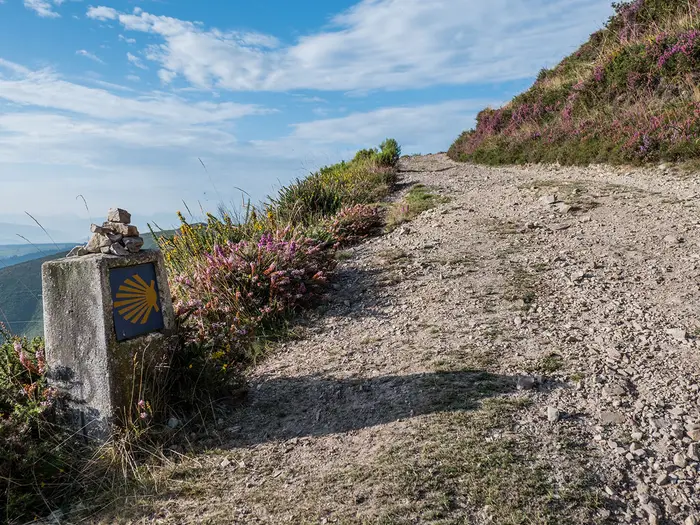
Image by Martin Schütz
i
Image by Martin Schütz The Camino Primitivo is the original Way of St James: a 320 km walk from Oviedo Cathedral in Asturias to Santiago de Compostela in Galicia. It suits fit, experienced walkers who want a quieter, hillier and more remote Camino than the Francés or Norte.
The first half crosses rugged Asturias, with steep road climbs, forest tracks, river valleys and exposed mountain ground. Its defining section is the Ruta de los Hospitales, a high moorland variant reaching about 1,225 m, with ruined medieval pilgrim hospitals and no shelter.
Beyond the Alto/Puerto del Acebo, the route changes character into greener Galicia: farmland, oak and eucalyptus woods, quiet lanes and rolling hills. At Melide it joins the Camino Francés for the final busy ~50 km into Santiago.
This is a hard Camino rather than a technical mountain route. The waymarking is good, but the cumulative climbing, sparse services on some Asturian stages, wet or foggy weather and the exposed Hospitales ridge all demand proper planning.
This guide covers stages, daily logistics, accommodation, food, transport, terrain and the common mistakes to avoid.
Stage-by-Stage Guide
Stage 1: Oviedo to Grado (Grau) — approx. 25 km
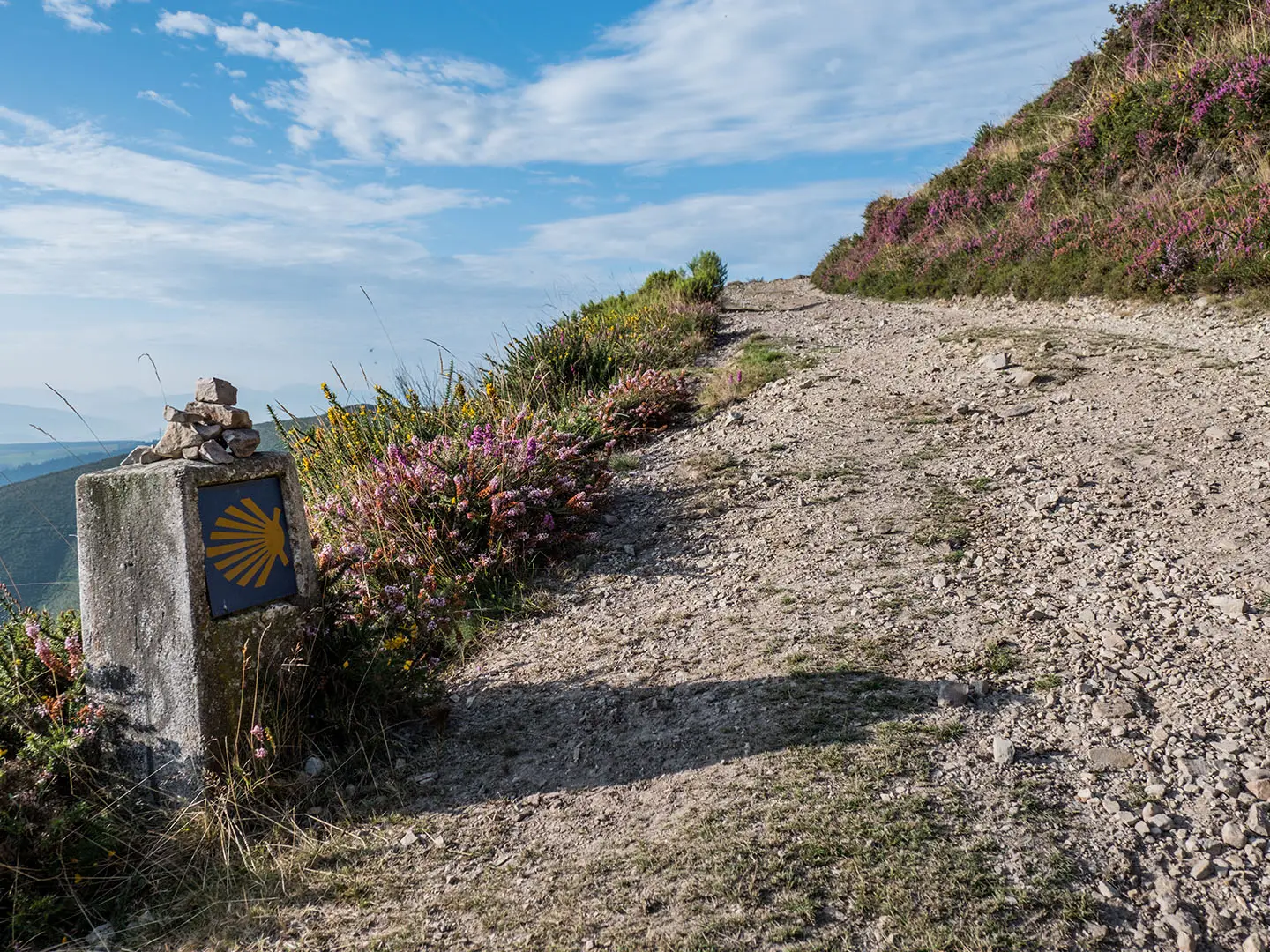
The Camino Primitivo begins at the Catedral de San Salvador de Oviedo, then follows yellow arrows and scallop-shell markers west out of the city. The first day is not a gentle ceremonial start: expect a full walking day as the route leaves urban Oviedo and begins to settle into the rolling Asturian countryside.
Underfoot, this stage mixes lanes, tracks and footpaths, with some hard surfaces while leaving and approaching settlements. In wet weather the rural sections can be muddy, and the early waymarking through the city needs attention until the route is fully clear of Oviedo.
Food, water and services are best treated as strongest at the start and finish, with only limited certainty between smaller places. Carry enough water and snacks to cover gaps between cafés or shops, especially if starting early or walking outside the main season.
Grado (Grau) is a practical first overnight stop with pilgrim-focused accommodation and other town services. Road access is straightforward at both Oviedo and Grado, and Oviedo is the key transport hub for reaching the start, with rail and bus connections plus access from Asturias Airport. Local onward transport from Grado should be checked before travelling.
Stage 2: Grado (Grau) to Salas — approx. 22 km
This stage continues west through rural Asturias and passes Cornellana, an important point on the route through the Narcea valley. The main cultural landmark is the Monasterio de Cornellana, a Benedictine monastery founded in the 11th century.
The walking is a mix of lanes, farm tracks, woodland paths and village approaches. It is not as high as the later mountain stages, but the Primitivo’s pattern of repeated climbing and descending is already clear, and wet ground can make the day slower than the distance suggests.
Cornellana is the main place to plan around between Grado and Salas. Food and water availability in smaller settlements can vary, so do not leave Grado without supplies for a normal hiking day.
Salas is a well-used stage end with pilgrim accommodation and small-town services. It also has road access, though any bus options or timetables should be checked before travelling. Navigation is generally straightforward on the official waymarks, but take care at road crossings and on lane sections where arrows can be less obvious than on open track.
Stage 3: Salas to Tineo — approx. 20 km
The route climbs deeper into western Asturias on this stage, with La Espina lying on the line between Salas and Tineo. This is a shorter day by distance, but it should still be treated as mountain-Camino walking rather than an easy transfer between towns.
Expect a varied surface of forest tracks, rural lanes and paths, with steady ascent and descent. Fog, rain and mud are common practical issues on the Primitivo, and poor visibility can make exposed or open sections feel more serious even where the route is well marked.
Services are concentrated in Salas, La Espina and Tineo rather than evenly spread throughout the day. Carry water and food from the start, particularly if walking outside the busiest months when rural cafés and albergues may have reduced hours or closures.
Tineo is an important overnight halt before the route becomes more remote. Pilgrim albergues, private rooms and small hotels are normally the kind of accommodation to look for here. Road access is available at the town, but public transport options for section hikers should be checked before travelling.
Stage 4: Tineo to Pola de Allande — approx. 28 km
This is one of the harder planning days on the Asturian half, with a long distance and increasingly remote terrain. The route area includes the monastery near Obona and the small settlements around Borres and Campiello, which are important for walkers considering the high Hospitales variant.
The stage combines forest and farm tracks, quiet lanes, climbs and descents, with some steeper road-based walking typical of the Primitivo. Conditions can be slow in prolonged rain, and mud is a realistic issue on shaded tracks and rural paths.
Food and water need active planning. Tineo is the last substantial start-point town of the day, while the smaller places beyond it should not be relied on without checking current opening times. Beds are also thinner on this remote Asturian section, so accommodation should be arranged in advance where possible.
Pola de Allande is the stage end in this itinerary and a key stopping point before the big mountain crossing towards Berducedo. It has road access, making it a possible joining or leaving point, but local transport should be checked before travelling. Navigation is generally by Camino waymarks, but this is also where route-choice planning for the next day matters: the Hospitales high route is associated with the Borres/Campiello side of the route, while Pola de Allande is linked with the lower mountain option.
Stage 5: Pola de Allande to Berducedo via Puerto del Palo / Hospitales option — approx. 18 km
This is the defining mountain day of the Camino Primitivo and needs more care than its modest distance suggests. The high ground around the Ruta de los Hospitales reaches about 1,225 m near Hospital de la Freita, while Puerto del Palo is another major pass at roughly 1,146–1,147 m.
There is an important planning distinction here. The classic Ruta de los Hospitales is the exposed high moorland variant between Borres/Campiello and Berducedo, passing the ruined medieval pilgrim hospitals of Paradiella, Fonfaraón, Valparaíso and La Freita. If starting the day in Pola de Allande, the practical line to Berducedo is generally treated as the lower route over Puerto del Palo; the exact variant and access point should be checked before travelling.
The Hospitales route has no shelter and crosses bare, exposed high ground. It should only be walked in clear, settled weather with proper waterproofs, warm layers, navigation backup, food and water. In fog, storm, snow, high wind or poor visibility, use the lower Pola de Allande/Puerto del Palo option instead.
There are no reliable services on the exposed mountain section, so carry everything needed from the start. Water, lunch and emergency food should be packed before leaving the overnight stop.
Berducedo is a small but important mountain-stage stop with pilgrim accommodation and limited services. Beds can be in high demand because many walkers converge here after the Hospitales or lower variant, so booking ahead is sensible. Road access exists, but this is a remote area and transport should not be assumed; this should be checked before travelling.
Stage 6: Berducedo to Grandas de Salime — approx. 20 km
This stage is dominated by the dramatic descent towards the Embalse de Salime and its hydroelectric dam, followed by a hard climb on the far side towards Grandas de Salime. It is one of the most memorable landscape days on the route, but it is also demanding on tired legs after the Hospitales/Puerto del Palo crossing.
The descent can be long and steep, with hard surfaces and tracks both possible underfoot. After rain, take extra care on any muddy or slippery sections, and allow more time than the distance alone implies.
Services are limited between Berducedo and Grandas de Salime. Carry a full day’s water and food unless current intermediate facilities have been checked. This is not a stage where walkers should depend on finding frequent cafés.
Grandas de Salime is a practical overnight town with pilgrim accommodation and other small-town services. It is also home to the Museo Etnográfico, which focuses on traditional Asturian rural life. Road access is available, but public transport options should be checked before travelling.
Stage 7: Grandas de Salime to A Fonsagrada — approx. 25 km
This stage takes the Camino over the Alto/Puerto del Acebo, the Asturias–Galicia border pass and the gateway into the Galician half of the route. The feel of the walk begins to change here, from rugged western Asturias towards the greener hills and rural lanes of Galicia.
The walking still has significant climbing and descending, and the pass can be exposed in poor weather. Expect a mixture of quiet road, tracks and paths, with wet ground and fog both possible.
Grandas de Salime and A Fonsagrada are the main service points. Intermediate options should be treated as uncertain unless checked in advance, so carry water and food from the morning.
A Fonsagrada is an important Galician stage town with accommodation and pilgrim services. It has road access, making it a useful point for logistics, but bus times and availability should be checked before travelling. Navigation remains based on yellow arrows and Camino markers, with extra care needed around the pass in low cloud.
Stage 8: A Fonsagrada to O Cádavo (O Cádavo Baleira) — approx. 24 km
This is a Galician hill stage, generally greener and less stark than the Asturian high route but still far from flat. The route passes through rural country where small settlements, woodland, farm tracks and quiet lanes set the rhythm of the day.
Underfoot conditions can be wet, muddy and uneven, particularly through wooded or farmed sections. Galicia’s gentler profile should not be confused with easy walking: the Primitivo continues to undulate and can feel wearing over repeated days.
Services are more available than on the most remote Asturian mountain sections, but they are still not continuous. Stock up before leaving A Fonsagrada and check whether any planned café stops are open, especially outside summer.
O Cádavo (O Cádavo Baleira) is the overnight halt, with pilgrim accommodation and basic services. It has road access, though local public transport details should be checked before travelling. Waymarking is usually reliable, but pay attention through village exits and lane junctions.
Stage 9: O Cádavo (O Cádavo Baleira) to Lugo — approx. 30 km
This is one of the longest stages in the standard 14-day itinerary. The route passes through Castroverde before continuing to Lugo, so it is a day where pacing, early departure and foot care matter.
The terrain is Galician rather than high Asturian mountain walking, with lanes, tracks, woodland and farmland, but the distance makes it a substantial day. Mud and damp ground can slow progress, and hard-surface sections can be tiring over 30 km.
Castroverde is the key place to plan around between O Cádavo and Lugo. Food and water should still be carried from the start, because opening hours in smaller places can vary.
Lugo is a major overnight stop and one of the cultural highlights of the Primitivo. The Muralla romana de Lugo is the only complete, intact Roman city wall in the world and a UNESCO World Heritage Monument; pilgrims can walk along the top before continuing towards Melide. Accommodation and services are much more plentiful than in the mountain villages, and road access is straightforward, but any public transport connections should be checked before travelling.
Stage 10: Lugo to San Román da Retorta — approx. 19 km
After Lugo, the Camino leaves the city and returns to a quieter rural pattern. This is a shorter stage, useful after the long approach to Lugo and before the final link towards Melide.
Expect a mix of city-edge walking at the start, then country lanes, farm tracks and small rural paths. Navigation through and out of Lugo needs attention, as urban exits can be less intuitive than open countryside despite Camino waymarking.
Food and water are easiest to arrange in Lugo. San Román da Retorta is a much smaller overnight stop, so walkers should carry supplies and check current accommodation and meal availability before relying on them.
Accommodation near San Román da Retorta is more limited than in Lugo. Booking ahead is sensible, particularly in busy Camino months or if trying to keep to a fixed stage plan. Road access exists, but onward public transport should be checked before travelling.
Stage 11: San Román da Retorta to Melide — approx. 28 km
This stage links the quieter Primitivo countryside with Melide, where the route joins the Camino Francés for the final roughly 50 km to Santiago. It is a significant walking day by distance, and the character changes sharply at the end as pilgrim numbers increase.
The terrain is typical rural Galicia: lanes, tracks, woodland and farmland, with rolling hills rather than high passes. Wet and muddy conditions remain possible, and hard surfaces can add fatigue over a long day.
Services should be planned carefully before Melide. San Román da Retorta is small, and intermediate food stops should not be assumed without checking. Carry enough water and food for the full stage.
Melide is a large and important Camino town with many accommodation and food options compared with the preceding rural stages. It is also known for its pulpería tradition. From here, beds can be more plentiful but also busier because Primitivo walkers merge with the much busier Camino Francés; booking ahead can still be worthwhile.
Stage 12: Melide to Arzúa — approx. 14 km
This is a short stage and the first full day on the shared final approach with the Camino Francés. The walking is generally less remote and much busier than the Asturian and early Galician stages.
The route uses well-trodden Camino paths, lanes and tracks through green countryside. Surfaces may be easier to follow than earlier remote sections, but they can still be muddy in wet weather, and crowding can slow movement through popular stopping places.
Food, water and pilgrim services are much more frequent on this final section than on the Primitivo proper. Even so, opening hours should be checked outside the main season, and accommodation should not be left entirely to chance in peak periods.
Arzúa is a major Camino Francés stop with extensive pilgrim accommodation and services. Road access is straightforward, though current bus or other transport options should be checked before travelling. Navigation is simple by Camino standards, but the volume of pilgrims means it is easy to follow the crowd rather than actively checking the waymarks; keep an eye on the official arrows at junctions.
Stage 13: Arzúa to O Pedrouzo (Arca) — approx. 20 km
This stage continues along the busy final Camino corridor towards Santiago. It is a practical linking day, usually walked on good waymarked paths, tracks and quiet roads through rural Galicia.
The profile is undulating rather than mountainous, but accumulated fatigue from the full Primitivo often makes this stage feel harder than it looks on paper. Expect a mixture of woodland, lanes, village approaches and possible muddy sections after rain.
Food and water are generally easier to manage than on the Asturian mountain stages, with more pilgrim-oriented services along the Camino Francés. Accommodation at O Pedrouzo (Arca) is also aimed at pilgrims, but demand can be high because many walkers position themselves here for the final day into Santiago.
O Pedrouzo (Arca) has road access and is one of the standard last-night stops before Santiago. Public transport details should be checked before travelling. Navigation is usually straightforward, but take care where the Camino crosses or follows roads.
Stage 14: O Pedrouzo (Arca) to Santiago de Compostela — approx. 20 km
The final stage leads from O Pedrouzo (Arca) to the Catedral de Santiago de Compostela and the Praza do Obradoiro. It is not a wilderness day; it is the busy final approach used by large numbers of Camino Francés and Primitivo pilgrims.
The terrain is a mix of paths, lanes, built-up approaches and urban walking into Santiago. The waymarking is generally strong, but the final city approach requires normal attention at road crossings and junctions.
Food and water are widely available compared with earlier stages, though very early starts can still mean closed cafés at first. There is no need to carry mountain-stage quantities of food, but water and snacks remain sensible for a 20 km day.
Santiago de Compostela has extensive accommodation, rail and long-distance bus links, and its own airport, SCQ, with domestic and European flights. Direct buses and trains also link Santiago back to Oviedo, but current timetables should be checked before booking. The route finishes at the Catedral de Santiago de Compostela, where pilgrims with a stamped credencial can arrange the Compostela certificate according to the current pilgrim office requirements.
Recommended Itinerary
Standard 14-day itinerary
Most walkers are best served by the 14-day schedule below. It keeps the hardest Asturian mountain stages manageable, avoids forcing repeated 30 km days, and leaves the shorter stages near the end for tired legs and the busier final approach from Melide.
| Day | From | To | Approx. distance | Why this stage makes sense | Services/accommodation notes |
|---|---|---|---|---|---|
| 1 | Oviedo | Grado (Grau) | 25 km | A solid first day out of Oviedo, long enough to leave the city behind without overcommitting before the hillier Asturian stages. | Grado (Grau) is a sensible first overnight point with pilgrim accommodation and town services. Start with a full water bottle and food for the day rather than relying on frequent stops. |
| 2 | Grado (Grau) | Salas | 22 km | A moderate second day through the Narcea valley area, passing Cornellana before continuing to Salas. | Cornellana is a useful intermediate place on the way to Salas. Salas is a practical overnight stop before the route climbs towards Tineo. |
| 3 | Salas | Tineo | 20 km | Shorter on paper, but this is where the route begins to feel more mountainous, so the modest distance is useful. | Tineo is an important service stop before the remoter Asturian section. Use it to resupply and confirm the next beds, especially outside the main season. |
| 4 | Tineo | Pola de Allande | 28 km | One of the longer Asturian days, positioning you for the high mountain crossing towards Berducedo. | Facilities become thinner in this part of Asturias. Accommodation and evening food should be arranged in advance rather than assumed on arrival. |
| 5 | Pola de Allande | Berducedo, via Ruta de los Hospitales / Puerto del Palo | 18 km | A shorter distance but a major mountain stage, with high, exposed ground and one of the defining climbs of the Camino Primitivo. | The Ruta de los Hospitales has no shelter and should only be walked in clear, settled weather. Carry food, water and proper bad-weather layers; in poor visibility or unsettled weather, use the lower Pola de Allande option and check the route choice before setting out. |
| 6 | Berducedo | Grandas de Salime | 20 km | A dramatic stage with the descent to the Embalse de Salime and the climb up towards Grandas de Salime, so the distance is sensible. | Grandas de Salime is the key overnight stop after the reservoir section. Expect a physically demanding day despite the moderate mileage. |
| 7 | Grandas de Salime | A Fonsagrada | 25 km | This takes you over the Alto/Puerto del Acebo area and across from Asturias into Galicia, another high stage best not rushed. | A Fonsagrada is a significant Galician service stop after the border crossing. Check weather and visibility before leaving Grandas de Salime, as this remains exposed high country. |
| 8 | A Fonsagrada | O Cádavo (O Cádavo Baleira) | 24 km | A balanced Galician hill stage: still undulating, but generally less wild than the Asturian mountains. | O Cádavo is a practical overnight point before the longer approach to Lugo. Beds are usually easier to plan here than on the remote Asturian stages, but booking ahead remains sensible in busy periods. |
| 9 | O Cádavo (O Cádavo Baleira) | Lugo | 30 km | The longest day in this standard schedule, but it ends in Lugo, where services are far stronger than in the rural villages. | Lugo has extensive accommodation, food and transport services. It is also the best place on the route for a rest or half-day if time allows. |
| 10 | Lugo | San Román da Retorta | 19 km | A shorter recovery stage after the long walk into Lugo, leaving the city and returning to quieter rural walking. | Services become more limited again after Lugo. Confirm accommodation in San Román da Retorta before committing to this stage. |
| 11 | San Román da Retorta | Melide | 28 km | A substantial day that brings the Camino Primitivo to Melide, where it joins the Camino Francés for the final stretch. | Melide has more pilgrim infrastructure and a busier Camino atmosphere. From here, accommodation demand can increase sharply in peak periods. |
| 12 | Melide | Arzúa | 14 km | A deliberately short day after joining the Camino Francés, useful for recovery and for managing the busier final 50 km. | Arzúa is a major overnight stop on the shared Camino corridor. Book ahead if walking in popular months. |
| 13 | Arzúa | O Pedrouzo (Arca) | 20 km | A straightforward penultimate stage that keeps the final walk into Santiago manageable. | O Pedrouzo (Arca) is a common last-night stop before Santiago. Expect more walkers, more accommodation choice and more competition for beds than earlier on the Primitivo. |
| 14 | O Pedrouzo (Arca) | Santiago de Compostela | 20 km | A manageable final day into Santiago de Compostela, finishing at the Catedral de Santiago. | Santiago has full city services, rail and bus connections, and access to Santiago de Compostela Airport. Allow time for the final approach and any Compostela formalities. |
Slower variant: 15–16 days
A slower itinerary suits walkers who want a bigger safety margin for the Asturian mountains, uncertain weather on the Ruta de los Hospitales, or a more comfortable pace after several steep days. The most useful extra time is before or around the high mountain section, rather than at the end of the route.
Good places to slow the schedule include the Tineo–Borres/Campiello–Pola de Allande–Berducedo area, depending on whether you take the Hospitales high route or the lower Pola de Allande line. Because the bed spacing and route choice matter here, check official mapping and current accommodation before booking.
A second sensible use of extra time is Lugo. After the 30 km stage from O Cádavo, a rest afternoon or additional night in Lugo makes the transition into the quieter rural approach to Melide less rushed.
Faster variant: 12–13 days
A faster itinerary is only suitable for strong walkers already comfortable with consecutive long Camino days and repeated climbing. The Asturian half should not be compressed lightly: the terrain, weather exposure and thinner services make forced mileage a poor trade-off.
The least disruptive place to save a day is usually after Melide, where the route has joined the Camino Francés and services are more frequent. For example, the short Melide–Arzúa stage and the Arzúa–O Pedrouzo stage can be combined into a longer day of roughly 34 km, using the listed stage distances, before walking on to Santiago the following day.
A 12-day schedule requires at least one further long-stage adjustment beyond that and should be planned against current accommodation and mapping rather than improvised on the trail. Do not rely on a fast schedule if the Ruta de los Hospitales is a priority, as bad weather may make the high route unsafe and force a change of plan.
Planning the Route
The Camino Primitivo is easiest to plan as a chain of fixed overnight stops rather than as a route where daily distances can be adjusted freely. The waymarking is straightforward, but accommodation, food availability and weather exposure — especially in the Asturian mountains — shape the itinerary more than navigation does.
How many days to allow
Most walkers should allow 13–14 walking days from Oviedo to Santiago de Compostela. This gives enough room for the long climbs, the steeper descents and the less flexible overnight spacing in Asturias without turning every day into a race.
A 12-day itinerary suits strong, efficient walkers carrying light packs and happy with longer days. Faster schedules are possible, but they leave little margin for poor weather on the Ruta de los Hospitales, tired legs after repeated climbing, or full accommodation in smaller villages.
If time allows, building in a spare day is sensible. The best use of that buffer is not necessarily a rest day; it can be kept for weather around the Hospitales ridge or for adjusting stages if beds are limited.
How the stages are dictated
The route has natural overnight hubs, and the gaps between them matter. In the Asturian half, villages and services are thinner, so planning only by distance can be misleading: a shorter mountain stage may still be harder and more exposed than a longer Galician day.
| Section | Planning implication |
|---|---|
| Oviedo to Tineo | The route is still settling into the mountains, but daily stops such as Grado (Grau), Salas and Tineo make a conventional stage rhythm practical. |
| Tineo to Grandas de Salime | This is the least flexible and most important section to plan carefully, with the Ruta de los Hospitales / Puerto del Palo, Berducedo, La Mesa and the descent and climb around the Embalse de Salime. Accommodation and food should be arranged in advance where possible. |
| Grandas de Salime to Lugo | The route crosses into Galicia over the Alto/Puerto del Acebo and continues through A Fonsagrada and O Cádavo. The walking becomes greener but remains hilly enough that daily distances still need respect. |
| Lugo to Santiago de Compostela | Stages become easier to adapt, especially after joining the Camino Francés at Melide. The final ~50 km are busier, with more pilgrims competing for beds. |
The key route decision: Ruta de los Hospitales
The most important planning choice is the high Ruta de los Hospitales between the Borres/Campiello area and Berducedo, reaching about 1,225 m before Puerto del Palo. It is the classic Primitivo mountain day, but it is fully exposed and has no shelter.
This variant should only be used in clear, settled weather with suitable clothing, food and water for the whole crossing. In fog, high wind, poor visibility or uncertain weather, the lower Pola de Allande option is the safer plan. Treat the decision as a serious mountain choice, not a casual scenic detour.
Accommodation either side of this section should be planned before arrival. If relying on albergues or small guesthouses in the mountain villages, current openings and bed availability should be checked before travelling, particularly outside the main season.
Shortening or extending the itinerary
The Primitivo can be shortened by strong walkers, but it is not the best Camino for aggressive stage-combining. The repeated climbing in Asturias and the limited intermediate services make long days more committing than they look on paper.
Extending the walk is generally more comfortable, provided accommodation exists at the intended stopping points. This works best by splitting demanding Asturian days or keeping the standard mountain stages but slowing the pace later in Galicia. Exact accommodation openings change seasonally and should be checked before booking transport.
The final section from Melide to Santiago de Compostela is easier to reshape because it follows the busier Camino Francés corridor. It is also less quiet, so booking or arriving early becomes more important during busy periods.
Section hiking
Section hiking is practical, but it needs transport planning. Oviedo and Santiago de Compostela are the simplest end points: Oviedo is reached via Asturias Airport, train or bus, while Santiago has its own airport plus rail and long-distance bus links.
For a split itinerary, larger towns on the route — especially Lugo — make the most logical break points. Public transport times and onward connections from intermediate towns should be checked before travelling.
A useful split is to treat the route as two different walks: the rugged Asturian mountain section to Lugo, then the greener Galician section to Santiago. This also helps if only one week is available and the harder mountain days need to be walked separately from the final Camino Francés approach.
What needs planning most
Accommodation: This is the biggest practical issue. The route has municipal, parish and private albergues, plus guesthouses, hostels, casas rurales and small hotels, but beds are thinner in the remote Asturian stages. Municipal albergues are typically low-cost, often donativo or around €8–15, but prices and openings change; confirm current details before relying on them.
Food and water: Do not assume there will be frequent shops or cafés on the mountain stages. Carry enough food and water for the day on exposed sections, especially around the Ruta de los Hospitales and the high passes.
Weather: Spring, summer and autumn are the normal walking seasons, but wet weather, mud and fog are still part of the route. The Hospitales ridge is dangerous in poor visibility, so weather should be checked locally before committing to that variant.
Navigation: The Primitivo is waymarked with yellow arrows and scallop-shell markers, so route-finding is usually straightforward. A map or offline navigation backup is still sensible for the high, exposed sections and for days when fog or heavy rain reduces visibility.
Transport: Book start and finish travel with enough slack for late arrivals. Oviedo has no airport of its own, but Asturias Airport is about 45 minutes away by bus or transfer, and Oviedo is also linked by train and bus with Madrid, León, Gijón and other cities. From Santiago, flights, rail, long-distance buses and direct links back to Oviedo make the exit relatively straightforward.
Pilgrim paperwork: Carry a credencial if the Compostela certificate matters. It must be stamped along the way, so keep it accessible at accommodation, churches, cafés and other stamping points.
Towns, Villages and Overnight Stops
Accommodation on the Camino Primitivo is a mix of pilgrim albergues, guesthouses, hostels, casas rurales and small hotels. The larger towns are the safest places for beds, meals, cash and supplies; the Asturian mountain villages are much thinner, and openings can be seasonal or limited.
For the remote stages, especially around Borres, Campiello, the Ruta de los Hospitales, Berducedo and La Mesa, do not rely on turning up late and finding everything open. Book ahead where possible, carry food for the day, and check current albergue openings before committing to a stage plan.
Oviedo
Oviedo is the official start of the Camino Primitivo, with the route beginning at the Catedral de San Salvador de Oviedo in the old capital of Asturias. It is the best place to arrive the day before walking, collect or organise a credencial if needed, buy supplies and start with a full food plan for the first Asturian stages.
Accommodation is plentiful compared with the rural route ahead, ranging from pilgrim-style options to hotels and hostels. Food, cafés and shops are easy to find in the city, so this is the place to replace forgotten kit rather than hoping to find it later.
There is no airport in Oviedo itself. Access is via Asturias Airport, around 45 minutes away by bus or transfer, or by train and bus to Oviedo station from cities including Madrid, León and Gijón; current timetables should be checked before travelling.
Grado (Grau)
Grado (Grau) is the first standard overnight stop after leaving Oviedo, around 25 km into the route. It suits most walkers better than trying to push further on day one, especially as the Primitivo becomes progressively hillier after the opening stage.
As a recognised stage town, it is one of the more practical early stops for accommodation and food. Expect a better chance of pilgrim beds, cafés and basic resupply than in the smaller villages between major stage ends, but check current openings outside the main season.
Transport and onward connections should not be assumed without checking current local services. For most walkers, Grado functions primarily as a walking-stage overnight rather than a transport hub.
Cornellana
Cornellana sits between Grado (Grau) and Salas in the Narcea valley and is passed on the second stage. Its main route landmark is the Monasterio de Cornellana, a historic Benedictine monastery on the Camino line.
It can be useful as a rest, food or pacing point rather than a default overnight on the standard 14-day itinerary. Accommodation and food availability should be checked before relying on Cornellana as a planned stop, especially if breaking the Grado–Salas stage.
Walkers shortening stages may consider it as part of a gentler early schedule, but only with confirmed beds. Do not assume that every intermediate village on the Primitivo has the same level of services as the named stage towns.
Salas
Salas is the usual second overnight stop, reached after the stage from Grado (Grau). It is a sensible place to stop before the route climbs onwards towards La Espina and Tineo.
As a regular Camino stage end, Salas is a practical accommodation and food stop. Beds are more likely here than in small rural settlements, though albergue and guesthouse availability can still vary by season.
Use Salas to reset before the tougher Asturian walking begins. The following stage to Tineo is not exceptionally long in distance, but the profile becomes more demanding than the early route out of Oviedo.
La Espina
La Espina lies between Salas and Tineo and is useful mainly as an intermediate point on the climb westwards. It is not listed as a standard overnight on the 14-day itinerary, but it may help walkers who are adjusting stage lengths.
Accommodation, meals and shop options should be checked before planning to stop here. If using La Espina to shorten or reshape the Salas–Tineo stage, book ahead rather than assuming pilgrim infrastructure will match the larger towns.
For most hikers, La Espina is a place to pass through or pause briefly, with Tineo remaining the stronger overnight target.
Tineo
Tineo is the normal third overnight stop and an important Asturian stage town. It marks the point where the route is fully into hillier, more rural country, with more serious stages ahead.
Accommodation and food options are better here than in the smaller mountain villages that follow. It is a good place to stock up, check the weather outlook and make sure onward beds are arranged for the next one or two nights.
The stage beyond Tineo towards Pola de Allande is long and strenuous at around 28 km on the standard itinerary. Leaving Tineo with snacks, water and a clear overnight plan is sensible.
Obona
Obona is noted for its monastery and lies near the route after Tineo. It is best treated as a local point of interest rather than a main service centre.
Do not rely on Obona for accommodation, food or transport unless current arrangements have been checked in advance. It may be relevant for walkers following local route options or taking a slower schedule through this part of Asturias.
The practical overnight decisions in this area are usually made around Tineo, Borres, Campiello or Pola de Allande, depending on the chosen pacing and variant.
Borres
Borres is one of the key small settlements before the high Ruta de los Hospitales variant. It is important because walkers often use this area to position themselves for the exposed mountain crossing towards Berducedo.
Services are much more limited than in towns such as Tineo or Pola de Allande. Accommodation and food must be checked before relying on Borres as an overnight, and carrying food for the following day is strongly advised.
The decision to take the Ruta de los Hospitales should not be made casually from here. The ridge has no shelter and should only be walked in clear, settled weather; in poor visibility or bad conditions, use the lower alternative via Pola de Allande.
Campiello
Campiello, like Borres, is a practical staging point before the Ruta de los Hospitales. It is one of the last useful places to organise the high variant before the route commits to exposed upland ground.
Accommodation and meals may be available, but this is a small mountain stop rather than a town with broad fallback options. Beds, food and opening times should be checked before travelling, particularly outside peak season.
If staying here, prepare for the next day before going to bed: food packed, water sorted, weather checked and the lower option understood. The Hospitales day is one of the defining logistical decisions of the whole Camino Primitivo.
Pola de Allande
Pola de Allande is a major overnight hub in this section and the standard fourth stop on the itinerary from Tineo. It is also the practical lower-route alternative area for walkers avoiding the high Hospitales variant in poor weather.
As a town, it is a stronger bet for accommodation and meals than Borres or Campiello. It is a sensible place to pause, check conditions and avoid forcing the high route if the forecast is wrong.
The route onward towards Berducedo and Puerto del Palo is serious mountain walking by Camino standards. Make sure the next bed is arranged and do not leave Pola de Allande short of food.
Ruta de los Hospitales / Puerto del Palo
The Ruta de los Hospitales is not an overnight stop; it is the high, exposed mountain variant between the Borres/Campiello area and Berducedo. The route reaches around 1,225 m near Hospital de la Freita and passes the ruins of medieval pilgrim hospitals before the Puerto del Palo.
There is no shelter on the high ridge. There should be no expectation of accommodation, cafés, shops or easy transport once committed to this section.
Only take this route in clear, settled weather with proper mountain kit. In fog, high wind, storms or poor visibility, use the lower Pola de Allande option instead.
Berducedo
Berducedo is the key overnight stop after the Hospitales/Puerto del Palo crossing. It is a small but strategically important village because it breaks the mountain section before the descent towards Grandas de Salime.
Beds and food are limited compared with larger towns, so this is one of the places where booking ahead matters. Arriving late after the high route without a confirmed bed is poor planning.
The next stage to Grandas de Salime includes the dramatic descent towards the Embalse de Salime and a hard climb afterwards. Rest, eat properly and carry enough for the following day.
La Mesa
La Mesa lies between Berducedo and Grandas de Salime and is relevant for walkers splitting this demanding section. It is not the standard overnight on the 14-day schedule, but it can be useful if adjusting pace after the high mountains.
Accommodation and food availability should be checked before planning a stop. This is not a place to rely on as a guaranteed fallback without current information.
For most walkers, La Mesa is a waypoint on the way to Grandas de Salime. If the weather, fatigue or a late start affects the day, having checked options in advance gives more flexibility.
Grandas de Salime
Grandas de Salime is the usual overnight after Berducedo and a significant mountain town before the route crosses towards Galicia. It follows one of the most dramatic sections of the Primitivo, with the Embalse de Salime and its hydroelectric dam forming a major landscape feature.
Accommodation and food options are more useful here than in the small mountain villages. It is a good place to recover from the reservoir descent and climb, and to prepare for the next stage over the Alto/Puerto del Acebo.
Grandas de Salime is also home to the Museo Etnográfico, but hikers should prioritise practical tasks first: bed, meal, supplies and weather check. The next day reaches the Asturias–Galicia border before A Fonsagrada.
Alto/Puerto del Acebo
The Alto/Puerto del Acebo is the mountain pass at the Asturias–Galicia border on the way from Grandas de Salime to A Fonsagrada. It is a route feature, not a service stop.
Do not plan on accommodation, food, shops or transport at the pass unless something specific has been checked before travelling. Treat it as exposed upland walking and carry what is needed from Grandas de Salime.
After this point the route enters Galicia, where the landscape becomes greener and generally gentler, but the day still demands respect. A Fonsagrada is the practical overnight target.
A Fonsagrada
A Fonsagrada is the first major Galician overnight on the standard itinerary. It is the logical place to stop after crossing the Alto/Puerto del Acebo from Grandas de Salime.
As a town, it offers a stronger base for accommodation, meals and resupply than the smaller upland settlements before and after it. Current albergue and guesthouse openings should still be checked, particularly outside the main walking season.
This is a useful place to reassess pace. The worst of the Asturian high mountain exposure is behind, but the route to O Cádavo and Lugo still includes long, undulating walking.
O Cádavo (O Cádavo Baleira)
O Cádavo is the standard overnight between A Fonsagrada and Lugo. It is a practical staging point that prevents the Galician approach to Lugo becoming too long.
Accommodation and food are more dependable here than in minor hamlets, but still worth checking before arrival. For walkers using albergues, aim to arrive with enough time to sort a bed and meal rather than cutting the day too fine.
The following stage to Lugo is around 30 km on the itinerary, one of the longer days. Buy food before leaving if required, and do not assume frequent services all the way into the city.
Castroverde
Castroverde lies between O Cádavo and Lugo and can be useful for breaking, pausing or reshaping the long approach to Lugo. It is not the standard overnight in the 14-day plan, but it may suit walkers who prefer shorter stages.
Accommodation and food should be checked before relying on it as a planned stop. If using Castroverde to shorten the O Cádavo–Lugo day, arrange beds in advance rather than improvising.
For many walkers, Castroverde is an intermediate resupply or rest point before continuing to Lugo. The key practical value is flexibility on one of the route’s longer Galician stages.
Lugo
Lugo is one of the most important overnight stops on the Camino Primitivo. It comes after the long stage from O Cádavo and gives walkers access to a proper city before the quieter route towards San Román da Retorta and Melide.
Accommodation, food and general services are much more plentiful here than in the rural stages. This is a strong place for laundry, restocking, repairing minor kit issues and taking a shorter evening before the final run west.
The Muralla romana de Lugo, the complete Roman city wall, is the main local landmark and can be walked along the top. From a hiking-planning perspective, Lugo is also where many walkers reassess whether to continue on the standard schedule or slow down before joining the busier Camino Francés at Melide.
San Román da Retorta
San Román da Retorta is the standard overnight after Lugo on the itinerary. It breaks the journey between Lugo and Melide, keeping the next day manageable.
This is a smaller rural stop, so accommodation and food should be checked before relying on it. It is especially important not to leave Lugo without knowing where you expect to sleep.
Services are thinner than in Lugo, Melide or Arzúa. Carry snacks and be prepared for a quieter stage with fewer fallback options.
Melide
Melide is a major Camino town and the point where the Camino Primitivo joins the Camino Francés for the final roughly 50 km to Santiago de Compostela. From here, the character of the walk changes: more pilgrims, more infrastructure and a much busier trail atmosphere.
Accommodation and food options are more plentiful than on the remote Primitivo stages, but demand is also higher because two Camino streams combine. Booking ahead can still be wise in busy periods, even though there are more choices.
Melide is famous for its pulpería tradition, but its main practical role is as the first large shared-stage hub before Arzúa, O Pedrouzo and Santiago. Expect less solitude from this point onwards.
Arzúa
Arzúa is the usual overnight after Melide and a major stop on the shared final section with the Camino Francés. The stage from Melide is relatively short on the itinerary, which can make Arzúa useful for a later start, recovery or laundry.
Accommodation, cafés and food are generally much more available here than in the Asturian mountain villages. However, because this is now the busy final approach to Santiago, beds can fill quickly in popular periods.
Use Arzúa to plan the final two walking days. The route ahead is well served by Camino infrastructure, but it is also busier and less flexible if arriving late without a booking.
O Pedrouzo (Arca)
O Pedrouzo (Arca) is the standard final overnight before Santiago de Compostela. It is positioned for a manageable last day of around 20 km into the city.
Accommodation and food are geared to pilgrims on the final Camino stages, but demand is high because many walkers converge here before Santiago. Booking ahead is sensible if walking in a busy season or wanting a private room.
This is the place to organise the final morning: start time, breakfast plan and arrival expectations in Santiago. The walking is no longer remote, but the number of pilgrims can slow cafés, check-ins and evening meals.
Santiago de Compostela
Santiago de Compostela is the finish of the Camino Primitivo at the Catedral de Santiago de Compostela. Most walkers stay at least one night here to collect the Compostela certificate if eligible, visit the cathedral and avoid rushing onward travel after the final stage.
Accommodation is plentiful across pilgrim hostels, guesthouses and hotels, but demand can be high because every Camino route funnels into the city. Book ahead if arriving at a weekend, in peak season or with fixed travel plans.
Santiago has its own airport, with domestic and European flights, plus rail and long-distance bus connections. Direct buses and trains also link Santiago back to Oviedo; current times and ticket conditions should be checked before travelling.
Getting to the Start
The Camino Primitivo starts in Oviedo, Asturias, with the official beginning at the Catedral de San Salvador de Oviedo / Oviedo Cathedral. The first yellow arrows and scallop-shell waymarks lead west out of the city, so it is worth arriving the day before, collecting any final supplies and locating the cathedral before the morning start.
Oviedo is a practical trailhead: it has rail and long-distance bus connections, but no airport in the city itself. Most international walkers arrive via Asturias Airport (OVD) or travel overland from another Spanish city.
By train
Oviedo has a main railway station with connections from major northern Spanish cities and from Madrid. The most useful long-distance option for many walkers is the direct rail connection from Madrid to Oviedo, taking roughly 3.5 hours.
Rail access is also possible from León, Gijón and other cities, making Oviedo straightforward to reach if linking the Camino Primitivo with wider travel in northern Spain. Train times and seat reservations should be checked before travelling, especially around weekends, public holidays and summer holiday periods.
From Oviedo station, the cathedral and old centre are close enough to reach by local transport or taxi if arriving with a full pack. Allow extra time if arriving late and needing to find accommodation, food or a credencial before starting.
By bus
Long-distance buses also serve Oviedo, with connections from Spanish cities including Madrid, León and Gijón. Buses can be a useful fallback if train times do not fit, or if rail seats are unavailable.
Arrival points and onward city transport can vary by operator, so check the current bus station location, timetable and ticket conditions before booking. This should be checked before travelling.
If finishing in Santiago de Compostela and returning to the start, direct buses and trains link Santiago back to Oviedo. This is useful for anyone leaving luggage, a vehicle or onward travel arrangements in Asturias.
By car
Driving to Oviedo is possible, but it is not usually the simplest option for a point-to-point Camino ending in Santiago de Compostela. Anyone leaving a vehicle in Oviedo must plan the return journey from Santiago at the end of the walk.
Long-stay parking arrangements in Oviedo should be checked carefully before travelling. Do not rely on turning up and finding suitable secure parking for nearly two weeks without confirming current options, access hours and costs.
A common approach is to travel to Oviedo by public transport, walk to Santiago, then fly, train or bus onwards from there. This avoids the need to return across northern Spain purely to collect a car.
From the nearest airport
The nearest airport for the start is Asturias Airport (OVD). Oviedo itself has no airport, but Asturias Airport is around 45 minutes by bus or transfer from the city.
This is the most convenient flight gateway for starting the Camino Primitivo. On arrival, use the airport bus, a pre-booked transfer or a taxi into Oviedo, depending on arrival time and budget.
Late arrivals need particular care. If the last public transport connection has gone, a taxi or pre-booked transfer may be necessary, and accommodation in Oviedo should be booked in advance.
Where to stay before starting
Stay in Oviedo the night before setting out. This gives time to visit Oviedo Cathedral, orientate yourself in the old centre, buy food for the first stage to Grado (Grau) and deal with any last-minute kit or credencial arrangements.
Accommodation in Oviedo ranges from hostels and guesthouses to hotels. Booking ahead is sensible in busy periods, as most walkers will want an early start and a stress-free first morning.
The first day to Grado (Grau) is a full walking stage rather than a gentle half-day, so avoid arriving in Oviedo late and starting immediately unless travel delays have already been built into the plan.
Getting Home from the Finish
The Camino Primitivo finishes at the Catedral de Santiago de Compostela, in the centre of Santiago de Compostela. From there, onward travel is straightforward compared with many earlier trail towns: the city has rail, long-distance bus and airport connections, including direct buses and trains back to Oviedo.
If you reach Santiago late in the day, the most sensible plan is usually to stay overnight and travel the next morning. This gives time to reach accommodation, sort onward tickets, and avoid relying on evening departures that may change by season or day of week.
By train
Santiago de Compostela has rail connections to other Spanish cities, and direct trains also link Santiago back to Oviedo. This is the most useful option if returning to Asturias after completing the route, or if continuing elsewhere in Spain by rail.
Train times, direct services and seat availability should be checked before travelling, especially at weekends, on public holidays and in the busy Camino season. If a same-day train is important, book before the final walking day rather than waiting until arrival in Santiago.
From the cathedral area, allow enough time to reach the city railway station, collect or display tickets, and deal with queues or platform changes. This should be checked before travelling.
By bus
Santiago de Compostela also has long-distance bus connections, including direct buses back to Oviedo. Buses can be useful where train times do not fit, or for onward journeys to towns not conveniently served by rail.
Timetables are operator-dependent and can vary by season and day of week. Check current departures before committing to a tight onward connection, particularly if finishing the walk in the afternoon.
For hikers returning to the start, compare the direct Santiago–Oviedo bus and train options before booking. The best choice will usually depend on the departure time rather than the route itself.
By car/taxi
For most walkers, a private car is not the natural choice for the Camino Primitivo because the route is a point-to-point walk from Oviedo to Santiago de Compostela. If a car has been left at or near the start, plan the return to Oviedo by train or bus rather than assuming a simple same-day transfer.
Taxis are most useful for short city transfers at the finish, especially if arriving tired, in bad weather, or with onward luggage. They can also be the simplest option for an early airport departure, but current fares, journey times and availability should be checked before travelling.
From the nearest airport
Santiago de Compostela Airport (SCQ) is the nearest airport for the finish and has domestic and European flights. This makes Santiago a practical place to end the route without needing to return to Oviedo first.
If flying home, build in a buffer night in Santiago unless the flight is late enough to allow for delays on the final walking day. The last stage from O Pedrouzo (Arca) to Santiago is around 20 km, and arrival time can be affected by tiredness, weather, café stops and the busier Camino Francés approach into the city.
Airport transfer details, flight times and baggage rules should be checked before booking. Do not rely on reaching an early or tightly timed flight on the same day as finishing the walk.
Where to stay at the finish
Staying in Santiago de Compostela for at least one night is strongly recommended. It removes pressure from the final stage, gives time to visit the cathedral area properly, and makes onward train, bus or flight departures much easier to manage.
Accommodation demand can be high because the Camino Primitivo joins the Camino Francés at Melide for the final section, and many pilgrims from different routes finish in Santiago. Book ahead if arriving in peak season, at weekends, or with a fixed flight or train the next day.
Santiago has far more accommodation choice than the remote Asturian mountain stages, but prices and availability can still vary sharply. Confirm current rates, check-in times and luggage arrangements before booking.
Which Direction Should You Walk?
Standard direction: Oviedo to Santiago de Compostela
The Camino Primitivo is overwhelmingly a westbound Camino: Oviedo to Santiago de Compostela. This is the traditional and practical direction, starting at the Catedral de San Salvador de Oviedo and finishing at the Catedral de Santiago de Compostela.
It also matches the way the route is emotionally and logistically structured. The yellow arrows and scallop-shell markers lead pilgrims towards Santiago, the credencial-stamping rhythm is built around that goal, and the final approach from Melide joins the Camino Francés for the last ~50 km into Santiago.
Transport also works well this way. Oviedo is straightforward to reach by train, bus or via Asturias Airport, while Santiago de Compostela is the stronger end point for onward travel, with its own airport plus rail and long-distance bus connections.
Scenery and difficulty progression
Walking from Oviedo puts the hardest terrain early. The Asturian stages come first: steep climbs and descents, remote mountain villages, the exposed Ruta de los Hospitales, Puerto del Palo, the descent to the Embalse de Salime and the climb towards the Alto/Puerto del Acebo.
After crossing into Galicia, the route becomes greener and generally gentler, with farmland, woods, lanes and rolling hills through A Fonsagrada, O Cádavo, Lugo and onwards. This gives a useful psychological progression: hard mountain walking first, then a steadier run-in towards Santiago.
The trade-off is that legs and feet are tested quickly. Anyone starting in Oviedo should avoid treating the opening days as a warm-up holiday walk; by Tineo, Pola de Allande and the Hospitales/Puerto del Palo section, the route is already serious mountain Camino terrain.
Reverse direction: Santiago to Oviedo
Walking in reverse is possible in principle, but it is not the natural direction for this Camino. You would be moving against the main pilgrim flow, away from Santiago rather than towards it, and the waymarking rhythm is less intuitive.
The reverse also changes the difficulty profile. The easier Galician stages come first, then the route becomes progressively harder as it enters Asturias, with the toughest mountain terrain saved for the second half. For most walkers, finishing with the exposed Asturian ridges and steep road climbs is less appealing than tackling them while fresher.
Accommodation stops are the same settlements, but the flow of pilgrim albergues and social movement is designed around Santiago-bound walkers. On the remote Asturian stages, reverse walkers still need to plan beds and food carefully, especially around Borres, Campiello, Pola de Allande, Berducedo and Grandas de Salime.
Weather and the Hospitales ridge
There is no strong reason to choose direction based on prevailing wind from the route information. The bigger weather issue is the Ruta de los Hospitales itself: it is high, bare, exposed and has no shelter.
Whichever direction you walk, the Hospitales route should only be taken in clear, settled weather. In fog, poor visibility or bad weather, use the lower Pola de Allande variant instead.
Recommendation
For almost everyone, the best direction is Oviedo to Santiago de Compostela. It is the traditional Camino Primitivo, follows the natural waymarking and pilgrim infrastructure, gives the strongest finish, and makes transport simple at both ends.
Walk in reverse only for a specific logistical reason, and only if comfortable navigating against the normal pilgrim flow. For a first Camino Primitivo, Oviedo to Santiago is the clear choice.
Accommodation Along the Route
Accommodation on the Camino Primitivo is a mix of pilgrim albergues, private albergues, guesthouses, hostels, casas rurales and small hotels. It is generally straightforward in the main towns and cities, but the Asturian mountain stages have noticeably thinner spacing, so this is not a route to walk without checking the next night’s bed.
The most reliable overnight spine is the standard 13–14 day sequence: Oviedo, Grado (Grau), Salas, Tineo, Pola de Allande or the Borres/Campiello area depending on route choice, Berducedo, Grandas de Salime, A Fonsagrada, O Cádavo (O Cádavo Baleira), Lugo, San Román da Retorta, Melide, Arzúa, O Pedrouzo (Arca) and Santiago de Compostela.
Municipal and pilgrim albergues are usually the lowest-cost option, often around €8–15 where they are donativo or municipal, but prices, opening dates and booking rules change. Confirm current prices before booking, especially outside the main spring, summer and autumn walking season.
Where beds are easiest — and where they are tight
Oviedo, Lugo and Santiago de Compostela have the strongest choice, with the broadest range beyond pilgrim albergues. Grado (Grau), Salas, Tineo, Grandas de Salime, A Fonsagrada, Melide, Arzúa and O Pedrouzo (Arca) are also practical overnight towns on a typical itinerary.
The fragile section is the mountain middle of the route through Asturias: around Borres, Campiello, Pola de Allande, Berducedo and La Mesa. These places matter because they sit either side of the Ruta de los Hospitales and the Puerto del Palo crossing, where there is no shelter on the high route. Beds and food should be planned before committing to the ridge.
After Melide, the Primitivo joins the Camino Francés for the final roughly 50 km. Facilities become more frequent, but the route is also busier, so private rooms and preferred albergues can fill quickly in peak periods.
| Place | Accommodation level | Best for | Notes |
|---|---|---|---|
| Oviedo | Good | Start night, rest before the first stage | Best place to arrive early, collect supplies and begin from the Catedral de San Salvador de Oviedo. Broadest choice at the start. |
| Grado (Grau) | Good | Standard first overnight | Practical end to the first 25 km stage from Oviedo. |
| Cornellana | Limited | Shorter staging or intermediate stop | Passed between Grado (Grau) and Salas; check current accommodation before relying on it as an overnight. |
| Salas | Good | Standard overnight | Useful stop before the climb towards Tineo. |
| La Espina | Limited | Intermediate staging | Can help split the Salas–Tineo area, but options should be checked before travelling. |
| Tineo | Good | Key Asturian mountain-stage base | One of the more important service towns before the route becomes more remote. |
| Obona (monastery, near) | None | Route feature | Not a reliable overnight base; plan around Tineo, Borres, Campiello or Pola de Allande instead. |
| Borres | Limited | Positioning for the Ruta de los Hospitales | Important for walkers setting up the high variant. Book or check ahead because alternatives are sparse. |
| Campiello | Limited | Positioning for the Ruta de los Hospitales | Another practical staging point before the exposed high route. Do not assume last-minute beds. |
| Pola de Allande | Good | Lower-route staging, mountain rest point | Useful if taking or joining the lower Pola de Allande option. Also a stronger base than the smallest mountain villages. |
| Ruta de los Hospitales / Puerto del Palo | None | Day crossing only | No shelter on the high route. Accommodation must be secured before and after the crossing. |
| Berducedo | Limited | End of the Hospitales/Puerto del Palo crossing | Critical overnight point after the exposed mountain day. Book ahead in busy periods and check out-of-season opening. |
| La Mesa | Limited | Alternative or short-stage mountain stop | Small remote stop between Berducedo and Grandas de Salime; useful for splitting the approach to the Embalse de Salime area. |
| Grandas de Salime | Good | Standard overnight after the reservoir stage | Important service town after the descent and climb around the Embalse de Salime. |
| Alto/Puerto del Acebo | None | Pass crossing only | Asturias–Galicia border high ground; continue to a proper overnight stop such as A Fonsagrada. |
| A Fonsagrada | Good | First major Galician overnight | Strong practical stop after crossing from Asturias into Galicia. |
| O Cádavo (O Cádavo Baleira) | Good | Standard overnight between A Fonsagrada and Lugo | Useful base before the long stage towards Lugo. |
| Castroverde | Limited | Shortening the approach to Lugo | Can be useful for breaking the O Cádavo–Lugo section; check current options before planning around it. |
| Lugo | Good | Major rest, resupply and private-room stop | One of the best places on the route for a proper recovery night, with city facilities and the Muralla romana de Lugo. |
| San Román da Retorta | Limited | Rural overnight after Lugo | Important because it splits the long Lugo–Melide section. Book or check ahead. |
| Melide | Good | Join-point with the Camino Francés | More services, but also a much busier pilgrim flow from here to Santiago. |
| Arzúa | Good | Short Francés-stage overnight | Strong accommodation choice, but competition increases because several Camino routes funnel through this section. |
| O Pedrouzo (Arca) | Good | Final night before Santiago | Popular last-stage base; book ahead if a private room is important. |
| Santiago de Compostela | Good | Finish night and onward travel | Widest choice at the finish, from pilgrim beds to hotels. Reserve early in peak periods. |
Booking strategy
For a flexible albergue-based Camino, book or at least check the next night whenever the route enters the Asturian mountain section. The critical nights are around Borres/Campiello, Pola de Allande, Berducedo, La Mesa and Grandas de Salime, where there are fewer fallback options and the terrain makes long detours unattractive.
For private rooms, book further ahead. This applies especially in Oviedo, Lugo, the final Camino Francés section from Melide onwards, and any night where the next village has only limited accommodation.
Some rural albergues close or reduce hours out of season. This matters more on the Primitivo than on busier Caminos because there may not be another bed close by. Current openings should be checked before travelling.
Inn-to-inn and luggage-supported walking
The Camino Primitivo can work for inn-to-inn walkers if the itinerary is built around the larger towns and the available small hotels, guesthouses and casas rurales. It is less forgiving than the Camino Francés because some of the best stage lengths depend on small mountain villages rather than towns with broad hotel choice.
Luggage transfer and taxi arrangements should not be assumed on the remote Asturian stages, especially around the Ruta de los Hospitales and Berducedo. If carrying a light pack is essential, arrange transfers in advance and check that the service covers every planned overnight stop.
Taxi transfers can sometimes solve awkward gaps by moving a walker to accommodation off the immediate stage line, but they should be treated as a pre-arranged contingency rather than a default plan. This should be checked before travelling.
Camping and Wild Camping
The Camino Primitivo is primarily an albergue-and-guesthouse route, not a camping trek. Most walkers use pilgrim albergues, hostels, casas rurales and small hotels, especially because the route passes through established Camino stage towns such as Grado (Grau), Salas, Tineo, Berducedo, Grandas de Salime, A Fonsagrada, Lugo, Melide and Arzúa.
Camping can be used as a back-up or personal preference, but it is not the easiest way to walk this route. The Primitivo is already one of the hardest main Caminos, with steep Asturian climbs, long descents and exposed high ground; carrying a tent, stove and full camping kit makes those stages noticeably tougher.
Campsites and planned camping
No reliable campsite-by-campsite plan should be assumed for the Camino Primitivo. Formal campsites may exist in the wider regions of Asturias and Galicia, but they are not the standard accommodation network on this route and may be off the walking line, seasonal or impractical for a 12–14 day stage plan. This should be checked before travelling.
For most independent hikers, the more practical approach is to book or identify albergues and guesthouses in advance for the thinner Asturian mountain stages, then use camping only where a legal, open campsite fits the day naturally. This is especially important around the remote sections between Tineo, Pola de Allande, the Ruta de los Hospitales / Puerto del Palo, Berducedo and Grandas de Salime, where services are more spread out.
Wild camping legality and practical reality
Wild camping rules in Spain vary by region, municipality, land status and protected-area regulations. The Camino Primitivo crosses Asturias and Galicia, passes through rural private land and uses tracks, lanes, woodland and open mountain ground, so permission and local rules matter. Do not assume that pitching anywhere beside the Camino is legal.
If considering any form of bivouac or discreet overnight stop, check locally before relying on it: ask at the local council, tourist office, accommodation, bar or Guardia Civil post where appropriate. On private farmland, woodland or grazing land, landowner permission is required. In or near protected or sensitive areas, restrictions may be stricter.
Fires should not be lit. Use of stoves, cooking outside, smoking restrictions and seasonal fire bans can change, particularly in dry periods, and must be checked locally.
Where camping is least suitable
The Ruta de los Hospitales is not a sensible place to plan a camp. This high variant between Borres/Campiello and Berducedo reaches about 1,225 m, is fully exposed and has no shelter; it should only be walked in clear, settled weather. In poor visibility or bad weather, take the lower Pola de Allande variant instead.
The long descent to the Embalse de Salime and the climb beyond it are also demanding with a heavy pack. In the Asturian mountains generally, the combination of steep gradients, wet ground, fog and sparse facilities makes legal, comfortable camping harder than it may look on a map.
The Galician half is gentler, with farmland, woods, country lanes and more frequent settlements, but that does not make wild camping automatically appropriate. Much of this land is worked, enclosed or privately owned, and the final section after Melide joins the busier Camino Francés, where camping discreetly near the route is even less realistic.
Water and supplies
Plan water around villages, towns, accommodation and cafés rather than assuming reliable natural water beside the path. The Primitivo has wet, green terrain in places, but untreated streams or agricultural run-off should not be treated as safe drinking water.
Carry enough water before remote or exposed stages, especially the Hospitales high route and the Asturian mountain days. Food should also be bought before committing to the thinner sections, as there are fewer services than on the Camino Francés.
Leave No Trace on the Primitivo
If camping legally, keep the impact extremely low:
- pitch only where camping is permitted or permission has been granted;
- avoid damaging pasture, crops, stone walls, woodland and historic features;
- never camp beside or inside ruins, including the medieval hospital remains on the Ruta de los Hospitales;
- carry out all rubbish, including food waste and toilet paper;
- use toilets in villages and accommodation wherever possible;
- keep away from livestock, gates and farm access tracks;
- leave early and leave no visible trace of the pitch.
For most walkers, the best low-impact choice is to use the Camino accommodation network and reserve ahead where beds are limited. Camping is possible only with careful local checking, but it is rarely the simplest or most efficient way to complete the Camino Primitivo.
Food, Water and Resupply
Food and water planning on the Camino Primitivo is mostly straightforward in the towns, but it becomes much more important through the Asturian mountain stages. The route is well waymarked, but it is not a continuous strip of cafés and shops: several days pass through small settlements, forest tracks, river valleys and exposed high ground where services can be thin or absent.
Treat Oviedo, Grado (Grau), Salas, Tineo, Pola de Allande, Grandas de Salime, A Fonsagrada, Lugo, Melide, Arzúa, O Pedrouzo (Arca) and Santiago de Compostela as the main resupply points. Smaller places such as Borres, Campiello, Berducedo, La Mesa and San Román da Retorta are useful overnight stops, but food choice and opening hours should not be taken for granted.
Where food is easiest
Food is easiest at the start and finish of the route, and in the larger stage towns. Oviedo, Lugo and Santiago de Compostela are the best places for full resupply, with the widest choice of shops, bars, restaurants and takeaway food. Melide, Arzúa and O Pedrouzo (Arca) are on the busier Camino Francés section, so services are generally more frequent over the final ~50 km.
In the Asturian and early Galician mountains, the main practical pattern is to eat where you sleep and carry food for the walking day. Many pilgrims rely on town bars, albergue meals, cafés and small shops where available, but rural opening times can be limited and seasonal. This should be checked before travelling, especially outside the main spring-to-autumn walking season.
Where food is limited
The most important food gap is the Ruta de los Hospitales (Route of the Hospitals). This high variant between the Borres/Campiello area and Berducedo crosses exposed moorland and has no shelter, so it should be treated as a self-sufficient mountain day. Carry lunch, emergency snacks and enough water before committing to the ridge.
The other stages needing care are the longer and hillier Asturian days: Tineo to Pola de Allande, Berducedo to Grandas de Salime, and Grandas de Salime to A Fonsagrada over the Alto/Puerto del Acebo. These are not wilderness expeditions, but services can be far enough apart that a missed shop or closed bar can affect the day.
Sunday closures, local holidays, afternoon closures and reduced rural hours can all matter. Do not leave a small village in the morning assuming the next hamlet will have food. Buy bread, fruit, cheese, nuts, chocolate, tortillas, pastries or other simple walking food the evening before whenever the following stage is remote.
Water planning
Carry enough water to reach the next certain refill, not just the next settlement on the map. On ordinary lower stages, many walkers will be comfortable starting with around 1.5–2 litres, then refilling in towns or at accommodation where possible. On hot days, long climbs, or the Hospitales ridge, 2–3 litres is a safer planning range.
Use signed potable water points, accommodation taps, cafés and shops where available. Do not assume every fountain, trough or natural source is safe to drink. If you intend to take water from streams or unmarked springs, carry a reliable filter or purification method; livestock, farming and wet mountain ground make untreated natural water a poor default choice.
The Hospitales day deserves special attention. There is no shelter on the high ridge and no dependable service stop to break the day, so water must be carried from the start. In fog, heat, wind or poor weather, dehydration and navigation stress can build quickly; if conditions are not settled, take the lower Pola de Allande variant instead.
Practical carry strategy
For most stages, leave each overnight stop with breakfast arranged or bought the night before, one packed lunch, high-energy snacks and at least enough water for half a day. In the mountain half, increase that to a full day’s food unless there is a clearly open food stop ahead. This should be checked before travelling.
A light emergency food reserve is sensible throughout the Primitivo: enough for one missed meal, such as nuts, biscuits, energy bars or dried fruit. It is especially useful before the Hospitales route, before the descent and climb around the Embalse de Salime, and before the crossing into Galicia via the Alto/Puerto del Acebo.
| Section | Food availability | Water availability | Notes |
|---|---|---|---|
| Oviedo to Grado (Grau) | Best resupply is at Oviedo before starting; Grado (Grau) is a main stage town. | Start full from accommodation in Oviedo and refill in towns where possible. | Do not delay first-day food shopping until late if starting early. |
| Grado (Grau) to Salas via Cornellana | Food is more likely in the stage towns; Cornellana is a useful intermediate settlement. | Refill at accommodation, cafés or signed potable points where available. | Opening hours in smaller places can vary. This should be checked before travelling. |
| Salas to Tineo | Salas and Tineo are the key food points. | Carry enough water for the climbs and rural sections. | Buy lunch before leaving Salas if relying on a steady walking pace. |
| Tineo to Pola de Allande | More limited and mountainous; food stops must be planned. | Carry more water than on easier days, especially in warm weather. | One of the harder Asturian stages; leave with a full day’s snacks. |
| Pola de Allande / Borres / Campiello to Berducedo via Ruta de los Hospitales | No reliable food on the exposed high variant; carry all food needed for the day. | Carry all required water from the start; do not rely on natural sources. | The ridge has no shelter and should only be walked in clear, settled weather. |
| Berducedo to Grandas de Salime via La Mesa and Embalse de Salime | Limited between overnight settlements; Grandas de Salime is the main resupply point. | Carry enough for the long descent to the reservoir and climb after it. | A physically demanding day where a missed meal stop can be costly. |
| Grandas de Salime to A Fonsagrada via Alto/Puerto del Acebo | Resupply at Grandas de Salime and A Fonsagrada; limited through the crossing. | Start full before the Asturias–Galicia border climb. | Mountain weather can change quickly; carry spare food and water. |
| A Fonsagrada to O Cádavo (O Cádavo Baleira) | Main food points are the overnight towns. | Use accommodation and clearly potable refills. | Rural Galicia is greener but still has gaps between dependable services. |
| O Cádavo (O Cádavo Baleira) to Lugo | O Cádavo and Lugo are the key resupply points; Lugo offers full city services. | Carry enough for a long 30 km stage. | This is a long walking day, so buy lunch before leaving O Cádavo. |
| Lugo to San Román da Retorta | Lugo is the major resupply point; San Román da Retorta is much smaller. | Leave Lugo with plenty of water and refill only where clearly available. | Shop in Lugo for dinner or breakfast if accommodation food is uncertain. |
| San Román da Retorta to Melide | Food options improve on arrival at Melide, where the Primitivo joins the Camino Francés. | Carry enough from San Román da Retorta for a long rural stage. | Melide is a strong resupply point and is known for its pulpería tradition. |
| Melide to Arzúa | Food is generally easier on the busier Camino Francés section. | Refill at towns, cafés and accommodation. | A shorter stage, but rural opening hours can still vary. |
| Arzúa to O Pedrouzo (Arca) | Regular Camino services are more likely than in the mountains. | Standard daily carry is usually sufficient, with refills in settlements. | Still carry snacks; do not depend on every bar being open early. |
| O Pedrouzo (Arca) to Santiago de Compostela | Food is easy at both ends, with full services in Santiago de Compostela. | Start with enough water for the final 20 km and refill where available. | No special resupply issue, but Santiago can be busy in peak season. |
Luggage Transfer, Guided Tours and Support Services
Luggage transfer on the Camino Primitivo
Luggage transfer can make the Camino Primitivo much more manageable, especially on the steep Asturian stages where long climbs, rougher tracks and wet weather make a heavy pack tiring. It is most useful for walkers staying in pre-booked guesthouses, small hotels or private albergues, where a bag can usually be delivered to a named address.
Coverage should be checked stage by stage before relying on it. The Primitivo is quieter and more remote than the Camino Francés, with thinner services between Tineo, Pola de Allande, Berducedo, Grandas de Salime and A Fonsagrada, so do not assume every village or albergue can receive luggage.
If using luggage transfer, carry a proper day pack rather than treating the route like a light village walk. On the Ruta de los Hospitales there is no shelter on the exposed high section, so waterproofs, warm layers, food, water, phone, power bank and any essential medication must stay with you.
Practical points to arrange in advance:
- Confirm that each accommodation accepts delivered bags before booking the transfer.
- Check cut-off times for leaving luggage in the morning.
- Label bags clearly with name, phone number and destination accommodation.
- Keep valuables, documents, credencial and essentials with you.
- Do not send a bag to an unbooked rural stop unless the lodging has agreed to receive it.
Self-guided walking packages
Self-guided Camino Primitivo packages suit walkers who want the independence of walking without a guide but prefer accommodation, luggage transfer and daily logistics arranged in advance. Specialist Camino companies such as CaminoWays and Pilgrim.es offer Camino Primitivo itineraries, typically built around booked accommodation and staged walking days.
These packages are particularly useful on the Primitivo because the Asturian mountain stages have fewer beds and food stops than the busier Camino routes. They also reduce the risk of arriving late in a small place such as Berducedo, La Mesa or San Román da Retorta without a secure bed.
They are less necessary for experienced Camino walkers who are happy carrying a full pack, using pilgrim albergues and adjusting stages as they go. Independent walkers should still book ahead in the thinner mountain sections and during busy periods.
Prices, inclusions and available dates vary by company and season. Confirm current details before booking, especially whether luggage transfer is included on every stage and whether the itinerary uses private rooms, albergues or a mixture.
Guided options
A guide is not normally needed for navigation on the Camino Primitivo: the route is waymarked with yellow arrows and scallop-shell markers. The main reasons to book a guided option are social walking, language support, pre-arranged logistics and extra reassurance on a strenuous first Camino.
Guided group departures are more restrictive than a self-guided trip because dates, pace and accommodation are fixed. They can work well for walkers who want support but still need to be fit enough for steep consecutive days and the exposed high ground around the Ruta de los Hospitales.
Even with a guide or organised support, the Hospitales high route should only be taken in clear, settled weather. In poor visibility or bad conditions, the lower Pola de Allande variant is the safer choice.
Taxi transfers and local support
Taxis are useful as a fallback on the Camino Primitivo, particularly if injury, bad weather or fatigue makes a mountain stage unrealistic. They can also help with shorter transfers between accommodation and the trail where a rural bed is slightly off-route.
Do not rely on taxis as an instant on-demand service in the quieter Asturian sections. In small mountain towns and villages, availability may be limited, so accommodation hosts are often the best people to help arrange a local transfer for the next morning.
Taxi support should be planned carefully around the remote stages. If there is any doubt about continuing over the Ruta de los Hospitales, make the decision before committing to the exposed high route, not once already on the ridge.
When support is worth paying for
Support services are most worthwhile if you want to reduce pack weight, guarantee beds, walk at a steadier pace or avoid spending each evening arranging the next day. They are also sensible for walkers tackling the Primitivo in spring or autumn, when rural albergue openings and services can vary.
They are unnecessary for many fit, experienced walkers who are comfortable with a full pack, basic pilgrim accommodation and flexible planning. The route is demanding but not technically complex; the main challenge is stamina, weather judgement and sensible staging rather than navigation.
Shorter Hikes and Best Sections
The Camino Primitivo can be split effectively, but the best short sections are not always the easiest to reach. Oviedo and Santiago de Compostela are the only transport hubs that can be relied on from the route information here; intermediate towns such as Tineo, Berducedo, Grandas de Salime, A Fonsagrada and Lugo need current local transport checked before travelling.
For most short itineraries, accommodation should be booked ahead in the Asturian mountains, especially around the high Hospitales section and the smaller mountain villages.
| Best for | Section | Approx. distance | Why choose it | Transport notes |
|---|---|---|---|---|
| Best day walk | Borres/Campiello to Berducedo via the Ruta de los Hospitales | ~13.8 km between Borres and Berducedo | The signature high-level mountain day of the Primitivo, crossing exposed moorland past the ruins of medieval pilgrim hospitals and reaching the route’s highest ground at about 1,225 m | Remote start and finish; not a casual public-transport day. Arrange access and exit in advance. Walk only in clear, settled weather; there is no shelter on the ridge |
| Best weekend section | Berducedo to A Fonsagrada, via Grandas de Salime and Alto/Puerto del Acebo | ~45 km over 2 days | A compact mountain crossing with the dramatic descent to the Embalse de Salime, the climb beyond Grandas de Salime, and the pass into Galicia at Alto/Puerto del Acebo | Start/end transport from these smaller mountain towns should be checked before travelling. Book beds ahead |
| Best 3–5 day section | Tineo to A Fonsagrada | ~91 km over 4 days | The strongest short version of the Primitivo’s mountain character: Tineo, the approach to the Hospitales/Puerto del Palo high ground, Berducedo, Grandas de Salime and the Asturias–Galicia crossing | Logistics are more involved than on the final Galician section. Confirm transport to Tineo and onward travel from A Fonsagrada before committing |
| Best section for scenery | Pola de Allande/Borres-Campiello area to Grandas de Salime | Around 38 km depending on exact start and variant | This is the wildest, most mountainous part of the route, with the choice of the high Ruta de los Hospitales in good weather and the descent to the Salime reservoir afterwards | The Hospitales variant must be treated as a serious exposed mountain route. Use the lower Pola de Allande option in poor visibility or unsettled weather |
| Best for beginners | Melide to Santiago de Compostela | ~54 km over 3 days | Gentler walking, more services, and the busiest, most supported final stretch after the Primitivo joins the Camino Francés | Santiago is the easiest endpoint, with airport, rail and long-distance bus connections. Transport to Melide should be checked before travelling |
| Best for public transport | Oviedo start section or any section finishing in Santiago de Compostela | Flexible | Oviedo is the easiest place to start because it has train and bus links and access from Asturias Airport. Santiago is the easiest place to finish because it has its own airport, rail and long-distance buses | Intermediate transport on the Primitivo is variable; check current bus/train times before building a short itinerary around smaller towns |
| Best for villages and accommodation | Lugo to Santiago de Compostela, via San Román da Retorta, Melide, Arzúa and O Pedrouzo (Arca) | ~101 km over 5 days | The Galician end is greener and less severe than the Asturian mountains, with the major stop of Lugo and the better-served final Camino Francés after Melide | This is the most practical longer short section for walkers prioritising services over wilderness. Santiago is straightforward for onward travel |
Best day walk: Ruta de los Hospitales
The Ruta de los Hospitales is the standout single-day section of the Camino Primitivo, but it is not an easy day walk in the usual sense. It crosses high, bare, exposed moorland between the Borres/Campiello area and Berducedo, with no shelter and no reliable intermediate services.
Choose it only in settled weather and good visibility. In fog, storms, high wind or wintery conditions, the lower Pola de Allande variant is the safer choice.
Best weekend: Berducedo to A Fonsagrada
For a two-day sample with real mountain character, Berducedo to A Fonsagrada is hard to beat. The first day continues to Grandas de Salime after the long descent towards the Embalse de Salime; the second crosses the Alto/Puerto del Acebo into Galicia.
This is a strenuous weekend rather than a gentle taster. Beds and food stops should be planned before setting off, and current transport from both ends should be checked before travelling.
Best 3–5 day section: Tineo to A Fonsagrada
Tineo to A Fonsagrada gives the most complete short version of the Primitivo’s mountain half. It includes the demanding stages around Pola de Allande, the Hospitales/Puerto del Palo high ground, Berducedo, Grandas de Salime and the crossing from Asturias into Galicia.
This is the best choice for fit walkers who want the essence of the route without walking all the way from Oviedo to Santiago. It is also the section where accommodation and weather planning matter most.
Best easier section: Melide to Santiago de Compostela
Melide to Santiago is the easiest short option logistically and physically, though it is also the least distinctive part of the Primitivo because it follows the busy Camino Francés for the final approach. The stages through Arzúa and O Pedrouzo (Arca) are gentler than the Asturian mountain days and have more pilgrim infrastructure.
Choose this section if the priority is a manageable first Camino-style walk, straightforward accommodation and a finish at the Catedral de Santiago de Compostela. It is not the best choice for solitude.
Camping
Camping is not the natural way to walk the Camino Primitivo. The route is planned around albergues, guesthouses and small hotels, and the remote mountain stages require careful use of the limited settlements rather than informal camping.
Rules on wild camping and any campsite availability are not covered here. This should be checked before travelling.
Highlights and Points of Interest
The Camino Primitivo’s strongest points of interest are concentrated in two very different sections: the historic Asturian start and mountain stages, then the Galician approach through Lugo before the route joins the Camino Francés at Melide. If you have flexibility, the places most worth extra time are Oviedo, the Ruta de los Hospitales area, Grandas de Salime, Lugo and Santiago de Compostela.
Oviedo: Catedral de San Salvador and the original Camino setting
The official start is at the Catedral de San Salvador de Oviedo, also known as Oviedo Cathedral. Its Cámara Santa holds revered relics, and the cathedral gives the Primitivo its strong claim as the original Way of St James, linked to the early 9th-century journey of King Alfonso II of Asturias from Oviedo to Santiago.
Oviedo is worth arriving in at least the day before walking. That gives time to collect a credencial if needed, visit the cathedral properly, and start the first stage west out of the city without rushing.
Cornellana and the Narcea valley
Between Grado (Grau) and Salas, the route passes Cornellana in the Narcea valley. The main point of interest here is the Monasterio de Cornellana, a Benedictine monastery founded in the 11th century.
This is a good cultural stop on an otherwise practical Camino stage. If accommodation timing allows, Cornellana can also work as a useful place to pause before continuing towards Salas.
The Ruta de los Hospitales: the defining mountain highlight
The Ruta de los Hospitales (Route of the Hospitals) is the most memorable high-level section of the Camino Primitivo. It runs between the Borres/Campiello area and Berducedo, crossing bare Asturian moorland and reaching about 1,225 m near the Hospital de la Freita.
The route passes the stone ruins of medieval pilgrim hospitals at Paradiella, Fonfaraón, Valparaíso and La Freita, built to shelter travellers in severe mountain conditions. The history is part of the appeal, but this is also the section where the Primitivo feels most like a mountain walk rather than a village-to-village Camino.
Treat this as a weather-dependent highlight, not an automatic choice. The ridge is fully exposed, with no shelter, and should only be walked in clear, settled conditions; in poor visibility or bad weather, take the lower Pola de Allande variant instead.
Puerto del Palo
Puerto del Palo, at roughly 1,146 m, is one of the great passes of the route and a key landmark on the Hospitales/Pola de Allande day. It delivers the broad Asturian mountain views that many walkers associate with the Primitivo.
This is also a physically demanding part of the walk. The climb and descent around this section make it a highlight to plan carefully rather than simply admire on the map.
Embalse de Salime and Grandas de Salime
After Berducedo and La Mesa, the route drops steeply towards the Embalse de Salime (Salime reservoir) and its hydroelectric dam. The descent to the water and the climb up the far side create one of the most dramatic landscape transitions on the trail.
Grandas de Salime is the main settlement associated with this section and is worth extra time if your schedule allows. Its Museo Etnográfico focuses on traditional Asturian rural life, making it one of the more interesting cultural stops between the high mountains and Galicia.
Alto/Puerto del Acebo: crossing into Galicia
The Alto/Puerto del Acebo marks the Asturias-Galicia border on the way from Grandas de Salime towards A Fonsagrada. The pass is usually given at roughly 1,030–1,120 m, and it acts as the gateway from the rugged Asturian mountain half into the greener Galician stages.
The scenery changes noticeably after this point. Expect more farmland, woodland, quiet lanes and rolling hills as the route moves towards A Fonsagrada, O Cádavo (O Cádavo Baleira), Castroverde and Lugo.
Lugo and the Roman walls
Lugo is the outstanding historic city between Oviedo and Santiago. Its Muralla romana de Lugo (Roman Walls of Lugo) are a UNESCO World Heritage Monument and the only complete, intact Roman city wall in the world.
Pilgrims can walk along the top of the walls before continuing towards San Román da Retorta and Melide. Lugo is one of the best places on the Primitivo to build in extra time, especially if the previous mountain stages have been demanding.
Melide and the join with the Camino Francés
At Melide, the Camino Primitivo merges with the Camino Francés for the final roughly 50 km to Santiago de Compostela. This is a major change in atmosphere: the walking becomes busier and the pilgrim infrastructure feels more developed.
Melide is also known for its pulpería tradition, centred on octopus. For many walkers, it is the natural place to pause before the final run through Arzúa and O Pedrouzo (Arca).
Santiago de Compostela
The route finishes at the Catedral de Santiago de Compostela above the Praza do Obradoiro. The cathedral holds the tomb of the apostle St James and is the focal point of every Camino route.
Allow time at the end rather than planning an immediate onward journey. Santiago is where the Primitivo’s long mountain approach, the quieter Galician lanes and the busy final Camino Francés stages all come together.
Quick planning view: where to spend extra time
| Place or section | Why it matters | Planning note |
|---|---|---|
| Oviedo | Official start at Catedral de San Salvador de Oviedo; Cámara Santa and Camino origins | Arrive early enough to visit the cathedral and organise the credencial |
| Cornellana | 11th-century Monasterio de Cornellana in the Narcea valley | A worthwhile stop between Grado (Grau) and Salas |
| Ruta de los Hospitales | Highest and wildest section, with medieval hospital ruins and open moorland | Walk only in settled weather; no shelter on the ridge |
| Puerto del Palo | Major Asturian pass with sweeping mountain views | Expect a demanding mountain day |
| Embalse de Salime | Steep descent to reservoir and dam, followed by a hard climb | One of the most dramatic landscape sections |
| Grandas de Salime | Mountain town with the Museo Etnográfico | Good place to pause before crossing towards Galicia |
| Alto/Puerto del Acebo | Asturias-Galicia border crossing | Marks the shift into greener Galician terrain |
| Lugo | Complete Roman city walls, UNESCO-listed | One of the best rest or short-day candidates |
| Melide | Join with the Camino Francés; pulpería tradition | Expect a busier Camino from here to Santiago |
| Santiago de Compostela | Finish at the cathedral and Praza do Obradoiro | Avoid rushing onward travel if possible |
Common Mistakes and Planning Tips
| Common mistake | Practical fix |
|---|---|
| Treating the Camino Primitivo like an easier, social Camino | Plan it as a mountain walk with pilgrim infrastructure, not just a long stroll between albergues. The Asturian half has steep climbs, exposed ground, mud, fog and long stretches with thinner services. Arrive fit enough for repeated ascent and descent, and keep the first week conservative rather than racing to Santiago. |
| Booking too casually on the remote Asturian stages | Accommodation is plentiful in the larger towns but noticeably thinner around the mountain stages. Beds around Tineo, Borres, Campiello, Pola de Allande, Berducedo, La Mesa and Grandas de Salime need more care than the final days after Melide. Book ahead where the stage has few obvious alternatives, and check current albergue opening dates before travelling, especially outside the main season. |
| Committing to the Ruta de los Hospitales regardless of weather | The Hospitales high route is the wildest and most exposed part of the Primitivo, reaching about 1,225 m on bare moorland with no shelter. It should only be taken in clear, settled weather with proper layers, waterproofs, food and water. In poor visibility, high wind or deteriorating conditions, take the lower Pola de Allande variant instead. |
| Underestimating the Hospitales / Puerto del Palo day because the distance looks short | Distance is misleading on this stage. The combination of exposed high ground, sustained climbing, no shelter and changeable mountain weather makes it one of the defining tests of the route. Start early, leave with enough supplies for the full crossing, and avoid treating it as a half-day walk unless conditions are genuinely favourable. |
| Planning over-long days in Asturias | Strong walkers can complete the route faster, but the hard work is front-loaded. Days such as Tineo to Pola de Allande and the approach to Berducedo should not be extended casually, particularly if using shared accommodation where arrival time matters. If there is flexibility in the itinerary, add it before Lugo rather than saving all spare time for the easier Galician end. |
| Assuming every village has food, shops or an open bar | The Primitivo passes many small settlements, but services can be sparse on the remote Asturian sections and rural opening hours can be limited. Carry emergency food each day and buy supplies when passing larger hubs such as Grado (Grau), Salas, Tineo, Pola de Allande, Grandas de Salime, A Fonsagrada, O Cádavo and Lugo. Do not leave high or remote stages dependent on a single café being open. |
| Relying only on yellow arrows in fog or poor weather | The route is well waymarked, but fog, rain and tiredness make mistakes more likely, especially on exposed moorland and where variants divide. Carry an offline map or GPS track as a backup, and make sure the chosen line matches the intended option: Ruta de los Hospitales or the lower route via Pola de Allande. Local waymarking and current conditions should take priority over an old downloaded track. |
| Forgetting that Galicia is not flat | The character changes after the Alto/Puerto del Acebo, but the walking does not become effortless. Galicia brings greener hills, lanes, woods and farmland, with continued undulation through A Fonsagrada, O Cádavo, Lugo and towards Melide. Keep footwear, poles and pacing suitable for wet paths, mud and repeated small climbs. |
| Leaving transport planning until Santiago | The start and finish are straightforward, but they still need arranging. Oviedo has no airport of its own; most walkers reach it via Asturias Airport or by train/bus from cities such as Madrid, León or Gijón. Santiago de Compostela has its own airport plus rail and bus links, including connections back towards Oviedo, but current times and seat availability should be checked before booking tight onward travel. |
| Expecting the final days to stay quiet after Melide | The Primitivo joins the Camino Francés at Melide for the final roughly 50 km. From there through Arzúa and O Pedrouzo (Arca) to Santiago, the trail is busier and accommodation demand can be higher. Book the last two or three nights ahead in peak periods if a guaranteed bed matters. |
| Not managing the credencial properly | Pilgrims wanting the Compostela certificate need a credencial, stamped along the way. Keep it accessible, protect it from rain, and build the habit of collecting stamps at accommodation and regular stopping points rather than leaving it to the final stages. Current Compostela requirements should be checked before travelling. |
| Carrying kit for a lowland Camino only | The Primitivo needs proper wet-weather and mountain-capable kit, particularly before Galicia. Waterproofs, warm layers, reliable footwear and sun protection all matter on the same route, as the high Asturian ground can be exposed while lower valleys and lanes can be humid or wet. Keep the pack light, but do not strip out safety layers for the Hospitales ridge. |
Final Advice
The Camino Primitivo is best suited to fit, experienced walkers who want a quieter and more mountainous Camino rather than the busier rhythm of the Camino Francés. It is well waymarked and does not involve technical climbing, but the repeated ascents and descents across Asturias make it a demanding long-distance walk rather than an easy pilgrim stroll.
The main planning priority is the Asturian mountain section, especially the Ruta de los Hospitales between Borres/Campiello and Berducedo. This high variant has no shelter and should only be taken in clear, settled weather; in poor visibility, high wind or deteriorating conditions, the lower Pola de Allande option is the sensible choice. Accommodation and food stops are also thinner on these remote stages, so beds and supplies need more attention here than on the Galician half.
The most rewarding part of the route is the contrast: hard, exposed mountain walking in Asturias followed by greener, gentler country through Galicia, with the finish becoming progressively more social after Melide, where the Primitivo joins the Camino Francés for the final ~50 km. Walkers who value solitude may find the last two days busy, but they also bring the shared momentum of the wider Camino into Santiago de Compostela.
As a full thru-hike, the route works well over 13–14 days and gives the clearest sense of crossing from Oviedo’s old Asturian capital to Santiago. It can also be section-hiked effectively, with natural breaks at larger towns such as Lugo, though transport and accommodation logistics should be checked before travelling.
Carry a credencial and keep it stamped if the Compostela certificate matters. Book ahead where beds are limited, check current albergue openings outside the main season, and treat the Hospitales ridge with proper mountain caution. For walkers prepared for steep days, wet weather and occasional remoteness, the Camino Primitivo is one of the most satisfying and serious of the main Ways to Santiago.
Starting at Oviedo Cathedral, the Camino Primitivo begins with scenic urban sections before heading into lush rural countryside. The route passes through small villages such as San Lázaro and Escamplero, featuring rolling hills and tranquil pastureland. The stage ends in Grado, a welcoming market town with ample facilities.
Departing Grado, the trail features a steady uphill climb toward Cornellana, a village known for its historic monastery. Continuing through forested hills and rural farmlands, hikers reach the charming medieval town of Salas after a day marked by rolling terrain and ancient hamlets.
Leaving Salas, the path gradually ascends through oak and chestnut forests, offering pleasant shade and rural vistas. Passing through La Espina, the trail continues to the hillside town of Tineo, where traditional Asturian architecture and panoramic views await.
This section leads from Tineo to the small town of Pola de Allande. The trail is characterized by a series of challenging ascents, forest paths, and superb mountain scenery. Highlights include the historic site of Obona Monastery and wide-ranging vistas over the surrounding valleys.
A demanding ascent over the Puerto del Palo (1,146m) marks this day, with spectacular views at the summit. The route then descends quickly through remote terrain before reaching the quiet mountain hamlet of Berducedo, known for its tranquil setting.
From Berducedo, the trail descends steeply to the Salime reservoir, passing through scenic forests and open ridges. After crossing the dam, a final steep climb leads into Grandas de Salime, a larger town with an excellent ethnographic museum.
This stage marks the entry into Galicia, featuring a rigorous climb up to the Alto del Acebo (1,030m) and passing through the border village of O Acebo. The terrain is challenging but rewards with beautiful green landscapes, rural villages, and a final ascent to A Fonsagrada.
Leaving A Fonsagrada, the route traverses lush Galician countryside, descending and climbing through oak groves, streams, and traditional villages. The day ends in O Cadavo Baleira, a small but well-equipped town with several pilgrim services.
The path leads through undulating farmland and rural hamlets before reaching the historical city of Lugo. Notable for its impressive intact Roman walls, Lugo offers a wealth of history, restaurants, and accommodation.
Departing Lugo through its ancient gates, the trail returns to quiet country roads and paths, winding through villages surrounded by fields and woodland. This stage is notably peaceful, ending at the tiny hamlet of San Román da Retorta.
Continuing through rural Galicia, the Camino traverses small villages and pastoral landscapes before reaching Melide. Here, the Camino Primitivo joins the Camino Francés and hikers encounter a vibrant pilgrim atmosphere along with renowned local cuisine.
This stage follows the busy Camino Francés through a series of undulating farmlands and eucalyptus groves. Numerous villages offering refreshments and rest stops punctuate the path as it winds toward Arzúa, a bustling pilgrim town.
Continuing west, this relatively gentle stage travels through a patchwork of villages and forests. The route is well-marked and busy with fellow pilgrims, leading to O Pedrouzo, the last main stop before Santiago.
The final leg features an early start and a mix of forest trails and suburban paths leading into Santiago de Compostela. Anticipation builds as you enter the city, culminating with arrival at the magnificent cathedral, the pilgrimage’s spiritual and geographical endpoint.
Useful Links
Hand-picked external resources for planning and researching the Camino Primitivo (Primitive Way) — official trail sites, maps and GPX downloads, baggage transfer and local information. Each link opens in a new tab.
Official & reference
- Camino Primitivo – Turismo Asturias (official) turismoasturias.es
The Asturias tourism board's English guide to the Primitive Way's mountainous first half: the seven Asturian stages (145.6 km, or 141.9 km via the Hospitales variant), the official itinerary via Pola de Allande versus the high Hospitales route, plus accommodation along the way.
- The Primitive Way – Way of Saint James in Galicia (Xunta official) caminodesantiago.gal
The Xunta de Galicia's official Camino portal page for the Primitivo's Galician half, from A Fonsagrada through Lugo to Santiago, with the officially delimited route, stage information and practical planning resources.
- The Compostela – Pilgrim's Reception Office, Santiago (official) oficinadelperegrino.com
The official rules for earning the Compostela certificate: walk at least the last 100 km with a credencial (pilgrim passport) stamped along the way — at least twice a day in the final 100 km — and present it at the office beside the cathedral in Santiago.
Maps & GPX
-
 Route of the Hospitals stage – Senditur (map & elevation profile) senditur.com
A detailed English description of the exposed Ruta de los Hospitales high variant, with its elevation profile topping out around 1,225 m, waypoints past the medieval hospital ruins and practical warnings for this shelterless mountain crossing.
Planning & logistics
-
 Camino Primitivo – Gronze (stages, albergues & profiles) gronze.com
The standard Spanish-language Camino planning site: stage-by-stage tables with distances and elevation profiles, complete albergue listings with prices, and both stage-5 options (24.1 km via Hospitales or 28.6 km via Pola de Allande).
Local area & national parks
-
 Camino Primitivo – Wikipedia en.wikipedia.org
Encyclopaedic overview of the Original Way: its reputed origin in King Alfonso II's 9th-century journey from Oviedo to the apostle's tomb, the route through Asturias and Galicia, and its place in the wider Camino network.
- Routes of Santiago de Compostela – UNESCO World Heritage Centre whc.unesco.org
The official UNESCO entry for the 'Camino Francés and Routes of Northern Spain' World Heritage property — inscribed in 1993 and extended in 2015 to cover the northern routes including the Camino Primitivo — with maps and documentation.
External links are provided for convenience and are not affiliated with HikeList. Always check official sources for the latest trail conditions before you set out.
How long is the Camino Primitivo and how many days does it take?
The Camino Primitivo runs about 320 km (199 miles) from Oviedo Cathedral to Santiago de Compostela, with published measurements ranging roughly 311–321 km depending on the variants walked. Most pilgrims take 12–14 days over the classic fourteen stages, while strong walkers manage it in 12 or fewer. At Melide the route joins the Camino Francés for the final 50 km or so into Santiago.
How hard is the Camino Primitivo?
It is widely considered the toughest of the main Camino routes: the Asturian half brings relentless steep climbs and descents, with more than 1,000 m of ascent on some days and cumulative climbing of around 7,000 m or more over the full route, depending on the variants taken. There is no technical climbing, and the waymarking — yellow arrows and scallop shells — is good throughout. Galicia is much gentler, so the hardest walking is front-loaded into the first week.
What is the Ruta de los Hospitales on the Camino Primitivo?
The Ruta de los Hospitales is the celebrated high variant between Borres/Campiello and Berducedo, crossing bare, exposed moorland at up to about 1,225 m past the stone ruins of the medieval pilgrim hospitals of Paradiella, Fonfaraón, Valparaíso and La Freita. It is the finest mountain day on the Primitivo, but there is no shelter and there are no villages or services along it, so it should only be walked in clear, settled weather. In poor conditions take the official lower itinerary via Pola de Allande and the Puerto del Palo (about 1,146 m).
Where does the Camino Primitivo start and why is it called the original Way?
The Camino Primitivo starts at the Catedral de San Salvador in Oviedo, capital of Asturias, and is regarded as the first Way of St James: King Alfonso II 'the Chaste' reputedly walked from his court at Oviedo to the newly discovered tomb of the apostle in the early 9th century. Oviedo is reached via Asturias Airport, about 45 minutes away by bus or transfer, or by direct trains from Madrid in around 3.5 hours. From Santiago, flights, trains and direct buses — including services back to Oviedo — make the return straightforward.
Do you need a credencial on the Camino Primitivo, and do you get a Compostela?
Yes — carry a credencial (pilgrim passport) and have it stamped along the way at albergues, churches, bars and shops; in the final 100 km at least two stamps a day are required. The Pilgrim's Reception Office in Santiago issues the Compostela to anyone who has walked at least the last 100 km, which the full Primitivo comfortably exceeds. The credencial is available from cathedrals, albergues and pilgrim associations before or at the start of the walk.
Can you walk just the last 100 km of the Camino Primitivo?
Yes — Lugo, around 100 km from Santiago along the route, is the established short start on the Camino Primitivo and the second most popular after Oviedo. Beginning there still qualifies for the Compostela, provided the credencial is stamped at least twice a day. From Lugo the way runs through San Román da Retorta to Melide, where it merges with the busy Camino Francés for the final approach.
How much does the Camino Primitivo cost per day?
The Primitivo is inexpensive by long-distance standards: municipal and parish albergues typically charge around €8–15 a night or operate donativo (donation-based), with private albergues, guesthouses and small hotels costing more. There is no fee or permit for the route itself. Budget in euros throughout, and plan beds and food a little further ahead on the remote Asturian mountain stages, where facilities are sparser and some rural albergues close or reduce hours out of season.
When is the best time of year to walk the Camino Primitivo?
Spring to autumn is the season for the Camino Primitivo, and this is one of the greenest — and wettest — corners of Spain, so good waterproofs matter whenever you go. The exposed Hospitales ridge is dangerous in poor visibility and should be kept for a clear, settled day at any time of year. Summer brings the fullest albergue coverage, while in the shoulder months it is worth checking that the remoter rural albergues are open.
Reviews
How would you rate Camino Primitivo (Primitive Way)?
Tap a star to start your review — you could be the first.