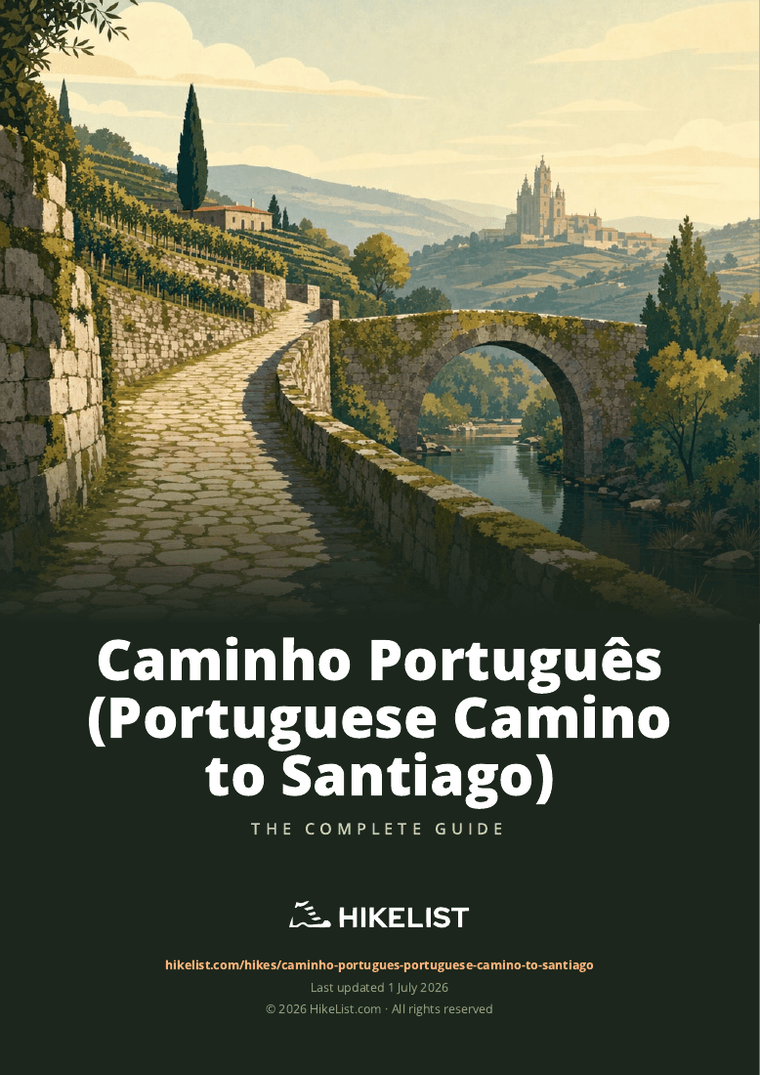
Caminho Português (Portuguese Camino to Santiago)
How would you rate Caminho Português (Portuguese Camino to Santiago)?
Tap a star to share your experience and help other hikers.
Caminho Português: Lisbon to Santiago on the Portuguese Way
HikeList Score
Caminho Português (Portuguese Camino to Santiago) scored 80/100 on HikeList's trail-quality metrics.
See score breakdownHide breakdown
- Ideal length 58
- Balanced challenge 90
- Scenery & wildness 74
- Varied terrain 100
- Accommodation 92
- Food & support 88
- Path quality 71
- Season flexibility 76
Computed from length, challenge, scenery & wildness, terrain variety, accommodation, food & support, path quality and season flexibility.
The Caminho Português is a waymarked pilgrimage route from Lisbon Cathedral to Santiago de Compostela in Galicia, Spain. This full Central Route is about 620 km and usually takes 28-30 days, with moderate difficulty rather than mountain terrain. Expect a long, steady walk on cobbles, asphalt, farm tracks, woodland paths and village streets, signed with yellow arrows and scallop-shell markers. It suits fit walkers planning a classic Camino through Portugal, with albergues, towns and historic stops along the way.
Route Overview
This is a point-to-point northbound route from Lisbon to the Cathedral of Santiago de Compostela. From Lisbon it passes Santarém, Golegã, Tomar, Coimbra and Águeda before reaching Porto, where many pilgrims start the shorter 10-14 day version. North of Porto the Central Route continues through Barcelos, Ponte de Lima, Rubiães, Valença and Tui, crossing the Minho into Spain, then Pontevedra, Caldas de Reis and Padrón before Santiago. A Vila do Conde/Póvoa variant is also associated with the northern section. For a shorter Portuguese long-distance walk with a very different feel, compare the coastal Fishermen's Trail or inland Grande Rota do Zêzere.
History of the Portuguese Camino
The Portuguese Way grew from medieval pilgrimage to the shrine of St James at Compostela, the legendary burial place of the apostle. The Central Route follows old Roman roads used by local communities and pilgrims for centuries, with Porto serving those arriving by local ports. Notable royal pilgrims include Queen Elizabeth (Isabel) of Portugal around 1325 and King Manuel I in 1502. Today it is the second-busiest Camino route, though many walkers begin at Tui, Porto or Valença.
Notable highlights
- Convent of Christ, Tomar: A UNESCO World Heritage Knights Templar castle and monastery, and one of the major landmarks on the Lisbon section.
- University of Coimbra: Portugal's oldest university, founded in 1290, set above the Mondego river and recognised as a UNESCO World Heritage site.
- Conímbriga Roman ruins: One of Portugal's best-preserved Roman towns, known for mosaics and bath complexes near the route south of Coimbra.
- Historic Porto: The UNESCO-listed old town on the Douro is a major Camino hub and the common starting point for the popular northern stages.
- Ponte de Lima and Alto da Portela: Ponte de Lima is known for its long bridge over the River Lima; the following climb to Alto da Portela is the route's highest and toughest section.
- Cathedral of Santiago de Compostela: The finish of the pilgrimage, in Santiago's UNESCO-listed old town, where pilgrims gather at the cathedral associated with St James the Great.
Challenges to expect
The challenge is endurance, not technical hiking. Daily stages are commonly 20-25 km, often on hard cobbles and asphalt, which can be tough on feet and knees. The terrain is mostly flat to gently rolling, but the Ponte de Lima to Rubiães stage climbs to Alto da Portela. Summer heat can be draining; winter brings cold, wet and windy weather, with many albergues closed. For rougher mountain walking, see the Peneda-Gerês National Park Trails or Arouca Geopark Trails.
HikeList Score
Caminho Português (Portuguese Camino to Santiago) scored 80/100 on HikeList's trail-quality metrics.
See score breakdownHide breakdown
- Ideal length 58
- Balanced challenge 90
- Scenery & wildness 74
- Varied terrain 100
- Accommodation 92
- Food & support 88
- Path quality 71
- Season flexibility 76
Computed from length, challenge, scenery & wildness, terrain variety, accommodation, food & support, path quality and season flexibility.
 Portugal
Show more data Show less
- Forest
- Woodland
- Farmland
- Vineyards
- Rolling
- Cobbles
- Asphalt
- Gravel
- Paved
- Albergues
- Hotels
- Guesthouses
- Quintas
- Family Friendly
- Pet Friendly
- Restrooms
- Water Sources
- Campsites
- Shelters
Download Our Full Guide to Caminho Português (Portuguese Camino to Santiago) FREE!
Get our comprehensive guide to this hike for free. Save it for later reading or print out at home.
Articles related to this hike
In these collections
Photos from hikers
Taken on the trail by people who've reviewed Caminho Português (Portuguese Camino to Santiago).
Caminho Português (Portuguese Camino to Santiago): The Complete Guide
The Caminho Português Central is a long, practical pilgrimage from Sé de Lisboa to the Cathedral of Santiago de Compostela, crossing Portugal from south to north before entering Galicia at Tui. It suits walkers who want a well-waymarked Camino with regular towns, pilgrim accommodation and a strong sense of history, without the demands of high mountains.
The full route is a serious month-long commitment of about 620 km, passing places such as Santarém, Tomar, Coimbra, Porto, Barcelos, Ponte de Lima and Valença. Most pilgrims choose the shorter northern half from Porto, while Tui gives the standard final 100 km-plus option for earning the Compostela.
Underfoot, expect cobbles, calçadas, farm tracks, woodland paths, village streets and plenty of asphalt. The walking is rarely technical, but repeated days on hard surfaces make footwear, pacing and foot care more important than mountain skills.
The route’s one notable climb comes between Ponte de Lima and Rubiães, over Alto da Portela Grande da Labruja. Beyond that, the challenge is consistency: getting up each morning, managing heat or rain, and keeping enough energy for the final approach into Santiago.
This guide covers stages, daily planning, accommodation, food, transport, terrain and the common mistakes to avoid.
Recommended Itinerary
For the full Lisboa (Lisbon) to Santiago walk, allow about 28–30 days in total. The Lisboa to Porto section normally takes roughly 12–14 days via places such as Santarém, Tomar, Coimbra, Águeda and São João da Madeira; exact daily distances for that southern section should be checked before booking.
The table below uses the standard Porto to Santiago Central Route stages supplied for this route. It is a fairly direct 10-stage schedule and suits fit walkers who are comfortable with several 25–33 km days on hard surfaces. Many pilgrims will prefer to split one or two of the longer stages and take 12–14 days from Porto.
Standard Porto to Santiago itinerary
| Day | From | To | Approx. distance | Why this stage makes sense | Services/accommodation notes |
|---|---|---|---|---|---|
| 1 | Porto | Vairão / Vila do Conde | 25 km | A practical first day out of Porto, long enough to leave the city behind without making the opening stage excessive. Vairão keeps to the inland Central spine; Vila do Conde is a variant rather than the classic inland line. | Porto has the widest choice of accommodation and is the main place to organise the credential before starting. Choose the overnight stop carefully: Vairão is the better fit for the Central Route towards Rates and Barcelos, while Vila do Conde suits walkers deliberately using the coastal/linking option. |
| 2 | Vairão | Barcelos | 28 km | This is a purposeful northbound day through the Minho towards one of the main towns on the Portuguese section. Barcelos is a logical overnight because it is a recognised Camino stop before the longer push to Ponte de Lima. | Barcelos is a major pilgrim stop with albergues and private accommodation. Book ahead in busy periods, especially if aiming for a private room rather than a pilgrim bunk. |
| 3 | Barcelos | Ponte de Lima | 33 km | One of the longer days on this itinerary. It positions you at Ponte de Lima ready for the next day’s climb over Alto da Portela, the toughest section of the Central Route. | Ponte de Lima is an important stop with good pilgrim infrastructure. If 33 km on hard surfaces is too much, split this stage using intermediate accommodation; exact options and distances should be checked before travelling. |
| 4 | Ponte de Lima | Rubiães | 18 km | A deliberately shorter day because it includes the climb to Alto da Portela Grande da Labruja, the route’s high point at about 395 m. The distance is modest, but this is the most physically demanding stage of the Portuguese Central Route. | Rubiães is the natural overnight after the pass. Accommodation exists for pilgrims, but capacity can matter in peak season because many walkers follow the same staging pattern. |
| 5 | Rubiães | Tui | 20 km | A manageable day from northern Portugal to the Spanish border, passing Valença before crossing the Minho into Galicia at Tui. It also brings walkers to the standard last-100 km start point for the Compostela. | Tui has a strong concentration of pilgrim services and accommodation. From here, the route becomes busier because many pilgrims start at Tui to meet the final 100 km requirement. |
| 6 | Tui | Redondela | 32 km | A long Galician stage that moves beyond the border towns and reaches Redondela, where the Central and Coastal routes converge. Expect more pilgrims from this point onwards. | This is a common stage to split, especially for walkers wanting a 6-day Tui to Santiago itinerary. O Porriño and Mos are the obvious intermediate places named on the route; check current accommodation and exact distances before booking. |
| 7 | Redondela | Pontevedra | 21 km | A more moderate day after the long Tui–Redondela stage. Pontevedra is one of the best overnight stops on the Galician section and gives access to a wide range of services. | Pontevedra is a larger town with pilgrim accommodation, guesthouses and hotels. It is a sensible place to recover, resupply or add an extra night if walking a slower schedule. |
| 8 | Pontevedra | Caldas de Reis | 19 km | A short-to-moderate day that keeps the final approach to Santiago well balanced. It avoids stacking too much distance immediately before the Padrón and Santiago stages. | Caldas de Reis is a regular Camino overnight with accommodation geared to pilgrims. In summer, book ahead if arriving late or travelling as a group. |
| 9 | Caldas de Reis | Padrón | 19 km | Another moderate stage, leaving a final 25 km day into Santiago. Padrón is a historically important Camino stop and a practical last night before the finish. | Padrón has pilgrim accommodation and other lodging. It is also the final major overnight before Santiago, so demand can be high in busy periods. |
| 10 | Padrón | Santiago de Compostela | 25 km | A final full walking day into Santiago, long enough to feel like a proper finish but not excessive after the preceding shorter stages. Start early if you want time at the Cathedral and Pilgrim’s Office on arrival. | Santiago has extensive accommodation, but it is still worth booking ahead in high season or around major feast days. Keep the stamped credential accessible for the Compostela process. |
Slower variant: 12–14 days from Porto
This is the better choice for most first-time Camino walkers, anyone carrying a full pack, and anyone concerned about repeated 28–33 km days on cobbles and asphalt.
The most useful stages to shorten are:
- Barcelos to Ponte de Lima — 33 km is a long day before the route’s main climb. Split it if accommodation is available on the date required.
- Tui to Redondela — 32 km can be divided via O Porriño or Mos, creating a more typical 6-day Tui to Santiago finish.
- Pontevedra to Santiago — the listed stages are already moderate, but adding an extra night here can make the final approach more relaxed.
Exact split points, distances and current albergue openings should be checked before travelling.
Faster variant: 10 days from Porto
The table above is already the faster practical version of the Porto to Santiago Central Route. It suits fit walkers who are used to long back-to-back days and who can manage hard surfaces without foot or knee problems.
Do not compress it further unless accommodation and recovery are carefully planned. The route is not technically difficult, but long asphalt and cobbled sections can become the limiting factor well before the hills do.
Last-100 km variant: about 6 days from Tui
Tui is the standard short-start option because it is about 115 km from Santiago and clears the final 100 km requirement for the Compostela. A sensible 6-day plan usually splits the long Tui to Redondela section, using O Porriño or Mos as the intermediate stop, then continues through Pontevedra, Caldas de Reis, Padrón and Santiago de Compostela.
Carry and stamp the pilgrim credential throughout this final section. Compostela requirements and current Pilgrim’s Office procedures should be checked before travelling.
Planning the Route
Choose the right starting point
Plan the Caminho Português by first choosing which version of the Central Route fits the time available. The full Lisboa (Lisbon) to Santiago route is a multi-week commitment, while Porto and Tui are the practical starts for most shorter itineraries.
| Start point | Typical time to allow | Best for |
|---|---|---|
| Lisboa (Lisbon Cathedral) | About 28–30 days | Walking the full Central Route through Portugal and Galicia |
| Porto (Sé do Porto / Porto Cathedral) | About 12–14 days | The classic popular northern half with a good balance of distance, services and Camino atmosphere |
| Tui | About 6 days | The minimum practical Portuguese-route start for the Compostela, as it is about 115 km from Santiago |
To receive the Compostela in Santiago, pilgrims must walk the final 100 km with a stamped credential. Tui is therefore the standard short-start option on this route; starting later than Tui risks falling below that requirement.
Pace and daily stages
This is not a route that rewards rushing. The walking is non-technical, but many kilometres are on cobbles, asphalt, village streets and quiet roads, so feet and knees often decide the pace more than fitness.
Most walkers should plan steady days rather than long heroic stages. The Porto to Santiago itinerary is commonly broken into town-to-town stages of roughly 18–33 km, with the longest days often feeling harder because of surface rather than height gain.
The one stage that deserves particular respect is Ponte de Lima to Rubiães, which crosses Alto da Portela Grande da Labruja, the highest and toughest point of the Central Route. Although it is a shorter day on many itineraries, it is the main climb of the route and should not be treated as an easy recovery stage.
For the full Lisboa start, allow enough flexibility for a rest or shorter day around the larger service towns such as Tomar, Coimbra and Porto. A plan with no spare time can become fragile if heat, foot problems, accommodation availability or wet Galician weather slows progress.
How fixed are the stages?
Stages are naturally shaped by towns, albergues and services. This is especially true for pilgrims using albergues, where the day usually ends in recognised Camino towns rather than at arbitrary points on the map.
The Porto to Santiago section is the easiest part to plan stage-by-stage because pilgrim infrastructure is well established and towns are frequent. The Lisboa to Porto section needs more careful advance planning, as it is longer, quieter and less commonly walked than the northern half.
Daily distances can usually be adjusted by stopping earlier or continuing to the next town, but this depends on accommodation being open and available. Albergue openings and seasonal closures should be checked before travelling, especially outside the main spring-to-autumn walking season.
Central Route, Coastal Route and variants
This guide follows the Central Route: Porto to Vairão, Rates, Barcelos, Ponte de Lima, Rubiães, Valença, Tui and onwards through Galicia. Do not confuse it with the Coastal Route, which leaves Porto for the Atlantic coast via places such as Vila do Conde and later rejoins the main flow before Pontevedra.
There is also a Vila do Conde / Póvoa de Varzim variant out of Porto, but the classic inland Central line is via Vairão and Rates. Decide this before leaving Porto, as it affects the first days and accommodation planning.
After Pontevedra, some pilgrims consider the Variante Espiritual side-option, which involves a boat crossing. That is not the standard Central Route and current arrangements should be checked before travelling.
Accommodation planning
Accommodation planning is the most important practical task on this Camino. The route has public and municipal albergues, donativo and private pilgrim hostels, plus pensões, hotels and quintas, but availability varies by season and by how busy the Camino is.
A pilgrim credential is required to use pilgrim albergues and to claim the Compostela in Santiago. It should be stamped regularly along the way, and especially carefully from Tui onwards for anyone walking the final 100 km for the certificate.
In busy periods, private rooms and popular albergues can fill quickly in the main Camino towns. Booking ahead is sensible if walking in summer, travelling as a group, arriving late in the day, or needing a private room rather than a dormitory bed.
In winter, the main issue is different: wet weather in Galicia and closed albergues. Do not assume the same accommodation network is available year-round; openings should be checked before travelling.
Food, water and daily logistics
This is a town-and-village Camino rather than a wilderness trail, so resupply is normally based around cafés, small shops, restaurants and accommodation stops. Even so, each day should start with enough water and snacks to cover the planned stage, particularly on hotter inland days and on quieter sections between larger towns.
The hard-surface nature of the route makes footwear, socks and blister care more important than technical mountain equipment. Lightweight hiking shoes or boots that are already broken in are preferable to heavy footwear chosen only for rugged terrain.
Long road and cobbled sections also make it worth keeping pack weight low. The route’s accommodation network means camping equipment is generally unnecessary for most pilgrims using albergues, guesthouses or hotels.
Navigation and waymarking
Navigation is generally straightforward, with yellow arrows, scallop-shell markers and Camino signage guiding the route. A map or offline route file is still useful in towns, at junctions, and where variants leave the main Central Route.
Pay particular attention when leaving Porto, where Central, Coastal and linking options can cause confusion. Once committed to the inland line via Vairão, Rates and Barcelos, planning becomes simpler.
Transport and section hiking
Section hiking is practical because the route passes through major towns and transport hubs. Lisboa and Porto both have international airports and mainline stations, and Porto is around three hours by train from Lisboa.
Tui and Valença are useful access points for the final 100 km section, with onward travel possible via Vigo. At the finish, Santiago de Compostela has an airport and rail and bus connections back towards Porto, Vigo, Madrid and beyond.
This makes it realistic to walk the route in blocks: Lisboa to Porto, Porto to Tui, and Tui to Santiago are the most logical divisions. Transport times, current services and any cross-border connections should be checked before booking travel.
Towns, Villages and Overnight Stops
Accommodation on the Caminho Português is built around the pilgrim system: public or municipal albergues, donativo and private pilgrim hostels, plus pensões, hotels and rural accommodation. A pilgrim credential is needed for pilgrim albergues and for the Compostela in Santiago, and albergue opening dates, bed numbers and prices should be checked before travelling, especially outside spring to autumn.
The route has far more services from Porto northwards than on some quieter Lisbon–Porto stages. In larger towns, food, cafés and resupply are straightforward; in smaller villages, plan the next meal and water before leaving in the morning.
Lisboa (Lisbon)
Lisboa is the traditional start of the full Central Route, beginning at Sé de Lisboa. It is a major city with the widest choice of accommodation, food, shops and transport on the route, so it is the place to sort the credential, final kit and any travel admin before walking.
Lisboa has an international airport and mainline rail connections. Many walkers starting farther north still pass through Lisboa because Porto is reached by train from Lisboa in about 3 hours.
Vila Franca de Xira
Vila Franca de Xira is one of the first major stops north of Lisboa on the full route. It works as an overnight stop for walkers breaking the early Lisbon stages into manageable days, with urban services more reliable than in smaller settlements.
Accommodation and food options should be checked before committing to a stage plan. Transport details for this stop should be checked before travelling.
Azambuja
Azambuja is another practical stage town on the Lisbon section. It is useful because it gives walkers a structured stopping point before the route continues deeper into central Portugal.
Expect basic town services rather than the dense pilgrim infrastructure found north of Porto. Check current albergue or guesthouse availability before travelling.
Santarém
Santarém is a significant town on the Lisboa to Porto section and a sensible overnight stop. It is one of the better places on the southern half for food, resupply and a wider accommodation search.
Walkers on the full route should use Santarém as a planning anchor rather than relying only on small intermediate villages. Public transport details should be checked before travelling.
Golegã
Golegã sits between Santarém and Tomar on the central Portuguese section. It can be used as an overnight stop when spacing the full Lisbon itinerary, particularly before continuing towards Tomar.
Services are more limited than in the larger cities, so book or confirm accommodation in advance where possible. Carry enough food and water for the next stage if leaving early.
Tomar
Tomar is one of the most useful overnight stops on the full route south of Porto. It has strong practical value for walkers because it combines accommodation, food and resupply with one of the route’s major landmarks, the Convento de Cristo.
It is a good place for a shorter day, laundry, restocking or a rest-style overnight if the early stages from Lisboa have been hard on the feet. Transport details should be checked before travelling.
Alvaiázere
Alvaiázere is a smaller inland stop between Tomar and Ansião. It is mainly a functional overnight point for full-route walkers rather than a place to rely on for abundant services.
Accommodation should be arranged or checked in advance. Food options may be more limited than in Tomar, Coimbra or Porto, so do not arrive late assuming there will be several choices.
Ansião
Ansião is another practical stage stop on the approach to Coimbra. It helps divide the quieter central Portuguese section into workable walking days.
Expect a more modest service base than in the larger towns. Check accommodation, evening meals and onward transport before travelling if using it as a fixed overnight.
Coimbra
Coimbra is a major city and one of the best logistics stops on the Lisbon–Porto half. It has a broad range of accommodation, food and resupply options, and is a natural place to pause if the full route is being walked over 28–30 days.
The Universidade de Coimbra sits above the River Mondego and is one of the main landmarks on this section. Coimbra is also a sensible place for replacing footwear, adjusting the itinerary or taking an easier day.
Mealhada
Mealhada lies north of Coimbra and is a useful intermediate overnight stop on the way towards Águeda. It is primarily a practical town for breaking the distance rather than a major Camino hub.
Check current beds before travelling, particularly in quieter seasons. Food and basic resupply are more likely here than in the smaller places between stage towns.
Águeda
Águeda is a good overnight stop between Mealhada and Albergaria-a-Velha. It offers the advantage of town services on a part of the route where walkers need to keep a close eye on stage spacing.
Use it for food, supplies and accommodation before continuing north. Transport options should be checked before travelling.
Albergaria-a-Velha
Albergaria-a-Velha is a practical stage town on the final approach to the Porto area. It is a sensible overnight stop for full-route walkers who are not yet ready to push on towards São João da Madeira.
Accommodation availability and albergue opening should be checked in advance. It is also a useful point to reassess timing before joining the busier northern half beyond Porto.
São João da Madeira
São João da Madeira sits south of Porto on the full Central Route. It is a more urban stop than many of the preceding villages, so it can be useful for food, shops and accommodation.
This is a good place to deal with practical tasks before the approach to Porto. Transport details should be checked before travelling.
Grijó
Grijó is a smaller stop between São João da Madeira and Porto. It can be used to shorten the approach into Porto or to avoid arriving in the city late in the day.
Do not assume the same range of pilgrim services as in Porto. Check beds and meals in advance if planning to overnight here.
Porto
Porto is the main restart point on the Caminho Português and the most common beginning for the popular northern half. Sé do Porto is the usual pilgrim starting point, and the city has extensive accommodation, food, shops and transport.
Porto has an international airport and mainline rail connections, including trains from Lisboa taking about 3 hours. It is the best place to obtain or stamp the credential, buy any missing kit and decide whether to follow the inland Central line or a coastal variant out of the city.
Vila do Conde
Vila do Conde is associated with the coastal or linking variant out of Porto, rather than the classic inland Central spine via Vairão and Rates. It can be used as an overnight stop by walkers choosing that variant before rejoining the main Portuguese Way later.
It should not be treated as the default Central Route stage unless the chosen itinerary specifically follows the Vila do Conde option. Check the exact variant, accommodation and onward waymarking before travelling.
Póvoa de Varzim (variant)
Póvoa de Varzim is also a variant stop linked with the coastal line from Porto. It is relevant only if deliberately choosing the Vila do Conde/Póvoa de Varzim option rather than the inland Central route.
Because variants can create confusion on the first day out of Porto, confirm the intended line before leaving the city. Accommodation and transport details should be checked before travelling.
Vairão
Vairão is the standard first-night target on many Porto-start Central Route itineraries. It is useful because it keeps walkers on the inland line out of Porto and positions them for the walk towards Barcelos.
Accommodation is more limited than in Porto or Barcelos, so check current availability before setting off. If beds are tight, some walkers plan the first stage around nearby alternatives such as Vila do Conde only when using the appropriate variant.
Rates
Rates lies between Vairão and Barcelos on the inland Central Route. It is a useful intermediate Camino village and can help shorten a stage if the Porto-to-Barcelos spacing feels too long.
Services are smaller-scale than in Barcelos, so it is best treated as a planned stop rather than a place to improvise late in the day. Check food and beds before travelling.
Barcelos
Barcelos is one of the key overnight towns north of Porto. It sits on the Central Route before the long stage towards Ponte de Lima and has enough practical value to make it a natural resupply and rest point.
The town is known for the Galo de Barcelos and its medieval bridge over the River Cávado, but for walkers its main appeal is logistics: accommodation, meals and the chance to prepare for one of the longer walking days. Book ahead in busy periods.
Ponte de Lima
Ponte de Lima is a major stop and one of the most important overnight towns on the Portuguese side. It is normally used before the climb to Alto da Portela and the onward descent to Rubiães.
This is the place to rest, eat properly and prepare for the toughest section of the Central Route. The town has a strong pilgrim focus, a riverside setting on the Rio Lima and the long medieval-Roman bridge that gives the town its name.
Rubiães
Rubiães is a small but important overnight stop immediately after the high point of the route. It comes after the climb from Ponte de Lima over Alto da Portela Grande da Labruja, so many walkers arrive tired despite the relatively modest altitude.
Accommodation should be checked ahead because this is not a large town. The Igreja de São Pedro de Rubiães and Roman Via XIX milestones are nearby route features, but the main planning point is simple: secure a bed before walking the pass.
Valença
Valença is the final Portuguese town before Spain and an important overnight or meal stop. Its fortress and the Ponte Internacional over the Minho mark the transition into Galicia, with Tui just across the border.
Valença is useful for resupply, cash, food and a final check of Portuguese-side logistics. Tui/Valença is also part of the common last-100 km access corridor, reachable by train or bus via Vigo; current connections should be checked before travelling.
Tui (Tuy)
Tui is the standard start for pilgrims wanting to walk the minimum qualifying distance for the Compostela, because it is about 115 km from Santiago. It is also the first major Spanish stop after crossing from Valença over the Minho.
Accommodation demand can be high because many pilgrims join here. Tui Cathedral is a major landmark, and the town is a sensible place to organise the credential stamps, food and accommodation before entering the busiest final week.
O Porriño (Porriño)
O Porriño is a practical Galician stage town after Tui. It is commonly used as an overnight stop on the final 100 km corridor, especially by walkers not pushing all the way to Redondela in one day.
Expect a pilgrim-oriented service base, but check beds in busy periods because numbers increase from Tui onwards. Food and basic resupply are generally easier here than in the smaller villages.
Mos
Mos sits between O Porriño and Redondela. It is useful as a smaller stop or break point on a stage that can otherwise feel long, particularly for walkers easing into the final Galician section.
Accommodation and services are more limited than in O Porriño or Redondela. Check availability before planning an overnight here.
Redondela
Redondela is a key junction town because the Coastal and Central routes converge here before Pontevedra. It is a busy pilgrim stop and a logical overnight for many Porto and Tui itineraries.
Because traffic from more than one Camino line meets here, accommodation can fill quickly in peak periods. Book ahead or arrive with a backup plan, especially in summer.
Pontevedra
Pontevedra is one of the best overnight stops in Galicia. It has a handsome old town, the Santuario da Virxe Peregrina and enough services to make it useful for laundry, resupply and a more comfortable night.
This is also where some walkers consider side-options such as the Variante Espiritual after Pontevedra. That side-option, including any boat element, should be checked before travelling if it is being considered.
Caldas de Reis
Caldas de Reis is the standard stop between Pontevedra and Padrón on many itineraries. It is a practical overnight town that keeps the final approach to Santiago in manageable stages.
Accommodation, food and pilgrim services are generally part of its role on the route, but demand rises on the final 100 km. Check or book beds in advance during busy periods.
Padrón
Padrón is the last major overnight stop before Santiago for many walkers. It is a strategically important place to rest before the final day and has strong route identity through the O Pedrón stone in the Igrexa de Santiago and its association with pementos de Padrón.
Do not treat the last night casually: beds can be in demand because many pilgrims aim to finish together the next day. Sort accommodation and an early breakfast or supplies before the final stage.
Santiago de Compostela
Santiago de Compostela is the endpoint at the Cathedral of Santiago de Compostela in Praza do Obradoiro. It has the full range of city accommodation, food and onward transport, but beds can still be expensive or scarce at busy times.
The Pilgrim’s Office issues the Compostela for qualifying pilgrims with the correct stamped credential. Santiago–Rosalía de Castro airport and the rail and bus network connect onwards to Porto, Vigo, Madrid and beyond, and many pilgrims return to Porto by bus or train.
Getting to the Start
Most walkers choose one of three practical starting points: Sé de Lisboa (Lisbon Cathedral) for the full Central Route, Sé do Porto (Porto Cathedral) for the popular northern half, or Tui for the final 100 km-plus required for the Compostela. Public transport is usually the simplest option because this is a point-to-point walk ending in Santiago de Compostela, not a loop.
By train
Lisboa and Porto both have mainline rail access and are straightforward rail gateways for the route. If starting in Lisboa, allow time to cross the city from the station to Sé de Lisboa; the best local connection depends on arrival station and time of day. This should be checked before travelling.
Porto is reached by train from Lisboa in about 3 hours, making it easy to begin at Sé do Porto after flying or arriving first in the capital. Porto is the common start for the 12–14 day Central Route to Santiago, so it has the simplest pre-walk logistics for most pilgrims.
For the last-100 km start, Tui is reached via the Valença/Tui border area, commonly by rail or bus connections through Vigo. Build in buffer time if arriving from Portugal or from Santiago, as cross-border local connections can be less frequent than mainline services. This should be checked before travelling.
By bus
Long-distance buses are useful for reaching Lisboa, Porto and the Galicia border area when train times do not suit. They are also practical for connecting through Vigo towards Tui or Valença for a shorter Camino start.
Timetables, departure points and operators change, and bus stations may not be beside the cathedral or old-town start point. Check current times, arrival terminals and onward local transport before booking. This should be checked before travelling.
By car
Driving to the start is possible, but it is rarely the most convenient plan unless someone is collecting the vehicle. The Caminho Português is a long point-to-point route ending in Santiago de Compostela, so leaving a car in Lisboa, Porto or Tui means arranging a return journey days or weeks later.
If a car is used, arrange secure long-stay parking in advance through a hotel or a suitable car park near the chosen start. Long-stay availability, costs and conditions should be checked before travelling.
Taxis are most useful for the final urban transfer from a rail or bus terminal to Sé de Lisboa, Sé do Porto or accommodation in Tui, particularly after a late arrival. They should not be needed for normal trail access once walking begins.
From the nearest airport
Lisboa and Porto both have international airports, making them the main air gateways for the Portuguese Camino. Lisboa is the natural airport for the full route from Sé de Lisboa, while Porto is the simplest airport for the popular Porto to Santiago itinerary.
For a Tui start, common access is via Vigo and the Valença/Tui border area. Santiago–Rosalía de Castro airport can also work for walkers starting in Galicia, with onward rail or bus connections towards Vigo and Tui. Current airport transfer and onward transport times should be checked before travelling.
Where to stay before starting
For the full route, stay in Lisboa close enough to reach Sé de Lisboa easily on the first morning. Starting directly after a flight is possible but not ideal for a multi-week walk; a night in the city gives time to organise the pilgrim credential, check the first stage and begin early.
In Porto, staying near Sé do Porto is practical because the cathedral is the usual starting point and a place to get the credential stamped. Be clear from the first morning that you are following the Central Route inland via Vairão, Rates, Barcelos, Ponte de Lima and Valença/Tui, rather than drifting onto the Coastal or Senda Litoral routes out of Porto.
In Tui, stay near the old town or cathedral area if walking the final 100 km-plus to Santiago. Tui is the standard Portuguese-route start for pilgrims who want the Compostela without walking from Lisboa or Porto, but the credential still needs to be stamped properly along the way.
Accommodation before the start ranges from pilgrim albergues to pensões, guesthouses and hotels. Seasonal closures and current albergue openings should be checked before travelling, especially in winter.
Getting Home from the Finish
Santiago de Compostela is one of the easiest Camino finish points to leave from. The city has rail, bus and airport connections, so there is no need to retrace the route on foot unless continuing to another Camino destination.
If finishing late in the day, staying overnight in Santiago is usually the simplest plan. It gives time to reach the cathedral, deal with the Pilgrim’s Office if claiming the Compostela, collect luggage if it has been forwarded, and travel the following morning without relying on the last departures of the day.
By train
Use Santiago de Compostela’s railway station for onward travel. Rail services connect Santiago with major Spanish destinations, including routes towards Madrid, and can also be used as part of a return journey towards Vigo or onward to Portugal.
Many pilgrims heading back to Portugal travel by train or bus towards Porto. Exact routing, changes and journey times vary by date and operator, so train times should be checked before booking accommodation or flights.
| Common onward direction | Practical note |
|---|---|
| Madrid | A major onward rail direction from Santiago for international connections and onward Spanish travel. |
| Vigo | Useful for connections towards the Portuguese border and the Tui/Valença area. |
| Porto | Many pilgrims return this way after finishing; compare train and bus options before committing. |
By bus
Santiago de Compostela is served by the regional and long-distance bus network, with onward connections towards Vigo, Porto, Madrid and other destinations. Buses can be a practical choice where rail times are awkward or where a direct coach is available.
Timetables, operators and cross-border services change seasonally and by day of week. This should be checked before travelling, especially if leaving Santiago on the same day as finishing the walk.
For Porto-bound pilgrims, both bus and train are realistic options. Compare departure times from Santiago with flight times from Porto or onward travel in Portugal before deciding.
By car/taxi
The Camino finishes at the Catedral de Santiago de Compostela on Praza do Obradoiro, in the old town. If being collected by car or using a taxi, allow for central-city access restrictions, traffic and the need to walk the final short distance from wherever vehicles can conveniently stop.
Taxis are useful for transfers between the old town, the railway station, the bus station and the airport, particularly with a pack or after a late finish. For very early airport departures or late arrivals, pre-booking through accommodation is the safer option.
A hire car is rarely necessary for leaving Santiago unless combining the Camino with further travel in Galicia. For a straightforward return to Porto, Vigo or Madrid, public transport is normally simpler.
From the nearest airport
The nearest airport is Santiago–Rosalía de Castro airport (SCQ). It is the main airport for leaving directly from the finish and has connections onwards to Porto, Vigo, Madrid and beyond through the wider transport network.
Airport transfer times and services should be checked before booking flights. If a flight leaves early in the morning, staying in Santiago the night before is strongly recommended rather than trying to finish the walk and fly the same day.
Pilgrims returning to Portugal may also choose to travel overland to Porto and fly from there, especially if flights are better timed or cheaper. Build in enough margin for cross-border bus or train connections.
Where to stay at the finish
Santiago has a wide range of accommodation for pilgrims and general travellers, from albergues and guesthouses to hotels. Demand rises in busy Camino periods, so booking ahead is sensible if arriving in summer, at weekends or with a fixed onward flight.
Staying at least one night in Santiago is the most practical finish strategy. It removes pressure on the final stage from Padrón, gives time for the cathedral and Compostela formalities, and avoids making onward transport depend on an exact walking arrival time.
If travelling onwards the next morning, choose accommodation with easy access to the railway station, bus station or airport transfer route rather than focusing only on the old town. For a celebratory final night, staying close to Praza do Obradoiro is more convenient for the cathedral and pilgrim services.
Which Direction Should You Walk?
Standard direction: north to Santiago
The Caminho Português Central is normally walked northwards towards Santiago de Compostela. For the full route that means starting at Sé de Lisboa (Lisbon Cathedral); for the most common shorter versions it means starting at Sé do Porto (Porto Cathedral) or Tui and continuing north to Santiago.
This is the direction that fits the pilgrimage logic of the route. The yellow arrows, scallop-shell markers, pilgrim accommodation pattern and Compostela requirement are all built around reaching Santiago, not leaving it.
It also gives the clearest psychological finish. The route builds from Portugal into Galicia, crosses the Minho at Valença / Tui, then works through Pontevedra, Caldas de Reis and Padrón before the final approach to the Cathedral of Santiago de Compostela.
Reverse direction: possible, but not recommended for most walkers
Walking from Santiago southwards towards Tui, Porto or Lisboa is possible in practical terms, but it is a niche choice. Transport is not the main problem: Santiago has airport, rail and bus connections, and Lisboa and Porto are also easy to reach.
The disadvantages are more significant on the trail. You would be walking against the normal flow of pilgrims, using a route culture and accommodation network designed mainly for people heading to Santiago. Navigation may also feel less intuitive because Camino waymarking is primarily intended for Santiago-bound walkers.
The biggest issue is the Compostela. To claim it in Santiago, you must walk at least the final 100 km to Santiago with a stamped credential. A southbound walk away from Santiago does not provide that conventional certificate finish.
Climbs and terrain by direction
There is no major mountain logic that makes one direction dramatically easier. The Central Route is a long endurance walk on cobbles, asphalt, farm tracks, woodland paths and village roads rather than a high-level trek.
The one notable climb is between Ponte de Lima and Rubiães, over Alto da Portela / Alto da Portela Grande da Labruja at about 395 m. Northbound, this is tackled after Ponte de Lima and before Rubiães; southbound, the same high point is crossed in reverse. Direction matters less than pacing, footwear and managing repeated days on hard surfaces.
Weather and seasonal considerations
There is no strong direction-based weather advantage for this route. Season matters more than whether you walk northbound or southbound: spring and autumn are generally the best balance, summer can be hot inland, and winter is wetter in Galicia with many albergues closed.
For that reason, do not choose a reverse itinerary expecting a meaningful weather benefit. Choose the season carefully, then walk the route in its standard direction unless there is a specific logistical reason not to.
Accommodation and stage flow
Accommodation planning is easiest northbound. The common stage structure, pilgrim traffic and albergue network all make most sense when moving towards Santiago, especially on the popular Porto → Santiago and Tui → Santiago sections.
Starting at Tui is the simplest option for walkers who want the Compostela with the shortest Portuguese-route itinerary, because it is about 115 km from Santiago and clears the 100 km walking requirement. Starting at Porto gives a fuller two-week Camino, while starting at Lisboa is the full multi-week undertaking.
Recommendation
Walk the Caminho Português Central northbound to Santiago. Start in Lisboa for the full route, Porto for the classic shorter version, or Tui for the minimum Compostela-distance walk. Reverse direction is only worth considering for walkers with a very specific personal or logistical reason, and it sacrifices much of the route’s practical and emotional structure.
Accommodation Along the Route
Accommodation is one of the strengths of the Caminho Português Central. This is a pilgrimage route with a well-established mix of public/municipal albergues, donativo and private pilgrim hostels, plus pensões, hotels and quintas in larger towns.
A pilgrim credential is essential if you want to use pilgrim albergues, and it is also required for the Compostela in Santiago. Keep it accessible and get it stamped regularly, especially from Tui onwards if walking the final 100+ km for the certificate.
Booking strategy
The safest approach is to plan around the recognised stage towns rather than assuming every village between them has beds. Larger places such as Lisboa, Coimbra, Porto, Barcelos, Ponte de Lima, Valença, Tui, Pontevedra, Padrón and Santiago de Compostela give the most flexibility.
Smaller stops such as Vairão, Rates, Rubiães and Mos need more care. They can work well as overnight stops, but availability is more limited and seasonal closures can matter. This should be checked before travelling, particularly in winter.
Summer is the busiest period on the Camino, and private rooms can book out in popular stage towns. Spring and autumn are usually easier, but booking ahead is still sensible if you want a private room, are walking to a fixed schedule, or need accommodation that will accept luggage transfers.
Winter is the least reliable season for accommodation because many albergues close. A winter itinerary should be built around towns with multiple lodging types rather than single-hostel villages.
Albergues vs private accommodation
Albergues keep costs down and suit pilgrims who are flexible about where they sleep. They are the classic Camino option, but they rely on having a valid credential and should not be treated as guaranteed without checking current opening dates.
Pensões, hotels and quintas make the route very workable for inn-to-inn walkers. This is especially straightforward from Porto to Santiago and from Tui to Santiago, where stage towns are frequent and the route is heavily used.
From Lisboa to Porto, accommodation is still possible in the main towns, but the full route is a longer commitment and needs more advance planning. Do not build a Lisboa-start itinerary around unverified intermediate hamlets.
Pressure points and awkward stages
The Ponte de Lima to Rubiães stage is the key accommodation-planning point in northern Portugal because it includes the climb over Alto da Portela. Rubiães is a logical stop after the climb, but it is a smaller place, so beds should be checked before committing to that stage.
The Barcelos to Ponte de Lima stage is long on many itineraries. If that distance is too much, any intermediate overnight plan should be confirmed in advance rather than assumed.
Tui is the standard last-100 km start, so accommodation pressure increases from there towards Santiago. Redondela can also be busier because the Central and Coastal routes converge there before Pontevedra.
Luggage transfers and taxi back-up
If using luggage transfer, book accommodation that will accept transferred bags and check the conditions before travelling. This is most practical on standard stages between recognised Camino towns.
Taxi transfers can help if a planned stop is full or if a stage needs to be shortened, but availability and cost should be checked locally before relying on them. Pilgrims seeking the Compostela should still walk the required final 100 km and avoid skipping sections of the route.
Accommodation planning table
| Place | Accommodation level | Best for | Notes |
|---|---|---|---|
| Lisboa (Lisbon) | Good | Full-route start, pre-walk night | Major city start at Sé de Lisboa; book ahead if starting on a fixed date. |
| Vila Franca de Xira | Limited | Early Lisboa-section stop | Useful first-stage town, but check current pilgrim accommodation before relying on it. |
| Azambuja | Limited | Lisboa-section staging | Plan ahead; do not assume many alternatives nearby. |
| Santarém | Good | Rest, resupply, flexible staging | One of the stronger accommodation towns on the Lisboa to Porto section. |
| Golegã | Limited | Intermediate Lisboa-section stop | Works as a stage town, but availability should be checked. |
| Tomar | Good | Overnight or rest stop | Stronger choice and a natural stop on the full Central Route. |
| Alvaiázere | Limited | Rural-stage overnight | Treat as a planned stop rather than a place to leave to chance. |
| Ansião | Limited | Lisboa–Coimbra staging | Check openings and private options before travelling. |
| Coimbra | Good | Rest day, private rooms, resupply | Major city with the best flexibility on the middle section. |
| Mealhada | Limited | Coimbra–Águeda staging | Useful for breaking the route, but confirm accommodation. |
| Águeda | Good | Overnight, resupply | A practical town stop before the approach to Porto. |
| Albergaria-a-Velha | Limited | Stage break | Suitable as a planned overnight, with checking advised. |
| São João da Madeira | Good | Overnight before Porto approaches | Better for walkers wanting more town services. |
| Grijó | Limited | Shorter approach to Porto | Useful if not walking directly into Porto, but check accommodation. |
| Porto | Good | Major start, rest, resupply | The most common starting point for the northern half; book before arrival in busy periods. |
| Vairão | Limited | First Central-route night from Porto | A standard inland stop, but smaller than Porto or Barcelos. |
| Vila do Conde | Good | Variant from Porto | Use only if deliberately taking the Vila do Conde/Póvoa coastal-linking variant rather than the classic inland Central line. |
| Rates | Limited | Alternative early northern stop | A small Central-route staging point; check beds before setting out. |
| Barcelos | Good | Overnight, resupply, stage reset | Stronger choice before the long walk towards Ponte de Lima. |
| Ponte de Lima | Good | Overnight before Alto da Portela | Sensible place to sleep before the main climb to Rubiães. |
| Rubiães | Limited | Overnight after Alto da Portela | Important but smaller stop; check availability, especially in busy season or winter. |
| Valença | Good | Final Portuguese stop | Good place to stay before crossing the Minho into Tui. |
| Tui | Good | Last-100 km start, credential focus | Popular starting point for pilgrims walking the minimum distance for the Compostela. |
| O Porriño | Good | Galician-stage overnight | Practical town stop between Tui and Redondela. |
| Mos | Limited | Shortening the Tui–Redondela stage | Useful if avoiding a longer day, but accommodation is more limited. |
| Redondela | Good | Overnight after Tui/O Porriño, route convergence | Can be busier because the Central and Coastal routes meet here. |
| Pontevedra | Good | Rest, private rooms, resupply | One of the best Galician stops for choice and services. |
| Caldas de Reis | Good | Standard Galician stage stop | Popular overnight between Pontevedra and Padrón; book private rooms ahead in busy periods. |
| Padrón | Good | Final night before Santiago | Strong practical stop before the last stage. |
| Santiago de Compostela | Good | Finish, recovery night, onward travel | Book ahead if arriving at a weekend, in summer, or around major pilgrimage dates. |
| Unlisted rural hamlets between stages | None / unreliable | Not recommended as fixed overnight stops | Do not plan around unverified beds; use recognised stage towns or check before travelling. |
Camping and Wild Camping
Camping is not the normal way to walk the Caminho Português Central. The route is built around pilgrim infrastructure: albergues, donativo and private hostels, pensões, guesthouses and hotels in the towns and villages along the way. For most walkers, especially from Porto or Tui, carrying a tent adds weight without solving a real accommodation problem.
Official campsites
Do not assume there will be a campsite at the end of each Camino stage. The signed route leads through pilgrim towns such as Santarém, Tomar, Coimbra, Porto, Barcelos, Ponte de Lima, Valença, Tui, Pontevedra, Caldas de Reis and Padrón, but campsite availability is a separate matter and should be checked before travelling.
If planning to camp, build the itinerary around official campsites rather than standard albergue stages. Check opening dates carefully: seasonal closures are a particular issue outside spring, summer and early autumn, and winter is already a difficult time for accommodation planning because many albergues close.
Camping can work as an occasional backup or for walkers deliberately linking official sites, but it is not the simplest or lightest strategy for this Camino. A sleeping bag or liner for albergues is usually more useful than a full tent, mat and stove set-up.
Wild camping
Wild camping should not be treated as a default option on the Caminho Português. The route crosses two countries, many municipalities, village streets, farm tracks, vineyards, eucalyptus and pine woodland, riverside paths and private land; rules and enforcement can vary locally. This should be checked before travelling.
Do not pitch on farmland, vineyards, church grounds, sports fields, municipal parks, beside houses, or near albergues without explicit permission. If a landowner, parish, municipality or accommodation owner gives permission, keep the camp discreet, arrive late, leave early and leave no trace.
The Porto to Santiago section is particularly poorly suited to stealth camping because settlements, roads and pilgrim services are frequent. From Tui onwards the route is busy, social and increasingly urbanised in places, so relying on informal camping is impractical as well as legally uncertain.
Where camping makes most sense
Camping is most plausible only where it is planned around official sites or permission-based stays. It is least useful on the popular Porto, Tui and Galicia sections, where albergues and towns are close together and the walking is mainly on hard surfaces that make extra pack weight more noticeable.
On the full Lisboa to Santiago route, a tent may appear attractive because the journey is longer, but the same caution applies: the Central Route is a pilgrimage corridor, not a wilderness trail. Accommodation planning should still start with albergues, guesthouses and hotels, with camping used only where a legitimate site or permission has been arranged.
Water, cooking and resupply
Water planning is normally based on towns, cafés, shops and accommodation rather than streams or wild sources. Carry enough between settlements, especially in hot summer conditions and on longer road-and-track days.
Do not rely on untreated natural water from rivers, irrigation channels or woodland streams. If camping away from services with permission, fill up before leaving the last village or accommodation.
Stove use needs care. Avoid open flames entirely, and do not cook in woodland, dry grass, farmland, vineyards or near buildings unless a campsite or host specifically allows it. Summer heat and dry vegetation make fire risk a serious practical concern.
Leave No Trace expectations
If camping legally, keep the footprint minimal:
- use official campsites wherever possible;
- ask permission on private land;
- pitch well away from homes, crops, chapels, cemeteries, livestock and watercourses;
- never light a fire;
- pack out all rubbish, including food waste and toilet paper;
- use toilets in towns, cafés, albergues and campsites whenever available;
- leave early and do not obstruct paths, farm access or Camino waymarks.
For most pilgrims, the best camping decision on the Caminho Português is not to carry camping kit at all. Book or plan around albergues and guesthouses, keep the pack light, and use official campsites only where they fit the route and are open.
Food, Water and Resupply
The Caminho Português Central is not a wilderness resupply route. Most walkers buy food daily in towns and villages, eat in cafés or simple restaurants, and refill water at accommodation and services along the way.
The main planning issue is timing: rural cafés and small shops may keep limited hours, close for part of the day, or be shut on Sundays and holidays. Do not start a long stage assuming the first village will have an open café.
How much to carry
For most stages, carry lunch or substantial snacks plus emergency food for the day. A full multi-day food carry is unnecessary on the standard route, but a small reserve is sensible on the quieter Lisboa–Porto section and on any day with an early start.
As a practical default, start each day with enough water to reach the next reliable settlement, then top up whenever there is a café, shop or accommodation stop. In hot summer weather, especially on asphalt and exposed inland sections, carry more than usual and avoid relying on mid-stage opening hours.
The longer Porto-stage days need particular attention: Barcelos to Ponte de Lima is about 33 km, and Tui to Redondela is about 32 km. The Ponte de Lima to Rubiães stage is shorter at about 18 km but includes the climb to Alto da Portela, so water should be sorted before leaving Ponte de Lima.
Where food is easiest
Food is easiest in the larger towns and cities: Lisboa, Santarém, Tomar, Coimbra, Águeda, Porto, Barcelos, Ponte de Lima, Valença, Tui, Redondela, Pontevedra, Caldas de Reis, Padrón and Santiago de Compostela. These are the best places to restock snacks, buy breakfast food for an early departure, and deal with any dietary requirements.
After Porto, services are generally more frequent because this is the most walked part of the route. From Tui onwards the Camino infrastructure becomes denser again, with more pilgrims and more regular café and accommodation options.
The full Lisboa to Porto section is the part where planning matters most. It still passes through towns, but it is quieter and less consistently pilgrim-focused than the Porto to Santiago half.
Water and natural sources
Use treated water from accommodation, cafés, restaurants and shops as the normal supply. Public taps or fountains may be available in some places, but they should be treated as a bonus rather than the backbone of the day’s plan.
Do not plan around drinking from rivers, streams, irrigation channels or farm water sources. The route passes through towns, farmland, vineyards and woodland rather than remote mountains, so natural water should only be used if necessary and should be filtered or treated first.
Section-by-section resupply
| Section | Food availability | Water availability | Notes |
|---|---|---|---|
| Lisboa to Porto | Regular town resupply, but quieter and less Camino-focused than the northern half | Refill at accommodation, cafés and shops | Carry a same-day food reserve, especially before leaving smaller places or on Sundays. Opening hours should be checked before travelling. |
| Porto to Barcelos | Generally good, with Porto as a major resupply point and Barcelos a substantial town | Reliable at accommodation and town services | Stock up in Porto if starting early. The Central line runs inland via Vairão, Rates and Barcelos; do not assume Coastal-route services apply. |
| Barcelos to Ponte de Lima | Good at each end; mid-stage services may be less predictable | Start with enough water for a long day and refill when services are open | This is one of the longer standard Porto-stage days at about 33 km. Carry lunch or buy it before leaving Barcelos if unsure. |
| Ponte de Lima to Rubiães | Food is best organised before leaving Ponte de Lima and on arrival in Rubiães | Leave Ponte de Lima with enough water for the climb | Shorter distance, but this is the route’s main climb over Alto da Portela. Do not rely on finding food at the high point. |
| Rubiães to Valença / Tui | Food is available at the town ends, with Valença and Tui important service points | Refill before leaving and again in Valença or Tui | This is the border crossing stage over the Minho. Tui is also the common last-100 km starting point, so services become more pilgrim-oriented from here. |
| Tui to Redondela | Good at Tui and Redondela; carry food for the day because the stage is long | Start full and top up where services are open | At about 32 km, this is another long day on the standard itinerary. An early start can mean cafés are not yet open. |
| Redondela to Pontevedra | Good at both ends | Straightforward refills in towns and accommodation | The route is busier from here, and resupply is generally simpler. |
| Pontevedra to Caldas de Reis | Good town-based resupply | Refill before leaving Pontevedra and again at Caldas de Reis | Buy snacks in Pontevedra if leaving before cafés open. |
| Caldas de Reis to Padrón | Good at both ends | Straightforward at accommodation and town services | Padrón is a useful final resupply stop before the last day into Santiago. |
| Padrón to Santiago de Compostela | Good at the start and finish; carry enough for a full walking day | Fill bottles before leaving Padrón | The final approach is not remote, but it is still a 25 km stage. Do not save all food and water planning for Santiago. |
Terrain, Conditions and Difficulty in Practice
The Caminho Português Central is not difficult because of altitude, remoteness or technical ground. It is difficult because it asks for repeated long days on hard surfaces: cobbles, asphalt, village streets, old calçadas, farm tracks and quiet country roads.
Most reasonably fit walkers can manage the terrain, but foot care and pacing matter more here than mountain skills. Blisters, hot spots, sore knees and tired shins are more likely to stop a pilgrimage than steep ground.
Path surfaces
Expect a mixed but generally straightforward walking surface:
| Surface | Where it affects the walk | Practical impact |
|---|---|---|
| Cobbled lanes and calçadas | Frequent in towns, villages and older road sections, including parts following old Roman roads | Hard underfoot; can be tiring over many days and slippery when wet |
| Asphalt and quiet roads | Common throughout the route, especially through settlements and rural linking sections | Fast walking but punishing on feet and knees; road awareness is needed |
| Farm and vineyard tracks | Common in the rural Portuguese stages, especially in central and northern Portugal | Usually easy walking, but can become rougher or muddy after rain |
| Eucalyptus and pine woodland tracks | Scattered wooded sections, especially north of Porto and into Galicia | Generally non-technical; wet leaves, roots and mud can make short sections slippery |
| Riverside paths and village streets | Regularly encountered near towns and river crossings such as Ponte de Lima and Valença/Tui | Easy navigation, but surfaces remain hard and often urban |
Trail shoes or light walking boots usually suit the route better than heavy mountain boots unless extra ankle support is needed. Cushioning matters: the repeated impact of stone and asphalt is one of the defining features of the Central Route.
Road walking and hard-surface fatigue
There is a significant amount of road and lane walking. Much of it is on quiet country road or through villages, but it still changes the character of the hike: the pace may be steady, yet the body absorbs more impact than on soft hill paths.
This is especially important on longer stages such as Barcelos to Ponte de Lima and Tui to Redondela, both listed at over 30 km in the common Porto-to-Santiago itinerary. Shortening long days, booking intermediate accommodation where possible, and avoiding an overloaded pack make a real difference.
Cobbles and old stone roads deserve respect in wet weather. They are part of the character of the route, but they are unforgiving underfoot and can become slick after rain.
Climbs, descents and high ground
The route is mostly lowland or gently rolling. It does not feel like a mountain trek, and the high point is only about 395 m.
The one genuinely significant climb is between Ponte de Lima and Rubiães, over Alto da Portela / Alto da Portela Grande da Labruja. This is the toughest stretch of the Central Route: shorter in distance than many other days, but steeper and rougher in feel than the surrounding lowland walking.
Treat the Ponte de Lima to Rubiães stage as a hill day rather than an easy recovery day. Allow more time than the distance suggests, carry enough water and food for the climb, and avoid starting it already injured or exhausted from the previous long approach into Ponte de Lima.
Descents are not technically difficult, but tired legs on stone, gravel or wet woodland track can be awkward. Walking poles can help on the Alto da Portela stage and on any wet, uneven descents in Galicia.
Mud, wet ground and slippery sections
The Caminho Central is not a boggy route in the mountain-trail sense. However, farm tracks, woodland paths and Galician lanes can become wet, muddy or slippery after rain.
Galicia is the dampest-feeling part of the walk, particularly outside summer. Expect greener, wetter hills after Tui, with more attention needed on shaded tracks, stone surfaces and leaf-covered paths.
Waterproof footwear is useful in spring, autumn and winter, but breathability also matters in warm conditions. In summer, many walkers prefer lighter footwear and accept that the occasional wet section is a trade-off for cooler feet.
Technical difficulty and exposure
There is no scrambling, no sustained exposed ridge walking and no alpine-style terrain on the Central Route. Navigation is also comparatively simple because the route is well waymarked with yellow arrows and scallop-shell markers.
The practical hazards are more ordinary: traffic on road sections, slippery cobbles, heat on open asphalt, and cumulative fatigue. A walker who is comfortable covering 20–30 km days on mixed hard surfaces is better prepared than a strong hillwalker who has not trained for repeated road mileage.
Fields, gates and rural obstacles
This is not a stile-and-fence type of long-distance path. The route mostly uses public lanes, tracks, village streets, old roads and woodland paths rather than crossing open livestock fields in the British sense.
You may pass through agricultural areas, vineyards and rural settlements, but the main planning issue is surface and distance rather than negotiating fences, gates or field boundaries.
Seasonal conditions
Spring and autumn are the most forgiving seasons for the terrain: cooler temperatures, generally manageable walking days and less strain on feet during long asphalt sections. Rain is still possible, so cobbles and woodland tracks should be treated carefully when wet.
Summer makes the route physically harder, especially on inland Portuguese stages where heat builds on road and stone surfaces. Early starts, sun protection and conservative daily distances are important; long exposed road sections feel much harder in high temperatures than they look on a map.
Winter changes the challenge again. The walking remains non-technical, but Galicia is wetter, surfaces are more slippery, daylight is shorter and many albergues close seasonally. Accommodation and services should be checked before travelling.
What makes it easier
The Central Route is easier than many long-distance hikes because towns and villages are frequent, waymarking is strong, and the terrain is mostly low-level. The social Camino infrastructure also reduces the need to carry camping equipment or large food loads.
Starting at Porto or Tui makes the commitment much shorter while keeping the same general terrain character. Tui is also the standard last-100 km start for pilgrims walking to qualify for the Compostela, provided the credential is stamped as required.
What makes it harder
The full Lisboa to Santiago route is a serious multi-week endurance walk. Even though the terrain is moderate, the cumulative distance of about 620 km means small problems become significant if ignored.
The hardest practical combination is heat, hard surfaces and long stages. A modest ascent profile can still produce a difficult day if it includes 25–30 km of asphalt, cobbles and village lanes with a tired body and a heavy pack.
Weather and Best Time to Walk
Best walking window
Spring and autumn are the best seasons for the Caminho Português Central. Conditions are generally milder, the long asphalt and cobbled sections are less punishing, and the route is usually quieter than in the main summer pilgrimage season.
For most walkers, the most practical windows are late spring and early autumn. These avoid much of the inland summer heat while still giving enough daylight for longer stages such as Barcelos to Ponte de Lima, Tui to Redondela, and Padrón to Santiago de Compostela.
The full Lisboa to Santiago route takes around a month, so expect conditions to change as you move north from central Portugal into the greener, wetter hills of Galicia. Packing for both warm days and wet weather is sensible even outside winter.
Summer: hot, busy and hard on feet
Summer is realistic, but it is not the easiest season. The Central Route has long stretches of asphalt, cobbles, village streets and quiet road walking, and these hard surfaces become tiring in heat, especially on the Lisboa–Porto and inland northern Portugal sections.
Start early, carry enough water between towns, and avoid pushing the longest stages into the hottest part of the day. A brimmed hat, high-SPF sun protection and breathable clothing matter more here than mountain equipment.
Summer is also busy, particularly from Porto and even more from Tui, the standard last-100 km starting point. Albergue beds and private rooms can fill quickly on popular stages, so booking ahead is sensible if walking in peak season or arriving late in the day.
Autumn and spring: the most balanced seasons
Spring and autumn give the best balance of manageable temperatures, open services and comfortable walking days. They are especially good for the full route from Lisboa, where repeated long days on hard surfaces are easier without summer heat.
Rain is still possible, particularly further north and in Galicia, so waterproofs should be carried. Trail shoes or boots with good wet-grip soles are useful on polished cobbles, calçadas and damp woodland tracks.
These seasons are also good choices for pilgrims who want a social Camino without the densest summer crowds. Accommodation is still generally more dependable than in winter, though individual albergue opening dates should be checked before travelling.
Winter: possible, but not the normal choice
Winter is possible for experienced, self-sufficient walkers, but it is the least convenient season. Galicia is wet in winter, daylight is shorter, and many albergues close outside the main walking season.
The route is low-level, with the highest point at Alto da Portela / Alto da Portela Grande da Labruja at about 395 m, so sustained snow conditions are not a normal planning issue. The bigger problems are cold rain, slippery stone surfaces, muddy tracks, reduced daylight and fewer accommodation options.
If walking in winter, plan shorter days, avoid relying on every pilgrim albergue being open, and carry reliable waterproof layers. Current accommodation openings should be checked before travelling.
Rain, fog and trail surfaces
The Caminho Português Central is not technically difficult, but wet weather changes the feel of the route. Cobbled lanes, Roman-road calçadas, forest tracks, stone steps and village paving can become slippery, especially in northern Portugal and Galicia.
The climb from Ponte de Lima to Alto da Portela and down towards Rubiães is the main place where weather affects effort and footing. It is not high mountain terrain, but it is the one real climb on the Central Route and is more awkward in rain, mist or poor visibility.
Fog and low cloud can occur in damp conditions, particularly in the greener northern sections. Waymarking is generally strong, but a mapping app or guidebook is useful when visibility is poor or arrows are missed in towns.
Daylight and daily timing
Long summer daylight makes early starts easy, but it can tempt walkers into overlong days on hot roads. In winter, the shorter day length makes 25–30 km stages more committing, especially if accommodation is not pre-booked.
On any season, the best routine is to start early, take longer breaks in the warmest or wettest part of the day, and arrive with enough time to sort beds, laundry and food. This matters most on the busier Porto–Santiago and Tui–Santiago sections, where late arrivals have less choice.
Safety Notes
The Caminho Português Central is not a technical mountain route, but it is a long walk on hard surfaces, quiet roads, farm tracks and village streets. Most safety issues are ordinary but cumulative: heat, sore feet, road traffic, wet cobbles and fatigue over many consecutive days.
Emergency help and communication
Portugal and Spain both use 112 for emergency services. Keep a charged phone, a power bank and the address or location of that night’s accommodation available offline.
Mobile coverage is generally more reassuring on this route than on remote mountain trails because the Camino passes frequent towns and villages. Do not rely on signal everywhere, especially in woodland, rural lanes and the hillier section between Ponte de Lima, Alto da Portela and Rubiães.
Solo walkers are common on the Portuguese Camino, particularly from Porto and Tui. The route is well waymarked with yellow arrows and scallop-shell markers, but solo hikers should still leave a daily plan with someone, avoid walking tired after dark, and keep enough water and food to cover delays between villages.
Road walking and village traffic
Road walking is one of the main practical hazards. The Central Route includes long stretches of asphalt, cobbled lanes, quiet country roads and village streets, where attention can lapse after several days of walking.
Walk facing traffic where there is no pavement, use reflective or bright clothing in poor light, and be especially cautious when leaving towns early in the morning. Headphones should be avoided or kept low on road sections so vehicles can be heard.
Hard surfaces are also a safety issue in themselves. Blisters, shin pain and knee strain can end a Camino faster than a steep climb, so footwear should be broken in, socks managed carefully, and any foot problem treated early rather than walked on for days.
Weather, heat and exposure
Spring and autumn are the most comfortable seasons. Summer can be hot inland, particularly on the longer open sections of the full Lisboa to Porto route through central Portugal, so early starts, sun protection and carrying more water are important.
Galicia is wetter, especially outside the main walking season, and winter brings frequent rain with some albergues closed. Wet cobbles, calçadas, stone bridges and woodland tracks can become slippery, so shoes with reliable grip matter even though the route is low-level.
Cold is rarely the defining hazard on the Central Route, but wet and windy days can still chill a tired walker. A light waterproof layer should be carried even in mild seasons, particularly on the northern Portuguese and Galician stages.
Alto da Portela and quieter rural sections
The climb from Ponte de Lima to Alto da Portela and down towards Rubiães is the one significant hill section of the Central Route. It is not high mountain terrain, but it is steeper, rougher and more tiring than most of the Camino, especially in rain or heat.
Start this stage with enough water, check the weather, and allow time rather than treating it like a short town-to-town stroll. Poles can be useful on the descent if knees are already sore from asphalt.
The route is generally well served by settlements, but some rural stages feel quieter than the popular Galician last 100 km from Tui. On longer days, check where food and water will be available before setting off.
Water, rivers and slippery surfaces
The Central Route crosses and follows rivers at several points, including the Lima at Ponte de Lima and the Minho between Valença and Tui, but there are no routine river fords to plan around. Use the bridges and marked route rather than informal shortcuts near water.
After rain, riverside paths, mossy stones, old paving and wooden or stone surfaces can be slick. Slow down through shaded lanes and on descents, where slips are more likely when legs are tired.
Animals and rural tracks
Livestock and farm activity are not major hazards on this Camino, but the route does use farm tracks and rural lanes. Give animals space where encountered, close gates where appropriate, and avoid approaching farm dogs or feeding animals.
What to check before setting off each day
- The day’s distance and whether there are long gaps between villages or services.
- Current weather, especially heat inland, heavy rain in Galicia, or poor visibility early and late in the day.
- Whether the intended albergue or accommodation is open, particularly in winter or outside peak season.
- Any local route changes, roadworks or temporary diversions from the yellow arrows.
- Water supply, food options and cash/card needs before leaving larger towns.
- Phone charge, offline map access, credential, ID and the address of the night’s stop.
If walking for the Compostela, make sure the credential is stamped as required along the final 100 km from Tui or beyond. Current Pilgrim’s Office requirements should be checked before travelling.
Gear Recommendations
The Caminho Português Central is not a technical mountain route, but it is hard on feet. Pack for repeated long days on cobbles, calçadas, asphalt, farm tracks, woodland paths and village streets, with changeable weather in northern Portugal and Galicia.
A light, disciplined pack is more useful than specialist trekking gear. Most walkers using albergues, pensões and hotels should be able to keep luggage compact enough for comfortable day-after-day road walking.
Footwear
Footwear matters more here than almost any other item. The main challenge is impact from hard surfaces, not rough terrain, so choose well-cushioned walking shoes or lightweight boots that are already broken in.
Trail runners work well for many pilgrims, especially in spring, summer and early autumn, provided they have enough cushioning for asphalt and cobbles. Heavier leather boots are usually unnecessary unless ankle support is a personal priority or the route is being walked in wetter, colder months.
Pack enough blister care for the whole route, especially if starting from Lisboa or Porto. Thin liner socks, spare walking socks, blister plasters or tape, and a small foot-care kit are more important than heavy technical equipment.
Waterproofs and warm layers
A reliable waterproof jacket is essential, particularly north of Porto and in Galicia, where damp weather is common outside the driest summer periods. Waterproof trousers are optional for many spring and autumn walkers, but useful in prolonged rain or winter conditions.
Use layers rather than one heavy garment. A light fleece or insulated layer is sensible for cool mornings, evenings in albergues, and the hillier northern stages around Ponte de Lima, Rubiães and Galicia.
Summer walkers should still carry a rain shell. Inland Portugal can be hot, but the route finishes in a greener, wetter part of Spain where conditions can change quickly.
Navigation
The Central Route is well waymarked with yellow arrows and scallop-shell markers, so heavy navigation equipment is not required. A phone with offline mapping or a Camino app is still useful for finding accommodation, checking variants, and avoiding wrong turns in towns.
Carry a power bank if relying on a phone for navigation, bookings and credential-related logistics. Long days, frequent photo use and shared albergue charging points make spare power a practical safeguard.
A small waterproof pouch or dry bag is useful for the pilgrim credential, passport, bank cards and phone. The credential is needed for pilgrim albergues and for proving the required final 100 km into Santiago de Compostela for the Compostela certificate.
Water and food carry
This is a town-to-town Camino rather than a wilderness walk, so expedition-level food carry is unnecessary. Carry snacks and a simple lunch backup, then resupply in towns and villages along the way.
Water needs vary sharply by season. In summer, inland Portuguese stages can be hot, so start early and carry enough water to cover several hours between stops. In spring and autumn, capacity can be lighter, but never assume every café or shop will be open exactly when needed.
From Lisboa, the full route is a longer commitment and demands more routine around daily resupply. From Porto and Tui, services are more pilgrim-focused, but a basic snack reserve is still sensible on longer stages such as Barcelos to Ponte de Lima, Tui to Redondela, and Padrón to Santiago de Compostela.
Trekking poles
Trekking poles are optional, but useful for walkers with knee issues or anyone carrying a heavier pack. They help reduce impact on long asphalt sections and add stability on the climb to Alto da Portela between Ponte de Lima and Rubiães.
Rubber tips are worth using on roads, cobbles and village streets. They reduce noise, improve grip on hard surfaces and make poles less intrusive in built-up areas.
Sleeping gear for albergues
Most pilgrims on this route sleep indoors, so a sleeping bag liner or very light sleeping bag is usually more appropriate than bulky camping equipment. Albergue conditions vary, and a compact liner gives flexibility without adding much weight.
Earplugs, an eye mask, a small towel and shower footwear are highly practical on a social Camino with shared dormitories and bathrooms. A head torch is useful for early starts, but keep it dim and considerate in dorms.
Camping gear
Camping is not necessary for the Caminho Português Central. The route has a dense network of albergues, guesthouses, hotels and other accommodation, especially from Porto northwards.
Anyone planning to camp should check current local rules, campsite availability and seasonal opening before travelling. Carrying a tent, mat and stove adds weight that will be felt on cobbles and asphalt, so camping only makes sense with a clear accommodation plan.
Sun, heat and insects
Sun protection is important, especially on the Portuguese stages in late spring, summer and early autumn. Carry a hat, sunglasses and sunscreen, and start early in hot weather to avoid the strongest part of the day.
Light, breathable clothing is preferable to heavy mountain layers for much of the route. Insect repellent can be useful in warmer months around riverside paths, woodland and rural accommodation, but it does not need to dominate the packing list.
Seasonal adjustments
Spring and autumn are the easiest seasons to pack for: take a light waterproof system, a warm layer, breathable walking clothes and reliable footwear. Expect a mix of warm afternoons, cool starts and wet days.
Summer packing should prioritise heat management: sun hat, high-SPF sunscreen, breathable clothing, extra water capacity and blister prevention. Avoid overpacking; a heavy rucksack becomes a major problem on hot asphalt.
Winter requires more caution. Galicia is wet, some albergues close, and daylight is shorter, so carry better waterproofing, warmer layers and a more robust accommodation plan. Current albergue openings should be checked before travelling.
Packing approach by hiker type
| Hiker type | Best gear approach |
|---|---|
| Inn-to-inn pilgrim | Keep the pack light and simple: cushioned footwear, waterproof jacket, warm layer, liner or light sleeping bag, small towel, foot-care kit, phone, power bank and credential protection. |
| Camper | Only carry camping equipment with a planned legal overnight strategy. The extra weight is a disadvantage on hard surfaces, and indoor accommodation is the normal approach on this Camino. |
| Fast or section hiker | Use a small pack, minimal spare clothing and very reliable footwear. A phone with offline mapping, power bank, waterproof layer, snacks and enough water are the key items for moving efficiently between booked stops. |
Budget and Costs
The Caminho Português is paid for in euros (€) throughout, as both Portugal and Spain are in the eurozone. Costs vary heavily by season, start point and comfort level, so treat any pre-trip budget as a framework rather than a fixed figure and confirm current prices before booking.
The biggest cost difference is accommodation. A pilgrim using albergues and simple food will spend far less than a walker booking private rooms in pensões, guesthouses, hotels or quintas every night.
Budget styles
| Style | Accommodation | Food | Best for | Cost control |
|---|---|---|---|---|
| Budget pilgrim | Public/municipal, donativo and private albergues where available | Supermarkets, cafés, simple pilgrim-style meals | Walkers prioritising low cost and social albergue life | Keep stages flexible, carry a sleeping liner, avoid relying on last-minute private rooms in busy periods |
| Mid-range | Mix of albergues and private rooms in pensões or guesthouses | Café breakfasts, shop lunches, simple restaurants | Most independent walkers wanting some privacy and rest days | Book key towns ahead, especially Porto, Tui and Santiago de Compostela |
| Comfortable | Private rooms most nights, hotels or rural quintas where available | Restaurants, luggage support where arranged, taxis if needed | Walkers wanting less daily admin and more recovery | Pre-book accommodation and build in rest days on the full Lisboa route |
Accommodation costs
Albergues are the main budget option and are central to the Camino model. A pilgrim credential is required to use pilgrim albergues, and it is also needed for stamps if claiming the Compostela in Santiago de Compostela.
Private accommodation is widely available on the more popular Porto → Santiago and Tui → Santiago sections, but the full Lisboa → Porto stretch has longer, quieter stages where planning matters more. If walking from Lisboa, do not assume every overnight stop has the same density of pilgrim beds as the Galician final 100 km.
Prices change by season and by whether the bed is in a dormitory, private hostel room, pensão, guesthouse, hotel or quinta. Confirm current prices before booking, particularly in Lisboa, Porto and Santiago de Compostela.
Food and daily spending
Food can be kept simple on this route because the Camino passes through frequent towns and villages rather than remote mountain country. Most walkers budget for café stops, bakery or supermarket lunches, and an evening meal in the overnight town.
The cheaper approach is to buy breakfast and lunch from shops where possible and use albergue kitchens when available. A higher daily budget is needed if eating all meals in cafés and restaurants, especially in larger cities and tourist-heavy stops.
Carry enough water and snacks for each stage, but there is no need to plan this like an expedition route. The main cost risk is repeated small café spending over 28–30 days on the full Lisboa → Santiago walk.
Transport to and from the route
Lisboa and Porto both have international airports and mainline rail stations. Porto is reached by train from Lisboa in about 3 hours, which makes it straightforward to start the shorter Porto → Santiago walk after arriving in Portugal.
Tui, the usual last-100 km start, is reached via the Valença/Tui border area and by train or bus connections through Vigo. From Santiago de Compostela, Santiago–Rosalía de Castro airport and the rail/bus network connect onwards to Porto, Vigo, Madrid and other destinations.
Transport prices vary by date, operator and booking time. Flights, long-distance trains and buses should be checked before travelling, especially if finishing in Santiago and returning to Porto or Lisboa.
Taxis, luggage transfer and packages
Taxis can be useful for injury, illness, missed accommodation or shortening an overlong day, but they should be treated as contingency spending rather than part of the basic walking budget. Local fares and availability vary by town; this should be checked before travelling.
Luggage transfer is most relevant on the busier Camino sections, particularly from Porto or Tui towards Santiago. Availability, stage coverage and prices should be checked before booking, especially if walking the full Lisboa route where services may be less consistent.
Guided or self-guided Camino packages can simplify accommodation and baggage logistics, but they usually cost more than booking independently. Check exactly what is included: accommodation standard, meals, luggage transfer, emergency support, route notes and transport at the beginning or end.
Camping
This is primarily an albergue, guesthouse and hotel route, not a camping-based trail. Campsites are not the normal planning backbone for the Caminho Português Central, and availability should not be assumed stage by stage.
Anyone intending to camp should research legal places to stay and current campsite openings before committing to that plan. This should be checked before travelling.
How start point changes the total budget
The full Lisboa → Santiago route usually takes about 28–30 days, so even a low daily spend adds up over a month. Porto → Santiago is typically about 12–14 days and is much easier to budget and pre-book.
Tui → Santiago takes about 6 days and is the lowest-cost option in total, while still meeting the 100 km walking requirement for the Compostela if the credential is stamped correctly. It is also the section where demand for beds can be highest in busy periods, so cheap accommodation may require earlier booking or flexibility.
Luggage Transfer, Guided Tours and Support Services
The Caminho Português is easy to walk independently, but support services can make the route more comfortable, especially on the longer Lisboa–Santiago version or for pilgrims who want to reduce daily load on hard cobbles and asphalt. The main options are luggage transfer, self-guided packages, guided trips and occasional taxi support.
Luggage transfer
Luggage transfer is most useful if carrying a full pack would make the repeated hard-surface walking difficult. Couriers typically move one bag from one booked accommodation to the next, leaving you to walk with a daypack containing water, waterproofs, food, documents, valuables and your pilgrim credential.
This service is particularly practical on the popular Porto–Santiago and Tui–Santiago sections, where many pilgrims follow a standard sequence of overnight stops through places such as Barcelos, Ponte de Lima, Rubiães, Tui, Redondela, Pontevedra, Caldas de Reis and Padrón. On the full Lisboa start, support is still possible in many towns, but arrangements may be less straightforward and should be planned stage by stage.
Before booking luggage transfer, check three points:
- your accommodation will accept delivered bags;
- the courier covers both Portugal and Galicia if your itinerary crosses the border at Valença/Tui;
- your overnight stops are fixed, as bag transfer works best with pre-booked accommodation.
Do not send valuables, passports, pilgrim credentials, medication or essential bad-weather gear in the transferred bag. If walking for the Compostela, luggage transfer does not matter in itself, but you must still walk the required final 100 km with stamped credential evidence; taxis or lifts cannot be used for sections you intend to count.
Prices, bag-weight limits, booking cut-off times and seasonal coverage vary. Confirm current details before booking.
Self-guided walking packages
Self-guided packages suit walkers who want the independence of walking alone or with their own group, but prefer accommodation, daily stages and luggage transfers to be arranged in advance. These packages commonly focus on Porto–Santiago or Tui–Santiago, reflecting the most popular starts and the standard Compostela-friendly last-100 km option from Tui.
A typical self-guided arrangement may include booked accommodation, luggage transfer, route notes or app access, and local support contact details. Companies such as CaminoWays offer Camino package planning for the Portuguese routes; check carefully that the itinerary is for the Central Route via Barcelos, Ponte de Lima, Valença/Tui, Pontevedra and Padrón, rather than the Coastal or Senda Litoral variants.
Self-guided booking is worthwhile if travelling in peak season, if private rooms are preferred, or if daily distances need to be controlled. It is less necessary for experienced Camino walkers happy to use albergues and adapt stages as they go.
Guided tours
Guided tours are not essential on this route. The Caminho Português Central is waymarked with yellow arrows and scallop-shell markers, passes frequent towns and villages, and is non-technical walking rather than remote mountain travel.
A guided option can still make sense for first-time long-distance walkers, groups, or anyone who wants a fixed social structure, cultural context and fewer decisions each day. Guided itineraries are more commonly offered on shorter, high-demand sections such as Porto–Santiago or Tui–Santiago than on the full Lisboa–Santiago route.
Check group size, whether luggage transfer is included, what happens on longer stages, and whether the guide walks every day or provides logistical support only. Dates and inclusions vary, so confirm current details before booking.
Taxi transfers and local support
Taxis can be useful for practical problems rather than as a substitute for walking: reaching off-route accommodation, shortening an overlong day, dealing with injury, or connecting to transport from larger towns. The route has good access at both ends and at many points between, including Lisboa, Porto, Tui/Valença and Santiago de Compostela.
If the Compostela matters, take particular care from Tui onwards. Tui is the standard start for the final 100+ km, so any skipped walking section after that point may affect eligibility unless the missing distance is made up properly on foot.
For most fit walkers, support services are optional rather than required. The best compromise is often to walk independently, book key nights ahead in busy periods, and use luggage transfer only where pack weight would otherwise reduce the chance of completing the route comfortably.
Shorter Hikes and Best Sections
The Caminho Português is easy to shorten because the strongest pilgrim infrastructure is concentrated on the Porto–Santiago and Tui–Santiago sections. For a certificate-focused short Camino, start at Tui; for the best compact taste of northern Portugal, use the Ponte de Lima–Rubiães–Tui stretch.
| Best for | Start → end | Approx. distance / time | Why choose it | Transport notes |
|---|---|---|---|---|
| Best single day | Ponte de Lima → Rubiães | 18 km / 1 day | The most distinctive walking day on the Central Route: Ponte de Lima, the climb to Alto da Portela, old calçadas, woodland and the descent towards Rubiães. It is the hardest day, but also the best one-day sample of the route. | Best done as part of a longer Camino. For a standalone day walk, local buses, taxis or transfers at Ponte de Lima and Rubiães should be checked before travelling. |
| Best weekend section | Ponte de Lima → Tui | About 38 km / 2 days | A compact two-day section with the route’s main climb, Rubiães and its Romanesque church, Valença fortress, the Ponte Internacional over the Minho and arrival in Spain at Tui. | Tui is reachable by train or bus via Vigo. Access to Ponte de Lima and any return transport should be checked before travelling. |
| Best 3–5 day section | Ponte de Lima → Pontevedra | About 91 km / 4 days | The strongest short cross-border section: Alto da Portela, Rubiães, Valença, Tui, Redondela and Pontevedra. It gives a real sense of the Central Route without committing to the full Porto–Santiago walk. | Tui and the Galician towns are the easier access points; exact services from Ponte de Lima and Pontevedra should be checked before booking. |
| Best short finish into Santiago | Redondela → Santiago de Compostela | About 84 km / 4 days | A satisfying final approach through Pontevedra, Caldas de Reis and Padrón, ending at the Cathedral of Santiago. Useful if time is limited and the goal is the arrival rather than the Compostela certificate. | Santiago has airport, rail and bus connections. Starting at Redondela alone is under the 100 km walking requirement for the Compostela. |
| Best for the Compostela in the shortest time | Tui → Santiago de Compostela | About 115 km / 6 days | Tui is the standard Portuguese-route start for pilgrims who want to walk the final 100 km and qualify for the Compostela. It is social, well waymarked and has regular pilgrim services. | Tui is reachable via Vigo by train or bus; Santiago has onward connections by airport, rail and bus. Carry and stamp a pilgrim credential. |
| Best for first-time Camino walkers | Tui → Santiago de Compostela | About 115 km / 6 days | Short enough to fit into a week, long enough to feel like a real Camino, and supported by albergues, guesthouses and towns at regular intervals. The walking is non-technical, though hard surfaces still make footwear and pacing important. | This is one of the simplest sections to arrange independently because both ends have clear onward transport options. Timetables should still be checked before travelling. |
| Best for public transport | Porto → Santiago de Compostela | About 240–260 km / 12–14 days | The most practical shorter version of the Central Route: a proper long-distance Camino, starting at Sé do Porto and finishing in Santiago, without the extra commitment of beginning in Lisboa. | Porto has an international airport and mainline rail links, including trains from Lisboa. From Santiago, many pilgrims return by bus or train towards Porto, Vigo, Madrid or elsewhere. |
| Best for villages and accommodation choice | Porto → Santiago de Compostela | About 240–260 km / 12–14 days | The busiest and best-served part of the route, with a dense network of pilgrim albergues, private hostels, pensões, hotels and towns close together. | A credencial do peregrino is required for pilgrim albergues and for claiming the Compostela. Seasonal openings should be checked before travelling, especially outside spring, summer and autumn. |
Best day walk: Ponte de Lima to Rubiães
This is the obvious choice if only one day can be walked. It includes Ponte de Lima’s riverside setting, the route’s one significant climb to Alto da Portela and the descent towards Rubiães, where the Igreja de São Pedro de Rubiães and Roman Via XIX associations give the day more historical depth than most road-and-village stages.
It is not the easiest day. The climb is modest by mountain standards, but it is the toughest sustained ascent on the Central Route and comes with the usual Camino mix of stone, track and hard surfaces. For a gentler standalone day, choose a shorter urban-access section near Porto or Santiago, but the walking character will be less distinctive.
Best weekend: Ponte de Lima to Tui
Ponte de Lima to Tui works well as a two-day highlight section: Ponte de Lima to Rubiães, then Rubiães to Tui. It compresses the best northern Portuguese elements into one weekend: vineyards and old lanes, Alto da Portela, Rubiães, Valença and the border crossing over the Minho.
The main weakness is access. Tui is relatively straightforward via Vigo, but Ponte de Lima logistics are less simple than Porto, Tui or Santiago. Check current bus options, or arrange a local transfer before committing to accommodation.
Best 3–5 day section: Ponte de Lima to Pontevedra
For a short Camino that feels varied rather than merely abbreviated, Ponte de Lima to Pontevedra is the strongest choice. Over roughly four days it covers the route’s high point, the Portugal–Spain border, Tui Cathedral, Redondela and the old town of Pontevedra.
It does not qualify as the full last-100 km walk if started at Ponte de Lima and stopped at Pontevedra, because it does not reach Santiago. If the Compostela matters, continue to Santiago or start at Tui and walk the final 115 km.
Best short Camino for the Compostela: Tui to Santiago
Tui is the practical minimum-start choice on the Portuguese Way. At about 115 km from Santiago, it clears the 100 km walking requirement for the Compostela, provided the pilgrim credential is stamped correctly along the way.
This section is busy, social and relatively easy to organise. It is still a multi-day walk on hard surfaces, so plan it as a proper hike rather than a casual city-to-city stroll.
Camping
Camping is not the natural way to plan the Caminho Português Central. The route is built around pilgrim albergues, private hostels, pensões, hotels and rural accommodation, and a credential is central to the Camino system.
Anyone intending to camp should check current local rules, campsite availability and seasonal opening before travelling. For most walkers, especially on short sections, staying in pilgrim accommodation is simpler and more in keeping with the route.
Common Mistakes and Planning Tips
Mistake: choosing the wrong start for the time available
The full Central Route from Sé de Lisboa to Santiago is a serious multi-week walk of about 620 km, normally taking around 28–30 days. Many pilgrims underestimate the commitment because the best-known version of the Portuguese Camino is the shorter Porto to Santiago section.
Fix: match the start point to the time available. Porto to Santiago is roughly 240–260 km and usually takes 12–14 days; Tui to Santiago is about 115 km and can be walked in about 6 days while still meeting the final-100 km walking requirement for the Compostela.
Mistake: confusing the Central, Coastal and Senda Litoral routes
The Central Route runs inland via Vairão, Rates, Barcelos, Ponte de Lima, Rubiães, Valença and Tui. Vila do Conde and Póvoa de Varzim are linked with the coastal options or variants out of Porto, not the classic inland Central spine.
Fix: decide before leaving Porto whether the plan is to follow the Central Route or a coastal variant. If walking the Central Route, check that accommodation and stage notes line up with Vairão/Rates/Barcelos rather than coastal towns such as Esposende, Viana do Castelo or Caminha.
Mistake: treating the route as easy because it is not mountainous
The Caminho Português is non-technical, but it is not effortless. The main physical strain comes from repeated days on cobbles, calçadas, asphalt, village streets and quiet roads, which are hard on feet, knees and hips.
Fix: train for consecutive walking days on hard surfaces, not just single hill walks. Footwear should be comfortable on road and cobble, and daily distances should allow time for foot care rather than being planned purely around how flat the route looks on a map.
Mistake: planning stages that are too long early on
Several common Porto-to-Santiago stages are substantial, including Barcelos to Ponte de Lima at around 33 km and Tui to Redondela at around 32 km. These distances can be punishing if attempted before the body has settled into the rhythm of daily walking.
Fix: build a realistic schedule with shorter days where needed, especially in the first week or after rest days. The dense network of albergues, pensões, hotels and towns makes it possible to adjust, but accommodation should be checked before relying on a shorter stopping point.
Mistake: underestimating Ponte de Lima to Rubiães
The climb to Alto da Portela Grande da Labruja, about 395 m, is the highest and toughest stretch of the Central Route. It comes between Ponte de Lima and Rubiães and is the one section that feels notably more like a hill walk than a lowland pilgrimage.
Fix: keep this stage deliberately shorter and avoid adding unnecessary distance on the same day. Start with enough water and food for the climb, use footwear with reliable grip, and take extra care if the ground is wet.
Mistake: assuming accommodation will always be available on arrival
The route has a strong accommodation network, including public/municipal albergues, donativo and private pilgrim hostels, pensões, hotels and quintas. Even so, summer is busy, Porto and Tui are popular starting points, and many albergues close in winter.
Fix: check current albergue openings before travelling, especially in winter or outside the main season. In busy periods, consider booking private albergues, guesthouses or hotels ahead for pressure points such as Porto, Tui, Pontevedra and Santiago de Compostela.
Mistake: leaving credential and Compostela planning too late
A pilgrim credential is required to use pilgrim albergues and to claim the Compostela in Santiago. To qualify for the Compostela as a walker, the final 100 km must be completed with a stamped credential; Tui is the standard Portuguese-route start because it sits just beyond that threshold.
Fix: obtain the credencial do peregrino before or at the start and keep it accessible each day for stamps. Current Compostela and credential requirements should be checked with the Pilgrim’s Office in Santiago before travelling.
Mistake: relying only on yellow arrows at complex junctions
The route is well waymarked with yellow arrows and scallop-shell markers, but the Portuguese Way has multiple variants, especially around Porto and where Central and Coastal options are discussed. A wrong turn can put a walker onto a different Camino line rather than simply a short detour.
Fix: use the waymarks as the primary guide, but carry a current map, guidebook or offline route file for the specific Central Route. Pay particular attention when leaving Porto and when route options or local variants appear.
Mistake: assuming every village has food, water and open shops when needed
The Caminho Português passes many towns and villages, so it is not a remote wilderness route. The mistake is treating that as a guarantee that every small place will have an open café or shop at the exact time it is needed.
Fix: start each day with water and enough food to cover the next section comfortably, especially on longer days and in hot summer weather. Opening hours, seasonal closures and Sunday availability should be checked locally rather than left to chance.
Mistake: ignoring seasonal conditions
Spring and autumn are generally the most comfortable seasons. Summer can be hot inland, while winter is wetter in Galicia and many albergues close.
Fix: in summer, start early and avoid overloading long asphalt stages in the hottest part of the day. In winter, treat accommodation planning as essential and check both weather and albergue availability before committing to each stage.
Mistake: making onward travel from Santiago too tight
Santiago de Compostela has airport, rail and bus connections, and many pilgrims return by bus or train towards Porto. The final walking day into Santiago from Padrón is still around 25 km, and arrival time can be affected by pace, weather, queues and the visit to the Pilgrim’s Office.
Fix: avoid booking an onward connection that depends on arriving early on the same day. If claiming the Compostela or travelling back to Porto, Vigo, Madrid or beyond, allow a buffer in Santiago wherever possible.
Final Advice
The Caminho Português Central is best for walkers who want a sociable, well-waymarked long-distance pilgrimage with regular towns, pilgrim infrastructure and a clear cultural goal, rather than a remote mountain trek. Its difficulty lies in repetition: long days on cobbles, asphalt, village lanes and farm tracks, with feet and knees taking more punishment than the modest height profile suggests.
The single most important planning decision is where to start. Lisboa (Lisbon) gives the full Central Route and a serious 28–30 day commitment; Porto is the practical choice for most walkers wanting a substantial Camino in roughly 12–14 days; Tui is the standard short option for those walking the final 100 km-plus to qualify for the Compostela.
Book or plan accommodation carefully in busy periods, especially from Porto northwards and on the final Galician stages after Tui. Carry a valid pilgrim credential from the start, keep it stamped along the way, and check current Compostela requirements with the Pilgrim’s Office before travelling.
The most rewarding stretch for many walkers is the northern half: Barcelos, Ponte de Lima, Alto da Portela, Rubiães, Valença, Tui and the Galician approach to Santiago provide the strongest sense of continuity between old roads, border towns, Roman remains and living pilgrimage culture. The climb from Ponte de Lima to Alto da Portela is the one place where the route feels like a proper hill day, so it deserves an early start and sensible pacing.
As a full thru-hike, the route is a memorable month-long journey across Portugal into Galicia. As a section hike, it works exceptionally well because Lisboa, Porto, Tui and Santiago de Compostela all have strong transport links, allowing the walk to be split without losing the logic of the pilgrimage.
Do not underestimate heat, hard surfaces or seasonal closures. Spring and autumn are the safest default choices; summer can be hot inland and crowded, while winter brings wetter conditions in Galicia and fewer open albergues. For a first Camino with enough distance to feel earned but without committing to a full month, Porto to Santiago is the strongest recommendation.
Useful Links
Hand-picked external resources for planning and researching the Caminho Português (Portuguese Camino to Santiago) — official trail sites, maps and GPX downloads, baggage transfer and local information. Each link opens in a new tab.
Official & reference
- Pilgrim's Office, Santiago — the Compostela and credencial rules (official) oficinadelperegrino.com
The official requirements for the Compostela certificate: at least the final 100 km on foot (200 km by bicycle) with a credencial stamped at the start and end of each stage. Essential reading before deciding where to begin the walk.
- The Portuguese Way — Camino de Santiago official Galician portal caminodesantiago.gal
The Xunta de Galicia's official Camino site describes the 620 km Portuguese Way and its Galician stages, with details of the public albergue network and the granite waymark pillars that count down the distance to Santiago.
- Caminho Português de Santiago, Central Route — Visit Portugal (official) visitportugal.com
Turismo de Portugal's English page for the certified Caminho Central from Lisbon Cathedral north via Santarém, Tomar, Coimbra and Porto. Good for the Portuguese half of the route and its cultural stops.
Maps & GPX
-
 Camino Portugués — Gronze stage planner gronze.com
The stage-by-stage planning reference most pilgrims use: maps, elevation profiles, distances and constantly updated albergue listings for every stage from Lisbon and Porto to Santiago. In Spanish, but easy to navigate.
Planning & logistics
- Comboios de Portugal (CP) — trains to Lisbon, Porto and Camino towns cp.pt
Official Portuguese railways site for reaching the traditional start in Lisboa or the popular start in Porto (about 3 hours apart by train), and for bailing out or joining mid-route at towns such as Santarém, Tomar and Coimbra.
- Via Lusitana — Portuguese pilgrims' association vialusitana.org
Volunteer pilgrim association for the Caminho Português, with credencial information and practical guidance on albergues and stages through Portugal. A useful Portuguese-side counterpart to the Santiago Pilgrim's Office.
Local area & national parks
-
 Portuguese Way — Wikipedia en.wikipedia.org
Background on the second-busiest Camino route: its medieval origins, the Roman roads it follows, royal pilgrims such as Queen Isabel of Portugal, and how the Central, Coastal and Litoral variants relate.
External links are provided for convenience and are not affiliated with HikeList. Always check official sources for the latest trail conditions before you set out.
How long does the Caminho Português take to walk?
The full Central Route of the Caminho Português runs about 620 km from Lisbon Cathedral to Santiago de Compostela and usually takes 28–30 days. Most pilgrims walk the shorter northern half from Porto, roughly 240–260 km and 10–14 days. Starting at Tui, just over the Spanish border, leaves about 115 km, which most walkers cover in around six days.
Where does the Caminho Português start?
The traditional start of the full Central Route is the Sé de Lisboa (Lisbon Cathedral), while the most popular starting point is the Sé do Porto (Porto Cathedral). Tui, on the Galician bank of the Minho, is the usual choice for pilgrims who only want the final stretch. Lisbon and Porto both have international airports and are linked by trains taking about three hours.
How hard is the Caminho Português?
The Caminho Português is moderate: the challenge is endurance rather than terrain, with daily stages commonly 20–25 km on cobbles, asphalt and farm tracks that can be hard on feet and knees. The route is mostly flat to gently rolling. The one real climb is to Alto da Portela (about 395 m), the high point of the route, between Ponte de Lima and Rubiães.
Do you need a credencial, and how do you earn the Compostela?
A credencial do peregrino (pilgrim passport) is stamped along the way — at the start and end of each stage — and is required to stay in pilgrim albergues. To receive the Compostela certificate in Santiago you must walk at least the final 100 km of the route (or cycle 200 km) with a duly stamped credencial. Starting at Tui, about 115 km out, comfortably meets the requirement.
Where do you stay on the Caminho Português?
Accommodation is plentiful: municipal and private albergues (pilgrim hostels), pensões, hotels and rural quintas, with towns and villages spaced closely along the whole route. Bunks in public albergues are the cheapest option, typically around €10 a night, and municipal ones generally cannot be booked in advance. In busy months a mix of albergues and pre-booked guesthouses works well.
When is the best time of year to walk the Caminho Português?
Spring and autumn are the best seasons — mild temperatures, open albergues and fewer crowds than midsummer. Summer is the busiest period and can be hot inland along the Portuguese sections. Winter walking is possible but Galicia is wet, days are short and many albergues close.
Is the Caminho Português well waymarked?
Yes — the route is signed northbound with the Camino's yellow arrows and scallop-shell markers through both Portugal and Spain, and navigation is straightforward. In Galicia, waymark pillars placed by the Xunta de Galicia also count down the remaining distance to Santiago. A guidebook or app still helps for choosing stages, variants and albergues.
What is the difference between the Central and Coastal Portuguese Camino routes?
The Central Route — the classic line described here — runs inland from Porto through Barcelos, Ponte de Lima and Valença, crossing the Minho at Tui. The Coastal Way (Caminho da Costa) follows the Atlantic from Porto via Vila do Conde and Viana do Castelo, with the boardwalk Senda Litoral hugging the shore itself. The two meet at Redondela, from where all pilgrims share the same final stages through Pontevedra, Caldas de Reis and Padrón.
Reviews
How would you rate Caminho Português (Portuguese Camino to Santiago)?
Tap a star to start your review — you could be the first.