Zagori Villages Circuit
How would you rate Zagori Villages Circuit?
Tap a star to share your experience and help other hikers.
Zagori Villages Circuit: Stone Villages and Vikos Gorge
HikeList Score
Zagori Villages Circuit scored 86/100 on HikeList's trail-quality metrics.
See score breakdownHide breakdown
- Ideal length 70
- Balanced challenge 100
- Scenery & wildness 98
- Varied terrain 71
- Accommodation 83
- Food & support 81
- Path quality 98
- Season flexibility 89
Computed from length, challenge, scenery & wildness, terrain variety, accommodation, food & support, path quality and season flexibility.
The Zagori Villages Circuit is a roughly 45 km, 3-day moderate walking loop in Zagori, Epirus, northwestern Greece. It links Monodendri, Vitsa, Koukouli, Kipoi, Kapesovo and Vradeto using old cobbled mule paths, stone staircases, rocky tracks and village lanes on the edge of Vikos-Aoos National Park. It suits fit walkers who want guesthouse-to-guesthouse hiking, UNESCO-listed stone villages, the Vikos Gorge rim, the Vradeto Steps and Beloi viewpoint without committing to a high-mountain Tymfi route.
Route Overview
The circuit usually starts and finishes in Monodendri, a well-connected trailhead about 38 km from Ioannina, though Kipoi is also used. It is a DIY loop rather than a single officially numbered trail, so exact distance depends on the villages and detours you include. A common line runs Monodendri–Vitsa–Koukouli/Kipoi–Kapesovo–Vradeto and back, crossing kalderimia, stone bridges and the Skala of Vradeto, with the Beloi viewpoint as a key out-and-back. Walk it in either direction. For longer Greek mountain walking, compare the E4 Greek section or the wilder Agrafa Mountains Circuit.
Zagori’s Mule Paths, Bridges and UNESCO Landscape
The Zagorochoria are mountain villages on the slopes of the Pindus that prospered under a degree of self-government during Ottoman times. Their isolation produced a dense network of cobbled mule paths, stone staircases and arched bridges, many built in the 18th and 19th centuries and often funded by wealthy Zagori emigrants trading across the Balkans, Central Europe, Russia and Constantinople. That surviving stone landscape — villages, bridges, kalderimia and the Skala of Vradeto — helped earn the Zagori Cultural Landscape UNESCO World Heritage status in 2023.
Notable highlights
- Vikos Gorge: The circuit follows the rim above near-vertical limestone cliffs carved by the Voidomatis River through Mount Tymfi. It is listed by Guinness World Records as the deepest gorge in the world relative to its width.
- Vradeto Steps / Skala of Vradeto: A dry-stone staircase of around 1,100 steps climbs the Mezaria Gorge in tight hairpins. It was the old access to Vradeto, the highest village in Zagori, before the road arrived.
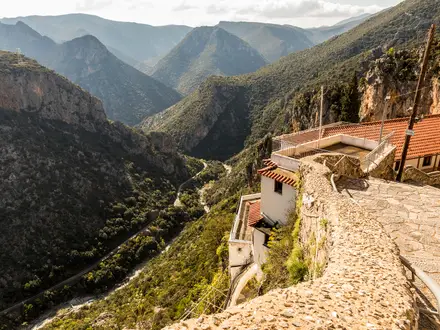
- Beloi viewpoint: A rocky balcony about 30 minutes from Vradeto with a direct view down the length of Vikos Gorge towards Monodendri and the Tymfi cliffs.
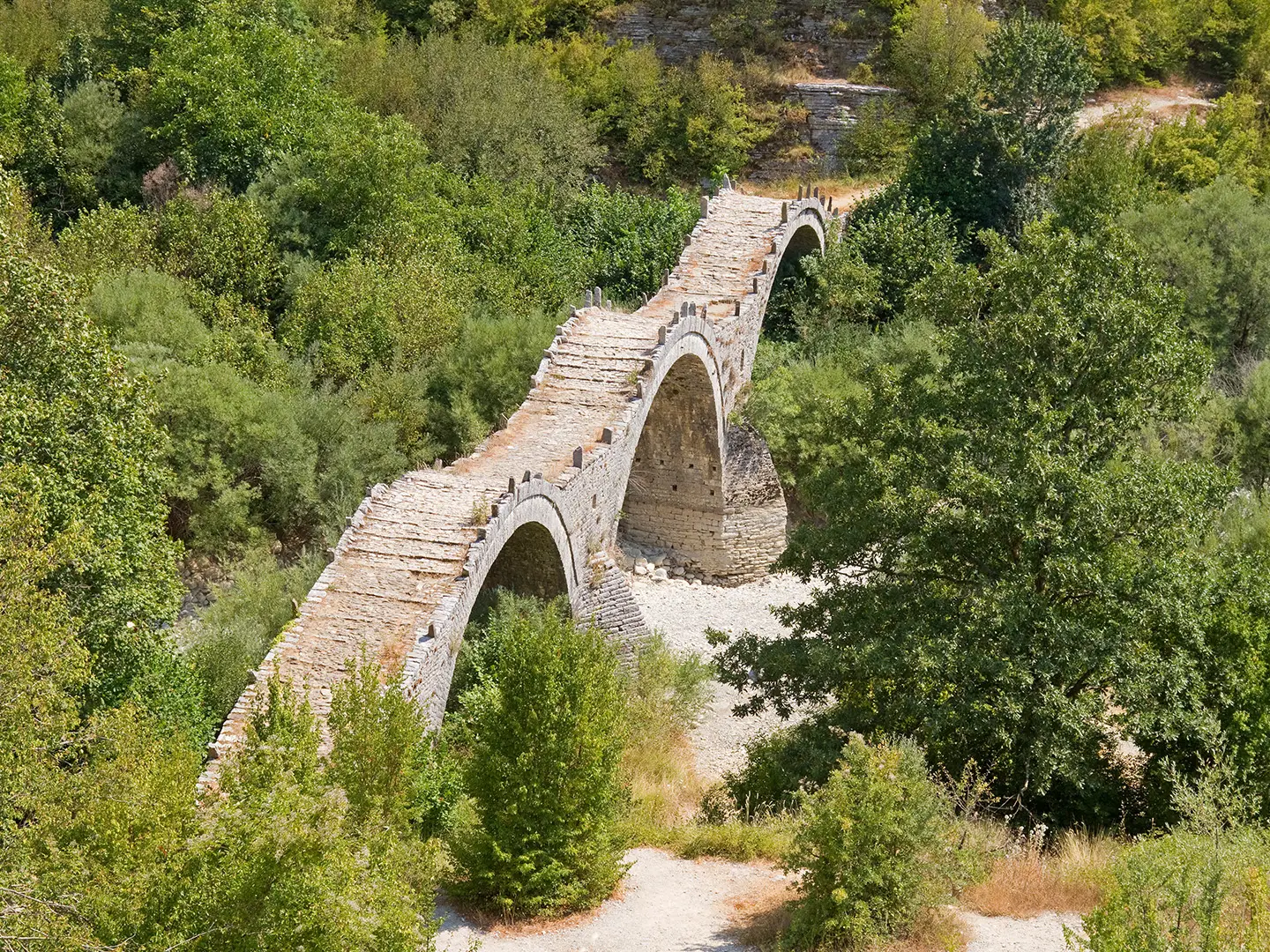
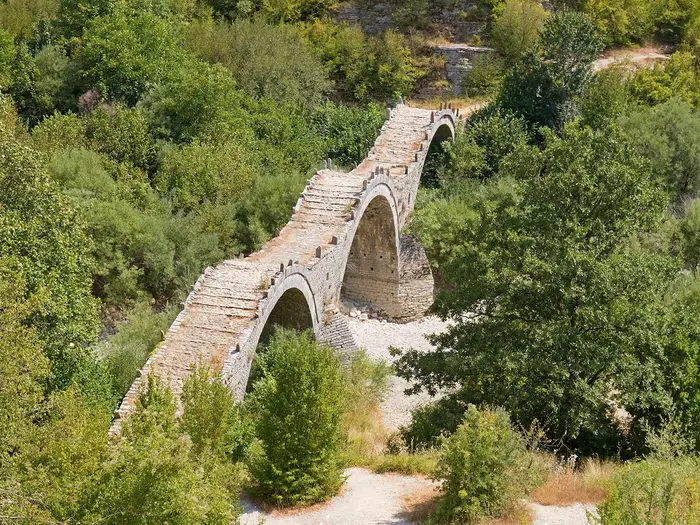
- Stone bridges around Kipoi and Koukouli: The route passes arched packhorse bridges including Plakidas/Kalogeriko and Kokkori/Noutsos, part of Zagori’s historic path network.
- Monodendri and Agia Paraskevi Monastery: Monodendri is the usual trailhead. Nearby Agia Paraskevi Monastery sits on the gorge lip; the exposed ledge beyond it is an optional extra, not part of the main circuit.
- Dilofo: A preserved, car-free hamlet of cobbled lanes and stone houses that shows the older character of the Zagorochoria.
Challenges to expect
Expect sustained mountain walking rather than technical climbing. The hardest sections are the steep Vradeto Steps and rocky descents or traverses near the Vikos Gorge, with daily ascent around 1,000 m on fuller village-to-village itineraries. Waymarking is generally present but can be patchy, so carry a map or GPX. Summer heat can build in the gorge; higher ground can be cold, wet or foggy. The Agia Paraskevi ledge is exposed and optional.
HikeList Score
Zagori Villages Circuit scored 86/100 on HikeList's trail-quality metrics.
See score breakdownHide breakdown
- Ideal length 70
- Balanced challenge 100
- Scenery & wildness 98
- Varied terrain 71
- Accommodation 83
- Food & support 81
- Path quality 98
- Season flexibility 89
Computed from length, challenge, scenery & wildness, terrain variety, accommodation, food & support, path quality and season flexibility.
 Greece
Show more data Show less
- Mountainous
- Forest
- Dirt
- Rocky
- Gravel
- Hotels
- Hostels
- Wild Camping Spots
- Pet Friendly
- Water Sources
- Campsites
- Shelters
Download Our Full Guide to Zagori Villages Circuit FREE!
Get our comprehensive guide to this hike for free. Save it for later reading or print out at home.
In these collections
Photos from hikers
Taken on the trail by people who've reviewed Zagori Villages Circuit.
Zagori Villages Circuit: The Complete Guide
 i
Image by Georgios Alexandris
i
Image by Georgios Alexandris Ζαγόρι (Zagori) is a mountain walking circuit where the old village paths are the main event. From Μονοδένδρι (Monodendri), the route threads UNESCO-listed stone villages, cobbled kalderimia, arched packhorse bridges and the rim of Φαράγγι Βίκου (Vikos Gorge).
This is a practical guesthouse-to-guesthouse hike, not a high-alpine traverse. It gives fit independent walkers the drama of the Pindus foothills without committing to Mount Τύμφη (Tymfi) or the separate Astraka refuge route.
The strongest days move between Βίτσα (Vitsa), Κουκούλι (Koukouli), Κήποι (Kipoi), Καπέσοβο (Kapesovo) and Βραδέτο (Vradeto), then out to Μπελόη (Beloi) for a clear look down the gorge. The Vikos through-day follows the Βοϊδομάτης (Voidomatis) riverbed between limestone walls before exiting towards Βίκος (Vikos) or Πάπιγκο (Papingo).
Moderate does not mean casual here. The Σκάλα Βραδέτου (Vradeto Steps), rocky gorge paths, loose limestone, heat in summer and patchy waymarking all demand proper footwear, a map or GPX, and sensible pacing.
This guide covers stages, days, accommodation, food, transport, terrain and the common planning mistakes that catch hikers out.
Stage-by-Stage Guide
This is a DIY route stitched together from old village paths, cobbled kalderimia, gorge tracks and short out-and-back viewpoints rather than a single continuous waymarked trail. Stage order and overnight stops vary, so book accommodation around the exact variant being walked and carry both a GPX and the Anavasi Zagori-Konitsa / Vikos-Aoos map.
Stage 1: Μονοδένδρι (Monodendri) to Κήποι (Kipoi) via Βίτσα (Vitsa), Κουκούλι (Koukouli), the stone bridges and Δίλοφο (Dilofo)
This is the classic stone-village day: a linking stage through Μονοδένδρι (Monodendri), Βίτσα (Vitsa), Κουκούλι (Koukouli), Κήποι (Kipoi) and Δίλοφο (Dilofo), using the old Zagori path network rather than high mountain ground. The walking is moderate rather than technical, but the surface is often uneven, with cobbled kalderimia, stone steps, forested tracks and rocky village approaches.
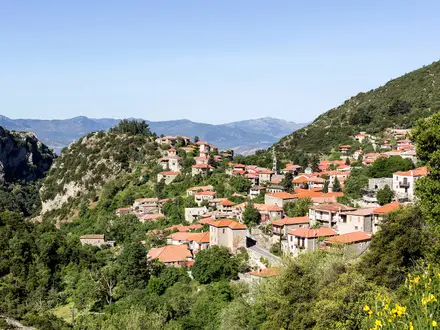
The main interest is the built landscape: grey-stone houses, slate roofs, plane-tree squares and the arched packhorse bridges around Κήποι (Kipoi) and Κουκούλι (Koukouli). The three-arched Πλακίδα/Καλογερικό (Plakidas/Kalogeriko) bridge and the single-span Κόκκορη/Νούτσου (Kokkori/Noutsos) bridge are the key landmarks on this stage.
Underfoot, the old cobbles can be tiring and become slippery when wet. Foot placement matters more than speed, especially on descents into and out of the small gullies between villages. In hot weather, expect the lower sections and stone tracks to feel warm and reflective, even though this is not the exposed gorge-floor day.
Food and water should be planned village by village. Μονοδένδρι (Monodendri), Βίτσα (Vitsa), Κουκούλι (Koukouli), Δίλοφο (Dilofo) and Κήποι (Kipoi) all have visitor infrastructure in the form of guesthouses or small hotels, but opening hours and food availability vary by season. Start with enough water for the day and do not rely on finding an open shop or café at every stop.
Κήποι (Kipoi) is a practical overnight halt, with traditional stone-built guesthouse accommodation. Booking ahead is sensible in summer and on autumn weekends, when the popular villages around the bridge network can fill quickly.
Road access exists at the villages, which makes this a relatively easy stage to shorten by taxi or guesthouse transfer if needed. Public buses from Ιωάννινα (Ioannina) to Zagori villages are infrequent and seasonal, so they should not be treated as a flexible fall-back without checking times before travelling.
Navigation is usually straightforward in concept — village to village — but less simple on the ground. Waymarking can be patchy, and the web of old paths around the bridges can be confusing where several tracks meet. Use the map and GPX actively rather than waiting until a junction feels wrong.
Stage 2: Κήποι (Kipoi) / Καπέσοβο (Kapesovo) to Βραδέτο (Vradeto) via the Σκάλα Βραδέτου (Vradeto Steps), with the Μπελόη (Beloi) viewpoint out-and-back
This is the steepest and most distinctive village-linking stage, built around the climb of the Σκάλα Βραδέτου (Vradeto Steps). The dry-stone staircase zigzags up the Mezaria gorge to Βραδέτο (Vradeto), the highest village in Zagori, and gives the day its main physical test.
The climb is not technical, but it is sustained. Around 1,100 stone steps, uneven risers and loose edges make it slow going, especially in heat, rain or mist. Poles can be useful on both ascent and descent, and footwear with good grip is important.
The approach commonly uses the village network around Κήποι (Kipoi) and Καπέσοβο (Kapesovo), then climbs towards the open high ground of Βραδέτο (Vradeto). Above the steps, the character changes from enclosed village paths to a more open, rocky plateau where poor visibility can make navigation more demanding.
The essential side trip is Μπελόη (Beloi), a rocky balcony above Φαράγγι Βίκου (Vikos Gorge), about a 30-minute walk from Βραδέτο (Vradeto). The view looks down the length of the gorge towards Μονοδένδρι (Monodendri) and the cliffs of Τύμφη (Tymfi). This is the high point of the circuit in walking terms, around 1,340–1,350 m, but it is not a Mount Tymfi ascent.
Carry enough food and water for the full stage. Services are limited in the higher villages, and Βραδέτο (Vradeto) has fewer options than the larger, lower settlements. If overnighting here or nearby, accommodation availability should be checked before committing to the stage plan.
Καπέσοβο (Kapesovo), Βραδέτο (Vradeto) and nearby Zagori villages have road access, so transfers are possible where arranged in advance. This matters because the end of this stage is not a place to rely on spontaneous public transport; KTEL services in the region are infrequent and seasonal.
The main warnings are weather and footing. The steps can be slippery after rain, the plateau can be cold, wet or foggy outside settled summer conditions, and the Beloi spur should not be rushed in poor visibility. In winter, snow and ice can make this stage a very different proposition.
Stage 3: Μονοδένδρι (Monodendri) to Βίκος (Vikos) or Μεγάλο/Μικρό Πάπιγκο (Megalo/Mikro Papingo) through Φαράγγι Βίκου (Vikos Gorge)
This is the gorge through-walk, descending from Μονοδένδρι (Monodendri) into Φαράγγι Βίκου (Vikos Gorge) and following the Βοϊδομάτης (Voidomatis) corridor towards the northern exit at Βίκος (Vikos). The Monodendri-to-Vikos gorge section is about 12 km and commonly takes 5–7 hours; continuing towards Πάπιγκο (Papingo) brings the day closer to the listed longer stage distance, depending on the exact finish.
This stage starts from Μονοδένδρι (Monodendri), so anyone ending the previous day around Βραδέτο (Vradeto) or Καπέσοβο (Kapesovo) must plan the logistics carefully. Either route back to Μονοδένδρι (Monodendri), arrange a transfer, or adjust the overnight sequence before booking. For a Monodendri-based loop, this is also the stage most likely to require a return transfer if finishing at Βίκος (Vikos) or Πάπιγκο (Papingo).
The terrain is rougher and more committing than the village stages. Expect a descent into the canyon, rocky gorge-floor walking, dry or stony riverbed sections, and stretches where the path follows the Voidomatis corridor. The gorge carries European O3 waymarks, but a map and GPX remain essential.
The Βοϊδομάτης (Voidomatis) is one of Europe’s cleanest rivers and gives the stage much of its character, but river water should not be assumed safe to drink untreated. Carry enough water from the start, especially in July and August, when the gorge can be very hot and shade is not always reliable. Any gorge-floor water crossings, diversions or awkward sections after heavy rain, spring snowmelt or storms should be checked before travelling.
There are no village services once committed to the gorge floor. Food for the full day should be carried from Μονοδένδρι (Monodendri), with the next practical resupply or meal stop at the exit village or at the Papingo end if continuing. Do not plan the day around finding supplies inside the gorge.
Βίκος (Vikos), Μεγάλο Πάπιγκο (Megalo Papingo) and Μικρό Πάπιγκο (Mikro Papingo) have accommodation in the form of guesthouses and small hotels, with more choice in the Papingo villages than in smaller hamlets. If finishing at Papingo, the Ωβίρες Ρογκοβού (Ovires of Rogovo) rock pools between Μεγάλο and Μικρό Πάπιγκο are a worthwhile add-on if time and energy allow.
Road access at Μονοδένδρι (Monodendri), Βίκος (Vikos) and Πάπιγκο (Papingo) makes taxi or guesthouse transfers the realistic transport solution for most walkers. Public buses should be checked before travelling, as services are too infrequent and seasonal to rely on casually after a long gorge day.
Navigation is more consequential here than on the village paths because escape options are limited once inside the canyon. Start early, allow for slow rocky going, and avoid entering the gorge in poor weather, extreme heat or when recent rain has affected the riverbed. The exposed rock ledge beyond Μονή Αγίας Παρασκευής (Agia Paraskevi Monastery) near Μονοδένδρι (Monodendri) is an optional extra, not part of the main through-walk.
Recommended Itinerary
Exact daily distances on the Ζαγόρι (Zagori) village paths vary with the accommodation used and whether you include Δίλοφο (Dilofo), Μπελόη (Beloi), Οξυά (Oxya) or Πάπιγκο (Papingo). Treat the outline below as a booking framework, then plot the exact version on a map/GPX before reserving rooms.
The key logistical point is Day 3: the Φαράγγι Βίκου (Vikos Gorge) through-walk starts from Μονοδένδρι (Monodendri) but usually finishes on the northern side at Βίκος (Vikos) village or Μεγάλο/Μικρό Πάπιγκο (Megalo/Mikro Papingo). If the car is in Monodendri, arrange a taxi or guesthouse transfer back; KTEL buses are infrequent and seasonal, so do not rely on same-day public transport without checking times.
Standard 3-day itinerary
| Day | From | To | Approx. distance | Why this stage makes sense | Services/accommodation notes |
|---|---|---|---|---|---|
| 1 | Μονοδένδρι (Monodendri) | Κήποι (Kipoi) via Βίτσα (Vitsa), Κουκούλι (Koukouli), the stone bridges and a loop through Δίλοφο (Dilofo) | ~14 km | A strong but manageable first day on the old kalderimia, linking the main stone villages and the bridge network before the rougher high-ground and gorge days. It works well as a village-to-village warm-up while still giving a full mountain-walking day. | Guesthouses are available in Monodendri, Vitsa, Koukouli, Dilofo and Kipoi, but capacity varies. Book ahead in summer and on autumn weekends. |
| 2 | Κήποι (Kipoi) or Καπέσοβο (Kapesovo) | Βραδέτο (Vradeto) via the Σκάλα Βραδέτου (Vradeto Steps), with an out-and-back to Μπελόη (Beloi) | ~15 km | This keeps the steep Vradeto Steps and the highest ground of the circuit on a dedicated day, rather than tacking them onto the Vikos Gorge traverse. Beloi is the essential side trip from Vradeto, with the gorge opening below the viewpoint. | Beds are simpler and fewer in the higher hamlets. If staying in Kipoi but starting the main climb from Kapesovo, arrange the link in advance or check the walking connection on mapping before booking. |
| 3 | Μονοδένδρι (Monodendri) | Βίκος (Vikos) village or Μεγάλο/Μικρό Πάπιγκο (Megalo/Mikro Papingo) through Φαράγγι Βίκου (Vikos Gorge) along the Βοϊδομάτης (Voidomatis) | ~16 km | The gorge day is the most committing stage, so it is best kept separate from the Vradeto/Beloi day. Starting from Monodendri follows the established gorge through-route towards the northern exit, with a long descent/traverse and a final climb out. | Arrange onward accommodation or a return transfer before setting off. Papingo has guesthouses and is the better finish if you want to include the rock pools, but this lengthens the logistical day. Check gorge-floor conditions after heavy rain or spring snowmelt. |
Slower variant
A 4–6 day version suits walkers who want shorter days, more time in the villages, or a less compressed schedule in hot weather. Guided and self-guided operators often stretch Zagori itineraries to 6–8 days by adding rest days and side trips.
| Day | From | To | Approx. distance | Why this stage makes sense | Services/accommodation notes |
|---|---|---|---|---|---|
| 1 | Μονοδένδρι (Monodendri) | Βίτσα (Vitsa), Κουκούλι (Koukouli), Δίλοφο (Dilofo) or Κήποι (Kipoi) | Check official mapping before booking | Splits the stone-village and bridge section so there is more time for the kalderimia, squares and packhorse bridges rather than rushing the first day. | Choose the overnight village before fixing the route, as accommodation supply is uneven. |
| 2 | Κήποι (Kipoi) / Δίλοφο (Dilofo) / Κουκούλι (Koukouli) | Καπέσοβο (Kapesovo) or nearby village | Check official mapping before booking | Positions you better for the Vradeto Steps without making the next day start with unnecessary road or transfer logistics. | Kapesovo is the practical launch point for the Vradeto Steps; if beds are unavailable, arrange a transfer from a neighbouring village. |
| 3 | Καπέσοβο (Kapesovo) | Βραδέτο (Vradeto) and Μπελόη (Beloi), then overnight as booked | Check official mapping before booking | Gives the Vradeto Steps and Beloi viewpoint a shorter, cleaner day, useful in heat, wet weather or poor visibility. | Higher-village accommodation is limited, so this night needs early planning. |
| 4 or 5 | Μονοδένδρι (Monodendri) | Βίκος (Vikos) village or Μεγάλο/Μικρό Πάπιγκο (Megalo/Mikro Papingo) through the Vikos Gorge | ~16 km | Leaves the gorge traverse for a fresh start rather than placing it immediately after a hard high-level day. | Pre-book the return taxi/transfer to Monodendri if completing the circuit logistics by car. |
Faster variant
The full route is not well suited to being compressed below three walking days unless a major component is cut. For fit walkers with limited time, the faster option is to keep the same three core stages but strip out optional extras: skip Oxya and Agia Paraskevi at Monodendri, only include Dilofo if time allows, and avoid adding the Papingo rock pools unless staying north of the gorge.
This version still needs proper mountain-day planning. The Vradeto Steps, rocky gorge paths, patchy waymarking and transfer logistics make a rushed schedule more fragile than the modest overall distance suggests.
Planning the Route
Plan this as a flexible village-to-village circuit, not as a single official long-distance trail with fixed stages. The walking links old kalderimia, gorge paths and village tracks, so the exact route depends on which villages and out-and-back viewpoints are included.
Most walkers should allow three full walking days for the main circuit. That is enough for a fit hiker moving efficiently between guesthouses, but it leaves little margin for poor weather, long lunches, photography, route-finding delays or extra time in the villages.
How many days to allow
A three-day plan works best when accommodation and transfers are already fixed. It suits walkers who are comfortable with sustained days on rocky ground, the Σκάλα Βραδέτου (Vradeto Steps), and the Φαράγγι Βίκου (Vikos Gorge) traverse.
A slower itinerary is often better if the aim is to enjoy the villages rather than simply connect them. Extra nights allow time for the Μπελόη (Beloi) viewpoint, Οξυά (Oxya) near Μονοδένδρι (Monodendri), the Μονή Αγίας Παρασκευής (Agia Paraskevi Monastery), or a northern-side finish around Μεγάλο/Μικρό Πάπιγκο (Megalo/Mikro Papingo).
Operators run longer 6–8 day versions by adding rest days, side trips and shorter village-to-village stages. Independent walkers can do the same, provided guesthouse availability and transfers are arranged in advance.
| Planning choice | Practical effect |
|---|---|
| Three walking days | Efficient and realistic for fit walkers, but requires early starts and firm accommodation bookings. |
| Slower village-based itinerary | Better for side trips, hot weather and time in the stone villages. |
| Finish at Βίκος (Vikos) or Πάπιγκο (Papingo) | Turns the route into a point-to-point finish and needs a taxi, guesthouse transfer or other onward transport. |
| Start at Κήποι (Kipoi) instead of Μονοδένδρι (Monodendri) | Useful if accommodation or bridge-area logistics work better, but the full route and return transport must be planned carefully. |
Let accommodation shape the stages
Daily stages are naturally dictated by the villages, because this is a guesthouse route rather than a camping trek. Good overnight bases include Μονοδένδρι (Monodendri), Βίτσα (Vitsa), Κήποι (Kipoi), Δίλοφο (Dilofo), Κουκούλι (Koukouli), Καπέσοβο (Kapesovo), Βραδέτο (Vradeto), and Μεγάλο/Μικρό Πάπιγκο (Megalo/Mikro Papingo).
Beds are simpler and fewer in the higher hamlets, so do not leave bookings late in summer or on autumn weekends. Book the key nights first, then adjust the walking line to fit them.
Do not assume every published stage list connects perfectly without a transfer or return leg. The route is a DIY circuit, so check the GPX, overnight village and next morning’s start point before committing to accommodation.
Shortening and extending the route
The easiest way to shorten the walk is to use taxis or guesthouse transfers between villages, omit optional loops, or finish after the Φαράγγι Βίκου (Vikos Gorge) at Βίκος (Vikos) or Πάπιγκο (Papingo). Public transport is too infrequent and seasonal to rely on for fine-tuned daily shortcuts.
The Μπελόη (Beloi) viewpoint is an out-and-back from Βραδέτο (Vradeto), so it can be dropped in bad weather, fog or if the day is running late. That said, it is one of the strongest reasons to include the Vradeto plateau in the first place.
Extensions are easiest as extra nights in the villages, not as high-mountain add-ons. The Mount Τύμφη (Tymfi) and Astraka refuge route is a separate, harder mountain itinerary and should not be folded into this circuit casually.
Section hiking
Section hiking is practical because the villages are road-accessible, but it works best with a car or pre-arranged taxi. KTEL buses from Ιωάννινα (Ioannina) to the Zagori villages are infrequent and seasonal, often only a few times a week, so timetables should be checked before travelling.
A car is useful for reaching the trailhead and for recovering from a non-loop finish. A Μονοδένδρι (Monodendri) to Ιωάννινα (Ioannina) taxi is roughly EUR 40, but current prices should be confirmed before booking.
What to lock in before travelling
Accommodation comes first. Guesthouses in the stone villages are part of the appeal of the route, but availability can be limited, especially in the smaller or higher settlements.
Navigation comes next. Waymarking exists, and the Vikos Gorge section carries O3 European path waymarks, but village-path marking can be patchy. Carry the Anavasi Zagori–Konitsa / Vikos–Aoos topographic map and a GPX, and do not rely on phone signal alone.
Food and water need simple but deliberate planning. Do not assume there will be reliable services between villages or on the gorge floor; carry lunch, snacks and enough water for the full day, especially in July and August when the gorge can be hot and exposed.
Weather can change the character of the walk quickly. Late April to June and September to October are generally the most practical seasons, while winter can bring snow and ice, and higher ground around Βραδέτο (Vradeto) can be cold, wet or foggy.
Before the Vikos Gorge day, check conditions after heavy rain or spring snowmelt. Gorge-floor water crossings, diversions and path conditions should be checked before travelling.
Towns, Villages and Overnight Stops
This route is best planned as a guesthouse-to-guesthouse walk. The useful overnight places are not evenly spaced: Μονοδένδρι (Monodendri), Κήποι (Kipoi), Καπέσοβο (Kapesovo), Βραδέτο (Vradeto) and Μεγάλο/Μικρό Πάπιγκο (Megalo/Mikro Papingo) are the main planning anchors, with other villages working well for shorter stages or route variations.
Do not rely on casual resupply in the smaller hamlets. Carry lunch food and emergency snacks each day, book accommodation ahead, and check whether evening meals, cafés or tavernas will be open when you arrive. This is especially important outside the main spring, summer and autumn walking periods, and on quieter weekdays.
Wild camping should not be treated as the normal plan here. The route passes through or beside the Vikos–Aoös National Park area and the walking culture of Zagori is built around traditional stone guesthouses rather than campsites or shelters.
| Place | Best use for hikers | Overnight suitability | Key caution |
|---|---|---|---|
| Μονοδένδρι (Monodendri) | Usual start/end, Vikos Gorge access | Very useful first/last night | Public transport is limited; arrange car, taxi or transfer |
| Βίτσα (Vitsa) | Early route village near Monodendri | Good short-stage alternative | Limited resupply; check food availability |
| Κουκούλι (Koukouli) | Bridge-and-village section | Useful if shortening the Kipoi stage | Services are village-scale |
| Κήποι (Kipoi) | Main overnight after the bridge section | Strong stage stop | Book ahead on busy weekends |
| Δίλοφο (Dilofo) | Loop variation / quieter stop | Useful alternative stop | Check whether your route variant passes directly through |
| Καπέσοβο (Kapesovo) | Base before the Vradeto Steps | Very useful overnight | Confirm meals and onward transfer options |
| Βραδέτο (Vradeto) | High village near Beloi viewpoint | Possible, but fewer beds | Reserve early; do not arrive without a plan |
| Βίκος (Vikos village) | Northern exit from Vikos Gorge | Possible finish/stop, but check ahead | Arrange onward transport in advance |
| Μεγάλο Πάπιγκο (Megalo Papingo) | Alternative northern finish | Good overnight option | Requires transport back if completing the Monodendri loop |
| Μικρό Πάπιγκο (Mikro Papingo) | Alternative finish / extension | Good if accommodation is available | Do not confuse with the separate high Tymfi route |
Μονοδένδρι (Monodendri)
Μονοδένδρι (Monodendri) is the usual trailhead and the most practical place to start and finish the loop. It sits around 38–39 km north of Ιωάννινα (Ioannina), roughly an hour by road, and gives direct access to the Φαράγγι Βίκου (Vikos Gorge) side of the route.
It is one of the best villages for a first and last night because it has traditional guesthouses and small hotels. Staying here also makes sense if you want time for the nearby Αγία Παρασκευή Monastery (Agia Paraskevi Monastery) or the Οξυά viewpoint (Oxya viewpoint) before or after the main walking days.
Food should be planned around guesthouses and whatever local cafés or tavernas are open. Do not assume a full grocery resupply; buy trail food in Ιωάννινα (Ioannina) or arrange packed lunches through accommodation where possible. This should be checked before travelling.
A car is the simplest way to reach Monodendri. KTEL buses from Ioannina to the Zagori villages are infrequent and seasonal, and a taxi between Monodendri and Ioannina is roughly EUR 40; current timetables and prices should be checked before booking.
Βίτσα (Vitsa)
Βίτσα (Vitsa) is close to Monodendri and usually appears early on the village-to-village section. It works well as a gentle first overnight if you arrive late in the day, want to shorten the opening stage, or prefer not to begin with a full day from Monodendri to Kipoi.
Accommodation is in the same traditional guesthouse style found across the central Zagori villages. Availability is usually more limited than in a larger gateway town, so reserve ahead rather than relying on turning up.
Food and drink options should be treated as village-scale. Check whether your accommodation provides dinner or can advise on open cafés or tavernas, and carry food for the next day’s walk.
Κουκούλι (Koukouli)
Κουκούλι (Koukouli) sits on the central stone-village section between Vitsa and Kipoi, close to the old path network and the arched packhorse bridges. It is useful for walkers who want a slower itinerary focused on the kalderimia, bridges and stone villages rather than pushing directly to Kipoi.
There are traditional guesthouse options, but this is not a place to treat as a guaranteed walk-in stop. Book in advance, especially on summer and autumn weekends.
Services are limited. Carry lunch and snacks, and check whether evening food will be available at your accommodation or in the village.
Κήποι (Kipoi)
Κήποι (Kipoi) is one of the strongest overnight stops on the circuit and a common end point for the first walking day from Monodendri via Vitsa, Koukouli and the bridge network. It is also sometimes used as an alternative start point for the whole route.
The village is particularly useful for hikers because it sits close to the famous arched bridges, including the Plakidas/Kalogeriko and Kokkori/Noutsos bridges. An overnight here gives time to explore that part of the old Zagori path network without rushing the onward walk towards Kapesovo and the Vradeto Steps.
Accommodation is in guesthouses and small village hotels. Book ahead in peak walking periods and on autumn weekends, when the Zagori villages can fill quickly.
Food availability should be checked with your guesthouse before arrival. Public transport should not be relied on for flexible stage planning; use a car, taxi or pre-arranged transfer if starting, ending or skipping sections here.
Δίλοφο (Dilofo)
Δίλοφο (Dilofo) is a useful route variation on the central village loop. It suits walkers who want to spend more time among the stone villages rather than taking the most direct line between the bridge area and the next stage.
It can work as an overnight alternative to Kipoi or Koukouli, depending on the exact route and accommodation availability. This is especially useful when rooms are full elsewhere or when building a slower 4-day version of the circuit.
Check your map or GPX carefully before committing to Dilofo as an overnight, because the do-it-yourself nature of this circuit means not every variant passes through the same villages. Food and transfer arrangements should also be checked before travelling.
Καπέσοβο (Kapesovo)
Καπέσοβο (Kapesovo) is a key practical stop before the Σκάλα Βραδέτου (Vradeto Steps). It is often a better staging point than trying to combine too much of the bridge section, the climb and the Beloi detour in one day.
Accommodation is available in traditional guesthouses, and the village works well as a night-before-the-climb base. From here, walkers are well placed for the ascent of the dry-stone staircase towards Vradeto.
Food planning matters here. Confirm dinner and breakfast with your accommodation, and arrange enough water and food for the climb and the onward section to Vradeto and Μπελόη (Beloi) if continuing the same day.
Transport is still limited and should be planned in advance. If using Kapesovo as a start, finish or bailout point, arrange a taxi or guesthouse transfer rather than assuming a same-day bus will be available.
Βραδέτο (Vradeto)
Βραδέτο (Vradeto) is the highest village in Zagori and the high point of the village circuit, reached by the Vradeto Steps from Kapesovo. It is the natural base for the out-and-back walk to the Μπελόη (Beloi) viewpoint, which is about 30 minutes from the village.
Overnighting here can be very rewarding logistically because it avoids rushing the climb, the viewpoint and the descent or onward travel. However, beds are fewer in the higher hamlets, so this is not a place to leave unbooked.
Food and supplies are more limited than in the better-connected villages. Confirm dinner, breakfast and any packed lunch before arrival, particularly outside busy periods.
Although Vradeto now has road access, public transport should not be assumed. If ending a stage here or arranging luggage movement, organise a taxi or transfer in advance.
Μπελόη (Beloi viewpoint)
Μπελόη (Beloi) is not an overnight stop but it matters for stage planning. It is a rocky gorge-rim viewpoint reached as an out-and-back from Vradeto, and most walkers include it on the Vradeto day.
There is no accommodation, food or reliable shelter at the viewpoint. Carry water, warm layers in poor weather, and allow time to return to Vradeto before continuing or meeting any transfer.
Fog, rain or heat can change the value and safety of the detour. If visibility is poor, reassess the timing rather than treating it as an automatic add-on.
Βίκος (Vikos village)
Βίκος (Vikos village) is the northern exit for the Vikos Gorge through-walk along the Βοϊδομάτης (Voidomatis) riverbed. It is a practical finish point for walkers who do not want to continue to Papingo the same day.
Do not assume the same depth of accommodation choice as in Monodendri or Papingo. If planning to sleep here, availability should be checked before travelling.
Food and transport need the same caution. Arrange a meal, taxi or guesthouse transfer in advance, especially because KTEL public buses in Zagori are infrequent and seasonal.
For hikers using the classic loop format, finishing at Vikos village creates a transport problem unless a transfer back to Monodendri has already been arranged. For hikers ending the trip on the northern side, it can be a sensible stopping point after the gorge.
Μεγάλο Πάπιγκο (Megalo Papingo)
Μεγάλο Πάπιγκο (Megalo Papingo) is a common alternative finish on the northern side of the gorge. It is useful for walkers who want a more settled overnight after the Vikos Gorge day rather than returning immediately to Monodendri.
Traditional guesthouses and small hotels are available, making it one of the more practical northern-side stops on this route. Book ahead in the main walking seasons and on weekends.
The village also gives access to the Papingo rock pools, the Ωβίρες Ρογκοβού (Ovires of Rogovo), between Megalo and Mikro Papingo. Treat this as a local add-on rather than part of the core walking day if time, weather and energy allow.
If the route is being walked as a Monodendri loop, ending at Megalo Papingo requires a taxi or pre-arranged transfer back to the start. This should be organised before setting out into the gorge.
Μικρό Πάπιγκο (Mikro Papingo)
Μικρό Πάπιγκο (Mikro Papingo) is another northern-side overnight option, close to Megalo Papingo and the Papingo rock pools. It suits walkers extending the trip after the gorge or choosing accommodation based on availability between the two Papingo villages.
Guesthouses and small hotels are available in the Papingo area, but availability should be checked before travelling. Carry the same caution on food: confirm dinner and breakfast rather than assuming late-opening services.
Do not confuse a night in Mikro Papingo with committing to the high Mount Tymfi route. The Astraka refuge and the Drakolimni/Tymfi traverse belong to a separate, harder mountain itinerary and are not part of this Zagori Villages Circuit.
Transport back to Monodendri or Ioannina should be arranged in advance. Public buses in Zagori are too infrequent for dependable same-day connections without checking the current timetable.
Getting to the Start
The normal trailhead is Μονοδένδρι (Monodendri), about 38–39 km north of Ιωάννινα (Ioannina) and roughly an hour by road. Κήποι (Kipoi) is also used as a start point, but Monodendri is the simplest choice for the standard loop because the route returns there.
By train
Rail is not a practical access method for this route based on the usual Zagori logistics. Plan to reach Ioannina first, then continue by car, taxi or limited KTEL bus connection into the villages.
If considering a train-and-bus approach from elsewhere in Greece, check current national rail and onward bus options carefully before committing. This should be checked before travelling.
By bus
Ioannina is the public transport gateway, with the main KTEL bus station serving the region. KTEL buses reach the main Ζαγόρι (Zagori) villages, but services are infrequent and seasonal, often only a few times a week.
Do not assume there will be a daily bus to Μονοδένδρι (Monodendri), Κήποι (Kipoi) or other trail villages at a time that suits a walking itinerary. Timetables can make it difficult to arrive, start walking the same day and keep to a three-day village-to-village schedule. This should be checked before travelling.
A practical bus-based plan is to travel to Ioannina, then use a pre-arranged taxi or guesthouse transfer for the final leg to Monodendri. A Monodendri–Ioannina taxi is roughly EUR 40, but current fares should be confirmed before booking.
By car
A car is the most reliable way to reach the start. From Ioannina, allow about an hour for the 38–39 km drive north to Monodendri.
Because this is normally walked as a loop, leaving a car at Monodendri is logistically straightforward compared with a point-to-point route. If starting at Kipoi instead, the same principle applies, but check that the chosen itinerary genuinely returns you there.
Parking arrangements are village-specific and should be agreed with your accommodation before arrival, especially if leaving a vehicle for several days. Some Zagori villages have car-restricted stone centres, so do not assume door-to-door access or long-stay parking immediately beside a guesthouse.
If you plan to finish on the northern side at Βίκος (Vikos) village or Μεγάλο/Μικρό Πάπιγκο (Megalo/Mikro Papingo) instead of returning to Monodendri, arrange the onward taxi or transfer in advance. Public transport is too limited to rely on at the end of a long gorge day.
From the nearest airport
Ioannina has the nearest relevant airport for this hike. From there, continue via Ioannina by hire car, taxi or arranged transfer to Monodendri.
The road transfer from Ioannina to Monodendri is roughly one hour. If flying in late in the day, it is usually more sensible to stay in Ioannina or Monodendri that night rather than trying to combine arrival logistics with the first walking stage.
For arrivals from other major cities, aim to connect into Ioannina first, then make the final village transfer separately. Flight schedules, KTEL connections and taxi availability should be checked before travelling.
Where to stay before starting
Monodendri is the best pre-hike base for the standard circuit. It has traditional stone-built guesthouses and small hotels, and starting from the village avoids needing an early-morning transfer from Ioannina.
Vitsa, Kipoi and other nearby villages can also work if they match your chosen first stage, but they may add a transfer or alter the day’s walking. Book ahead in summer and on autumn weekends, when guesthouse availability in the Zagori villages can tighten.
If relying on a taxi or guesthouse transfer from Ioannina, arrange it before arrival rather than trying to organise it on the morning of the walk. This is particularly important if starting early for the Vikos Gorge section or if your itinerary includes smaller villages with fewer services.
Getting Home from the Finish
For the standard circuit, the finish is back in Μονοδένδρι (Monodendri), so the simplest exit is whatever was used to reach the trailhead: parked car, pre-booked taxi, guesthouse transfer or an infrequent KTEL bus connection towards Ιωάννινα (Ioannina). If the route is adapted to finish at Βίκος (Vikos) or Μεγάλο/Μικρό Πάπιγκο (Megalo/Mikro Papingo) after the Vikos Gorge, treat it as a rural one-way finish and arrange transport before walking.
By train
Train is not a practical finish option for the Zagori villages. The useful transport hub is Ιωάννινα (Ioannina), reached by road from Μονοδένδρι (Monodendri), Βίκος (Vikos) or Πάπιγκο (Papingo).
Any onward rail plan from elsewhere in Greece should be checked before travelling, but do not rely on a train as the immediate way out from the trail.
By bus
KTEL public buses connect Ιωάννινα (Ioannina) with the main Zagori villages, but services are infrequent and seasonal, often only a few times a week. Timetables should be checked before travelling, and again locally before the final walking day.
Do not assume there will be a same-day bus after finishing the hike, especially if coming out of the gorge late in the afternoon. If using public transport, build the final day around the bus time rather than hoping to find a convenient departure on arrival.
For a finish at Βίκος (Vikos) or Μεγάλο/Μικρό Πάπιγκο (Megalo/Mikro Papingo), bus options may be even less convenient than from Μονοδένδρι (Monodendri). A guesthouse transfer or taxi is usually the safer plan.
By car/taxi
Car is the easiest way to leave the finish. The standard route returns to Μονοδένδρι (Monodendri), so walkers who parked there can drive straight back to Ιωάννινα (Ioannina), roughly 38–39 km away and about an hour by road.
A taxi between Μονοδένδρι (Monodendri) and Ιωάννινα (Ioannina) is roughly EUR 40, but current prices should be confirmed before booking. For a finish at Βίκος (Vikos) or Πάπιγκο (Papingo), arrange the taxi or guesthouse transfer in advance rather than trying to organise it at the trail end.
If the party has left a car at Μονοδένδρι (Monodendri) but chooses to finish on the northern side of the gorge, pre-book a taxi back to the car. This avoids being stranded in a small village with limited onward transport.
From the nearest airport
Ιωάννινα (Ioannina) has the nearest relevant airport for this hike and is also the main regional transport hub. From the finish, return to Ioannina by car, taxi or pre-arranged transfer, then continue by air or onward bus as required.
Flight times and onward connections are timetable-dependent and should be checked before committing to a same-day departure. If finishing late, allow for an overnight stay rather than planning a tight airport connection.
Where to stay at the finish
For the normal loop finish, stay in Μονοδένδρι (Monodendri) if onward transport is awkward, the final day runs late, or an early transfer to Ιωάννινα (Ioannina) is needed. The village has traditional stone-built guesthouses and small hotels.
If ending the walk at Μεγάλο/Μικρό Πάπιγκο (Megalo/Mikro Papingo), there are also guesthouses, making it a sensible overnight stop before a pre-arranged transfer the next morning. Accommodation should be booked ahead in summer and on autumn weekends, when village beds can fill quickly.
Which Direction Should You Walk?
There is no single official direction for the Ζαγόρι (Zagori) Villages Circuit, because it is a DIY link-up of old kalderimia, village paths and the Φαράγγι Βίκου (Vikos Gorge) route rather than one numbered trail. In practice, the most straightforward plan starts and ends at Μονοδένδρι (Monodendri), then works through the stone villages and bridge country before tackling the higher Βραδέτο (Vradeto) / Μπελόη (Beloi) section and the gorge.
Standard direction: village paths first, gorge as the big finale
The most practical direction is:
Μονοδένδρι (Monodendri) → Βίτσα (Vitsa) → Κουκούλι (Koukouli) / Κήποι (Kipoi) → Δίλοφο (Dilofo) / Καπέσοβο (Kapesovo) → Βραδέτο (Vradeto) and Μπελόη (Beloi) → Φαράγγι Βίκου (Vikos Gorge), usually from Μονοδένδρι (Monodendri) towards Βίκος (Vikos) or Μεγάλο/Μικρό Πάπιγκο (Megalo/Mikro Papingo).
This direction gives the best build-up. The first part links the UNESCO-listed stone villages, cobbled paths and arched bridges around Κήποι (Kipoi) and Κουκούλι (Koukouli); the second part climbs to the high plateau and the Μπελόη (Beloi) viewpoint; the final gorge day then feels like the natural climax of the route.
It also makes sense underfoot. Walking the Σκάλα Βραδέτου (Vradeto Steps) uphill is hard, but most walkers will find it more controlled than descending a long, dry-stone zigzag staircase on tired legs, especially if the stones are wet or loose.
Reverse direction: possible, but less neat
The reverse is perfectly possible if accommodation availability forces it, or if a taxi drop-off makes a different village start easier. However, it tends to put the more committing sections earlier and gives less of a gradual progression.
Starting with the Vikos Gorge can be dramatic, but it means taking on the longest, hottest and most serious-feeling terrain before getting used to the local waymarking and rocky paths. Reversing the Vradeto section may also mean descending the Vradeto Steps, which is not necessarily easier than climbing them.
Transport and accommodation logistics
For transport, direction matters less than start and finish. Μονοδένδρι (Monodendri) is the usual trailhead because it is relatively accessible from Ιωάννινα (Ioannina), and a loop lets you leave a car or arrange transfers around one base.
If finishing at Βίκος (Vikos) or Μεγάλο/Μικρό Πάπιγκο (Megalo/Mikro Papingo) instead of returning to Μονοδένδρι (Monodendri), the route becomes logistically more like a point-to-point walk. Public buses in Ζαγόρι (Zagori) are infrequent and seasonal, so taxi or guesthouse transfer arrangements should be made in advance. This should be checked before travelling.
Accommodation also favours the standard flow. The lower and better-known villages such as Μονοδένδρι (Monodendri), Βίτσα (Vitsa), Κήποι (Kipoi), Δίλοφο (Dilofo) and Κουκούλι (Koukouli) give more flexibility early in the route, while the higher hamlets have fewer beds. Book ahead, particularly in summer and on autumn weekends.
Weather and timing
There is no useful prevailing-wind advantage to either direction. The more important issue is daily timing: the Vikos Gorge can be very hot in July and August, while the Βραδέτο (Vradeto) plateau and gorge rim can be cold, wet or foggy outside settled weather.
Whichever way the route is walked, start the gorge day early, carry enough water, and avoid committing to the gorge floor after heavy rain, spring snowmelt or when diversions are in place. Gorge-floor water crossings and path conditions should be checked before travelling.
Recommendation
Most independent walkers should use the standard Monodendri-based direction: villages and bridges first, Vradeto Steps and Beloi next, Vikos Gorge last. It gives the cleanest accommodation flow, the most logical scenery progression and the better walking experience on the steep stone staircases.
Only reverse the circuit if accommodation, transfers or weather make the standard sequence awkward. For most hikers, the psychological finish of descending into the Vikos Gorge and emerging towards Βίκος (Vikos) or Πάπιγκο (Papingo) is the strongest way to end the route.
Accommodation Along the Route
The Zagori Villages Circuit works well as an inn-to-inn walk. Accommodation is centred on traditional stone-built guesthouses — often called archontika — and small hotels in the villages, rather than campsites, huts or mountain refuges.
The strongest bases are Μονοδένδρι (Monodendri), Κήποι (Kipoi) and Μεγάλο/Μικρό Πάπιγκο (Megalo/Mikro Papingo), with further guesthouse options in Βίτσα (Vitsa), Κουκούλι (Koukouli), Δίλοφο (Dilofo) and Καπέσοβο (Kapesovo). Higher and smaller hamlets, especially Βραδέτο (Vradeto), have fewer beds, so do not assume last-minute availability.
Best overnight strategy
For a straightforward 3-day guesthouse itinerary, most walkers should plan around village overnights rather than camping. A practical pattern is to use Μονοδένδρι (Monodendri) at the start and/or end, sleep around Κήποι (Kipoi) or Καπέσοβο (Kapesovo) for the stone-bridge and Vradeto Steps section, then use Βίκος (Vikos village) or Πάπιγκο (Papingo) if finishing after the Vikos Gorge traverse rather than returning immediately to Monodendri.
Because this is a DIY loop stitched together from old paths rather than a single official long-distance trail, accommodation planning and route planning are linked. If the preferred village is full, a taxi or guesthouse transfer can usually make a nearby overnight work, especially between the lower stone villages and the gorge-trail access points. This should be arranged before walking, not assumed at the end of a long day.
Booking pressure and seasonality
Book ahead for summer and autumn weekends, when the Zagori villages are busier and the smaller settlements can fill quickly. Late April to June and September to October are the best walking seasons, but they are also attractive periods for village-based visitors, so advance reservations still matter.
In Βραδέτο (Vradeto) and other higher hamlets, the issue is not luxury but capacity: there may simply be fewer rooms. If an itinerary depends on staying in a small village, secure that night first and build the walking stages around it.
Camping, refuges and alternatives
This is not a route to plan as a wild-camping trek. Zagori sits in and around the Vikos–Aoös National Park, and wild camping should not be treated as a normal or reliable option. Use village accommodation unless a specific legal campsite or permitted arrangement has been checked before travelling.
The Astraka mountain refuge serves the separate high route towards Mount Tymfi and Drakolimni; it is not part of this lower Zagori Villages Circuit. Do not book it for this itinerary unless deliberately adding a harder high-mountain extension.
Accommodation by village
| Place | Accommodation level | Best for | Notes |
|---|---|---|---|
| Μονοδένδρι (Monodendri) | Good | Start/end nights; access to the Vikos Gorge rim and Oxya/Agia Paraskevi area | The usual trailhead village, about an hour by road from Ioannina. A sensible place to stay before the first walking day and after completing the loop. |
| Βίτσα (Vitsa) | Good | Alternative first night or easier staging near Monodendri | Close to the early village-to-village walking. Useful if Monodendri is full or if a shorter first walking day is preferred. |
| Κουκούλι (Koukouli) | Limited | Stone-village atmosphere between the bridge area and the higher villages | Has guesthouse options, but should be booked ahead rather than treated as a flexible fallback. |
| Κήποι (Kipoi) | Good | Overnight after the stone bridges; practical base for the lower village network | One of the most useful stops for walkers linking the arched packhorse bridges, Koukouli and Dilofo. Also used as an alternative start point for the circuit. |
| Δίλοφο (Dilofo) | Limited | Quiet village overnight on a variant through the lower villages | Works well if building a slower itinerary, but availability should be checked before committing to the stage. |
| Καπέσοβο (Kapesovo) | Limited | Positioning for the Σκάλα Βραδέτου (Vradeto Steps) | A practical staging village before climbing towards Vradeto, but with fewer options than the main bases. |
| Βραδέτο (Vradeto) | Limited | High-level overnight near Μπελόη (Beloi) viewpoint | Zagori’s highest village and the natural stop if splitting the Vradeto Steps and Beloi section. Beds are fewer; book early. |
| Μπελόη (Beloi viewpoint) | None | Day-walk objective only | No accommodation at the viewpoint. It is an out-and-back from Vradeto, not an overnight stop. |
| Βίκος (Vikos village) | Limited | Northern exit from the Vikos Gorge | Can be used as an end point after the gorge traverse, but accommodation and onward transfer plans should be checked before travelling. |
| Μεγάλο Πάπιγκο (Megalo Papingo) | Good | Strong northern-side overnight after the gorge; access to the Papingo area | A good choice if finishing the route on the northern side rather than returning directly to Monodendri. |
| Μικρό Πάπιγκο (Mikro Papingo) | Good | Extra night in the Papingo area; possible rest day | Useful for walkers adding the Papingo rock pools or a slower finish. The high Tymfi/Astraka route is separate from this circuit. |
Camping and Wild Camping
Is camping a good option on this route?
The Ζαγόρι (Zagori) Villages Circuit is best planned as a guesthouse-to-guesthouse walk, not as a camping trek. The route links stone villages such as Μονοδένδρι (Monodendri), Κήποι (Kipoi), Καπέσοβο (Kapesovo), Βραδέτο (Vradeto) and Πάπιγκο (Papingo), where traditional guesthouses and small hotels are the normal overnight option.
There are no established campsites specified on the standard circuit. Do not plan this route around turning up each evening to a formal camping ground unless current local options have been checked before travelling.
Camping also adds weight on a route where the main difficulty is sustained ascent, rocky mule paths, stone staircases and the long Φαράγγι Βίκου (Vikos Gorge) day. For most walkers, carrying camping kit makes the route less practical without solving a real accommodation problem.
Wild camping and restrictions
Wild camping is not the normal or recommended way to walk this route. The circuit runs through the UNESCO-listed Zagori cultural landscape and on the edge of the Vikos–Aoös National Park, where camping is restricted and local rules should be checked before travelling.
Do not assume that a quiet-looking gorge rim, bridge approach, village edge or plateau is an acceptable camping place. Much of the walking is close to historic paths, protected landscape, villages, viewpoints and sensitive gorge terrain.
If a bivouac is genuinely necessary, keep it low-impact, discreet and temporary, and only where local rules and land access allow it. Avoid camping at Μπελόη (Beloi), Οξυά (Oxya), beside the arched bridges around Κήποι (Kipoi) and Κουκούλι (Koukouli), on village approaches, or on the floor of the Vikos Gorge.
Water and camping practicality
Water planning is one of the main reasons camping is awkward here. The route passes villages, and the Vikos Gorge follows the Βοϊδομάτης (Voidomatis), but reliable potable water points for camping should not be assumed between overnight stops.
Carry enough water for the day, especially in July and August when the gorge can be very hot and shadeless. Any natural water should be treated before drinking, and current gorge conditions should be checked after heavy rain or spring snowmelt.
Fires, waste and Leave No Trace
Do not light open fires. Summer heat, dry vegetation and protected landscape status make fires inappropriate, and stove use should only be considered where it is safe and permitted.
Pack out all rubbish, including food scraps and toilet paper. Keep well away from watercourses when toileting, and never wash directly in the Voidomatis or in village water sources.
The stone bridges, kalderimia, staircases and viewpoints are part of the protected cultural landscape, not camping infrastructure. Leave them clear, undamaged and exactly as found.
Practical recommendation
Book village accommodation instead of carrying camping gear. Guesthouses in Monodendri, Vitsa, Kipoi, Dilofo, Kapesovo, Tsepelovo and Papingo suit the character of the route and avoid legal, water and impact issues.
If every bed is full on summer or autumn weekends, adjust dates, shorten the itinerary, use taxis between villages, or base the walk from one or two settlements rather than defaulting to wild camping.
Food, Water and Resupply
Food planning on the Zagori Villages Circuit is guesthouse- and village-based, not wilderness resupply. The safest approach is to book evening meals or ask accommodation about local tavernas, then carry a packed lunch and snacks for each walking day.
Do any substantial food shopping before leaving Ιωάννινα (Ioannina), or at the start if suitable supplies are available in Μονοδένδρι (Monodendri). The smaller stone villages are not dependable resupply points: cafés, tavernas and small shops may keep rural or seasonal hours, and Sunday opening can be limited. This should be checked before travelling.
Food strategy
Carry enough food for the full day whenever leaving your overnight village. Even on stages that pass Βίτσα (Vitsa), Κουκούλι (Koukouli), Κήποι (Kipoi), Δίλοφο (Dilofo), Καπέσοβο (Kapesovo) or Βραδέτο (Vradeto), do not assume somewhere will be open at the exact time you arrive.
For a typical three-day itinerary, most walkers should carry:
- breakfast if it is not included at the guesthouse;
- a packed lunch for the day;
- high-energy snacks for the climbs and gorge sections;
- one emergency meal or substantial spare food, especially if relying on taxis or transfers at the end of a stage.
Βραδέτο (Vradeto) is the highest and one of the smaller hamlets on the circuit, so options there are simpler and more limited. If staying there or walking via the Μπελόη (Beloi) viewpoint, arrange food before setting out from Καπέσοβο (Kapesovo) or your previous overnight stop.
Water strategy
Fill bottles at your accommodation before leaving each morning. Village refills should be treated as useful but not guaranteed unless your guesthouse, café or taverna has confirmed potable water.
The Φαράγγι Βίκου (Vikos Gorge) day follows the Βοϊδομάτης (Voidomatis) riverbed, and the river is famously clear and cold, with springs partway down the gorge. Even so, natural water should be filtered, treated or otherwise made safe unless it is a signed potable source. Gorge-floor conditions and any diversions after rain or snowmelt should also be checked before travelling.
In spring and autumn, 1.5–2 litres may be enough for many walkers between reliable refills, but hot weather changes the calculation quickly. In July and August, and on exposed sections such as the Σκάλα Βραδέτου (Vradeto Steps), the Vradeto plateau and the gorge, carrying 2–3 litres is more prudent.
| Section | Food availability | Water availability | Notes |
|---|---|---|---|
| Μονοδένδρι (Monodendri) to Κήποι (Kipoi) via Βίτσα (Vitsa), Κουκούλι (Koukouli) and Δίλοφο (Dilofo) | Best treated as a packed-lunch day. Villages on or near the route may have cafés or tavernas, but opening hours can be seasonal and irregular. | Fill before leaving Monodendri. Refill only where potable water is available in villages or open businesses. | Do not rely on bridge or stream water around the old packhorse bridges unless filtered or treated. |
| Κήποι (Kipoi) / Καπέσοβο (Kapesovo) to Βραδέτο (Vradeto) and Μπελόη (Beloi) | Carry all lunch and snacks. Food options become more limited once committed to the Vradeto Steps and the high ground. | Start with a full carry. The climb and plateau can feel dry and exposed, especially in warm weather. | Arrange dinner and breakfast in advance if overnighting in Vradeto or another small hamlet. |
| Μονοδένδρι (Monodendri) through Φαράγγι Βίκου (Vikos Gorge) to Βίκος (Vikos) or Πάπιγκο (Papingo) | No reliable food inside the gorge. Carry a full lunch, snacks and spare calories. | Carry enough from the start, with the Voidomatis and springs as potential treated-water sources. | This is the stage where running short of water is most serious in hot weather; the gorge can be hot and shadeless in summer. |
Practical resupply checks
Before committing to each stage, ask the guesthouse about dinner, breakfast, packed lunches and whether the next village has open food options. This is especially important outside the main walking season, on Sundays, and in late autumn when village services may be quieter.
There are no dependable on-trail supermarkets or petrol-station resupply stops built into this circuit. Treat any small shop or café you find open as a bonus, not as the basis of the food plan.
Terrain, Conditions and Difficulty in Practice
What the ground is like
The Zagori Villages Circuit is mostly mountain path walking on old village infrastructure rather than a purpose-built long-distance trail. Expect cobbled mule paths, dry-stone staircases, rocky gorge-rim tracks, forest tracks and short passages through stone villages such as Μονοδένδρι (Monodendri), Βίτσα (Vitsa), Κουκούλι (Koukouli), Κήποι (Kipoi), Δίλοφο (Dilofo), Καπέσοβο (Kapesovo) and Βραδέτο (Vradeto).
The kalderimia — the traditional cobbled mule paths — are one of the pleasures of the route, but they are not always easy underfoot. The stones can be uneven, polished, loose or slippery when wet, so this is a route for proper walking shoes or boots rather than trainers with a smooth sole.
Around Κήποι (Kipoi) and Κουκούλι (Koukouli), the walking links old arched packhorse bridges and village paths. These sections are less technically serious than the gorge day, but the constant changes between cobbles, rock, stone steps and tracks can still be tiring over a full day.
This is not a muddy, boggy route in the British upland sense. After rain, the main issue is slick stone, greasy rock and possible problems in the gorge, rather than deep peat or prolonged wet ground.
Climbs, descents and the real effort
The overall difficulty is best understood as sustained mountain walking. The circuit is only around 45 km, but it has roughly 2,000 m of total ascent and the harder days can involve around 1,000 m of climbing.
The Σκάλα Βραδέτου (Vradeto Steps) are the most obvious single climb: a dry-stone zigzag staircase of around 1,100 steps rising towards Βραδέτο (Vradeto), the highest village in Zagori. The steps are not technical climbing, but they are steep, repetitive and exposed to the weather; take them steadily and avoid underestimating the descent if walking them in reverse.
The high ground around Βραδέτο (Vradeto) and Μπελόη (Beloi) reaches roughly 1,340–1,350 m. This is the high point of the circuit, not a summit, and the route does not climb Τύμφη (Tymfi) or cross the high mountain terrain around Astraka and Drakolimni.
Long descents matter as much as the climbs. The descent into Φαράγγι Βίκου (Vikos Gorge) and the later climb out towards Βίκος (Vikos) or Πάπιγκο (Papingo) are physically demanding, especially in heat or with a full pack.
Vikos Gorge underfoot
The gorge day is the section most likely to feel harder than the mileage suggests. The path follows the floor of Φαράγγι Βίκου (Vikos Gorge) along the Βοϊδομάτης (Voidomatis) riverbed, with rocky, uneven and sometimes faint ground.
The Vikos Gorge through-walk is signed as part of the European O3 path, but waymarking should not be treated as enough on its own. Carry a proper map and GPX, and allow for slower progress than on the village paths.
Conditions in the gorge can change after heavy rain or spring snowmelt. Gorge-floor water crossings, diversions and the state of the path should be checked before travelling, particularly early in the season or after unsettled weather.
In July and August the gorge can be very hot and shadeless in places. Start early, carry enough water, and do not assume the lower elevation makes the day easier than the Vradeto stage.
Exposure and technical difficulty
There is no technical climbing on the standard circuit, and no need for mountaineering equipment in normal hiking conditions. The difficulty comes from rough limestone, steep stone paths, navigation and heat or weather exposure.
The gorge-rim sections and viewpoints such as Μπελόη (Beloi) and Οξυά (Oxya) involve rocky ground close to major drops. The main walking is manageable for a steady hiker, but care is needed near edges, in wind, fog or wet conditions, and when taking photographs.
The exposed rock ledge beyond Μονή Αγίας Παρασκευής (Agia Paraskevi Monastery) is an optional extra rather than part of the main circuit. Anyone uncomfortable with exposure can omit it without affecting the core route.
Waymarking and navigation difficulty
This is a DIY circuit stitched together from village paths, kalderimia and gorge tracks, not one continuous officially numbered long-distance trail. That makes navigation more demanding than on a single waymarked national trail.
Waymarking exists but can be patchy away from the main gorge path. The Anavasi Zagori–Konitsa / Vikos–Aoös topo map and a GPX track are strongly recommended, especially where paths leave villages, cross open rocky ground or enter forest.
The route is easier in clear weather when village-to-village lines and gorge-rim terrain are obvious. Fog, rain or low cloud on the higher ground around Βραδέτο (Vradeto) and Μπελόη (Beloi) can make the same walking feel much more serious.
Seasonal conditions
Late April to June and September to October are generally the most practical hiking windows. Spring brings greener conditions and cooler walking, but snowmelt and rain can affect the gorge floor; autumn often gives better temperatures, though shorter daylight needs factoring into the gorge day.
High summer is possible but harder. The main hazards are heat, sun exposure and slow progress on rocky ground, especially inside Φαράγγι Βίκου (Vikos Gorge).
Winter changes the character of the route. Snow and ice can affect the higher ground, stone steps and shaded rocky paths, making a moderate hiking circuit unsuitable without winter judgement and equipment.
What makes it feel easier or harder
| Factor | Easier when… | Harder when… |
|---|---|---|
| Footing | Dry cobbles and clear rock give secure progress. | Wet kalderimia, loose stones and slick limestone slow everything down. |
| Navigation | You have a map, GPX and clear weather. | Waymarks are missed, fog sits on the plateau, or paths are faint leaving villages. |
| Fitness | You are comfortable with repeated climbs and descents over several days. | The Vradeto Steps, gorge descent and climb out come after underestimating the elevation. |
| Heat | Walking in spring or autumn with early starts. | The gorge is crossed in July or August heat with limited shade. |
| Route choices | Detours such as Μπελόη (Beloi) are planned into the day. | Extra viewpoints, village loops or a Papingo finish are added without adjusting time and water. |
Bottom line on difficulty
For a fit hillwalker, the Zagori Villages Circuit is moderate rather than technical. It becomes difficult when wet stone, heat, patchy waymarking or the cumulative ascent are underestimated.
The safest approach is to treat each stage as a proper mountain day: start with good footwear, carry map and GPX, check gorge conditions after rain or snowmelt, and leave enough time for slow rocky sections rather than planning by distance alone.
Weather and Best Time to Walk
The best walking windows for the Ζαγόρι (Zagori) Villages Circuit are late April to June and September to October. These periods give the best balance of walkable temperatures, usable daylight and village services, while avoiding the worst heat in the Φαράγγι Βίκου (Vikos Gorge).
July and August are possible, but they are not ideal for everyone. The gorge floor can be very hot and shadeless, so the Φαράγγι Βίκου (Vikos Gorge) day should be started early, with extra water carried and no reliance on shade.
Winter is a poor choice for the normal village-to-village circuit. Snow and ice can affect the higher ground around Βραδέτο (Vradeto), Μπελόη (Beloi) and the stone staircases, and the cobbled kalderimia can become hazardous when frozen.
Seasonal conditions
| Season | Suitability | What matters on the trail |
|---|---|---|
| Late April–June | Best | Good overall window, but spring rain and snowmelt can affect the Φαράγγι Βίκου (Vikos Gorge) floor and any water-affected sections. Check gorge conditions, water crossings and diversions before committing to the through-day. |
| July–August | Possible, but hot | Heat is the main issue, especially on the gorge floor and exposed rocky sections. Start early, carry more water than usual and avoid being in the gorge during the hottest part of the day. Book accommodation ahead. |
| September–October | Best | Usually the most practical autumn window for guesthouse-to-guesthouse walking. Higher ground can still turn cold, wet or foggy, so carry waterproofs and a warm layer rather than packing for warm village weather only. Autumn weekends can be busy, so book beds in advance. |
| November–March | Generally not recommended | Snow, ice, cold rain, fog and short daylight make the route much less forgiving. The Σκάλα Βραδέτου (Vradeto Steps), gorge paths and rocky rim sections are not sensible in winter conditions without appropriate winter judgement and equipment. |
Heat, water and the gorge day
The hottest and most committing day is the Φαράγγι Βίκου (Vikos Gorge) traverse along the Βοϊδομάτης (Voidomatis) riverbed. In high summer, the gorge can feel much hotter than the villages, with long exposed sections and limited escape options once committed.
Plan this day as an early start, not an afternoon objective. Carry enough water from the start, protect against sun, and be prepared to turn back or rearrange the stage if the forecast is poor or temperatures are excessive.
Spring snowmelt or heavy rain can change conditions on the gorge floor. Water crossings, washed-out sections or temporary diversions should be checked before travelling, especially after prolonged rain.
Cold, rain, fog and slippery stone
This route is not high-alpine, but it does reach around 1,340–1,350 m on the Βραδέτο (Vradeto) plateau and near the Μπελόη (Beloi) viewpoint. Conditions there can be noticeably colder and more exposed than in Μονοδένδρι (Monodendri), Κήποι (Kipoi) or the lower villages.
Wet weather makes the old cobbled mule paths, dry-stone steps and rocky ledges slippery. The Σκάλα Βραδέτου (Vradeto Steps) in particular deserves care after rain, as a slip on the stone staircase can have serious consequences.
Fog is a practical navigation issue on the plateau and gorge rim. Waymarking exists but can be patchy, so a map and GPX are important in any season and essential when visibility drops.
Accommodation and seasonal demand
Accommodation is mainly in traditional stone guesthouses and small hotels in the villages. Beds are fewer in higher or smaller hamlets, so do not assume same-day availability on a walking itinerary.
Book ahead for summer and autumn weekends. This is especially important if the route is being walked as a fixed three-day guesthouse-to-guesthouse circuit, where a missed booking can mean an awkward transfer rather than a simple change of campsite.
Insects, storms and daylight
Insects are not the defining seasonal constraint on this route; heat, wet stone, fog, snow and ice matter more for planning. Standard long-trouser and tick-check habits are still sensible when walking through forest and grass, but no special insect season needs to drive the itinerary.
Treat any forecast of heavy rain or thunderstorms as a reason to rethink exposed rim sections, the Μπελόη (Beloi) viewpoint detour and the gorge day. Shorter daylight outside the main walking season also makes the longer days less forgiving, particularly if navigation is slow on faint or wet paths.
Safety Notes
Emergency help and communication
Use 112 for emergency assistance in Greece. Before setting off, make sure someone knows your intended stage, especially for the Φαράγγι Βίκου (Vikos Gorge) traverse and the higher ground around Βραδέτο (Vradeto) and Μπελόη (Beloi).
Do not rely on mobile signal throughout the route. The gorge, wooded sections and quiet village paths can leave you with limited reception, so carry an offline GPX and a paper map as well as a charged phone and power bank.
If calling for help, be ready to give the nearest village or landmark in Greek and English where possible: Μονοδένδρι (Monodendri), Κήποι (Kipoi), Καπέσοβο (Kapesovo), Βραδέτο (Vradeto), Βίκος (Vikos) or Μεγάλο/Μικρό Πάπιγκο (Megalo/Mikro Papingo).
Navigation and remoteness
This is not a single officially numbered long-distance trail. It links old kalderimia, village paths, gorge tracks and sections of the O3 route through the Vikos Gorge, and waymarking can be patchy.
Carry the Anavasi Zagori–Konitsa / Vikos–Aoos topo map and a GPX track. This matters most where paths leave villages, on rocky gorge-rim ground, and on the long through-day in the gorge where a wrong turn can cost significant time.
Start early enough to finish in daylight. The stone paths, staircases and rocky riverbed sections are much harder and riskier after dark.
Gorge, steps and exposed viewpoints
The Vikos Gorge day is the most committing part of the circuit. Once down on the gorge floor, escape options are limited compared with the village-to-village stages, so check weather, water levels and any diversions before committing to the descent.
After heavy rain or spring snowmelt, gorge-floor crossings and wet rock may become more difficult. This should be checked before travelling and again locally before starting the stage.
The Σκάλα Βραδέτου (Vradeto Steps) are steep, long and uneven. Take them steadily, keep a gap between walkers where loose stones may be dislodged, and avoid rushing the descent.
At Μπελόη (Beloi), Οξυά (Oxya) and the optional ledges beyond Μονή Αγίας Παρασκευής (Agia Paraskevi Monastery), stay well back from cliff edges. Do not step onto exposed rock ledges in wind, fog, rain or poor visibility.
Weather: heat, cold and visibility
The best walking seasons are late April to June and September to October, but conditions can still change quickly. The higher ground around Βραδέτο (Vradeto) and Μπελόη (Beloi), roughly 1,340–1,350 m, can be cold, wet or foggy even when the villages feel mild.
In July and August, the gorge can be very hot and shadeless. Carry more water than for an ordinary village walk, start early, and avoid being on the hottest sections in the middle of the day where possible.
In winter, snow and ice change the character of the route. The Vradeto Steps, rocky gorge paths and high plateau should not be treated as a normal moderate walk in winter conditions unless you have suitable equipment and experience.
Water and river safety
The Βοϊδομάτης (Voidomatis) is clear and cold, but do not assume river water is safe to drink untreated. Carry enough water between villages and use treatment if taking water from natural sources.
Keep clear of slippery riverbed rocks and wet limestone, especially in the gorge. The route is a walking route, not a river activity, and cold water can become a serious hazard if someone slips, is injured or soaks essential clothing.
Roads, villages and animals
Most hazards are on paths rather than roads, but short road links, village streets and taxi drop-offs still require care. Expect narrow rural roads, parked vehicles and limited pavement in villages.
Livestock is not a defining hazard of this circuit, but animals may be encountered around rural tracks and villages. Give them space, do not feed them, and pass calmly; if dogs are present, avoid running or making sudden movements.
Solo hiking
Fit solo walkers can complete this circuit, but the Vikos Gorge stage deserves conservative planning. Carry a map, GPX, headtorch, first-aid kit, spare layer, food, water and a way to call for help.
Tell your guesthouse or transfer driver where you are going and when you expect to arrive. If plans change, update them as soon as possible.
Check before setting off each day
- Weather forecast for Ζαγόρι (Zagori), especially heat, rain, fog and winter conditions.
- Current condition of the Vikos Gorge path, water crossings and any diversions.
- That the day’s GPX and offline maps are downloaded and working.
- Battery level, power bank, headtorch and emergency contact plan.
- Water and food for the full stage, not just to the next village.
- Guesthouse booking and arrival arrangements, especially in smaller villages.
- Taxi or transfer plan if finishing at Βίκος (Vikos) or Πάπιγκο (Papingo) rather than returning directly to Μονοδένδρι (Monodendri).
Gear Recommendations
Gear for the Ζαγόρι (Zagori) Villages Circuit should be chosen for rocky mountain walking, changeable Pindus weather and self-navigation between villages. This is not a high-mountain Mount Tymfi traverse, but the cobbled kalderimia, dry-stone staircases, gorge paths and open plateau near Βραδέτο (Vradeto) still require proper hillwalking kit.
Footwear
Wear grippy hiking shoes or lightweight boots that cope well with limestone, loose stones and polished cobbles. The Σκάλα Βραδέτου (Vradeto Steps), rocky gorge-rim paths and the descent into Φαράγγι Βίκου (Vikos Gorge) are poor places for smooth-soled trainers.
Ankle support is useful if carrying a multi-day pack or if knees and ankles are vulnerable on stepped descents. In wet weather, the stone paths and old staircases can become slippery, so prioritise sole grip over minimal weight.
Waterproofs and Warm Layers
Carry a waterproof jacket even in the main walking seasons. Late April to June and September to October are the best periods, but the higher ground around Βραδέτο (Vradeto) and Μπελόη (Beloi) can still be cold, wet or foggy.
A warm mid-layer is sensible for early starts, shaded gorge sections, exposed viewpoints and cool evenings in the villages. In July and August the gorge can be very hot, but that does not remove the need for a light windproof or rain shell on the plateau.
Navigation
Do not rely only on waymarks. The Φαράγγι Βίκου (Vikos Gorge) section carries O3 European path waymarks, but the wider village-to-village circuit is a DIY link-up of paths where waymarking can be patchy.
Carry the Anavasi Zagori-Konitsa / Vikos-Aoos topographic map at 1:25,000 or 1:50,000 scale, plus an offline GPX on a phone or GPS device. A power bank is strongly recommended, especially if using a phone for mapping, photos and guesthouse or taxi contact.
Water and Food
Carry enough water for a full walking day, especially for the Φαράγγι Βίκου (Vikos Gorge) stage along the Βοϊδομάτης (Voidomatis) riverbed and for hot, shadeless sections in high summer. Do not assume every intermediate village, bridge or viewpoint has an open shop or dependable refill point.
Water availability, gorge-floor conditions and any diversions after rain or spring snowmelt should be checked before travelling. Pack lunch and snacks each day, as this route links small villages and the walking stages pass long stretches without services.
Trekking Poles
Trekking poles are useful rather than essential. They help on the sustained climbs, the long stone staircases, the descent into Φαράγγι Βίκου (Vikos Gorge) and loose sections where footing is uneven.
Poles are particularly worthwhile for walkers with knee issues or anyone carrying more than a light guesthouse pack. Rubber tips can reduce slipping and noise on cobbled village paths.
Sun and Insect Protection
Bring a sun hat, sunglasses and high-factor sunscreen. The gorge and open rocky plateau can be hot and exposed in summer, and shade is not continuous.
Insect protection is sensible for evenings in the villages and warmer, wooded sections of the route. A light long-sleeved layer is also useful for sun, insects and cooler conditions.
Gear by Hiking Style
| Hiker type | Route-specific gear priorities |
|---|---|
| Inn-to-inn hikers | A 25–35 litre daypack is usually enough if staying in stone guesthouses. Carry waterproofs, warm layer, map, GPX device or phone, power bank, first-aid basics, full-day water capacity and lunch. Keep footwear robust enough for rocky gorge paths, not just village lanes. |
| Campers | Camping is not the normal style for this circuit. Ζαγόρι (Zagori) is a guesthouse region inside or near the Vikos–Aoös National Park, and wild camping is restricted. Anyone considering camping should check the current rules before travelling and should not plan around informal wild-camping spots. The Astraka mountain refuge serves the separate Mount Tymfi high route, not this village circuit. |
| Fast or section hikers | Keep the pack light, but do not strip out navigation, waterproofs or spare warmth. A fast one-day section through Φαράγγι Βίκου (Vikos Gorge) still needs full water capacity, food, offline mapping and a charged phone. Arrange transport carefully, as public buses from Ιωάννινα (Ioannina) to the main Ζαγόρι (Zagori) villages are infrequent and seasonal. |
Seasonal Extras
For late spring, check whether snowmelt or heavy rain has affected the gorge floor and any crossings before committing to the Φαράγγι Βίκου (Vikos Gorge) through-walk. Waterproof footwear or quick-drying socks can be helpful if conditions are wet.
For July and August, increase sun protection and water-carrying capacity, and start early to avoid the hottest part of the gorge day. For autumn, add warmer layers and allow for shorter daylight.
Winter brings snow and ice, particularly on higher ground, so this circuit becomes a much more serious proposition. Winter hillwalking equipment and current local conditions should be checked before travelling.
Budget and Costs
Zagori is not a campsite-and-hostel trail. For most walkers, the main costs are stone-built guesthouses, meals in the villages and getting between Ιωάννινα (Ioannina) and Μονοδένδρι (Monodendri) or Κήποι (Kipoi). Exact prices vary by season, weekends and availability, so current rates should be checked before booking.
Main cost items
| Cost item | What to budget for | Practical notes |
|---|---|---|
| Guesthouses and small hotels | Variable; check current nightly rates | Traditional guesthouses are the normal accommodation style in Μονοδένδρι (Monodendri), Βίτσα (Vitsa), Κήποι (Kipoi), Δίλοφο (Dilofo), Καπέσοβο (Kapesovo), Τσεπέλοβο (Tsepelovo) and Μεγάλο/Μικρό Πάπιγκο (Megalo/Mikro Papingo). Beds are fewer in smaller and higher hamlets, so late booking can force a more expensive or less convenient stay. |
| Food and drink | Village meals plus trail snacks | Plan for breakfast/dinner at guesthouses or village tavernas where available, and carry lunch food or snacks for the walking day. Do not assume reliable resupply on the gorge or plateau sections. |
| Transport from Ιωάννινα (Ioannina) | Bus, hire car or taxi | KTEL buses to the Zagori villages are infrequent and seasonal, often only a few times a week. A car is usually the most convenient option. A taxi between Μονοδένδρι (Monodendri) and Ιωάννινα (Ioannina) is roughly €40; confirm the current fare before travelling. |
| Local transfers | Taxi or guesthouse-arranged lift | Useful if finishing the Φαράγγι Βίκου (Vikos Gorge) day at Βίκος (Vikos) or Πάπιγκο (Papingo), or if bad weather forces a stage change. Agree the fare in advance. |
| Maps/navigation | Topographic map and GPX | Budget for the Anavasi Zagori-Konitsa / Vikos-Aoos map if not already carried. Waymarking exists but can be patchy, so navigation should not rely on signs alone. |
| Camping | Not a normal budgeting strategy | This is a guesthouse-to-guesthouse route inside/near a national park area. Wild camping is restricted and should not be treated as the default low-cost option. |
| Luggage transfer | Arrange privately if needed | No standard fixed-price luggage-transfer system should be assumed. If luggage movement is required, ask guesthouses or local taxi drivers and confirm the price before booking. |
| Guided or self-guided packages | Usually higher total cost than DIY | Operators run longer 6–8 day Zagori itineraries with rest days and side-trips. Package prices vary with accommodation level, transfers and inclusions, so compare what is actually included before committing. |
Budget approach
The cheapest realistic version is a short DIY itinerary using modest guesthouses, simple meals and minimal transfers. This works best if accommodation is booked early and the route returns to Μονοδένδρι (Monodendri), avoiding extra end-of-walk transport.
Public transport can reduce costs, but it is not dependable enough to build a tight itinerary around without checking KTEL times first. If bus times do not fit, the saving can disappear once taxis are needed.
Mid-range approach
Most independent walkers should budget for guesthouses, village dinners, a proper map and at least one paid transfer if not travelling with a car. This is the most practical cost level for a 3-day circuit, especially if including Πάπιγκο (Papingo) or needing a pickup after the gorge day.
A hire car can be good value for two or more walkers because it solves the Ιωάννινα (Ioannina) access problem and gives flexibility around weather, rest days and accommodation availability. Factor in parking at the trailhead village and any unused car days while walking.
Comfortable approach
A higher-comfort budget means booking better guesthouses or small hotels, using taxis instead of waiting for buses, and possibly arranging private luggage movement between villages. This is also the safer financial assumption for summer and autumn weekends, when the better-located rooms can sell out first.
Guided or self-guided packages cost more than organising the route independently, but they can simplify transfers, accommodation sequencing and route notes. Check current prices before booking and compare whether luggage transfer, taxis, meals and extra nights are included.
Luggage Transfer, Guided Tours and Support Services
Luggage transfer
The Ζαγόρι (Zagori) Villages Circuit is not a single managed long-distance trail with a standard baggage-transfer network. Most independent walkers either carry a light overnight pack between guesthouses or arrange ad hoc transfers through accommodation hosts and local taxis.
Because the route is a short village-to-village circuit, full luggage transfer is often unnecessary if the itinerary is kept to three days and accommodation is pre-booked in Μονοδένδρι (Monodendri), Κήποι (Kipoi), Καπέσοβο (Kapesovo), Βραδέτο (Vradeto) or nearby villages. It becomes more useful for walkers adding Μεγάλο/Μικρό Πάπιγκο (Megalo/Mikro Papingo), travelling with non-walking companions, or using a longer 6–8 day itinerary with rest days and side-trips.
If luggage support is needed, arrange it before arrival rather than assuming it can be organised on the day. Guesthouses may be able to call a local taxi or advise on village-to-village bag movement, but availability varies by season and village. This should be checked before travelling.
Self-guided walking packages
Companies such as Wild Rover Travel offer self-guided walking holidays in Ζαγόρι (Zagori) and the Φαράγγι Βίκου (Vikos Gorge) area. These packages typically suit walkers who want the independence of walking without a group, but prefer accommodation, route notes and local transfers to be arranged in advance.
Operator itineraries are usually longer than the simple three-day DIY circuit, often spreading the walking over 6–8 days with rest days, viewpoints or side-trips. This can be a good option if you want to include the gorge, the stone villages, the arched bridges around Κήποι (Kipoi) and Κουκούλι (Koukouli), the Σκάλα Βραδέτου (Vradeto Steps) and Μπελόη (Beloi) without compressing the route.
Check exactly what is included before booking: accommodation villages, airport or Ιωάννινα (Ioannina) transfers, luggage movement, route notes, GPX files, emergency contact arrangements and taxi support for any non-walking links. Prices, dates and inclusions vary, so confirm current details when booking.
Guided walking
A guided trip is worth considering if navigation confidence is low, if the group wants local interpretation of the UNESCO-listed stone villages and old καλντερίμια (kalderimia), or if walking outside the main spring and autumn seasons. Waymarking exists but can be patchy, and the Φαράγγι Βίκου (Vikos Gorge) traverse, rocky gorge-rim paths and Σκάλα Βραδέτου (Vradeto Steps) reward careful route choice.
Guided support is also sensible after unsettled weather, during spring snowmelt, or when there is uncertainty about gorge-floor conditions along the Βοϊδομάτης (Voidomatis). Check current water crossings, diversions and local conditions before committing to the gorge day.
For fit independent walkers in settled weather, a guide is not essential. Carry the Anavasi Zagori–Konitsa / Vikos–Aoos topographic map and a GPX, and avoid relying only on village signs or phone signal.
Taxi and transfer support
A car is the simplest support tool for this route because public buses from Ιωάννινα (Ioannina) to the main Ζαγόρι (Zagori) villages are infrequent and seasonal. If travelling without a car, plan taxi transfers around the start, finish and any skipped road sections.
A taxi between Μονοδένδρι (Monodendri) and Ιωάννινα (Ioannina) is roughly €40, but current fares should be confirmed before booking. Taxis can also be useful if finishing at Βίκος (Vikos) village or Μεγάλο/Μικρό Πάπιγκο (Megalo/Mikro Papingo) instead of returning directly to Μονοδένδρι (Monodendri).
Do not leave transfer planning until the end of the gorge day. Villages are small, services are limited, and mobile reception may not be reliable in the most enclosed terrain. Book onward taxis through accommodation where possible, especially on summer and autumn weekends.
Shorter Hikes and Best Sections
The Zagori Villages Circuit is easy to break into shorter walks because several villages have road access and guesthouses. The limiting factor is transport: public buses from Ιωάννινα (Ioannina) are infrequent and seasonal, so most shorter versions work best with a hire car, taxi, or guesthouse-arranged transfer.
Best single day walk: Φαράγγι Βίκου (Vikos Gorge) through-hike
| Start | End | Approx distance | Best for | Transport notes |
|---|---|---|---|---|
| Μονοδένδρι (Monodendri) | Βίκος (Vikos village), with some walkers continuing towards Μεγάλο/Μικρό Πάπιγκο (Megalo/Mikro Papingo) | About 12 km one way to Vikos village; allow 5–7 hours | The classic gorge-floor day: limestone walls, the Βοϊδομάτης (Voidomatis) riverbed and the most dramatic enclosed section of the route | Point-to-point. Pre-arrange a taxi or transfer; do not rely on turning up for a bus. Check gorge water crossings and any diversions after heavy rain or spring snowmelt. |
This is the strongest option if there is only one full hiking day and fitness is good. It is not technically difficult, but the descent into and exit from the gorge make it a proper mountain day, with rocky ground and limited shade in hot weather.
Best short taster: Βραδέτο (Vradeto) to Μπελόη (Beloi) viewpoint
| Start | End | Approx distance | Best for | Transport notes |
|---|---|---|---|---|
| Βραδέτο (Vradeto) | Μπελόη (Beloi) viewpoint, returning to Vradeto | Short out-and-back; allow about 30 minutes each way from Vradeto | Maximum gorge view for minimum walking time | Requires road access to Vradeto by car or arranged taxi. Public transport should not be relied on. |
This is the easiest way to see the great sweep of Vikos Gorge without committing to the full descent. It still crosses open, rocky high ground near 1,340–1,350 m, so carry a layer and avoid fog, storms or poor visibility.
Best weekend section: stone villages, bridges and the Vradeto Steps
| Start | End | Approx distance | Best for | Transport notes |
|---|---|---|---|---|
| Μονοδένδρι (Monodendri) | Βραδέτο (Vradeto), via Βίτσα (Vitsa), Κουκούλι (Koukouli), Κήποι (Kipoi), Δίλοφο (Dilofo), Καπέσοβο (Kapesovo) and the Σκάλα Βραδέτου (Vradeto Steps) | About 14 km on the Monodendri–Kipoi stage, plus up to about 15 km for the Kipoi/Kapesovo–Vradeto–Beloi day | The best two-day sample of the Zagori path network: kalderimia, arched packhorse bridges, stone villages, the Vradeto Steps and the Beloi viewpoint | Stay in Kipoi, Kapesovo or nearby villages depending on availability. Arrange a pickup from Vradeto or Kapesovo, or leave a car where the weekend finishes. |
This weekend version misses the gorge-floor through-hike but gives the most varied village-to-village walking. It is a better choice than the gorge in very hot weather, although the Vradeto Steps are still a sustained climb.
Best 3–5 day version: the full core circuit, slowed down
| Start | End | Approx distance | Best for | Transport notes |
|---|---|---|---|---|
| Μονοδένδρι (Monodendri) | Μονοδένδρι (Monodendri), or finish instead at Βίκος (Vikos village) / Πάπιγκο (Papingo) | Around 45 km for the usual loop; distance varies with detours and the Papingo finish | Walkers who want the complete mix of villages, bridges, Vradeto/Beloi and the Vikos Gorge without rushing | A loop from Monodendri is simplest with a car left at the start. A Papingo finish needs a transfer back to Monodendri or Ioannina. |
Although the standard itinerary is often walked in about three days, it is better over four or five days if time is available. Extra nights let you shorten stages, add the Beloi viewpoint without pressure, and use guesthouses in places such as Kipoi, Kapesovo, Vradeto, Megalo Papingo or Mikro Papingo.
Best section for scenery: Καπέσοβο (Kapesovo) / Κήποι (Kipoi) to Βραδέτο (Vradeto) and Μπελόη (Beloi)
| Start | End | Approx distance | Best for | Transport notes |
|---|---|---|---|---|
| Kapesovo or Kipoi | Vradeto, with the Beloi out-and-back | Up to about 15 km if walked as the full circuit stage; shorter from Kapesovo only — this should be checked before travelling | The most concentrated high-level scenery: the dry-stone Vradeto Steps, open plateau walking and the Beloi balcony over Vikos Gorge | Start and finish are different unless turning it into an out-and-back. Arrange a taxi or use a car shuttle. |
This is the section to choose for rim views rather than gorge-floor walking. It is exposed to cold, wet or foggy weather on the higher ground, so navigation should not depend only on waymarks.
Best section for villages and accommodation: Μονοδένδρι (Monodendri) to Κήποι (Kipoi)
| Start | End | Approx distance | Best for | Transport notes |
|---|---|---|---|---|
| Monodendri | Kipoi, via Vitsa, Koukouli and the stone bridges, with a loop through Dilofo | About 14 km | Stone villages, cobbled lanes, guesthouses and the Plakidas/Kalogeriko and Kokkori/Noutsos bridges | Straightforward with a pre-booked night in Kipoi and a transfer plan for the next day. If walking it as a day hike, arrange return transport to Monodendri. |
This is the most accommodation-friendly slice of the route, with several traditional guesthouse villages close together. It is the best choice for walkers more interested in the Zagori cultural landscape than in a long gorge day.
Best option for beginners
The most beginner-friendly choice is the short Vradeto–Beloi out-and-back, provided transport to Vradeto is arranged. It gives a major viewpoint without the commitment of the full Vikos Gorge descent or a long village-to-village day.
For beginners who still want a proper walking day, the Monodendri–Kipoi village-and-bridges stage is the better introduction than the gorge traverse. It is still mountain walking on old mule paths and rocky tracks, so sturdy footwear, water and a map/GPX are needed.
Best option for public transport
There is no genuinely convenient public-transport section of this circuit. KTEL buses from Ioannina to the Zagori villages are infrequent and seasonal, often only running a few times a week, so timetables should be checked before travelling.
If travelling without a car, the least complicated plan is to base the walk around Monodendri and use pre-booked taxis or guesthouse transfers for point-to-point stages. A Monodendri–Ioannina taxi is roughly EUR 40, but current prices should be confirmed before booking.
Camping suitability
This is not a strong route for camping-based section hiking. Zagori is primarily a guesthouse-to-guesthouse walking area, and wild camping is restricted in and around the national park landscape.
Plan shorter sections around stone-built guesthouses in Monodendri, Vitsa, Kipoi, Dilofo, Kapesovo, Vradeto, Megalo Papingo or Mikro Papingo instead. Book ahead for summer and autumn weekends, when beds in the smaller villages can be limited.
Highlights and Points of Interest
Φαράγγι Βίκου (Vikos Gorge)
Φαράγγι Βίκου (Vikos Gorge) is the route’s defining natural feature: a deep limestone canyon cut by the Βοϊδομάτης (Voidomatis) through the slopes below Τύμφη (Tymfi). It is listed by Guinness World Records as the deepest gorge in the world relative to its width, and the circuit gives both rim views and a gorge-floor traverse.
The main through-walk follows the gorge from Μονοδένδρι (Monodendri) towards Βίκος (Vikos) village or Πάπιγκο (Papingo), using the O3-marked path along the riverbed. This is worth treating as a full mountain day rather than a scenic stroll: it is rocky, enclosed and can be very hot in July and August, with water crossings or diversions needing a check after heavy rain or spring snowmelt.
Βοϊδομάτης (Voidomatis) river
The Βοϊδομάτης (Voidomatis) is one of Europe’s cleanest rivers, rising from springs partway down the gorge and running clear and cold through the Vikos landscape. On the gorge day it provides the main line of travel and the strongest contrast with the dry limestone walls above.
Do not assume the river corridor makes the walking easy. The gorge floor is still rough underfoot, and conditions can change after rain or snowmelt; current route conditions should be checked before committing to the traverse.
Σκάλα Βραδέτου (Vradeto Steps)
Σκάλα Βραδέτου (Vradeto Steps) is one of the best pieces of walking infrastructure in Zagori: a dry-stone zigzag staircase of around 1,100 steps climbing the Mezaria gorge to Βραδέτο (Vradeto). Before the road arrived in the 1970s, this was the sole access to Vradeto, the highest village in Zagori.
This is a highlight to take slowly rather than rush through. The stonework, hairpin turns and exposed mountain setting make it one of the circuit’s most memorable climbs, but the steps can be tiring and slippery when wet.
Μπελόη (Beloi) viewpoint
Μπελόη (Beloi) is the key high-level viewpoint on the circuit, reached by an out-and-back walk of about 30 minutes from Βραδέτο (Vradeto). The rocky balcony looks straight down the length of Φαράγγι Βίκου (Vikos Gorge), towards Μονοδένδρι (Monodendri) and the cliffs below Τύμφη (Tymfi).
It is one of the best places to build in extra time, especially if cloud or heat affects the timing of the day. The ground around the viewpoint is open and rocky, so keep clear of the edge in wind, poor visibility or wet conditions.
Οξυά (Oxya) viewpoint and Μονή Αγίας Παρασκευής (Agia Paraskevi Monastery)
Οξυά (Oxya) near Μονοδένδρι (Monodendri) gives a dramatic balcony view over the deepest part of the gorge, opposite the Beloi side. It works well as a short spur from the trailhead village if arrival time, weather and transport allow.
Μονή Αγίας Παρασκευής (Agia Paraskevi Monastery) is a 15th-century clifftop monastery on the gorge lip at Monodendri. The exposed rock ledge beyond the monastery is optional and is not part of the main circuit; avoid it in poor weather or if uncomfortable with exposure.
Stone villages of Ζαγόρι (Zagori)
The village network is a major reason to choose this route over a simple gorge day. Μονοδένδρι (Monodendri), Βίτσα (Vitsa), Κουκούλι (Koukouli), Δίλοφο (Dilofo), Καπέσοβο (Kapesovo), Βραδέτο (Vradeto), Μεγάλο Πάπιγκο (Megalo Papingo) and Μικρό Πάπιγκο (Mikro Papingo) are built around grey-stone houses, slate roofs, cobbled lanes and plane-tree squares.
The wider Zagori Cultural Landscape was inscribed on the UNESCO World Heritage List in September 2023 as Greece’s first cultural landscape. For walkers, the significance is practical as well as architectural: the villages are linked by the old kalderimia, stone staircases and packhorse routes that make the circuit possible.
If time is limited, the most useful places to linger are those with accommodation or route junctions: Monodendri for the gorge rim, Κήποι (Kipoi) and Koukouli for the bridge network, Kapesovo for the approach to the Vradeto Steps, and Vradeto for Beloi.
Arched bridges around Κήποι (Kipoi) and Κουκούλι (Koukouli)
The arched packhorse bridges around Κήποι (Kipoi) and Κουκούλι (Koukouli) are among the most distinctive man-made features on the circuit. The three-arched Πλακίδα/Καλογερικό (Plakidas/Kalogeriko) bridge and the single-span Κόκκορη/Νούτσου (Kokkori/Noutsos) bridge are 18th- and 19th-century landmarks of the old Zagori path network.
This is one of the best areas for a slower day, because the walking combines village paths, river crossings and historic stonework rather than one single objective. Allow time for photographs and for navigating the small path links between villages, as waymarking on the connecting routes can be patchy.
Ωβίρες Ρογκοβού (Ovires of Rogovo) / Papingo rock pools
If the route is extended or finished on the northern side at Μεγάλο Πάπιγκο (Megalo Papingo) or Μικρό Πάπιγκο (Mikro Papingo), the Ωβίρες Ρογκοβού (Ovires of Rogovo) are worth extra time. These natural white-rock plunge pools and small waterfalls sit on the Rogovo stream between the two Papingo villages.
They are not essential to the Monodendri loop, so include them only if the itinerary genuinely reaches Papingo or if onward transport has been arranged. This matters because the standard loop logistics are easiest when returning to Monodendri.
Where to spend extra time
| If you have extra time | Best use of it |
|---|---|
| Before or after the walk in Μονοδένδρι (Monodendri) | Visit Οξυά (Oxya) and Μονή Αγίας Παρασκευής (Agia Paraskevi Monastery) if weather and daylight allow. |
| Around Κήποι (Kipoi) and Κουκούλι (Koukouli) | Slow down for the Plakidas/Kalogeriko and Kokkori/Noutsos bridges and the old village paths. |
| On the Βραδέτο (Vradeto) day | Allow enough time for both the Vradeto Steps and the out-and-back to Μπελόη (Beloi). |
| If finishing at Πάπιγκο (Papingo) | Add the Ωβίρες Ρογκοβού (Ovires of Rogovo) rock pools between Megalo and Mikro Papingo. |
Common Mistakes and Planning Tips
Mistake: treating the route like a single official long-distance trail
The Zagori Villages Circuit is a DIY link-up of old kalderimia, gorge paths and village tracks, not one continuously numbered trail. Waymarking exists, and the Φαράγγι Βίκου (Vikos Gorge) section follows the O3 European path, but the connecting village paths can be patchy.
Fix: carry the Anavasi Zagori–Konitsa / Vikos–Aoös topographic map and a GPX track, and check each day’s line before leaving the village. Do not rely on paint marks alone, especially around village exits, bridge junctions and faint rocky sections.
Mistake: assuming the 45 km figure is exact
The usual circuit is roughly 45 km, but the total changes depending on whether you include Δίλοφο (Dilofo), Μπελόη (Beloi), the Oxya viewpoint, or finish north at Μεγάλο/Μικρό Πάπιγκο (Megalo/Mikro Papingo). Published stage distances can therefore differ without either being “wrong”.
Fix: build the itinerary from the actual villages and detours being walked, not from the headline distance. Beloi is an out-and-back from Βραδέτο (Vradeto), and Papingo changes the transport plan as well as the walking day.
Mistake: underestimating the ascent because the stages look short
Stages of 14–16 km can still feel demanding. The route uses steep cobbled mule paths, stone staircases, loose rocky tracks and gorge descents rather than smooth valley walking. The Σκάλα Βραδέτου (Vradeto Steps), with around 1,100 steps, is a real climb, not a scenic shortcut.
Fix: plan by terrain and height gain, not by kilometres alone. Fit walkers commonly manage the route in about three days, but adding a fourth day is sensible if including extra viewpoints, walking in heat, or wanting slower village-to-village days.
Mistake: leaving accommodation too loose
Ζαγόρι (Zagori) is a guesthouse region, with traditional stone archontika and small hotels spread between villages such as Μονοδένδρι (Monodendri), Κήποι (Kipoi), Καπέσοβο (Kapesovo), Vradeto and Papingo. Beds are fewer in smaller and higher hamlets, and summer and autumn weekends can book up.
Fix: reserve accommodation before committing to the route order, especially if staying outside Monodendri, Vitsa, Kipoi or Papingo. Check whether dinner, breakfast and a packed lunch are available at each stop before arrival.
Mistake: assuming every village has full hiker services
The stone villages are small, and the circuit is not a hut-to-hut route with guaranteed trail facilities at set intervals. Shops, meals and opening hours should not be assumed in every hamlet.
Fix: carry enough food for the day and ask the guesthouse about packed lunches and evening meals when booking. This is particularly important before the Vikos Gorge day, where once committed to the gorge floor there are few practical alternatives.
Mistake: not carrying enough water in the gorge
The Vikos Gorge follows the Βοϊδομάτης (Voidomatis) riverbed and can be hot and shadeless in July and August. Water availability and any safe crossing conditions can vary after heavy rain, snowmelt or dry spells.
Fix: start the gorge day with sufficient water for a long, hot walk, and check local conditions before setting out. Gorge-floor water crossings, diversions and spring conditions should be checked before travelling, particularly after rain or during snowmelt.
Mistake: relying on public transport as if it runs daily and frequently
Ιωάννινα (Ioannina) is the gateway city, but KTEL buses to the Zagori villages are infrequent and seasonal, often only a few times a week. This is a serious planning issue if starting in Monodendri or finishing away from the loop at Papingo or Βίκος (Vikos village).
Fix: hire a car, arrange guesthouse transfers, or pre-book taxis. A Monodendri–Ioannina taxi is roughly EUR 40, but current fares and bus times should be checked before travelling.
Mistake: forgetting that a Papingo finish is no longer a simple loop
The classic circuit returns to Monodendri, but many walkers finish the Vikos Gorge day at Vikos village or continue towards Megalo/Mikro Papingo. That makes the hike more of a point-to-point route unless transport back to the car or Ioannina has been arranged.
Fix: decide before booking whether the route ends in Monodendri or on the northern side of the gorge. If finishing in Papingo, arrange the onward taxi or transfer in advance rather than trying to solve it at the end of the walk.
Mistake: confusing this circuit with a Mount Tymfi traverse
The circuit reaches high ground around the Vradeto plateau and Beloi viewpoint at roughly 1,340–1,350 m. It does not climb Τύμφη (Mount Tymfi) or use the Astraka mountain refuge, which belongs to a separate, harder high-mountain route.
Fix: book village guesthouses for this itinerary, not the refuge, unless deliberately adding a separate Tymfi extension. Treat the Zagori Villages Circuit as sustained mountain walking between villages, not as a summit trek.
Mistake: taking the optional exposed ledges too casually
The main route includes rocky gorge-rim paths and viewpoints. The exposed ledge beyond Μονή Αγίας Παρασκευής (Agia Paraskevi Monastery) near Monodendri is an optional extra, not part of the main circuit.
Fix: keep optional viewpoints optional. In wet, windy or foggy weather, prioritise the main walking route and avoid exposed extras unless conditions are clearly safe.
Mistake: ignoring weather changes between gorge floor and plateau
Conditions can vary sharply between the hot Vikos Gorge floor and the higher Vradeto/Beloi ground. The best seasons are late April–June and September–October; July and August can be very hot in the gorge, while winter brings snow and ice.
Fix: check the forecast for both valley and higher ground before each stage. Carry sun protection and sufficient water in summer, and take warmer waterproof layers for cold, wet or foggy conditions on the plateau and gorge rim.
Mistake: wearing light travel shoes on old stone paths
The surface is often hard, uneven and slippery when wet: cobbled kalderimia, dry-stone steps, rocky ledges, loose tracks and forest paths. Smooth-soled shoes are a poor choice, particularly on descents into or out of the gorge.
Fix: wear proper walking shoes or boots with reliable grip. Trekking poles are useful on the Vradeto Steps, stone staircases and long rocky descents, especially with a multi-day pack.
Mistake: using an old GPX without checking the day’s route
Because this is a stitched village-to-village circuit, GPX files may include different detours, start points or finishes. A track that includes Dilofo, Beloi, Oxya or Papingo will not match a shorter village loop.
Fix: compare the GPX with the intended accommodation stops before departure. Check that it matches the chosen start in Monodendri or Kipoi, the planned overnight villages, and whether the final day exits at Vikos village, Papingo or returns to Monodendri.
Final Advice
The Ζαγόρι (Zagori) Villages Circuit is best for fit, independent walkers who want a mountain walking route based around stone villages, guesthouses and historic paths rather than a high-alpine traverse. It suits hikers who are comfortable with rocky underfoot conditions, steep stone stairways and occasional navigation gaps, but who do not want to commit to the harder Mount Τύμφη (Tymfi) high route.
The main thing to plan carefully is logistics. Book village accommodation ahead, especially for summer and autumn weekends, and do not rely on turning up in the smaller hamlets. Public transport from Ιωάννινα (Ioannina) is limited and seasonal, so a hire car, taxi or pre-arranged guesthouse transfer is usually the most practical way to make the circuit work.
Navigation deserves equal attention. This is a DIY link-up of kalderimia, gorge paths and village tracks, not one continuous official long-distance trail. Carry the Anavasi Zagori/Vikos–Aoös map and a GPX, and check current conditions before committing to the Φαράγγι Βίκου (Vikos Gorge) traverse, especially after heavy rain or spring snowmelt.
The most rewarding section for many walkers is the combination of the Σκάλα Βραδέτου (Vradeto Steps) and Μπελόη (Beloi) viewpoint: it gives the strongest sense of the old Zagori path network and the scale of the gorge without leaving the moderate walking category. The gorge-floor day along the Βοϊδομάτης (Voidomatis) is the bigger physical undertaking and should be treated as a proper mountain day, not a casual village walk.
As a complete three-day circuit, the route has a strong shape: stone villages and bridges first, high rim and viewpoint next, then the Vikos Gorge as the main finale. It also works well as a section hike if time, weather or transport is limited, with the Vradeto Steps/Beloi outing and the Monodendri-to-Vikos Gorge walk the obvious priorities.
Go in late April–June or September–October if possible. July and August can make the gorge hot and exposed, while winter conditions can bring snow, ice and poor visibility on the higher ground. With accommodation booked, transport arranged and navigation sorted, this is one of Greece’s most distinctive village-to-village mountain walks.
Reviews
How would you rate Zagori Villages Circuit?
Tap a star to start your review — you could be the first.