Mount Takao Trails
How would you rate Mount Takao Trails?
Tap a star to share your experience and help other hikers.
Mount Takao Trails: Tokyo’s Classic Summit Day Hike
HikeList Score
Mount Takao Trails scored 79/100 on HikeList's trail-quality metrics.
See score breakdownHide breakdown
- Ideal length 55
- Balanced challenge 100
- Scenery & wildness 98
- Varied terrain 77
- Accommodation 57
- Food & support 81
- Path quality 84
- Season flexibility 76
Computed from length, challenge, scenery & wildness, terrain variety, accommodation, food & support, path quality and season flexibility.
Mount Takao, or Takaosan, is a 599 m forested mountain in Hachioji City on the western edge of Tokyo, inside Meiji no Mori Takao Quasi-National Park. This is a short Japan day hike, not a multi-day trek: a typical summit loop is around 6 km and takes about 3 hours. Difficulty is moderate overall, with easy paved options on Trail 1 and steeper, rooty natural trails on Trail 6 and the Inariyama Course. It suits hikers wanting quick access from Tokyo, clear waymarking and cultural stops.
Route Overview
Most hikers start near Takaosanguchi Station on the Keio line, then walk to Kiyotaki Station at the base. From there, the numbered trails climb towards the 599 m summit, where routes converge at an observation area with Mount Fuji views in clear weather. A common loop is to ascend the stream-side Trail 6 past Biwa Falls and descend the Inariyama ridge, giving about 6.4 km. Trail 1 is the broad, mostly paved main route via Yakuo-in Temple, the monkey park and wild-plant garden, and can be shortened by using the cable car or chairlift to the midway point. For a different sacred-path feel, compare Kyoto’s Fushimi Inari Shrine Path or the longer Kumano Kodo Nakahechi Route.
Mount Takao’s Sacred Mountain History
Mount Takao has been treated as a sacred mountain for over a millennium. Yakuo-in Temple was reputedly founded in 744 and later revived in the late 14th century by the priest Shungen, becoming an important centre of Shingon esoteric Buddhism and Shugendo mountain asceticism. The mountain’s religious identity is still visible in its tengu imagery, temple buildings and ritual sites. The surrounding forest was later protected as part of Meiji no Mori Takao Quasi-National Park in 1967.
Notable highlights
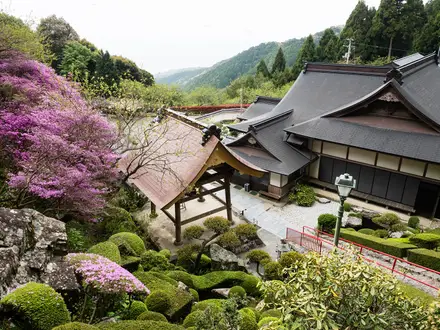
- Yakuo-in Temple: An esoteric Shingon Buddhist temple near the summit, traditionally founded in 744. Hikers on Trail 1 pass temple buildings, tengu imagery and a long-standing site of mountain worship.
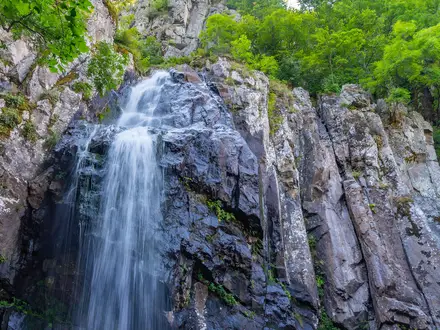
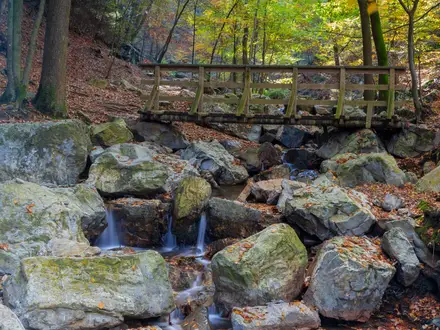
- Biwa Falls on Trail 6: A small sacred waterfall beside the stream-side route. It is historically linked with cold-water purification by ascetics and is not open for ordinary visitors to enter.
- Miyama suspension bridge on Trail 4: The only suspension bridge on Mount Takao, spanning about 36 m through the forest canopy. It gives the quieter Trail 4 a distinct feature compared with the busier main approach.
- Summit and Mount Fuji view: The 599 m summit has an observation area looking west towards Mount Fuji on clear days. Around the winter solstice it is known for the “Diamond Fuji” sunset alignment.
- Autumn foliage and cable car: November maple colour is a major draw, while the Takaotozan cable car climbs roughly 270 m in about 6 minutes and includes Japan’s steepest railway gradient.
Challenges to expect
Navigation is straightforward on the well-waymarked network, but crowds are the main issue on autumn weekends and Golden Week. Trail 1 is paved and beginner-friendly; Trail 6 and the Inariyama Course are more demanding, with dirt, roots, stone steps, rocky sections and steeper gradients. The summit is only 599 m, so altitude is not the challenge. For a far tougher Japanese mountain objective, see the Kamikochi to Mount Yari Trail.
HikeList Score
Mount Takao Trails scored 79/100 on HikeList's trail-quality metrics.
See score breakdownHide breakdown
- Ideal length 55
- Balanced challenge 100
- Scenery & wildness 98
- Varied terrain 77
- Accommodation 57
- Food & support 81
- Path quality 84
- Season flexibility 76
Computed from length, challenge, scenery & wildness, terrain variety, accommodation, food & support, path quality and season flexibility.
 Japan
JapanShow more data Show less
- Mountainous
- Forest
- Paved
- Boardwalk
- Dirt
- Rocky
- Hotels
- Family Friendly
- Pet Friendly
- Restrooms
- Water Sources
- Picnic Areas
Photos from hikers
Taken on the trail by people who've reviewed Mount Takao Trails.
Reviews
How would you rate Mount Takao Trails?
Tap a star to start your review — you could be the first.