Accommodation on the West Highland Way is clustered in small trail settlements, with long sections where there is little or no fallback if a bed, meal or campsite is unavailable. For May–September dates, book beds well in advance — often 9–12 months ahead — especially at Rowardennan, Inverarnan, Inveroran and Kingshouse, where the next practical stop may be a long walk away.
The route has a good range overall — hotels, inns, guesthouses, B&Bs, hostels, bunkhouses, pods/wigwams, campsites and wild camping — but not every stop has every type. Food opening times, accommodation meal policies, baggage-transfer acceptance and camping rules should all be checked before travelling.
| Place |
Role on the route |
Overnight usefulness |
Transport notes |
| Milngavie |
Official start |
Useful pre-walk night |
Frequent ScotRail trains from Glasgow Queen Street and Glasgow Central |
| Drymen |
First main village stop |
Strong first-night option |
Local onward transport should be checked before travelling |
| Balmaha |
Loch Lomond-side village after Conic Hill |
Useful shorter-stage stop |
This should be checked before travelling |
| Rowardennan |
Official section end on Loch Lomond |
Important overnight stop before rough Loch Lomond shore |
This should be checked before travelling |
| Inversnaid |
Small Loch Lomond stop |
Possible split point, very limited |
This should be checked before travelling |
| Inverarnan |
Official section end north of Loch Lomond |
Important overnight stop after the rough lochside section |
This should be checked before travelling |
| Crianlarich |
Near the route via spur |
Useful transport/accommodation alternative |
West Highland Line and Citylink coaches call here |
| Tyndrum |
Official section end and key service stop |
One of the most practical resupply/overnight stops |
West Highland Line and Citylink coaches call here |
| Bridge of Orchy |
Small stop before/after Inveroran |
Useful alternative to Inveroran |
West Highland Line and Citylink coaches call here |
| Inveroran |
Official section end before Rannoch Moor |
Strategic but very limited |
This should be checked before travelling |
| Kingshouse |
Glen Coe-side stage stop |
Strategic before the Devil’s Staircase |
This should be checked before travelling |
| Kinlochleven |
Main settlement before the final stage |
Important overnight stop |
This should be checked before travelling |
| Fort William |
Official finish |
Best end-of-walk base |
West Highland Line, Caledonian Sleeper, Scottish Citylink and Ember coaches |
Milngavie
Milngavie is the official start, marked by the granite obelisk on Douglas Street in the town centre. It is the easiest place to reach at the beginning of the walk, with frequent ScotRail trains from Glasgow Queen Street and Glasgow Central taking roughly 25 minutes.
A pre-walk overnight here suits anyone arriving late, starting early, or wanting to avoid carrying extra food out of Glasgow. The thistle waymarks lead north from the town centre through Mugdock Country Park, so there is no need for a transfer to the trailhead once in Milngavie.
Food and last-minute supplies are best dealt with before leaving the town centre. Specific shop and café opening times should be checked before travelling.
Mugdock Country Park
Mugdock Country Park is passed soon after leaving Milngavie and is part of the lowland approach rather than a normal overnight stop. It is useful mainly as the point where the route leaves the Glasgow fringe and settles into tracks, parkland and woodland.
Do not plan on Mugdock as a resupply or accommodation stop unless a specific arrangement has been made. This should be checked before travelling.
Drymen
Drymen is the first main overnight village on the standard south-to-north itinerary, reached after the opening stage from Milngavie. It is a practical first-night stop because it breaks the walk before Conic Hill, Balmaha and the start of the Loch Lomond section.
Accommodation is part of the route’s main village cluster, but it still books up quickly in the walking season. Expect limited capacity compared with a town, and avoid assuming that late availability will exist in May–September.
Food and pub/café options make Drymen a sensible place to eat properly before the more constrained Loch Lomond stretch. Current opening times and booking requirements should be checked before travelling.
Conic Hill
Conic Hill is crossed between Drymen and Balmaha and is not an overnight stop. Its importance is practical: it is the first real climb of the route and sits immediately before the descent to Loch Lomond.
There are no reliable trail services on the hill itself. Carry water and snacks from Drymen or Balmaha, and avoid treating the climb as a place where poor weather can be ignored; the route becomes more exposed here than on the opening lowland stage.
Balmaha
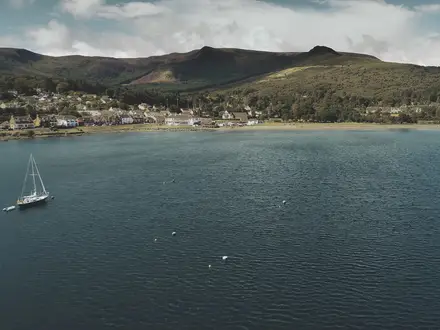
Balmaha sits on Loch Lomond after the crossing of Conic Hill. It is a useful stopping point for walkers who prefer a shorter day out of Drymen or who want to split the Loch Lomond approach before continuing to Rowardennan.
Accommodation is available in the broader cluster of trail villages, but capacity is limited and should be booked early. Balmaha is also a sensible place to check food and water before committing to the long eastern shore of Loch Lomond.
Transport details from Balmaha are not part of the main rail/coach break points listed for the route. This should be checked before travelling.
Rowardennan
Rowardennan is the official section end after Drymen on the standard eight-section itinerary. It is a key overnight stop because it places walkers at the start of the most rugged part of the Loch Lomond shore.
Beds here are limited and demand is high, particularly in the main walking season. If accommodation is unavailable, changing the stage plan may be necessary rather than simply walking on and hoping for another option.
Food and evening meal arrangements should be checked when booking accommodation. The following section towards Inversnaid and Inverarnan is rough, rocky and root-tangled in places, so starting fed, rested and with supplies is more important here than on the easier southern stages.
Inversnaid
Inversnaid is a small stop on the eastern shore of Loch Lomond between Rowardennan and Inverarnan. It can be useful for walkers who want to break up the demanding lochside stage, but it should be treated as a limited-service location rather than a guaranteed fallback.
Accommodation, food availability and any onward transport arrangements must be checked before relying on them. This part of the route is slow-going underfoot, so time estimates based only on distance can be misleading.
Inverarnan
Inverarnan is the standard overnight stop after the rough Loch Lomond shore when walking the official Rowardennan–Inverarnan section. It is an important logistical point because it marks the transition from the lochside stage into Glen Falloch and the approach towards Crianlarich and Tyndrum.
Accommodation is limited and should be booked well ahead. This is not a place to arrive without a plan in high season.
Food and drink arrangements should be tied to the accommodation booking or checked separately. After Inverarnan the route becomes less technically awkward than the Loch Lomond shore, but services are still spaced out and weather can deteriorate quickly.
Crianlarich
Crianlarich is near the West Highland Way rather than a standard stage end in the official eight-section breakdown. It is useful because the West Highland Line and Citylink coaches call here, making it one of the better places for joining, leaving or breaking the walk.
Walkers may use Crianlarich as an accommodation alternative if nearby trail beds are full, or as a transport point for a section-hike. Any spur distance, accommodation transfer, taxi or baggage-transfer arrangement should be confirmed before booking around it.
Food and shop details should be checked before travelling. Crianlarich is more useful logistically than many smaller trail stops, but it still needs advance planning.
Tyndrum
Tyndrum is an official section end and one of the most practical service points on the West Highland Way. It sits after the Inverarnan stage and before the shorter official day towards Inveroran.
Accommodation is part of the main trail cluster, with more planning flexibility than the smallest stops, but advance booking remains important. It is also one of the best places to organise resupply before the route becomes more remote towards Bridge of Orchy, Inveroran and Rannoch Moor.
Tyndrum is served by the West Highland Line and Citylink coaches, making it a strong place to split the walk or leave the route if needed. Current train and coach times should be checked before travelling.
Bridge of Orchy
Bridge of Orchy is a small but useful stop between Tyndrum and Inveroran. Although the official section in this itinerary ends at Inveroran, Bridge of Orchy is often a practical alternative because it has transport links.
The West Highland Line and Citylink coaches call here, which makes it valuable for section-hikers and for walkers adjusting plans around accommodation availability. Beds and meals are still limited, so it should not be treated like a large service town.
Bridge of Orchy is also a sensible point to reassess weather before the more exposed ground ahead. Opening times, accommodation meals and baggage-transfer arrangements should be checked before travelling.
Inveroran
Inveroran is the official stage end before the crossing of Rannoch Moor. It is strategically placed, but very small, so accommodation and food options are limited and must be arranged in advance.
This is one of the stops where booking failure can create a serious staging problem. If no bed or pitch is available, Bridge of Orchy or a revised itinerary may be more realistic than relying on a last-minute solution.
The next stage crosses exposed, boggy moorland on the line of an old military/Parliamentary road. Start from Inveroran with adequate food, waterproofs and an honest weather assessment.
Rannoch Moor
Rannoch Moor is a major route section, not an overnight service stop. The crossing between Inveroran and Kingshouse is remote and exposed, with heather, bog, lochans and mountain weather shaping the day.
Do not plan on resupply, shelter or easy escape once committed to this section. Carry what is needed for the full stage and check the forecast carefully before leaving Inveroran or Bridge of Orchy.
Altnafeadh
Altnafeadh sits below the Devil’s Staircase between Kingshouse and Kinlochleven. It is a route landmark and staging reference rather than a place to rely on for accommodation or food.
The practical significance is that the climb begins here. Treat it as the point to adjust layers, eat, drink and prepare for the steep zig-zag ascent to the high point of the West Highland Way.
Kingshouse
Kingshouse, near the mouth of Glen Coe, is the standard overnight stop after the Rannoch Moor stage in this itinerary. It is also the key base before the climb over the Devil’s Staircase to Kinlochleven.
Accommodation is strategically important and should be booked very early. If it is unavailable, the itinerary may need to be changed around Bridge of Orchy, Inveroran, Kinlochleven or arranged transport; this should be checked before travelling.
Food and breakfast arrangements matter here because the next day includes the trail’s highest pass. Confirm meal times, packed-lunch options and baggage-transfer acceptance directly with the booked accommodation.
Devil’s Staircase
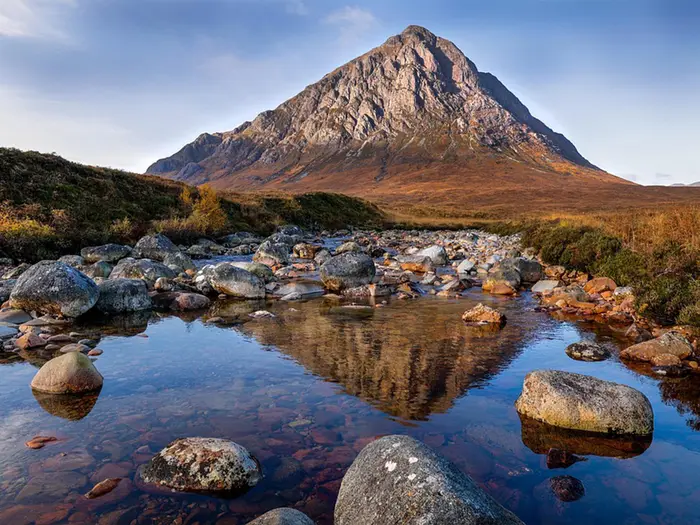
The Devil’s Staircase is the high point of the route, reached on the old military-road climb above Altnafeadh between Kingshouse and Kinlochleven. It is not a summit and it is not an overnight stop, but it is one of the main weather-sensitive sections of the walk.
There are no services on the pass. Carry waterproofs, warm layers, food and water from Kingshouse, and allow for slower progress in wind, rain or poor visibility.
Kinlochleven
Kinlochleven is the main overnight stop after the Devil’s Staircase and before the final stage to Fort William. It is one of the key accommodation clusters on the route and a practical place to recover before the longest official day in this itinerary.
Beds should still be booked early for May–September dates. Food, pubs, cafés and shop arrangements should be checked before arrival, especially if reaching Kinlochleven late after poor weather over the pass.
The final stage climbs out of Kinlochleven onto the Lairigmor and traverses high ground below the Mamores before dropping towards Glen Nevis and Fort William. Leave with enough food and water for a long day.
Lairigmor
The Lairigmor is the high, open section after Kinlochleven on the way to Fort William. It is not a settlement and should not be treated as a service point.
Its planning role is simple: it makes the final day more than a walk-in to town. Carry full hillwalking kit, food and water from Kinlochleven, and do not rely on services until the approach to Fort William.
Glen Nevis
Glen Nevis is the final approach area before Fort William, beneath the Ben Nevis range. For most West Highland Way walkers it is part of the finishing day rather than a separate overnight stop.
If planning to stay in or around Glen Nevis instead of Fort William, accommodation and transport details should be checked before travelling. Otherwise, continue into Fort William for the official finish and the strongest onward transport links.
Fort William
Fort William is the official finish, traditionally at the West Highland Way Walker statue in Gordon Square. It is the best place to plan an end-of-walk night, collect baggage, eat properly and organise onward travel.
The town has the strongest transport links on the northern end of the route. ScotRail trains run on the West Highland Line to and from Glasgow Queen Street, the Caledonian Sleeper links Fort William with London Euston, and Scottish Citylink and Ember coaches serve the town.
Accommodation should still be booked ahead in the walking season, particularly if finishing at a weekend or connecting with other Highland plans. Current rail, sleeper and coach times should be checked before travelling.
 United Kingdom
 Scotland