Marjan Hill Trail
How would you rate Marjan Hill Trail?
Tap a star to share your experience and help other hikers.
Marjan Hill Trail: Split’s Easy Forest-and-Coast Loop
HikeList Score
Marjan Hill Trail scored 75/100 on HikeList's trail-quality metrics.
See score breakdownHide breakdown
- Ideal length 55
- Balanced challenge 64
- Scenery & wildness 72
- Varied terrain 89
- Accommodation 100
- Food & support 81
- Path quality 84
- Season flexibility 63
Computed from length, challenge, scenery & wildness, terrain variety, accommodation, food & support, path quality and season flexibility.
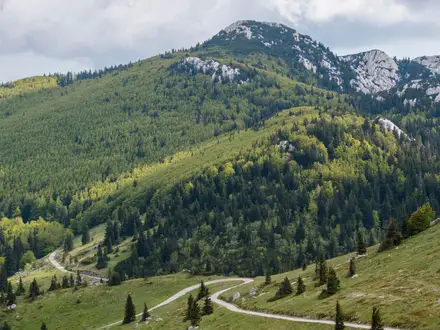
The Marjan Hill Trail is an easy 8 km loop in Marjan Forest Park, immediately west of Split’s old town in Croatia. It is a part-day walk, typically 2–2.5 hours for the full loop or 3–4 hours with viewpoint and beach stops. The route suits families, first-time visitors to Split and hikers wanting a short coastal walk with pine forest, chapels, historic sites and the 178 m Telegrin summit. The main effort is the steep stepped climb from Varoš.
Route Overview
Start at the Vidilica viewpoint terrace above the Varoš neighbourhood, reached on foot from Split’s Riva in about 10 minutes via Senjska street. The loop passes the Old Jewish Cemetery and Church of St Nicholas, climbs 314 stone steps to Telegrin, then continues through Aleppo pine forest past the Botanical Garden, Renaissance hermitage caves and Church of St Jerome. The coastal side runs by the Institute of Oceanography and Fisheries and the beaches or coves of Kašjuni, Bene, Kaštelet and the “vode” coves before returning to Vidilica. For other Croatian day walks, compare the Dubrovnik City Walls Trail, Brač Island Summit Trail (Vidova Gora) and Hvar Island Ridge Trail.
Marjan’s history and protection
Marjan has been used for recreation since Roman times, with tradition linking the hill to Emperor Diocletian’s palace-city. From the 13th to 15th centuries, chapels, hermitages and cave dwellings were built on its slopes by hermits and monks. Systematic planting with Aleppo pine began in the 19th century, and the Marjan Society, founded in 1903, helped protect and reforest the hill. Marjan became a forest park in 1964, and the whole peninsula was designated a protected cultural landscape in 2014.
Notable highlights
- Telegrin summit (178 m): The highest point on Marjan, reached by the 314 stone steps from Varoš. The summit has a tall white stone cross, a large Croatian flag and broad views over Split, the Adriatic and the islands of Brač, Šolta and Čiovo.
- Vidilica viewpoint terrace: The first lookout above Varoš, beside the Vidilica café. It gives the classic view back over Split’s old town roofs, harbour and sea before the climb begins.
- Old Jewish Cemetery: Founded in 1573 and used until 1945, with more than 700 graves. It is a protected cultural monument on the hillside and one of the route’s most important historic stops.
- Church of St Nicholas: A small early-13th-century Romanesque chapel dedicated to the patron saint of fishermen. It sits among the pines and has a freshwater tap nearby.
- Church of St Jerome and hermitage caves: A 15th-century church beside cliff-cut cave dwellings used by hermits. The site explains why Marjan was long both a recreation area and a spiritual retreat.
- Coastal coves and beaches: The flatter coastal section passes Kašjuni, Bene, Kaštelet and the sheltered “vode” coves, giving an easy sea-level contrast to the summit climb.
Challenges to expect
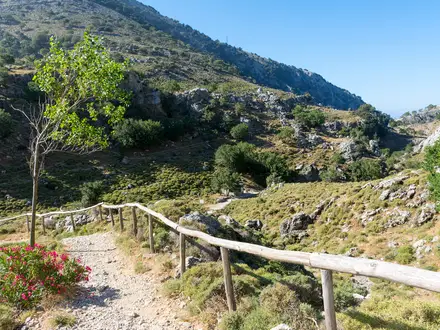
This is an easy city-park walk, but not completely flat. The main challenge is the steep climb of 314 stone steps from Varoš to Telegrin, plus extra stairs from old-town level. Underfoot, expect a mix of stone steps, paved park road, gravel, dirt and rocky forest paths. Waymarking is good, but intersecting paths and stairways can confuse first-timers. In summer, start early or late to avoid heat, crowds and exposed sections.
HikeList Score
Marjan Hill Trail scored 75/100 on HikeList's trail-quality metrics.
See score breakdownHide breakdown
- Ideal length 55
- Balanced challenge 64
- Scenery & wildness 72
- Varied terrain 89
- Accommodation 100
- Food & support 81
- Path quality 84
- Season flexibility 63
Computed from length, challenge, scenery & wildness, terrain variety, accommodation, food & support, path quality and season flexibility.
 Croatia
Show more data Show less
- Forest
- Coastal
- Urban
- Paved
- Gravel
- Dirt
- Rocky
- Hotels
- Hostels
- Guesthouses
- Apartments
- Family Friendly
- Pet Friendly
- Restrooms
- Water Sources
- Picnic Areas
Photos from hikers
Taken on the trail by people who've reviewed Marjan Hill Trail.
Reviews
How would you rate Marjan Hill Trail?
Tap a star to start your review — you could be the first.