GR4 (Massif Central Segment)
How would you rate GR4 (Massif Central Segment)?
Tap a star to share your experience and help other hikers.
GR4 Massif Central Segment: Volcanic Auvergne Traverse
HikeList Score
GR4 (Massif Central Segment) scored 89/100 on HikeList's trail-quality metrics.
See score breakdownHide breakdown
- Ideal length 91
- Balanced challenge 84
- Scenery & wildness 98
- Varied terrain 71
- Accommodation 92
- Food & support 81
- Path quality 98
- Season flexibility 89
Computed from length, challenge, scenery & wildness, terrain variety, accommodation, food & support, path quality and season flexibility.
The GR4 Massif Central Segment is a hard, 260 km point-to-point crossing of southern-central France, usually planned over about 12 days. It follows the white-and-red GR4 through the volcanic Auvergne, from Les Vans in the Ardèche to Royat near Clermont-Ferrand. Expect long daily distances, sustained ascent, exposed high ridges on the Sancy and Cantal tops, and quieter plateaus between villages. It suits experienced multi-day hikers who want a gîte-to-gîte mountain traverse without technical climbing.
Route Overview
This section is described south/east to north, starting at Les Vans in southern Ardèche and finishing at Royat, the Clermont-Ferrand gateway below the Chaîne des Puys, though it can be walked either way. The route climbs from the Ardèche edge through the Margeride, reaches Saint-Flour, crosses the Cantal around Plomb du Cantal and the Puy Mary area, then continues over the Cézallier plateau to Besse-et-Saint-Anastaise, Super-Besse, Mont-Dore, Orcival and the Puy de Dôme. It is a linear GR route, not a loop, with standard FFRandonnée white-over-red waymarking throughout. For other French mountain walking, compare the Chartreuse Trail GR9 segment or the Ballons des Vosges Park trails.
History of the GR4 and the Auvergne Uplands
The GR4 belongs to France’s Grande Randonnée network, coordinated since 1947 by the organisation that became FFRandonnée and maintained with volunteer waymarking. Its Massif Central crossing passes through historic Auvergne uplands linked with the Arverni and Vercingetorix near the Clermont/Gergovie area before Roman rule. The route also threads medieval villages, Romanesque churches such as Orcival’s basilica, and pastoral landscapes shaped by transhumance and buron cheese-making.
Notable highlights
- Puy de Sancy (1,885 m): The highest peak of the Massif Central and the high point of this GR4 segment. The trail traverses its summit ridge above the Chastreix-Sancy and Chaudefour nature reserves.
- Chaîne des Puys: A UNESCO World Heritage volcanic chain of around 80 dormant volcanoes. The GR4 crosses it for about 40 km, including the well-known Puy de Dôme at 1,465 m.
- Plomb du Cantal and Puy Mary: The Cantal section crosses the remains of a vast extinct stratovolcano, with high summer pastures, volcanic ridges and open views around Plomb du Cantal at 1,855 m.
- Orcival and Notre-Dame basilica: Orcival is a useful village stop between the Chaîne des Puys and the Sancy. Its Romanesque basilica, built around 1146–1178, is one of the major Auvergne churches.
- Cézallier plateau: A broad basalt plateau of grassland, peat bogs and grazing herds between the Sancy and Cantal. It gives some of the route’s most open and remote walking.
- Ardèche descent to Les Vans: The southern end drops towards a warmer landscape of chestnut woods, schist villages and the Chassezac gorges around Les Vans.
Challenges to expect
This is non-technical but strenuous walking: expect repeated ascent and descent, rocky volcanic ridges, grassy pasture paths and long gravel or forest-track sections. Weather can change quickly on the Sancy, Cantal and Puy de Dôme areas, with snow and cold making winter hazardous. Resupply gaps can be long on the plateaus, so book gîtes ahead and carry food between villages. For an easier French contrast, see the Canal du Midi Towpath.
HikeList Score
GR4 (Massif Central Segment) scored 89/100 on HikeList's trail-quality metrics.
See score breakdownHide breakdown
- Ideal length 91
- Balanced challenge 84
- Scenery & wildness 98
- Varied terrain 71
- Accommodation 92
- Food & support 81
- Path quality 98
- Season flexibility 89
Computed from length, challenge, scenery & wildness, terrain variety, accommodation, food & support, path quality and season flexibility.
 France
Show more data Show less
- Mountainous
- Forest
- Dirt
- Rocky
- Gravel
- Hotels
- Hostels
- Huts
- Campsites
- Wild Camping Spots
- Pet Friendly
- Water Sources
- Campsites
- Shelters
Download Our Full Guide to GR4 (Massif Central Segment) FREE!
Get our comprehensive guide to this hike for free. Save it for later reading or print out at home.
Photos from hikers
Taken on the trail by people who've reviewed GR4 (Massif Central Segment).
GR4 (Massif Central Segment): The Complete Guide
 i
Image by Patrick
i
Image by Patrick The GR4 Massif Central segment is a hard, deeply varied crossing of volcanic Auvergne, linking Les Vans in the southern Ardèche with Royat on the edge of Clermont-Ferrand. It suits experienced long-distance walkers who want a waymarked gîte-to-gîte traverse with big horizons, real ascent and few easy shortcuts.
The route starts in warm chestnut country above the Chassezac, then climbs into the quieter granite uplands of the Margeride and Lozère plateau. From there it builds towards the Monts du Cantal, where the walking becomes rockier and more exposed around the Plomb du Cantal, Peyre Arse and Puy Mary.
North of the Cantal, the character changes again across the broad grasslands and boggier ground of the Cézallier. The high point comes on the Monts Dore crest at Puy de Sancy, before the final volcanoes of the Chaîne des Puys and the descent past Puy de Dôme towards Royat.
This is not a technical mountain route, but it is a serious one: expect long days, sustained climbing, fast-changing weather on exposed ridges and thin resupply on the plateaux. Gîtes and food stops need planning, and the exact distance and ascent should be checked against a current topo-guide or GPX before fixing a tight schedule.
This guide covers stages, day planning, accommodation, food and water, transport, terrain, season choice and the common mistakes that make this route harder than it needs to be.
Stage-by-Stage Guide
The stages below follow the 12-day Les Vans → Royat schedule used for this route. Daily distances are approximate: the signed GR4 line through the Massif Central can measure longer than the headline distance, so check a current topo-guide or GPX before booking fixed accommodation.
Stage 1: Les Vans to Loubaresse — approx. 24 km
The opening stage leaves the warmer Ardèche country around Les Vans and begins the long transition from chestnut woods, schist hamlets and the Chassezac area towards the higher Massif Central. Expect a full first day rather than a gentle prologue: the walking is mostly non-technical, but the route climbs away from the southern foothills and starts to feel more remote as it approaches Loubaresse.
Underfoot, the GR4 uses a mix of forest paths, tracks and rural lanes. In wet weather the wooded sections can be slippery, and in hot early-season or summer conditions the lower Ardèche start can feel warm before the route gains height.
Les Vans is the last substantial starting point before the hills, so begin with food for the day and do not assume regular shops on the walk to Loubaresse. Water availability between settlements should be checked before setting off.
Accommodation at Loubaresse is limited compared with the larger towns later on the route, so book ahead. Public transport is weakest at this end of the trail: Les Vans has no railway station and is reached by regional bus from places such as Aubenas, Montélimar, Pierrelatte or Alès; current bus times should be checked before travelling.
Navigation is straightforward in principle on the red-and-white GR waymarks, but the first day has enough small tracks and hamlet exits to make a current map or GPX worthwhile. Do not rely only on waymarks when leaving Les Vans or when tracks branch in woodland.
Stage 2: Loubaresse to Margeride plateau / Chaliers–Saint-Flour approach — approx. 26 km
This is one of the more solitary-feeling stages as the route pushes onto the Margeride and Lozère plateau. The landscape opens into granite upland, pine, pasture and long, quiet tracks, with fewer obvious service points than on the Cantal and Sancy sections.
The walking is not technical, but it is committing because of the distance, the exposed plateau character and the limited options once away from villages. Paths and tracks can be grassy, stony or muddy after rain, and progress may be slower than the map distance suggests.
Carry a proper food margin from Loubaresse and treat water as a planning item rather than something to find casually. The Margeride is one of the resupply-thin parts of the whole crossing.
Accommodation at the end of this stage depends on the exact stopping point around Chaliers or the Saint-Flour approach, and beds may be sparse. This stage is a good example of why the 12-day schedule should be matched to real, bookable gîtes or chambres d'hôtes before travel.
Road access exists in the wider plateau area, but public transport should not be assumed. Navigation needs care in poor visibility: the GR4 waymarks help, but open upland tracks and forest edges can become confusing in mist or fading light.
Stage 3: Margeride plateau to Saint-Flour — approx. 24 km
The third stage continues across high, quiet country before dropping into the Planèze de Saint-Flour and the medieval town of Saint-Flour. This is a useful psychological break in the route: after the sparsely serviced Margeride, Saint-Flour provides one of the main town stops on the whole traverse.
Terrain remains a mix of plateau tracks, pasture paths and minor lanes, with less rugged footing than the volcanic ridges ahead. The effort comes from the length of the day, the accumulated ascent and descent, and the exposure of open ground in poor weather.
Saint-Flour has the best service position since Les Vans, so plan to resupply here for the Cantal stages. It is also a sensible place to review weather before committing to the high ridges over Plomb du Cantal and Puy Mary.
Accommodation is more plentiful in Saint-Flour than on the surrounding plateaux, including town-based options. The town also has a station on the Aubrac line between Clermont-Ferrand and Béziers, making it a key joining, leaving or rest-point location; current SNCF/TER timetables should be checked.
Navigation into Saint-Flour is generally less remote than the previous day, but still use the GR4 waymarks carefully where the route crosses rural tracks and approaches built-up areas. If bad weather is forecast for the Cantal, Saint-Flour is the place to pause rather than pushing on blindly.
Stage 4: Saint-Flour to Valuéjols / Col de Prat-de-Bouc — approx. 22 km
This stage leaves town services behind and climbs towards the Monts du Cantal. It is a transition day from the Planèze de Saint-Flour to the volcanic high country, ending either around Valuéjols or higher towards the Col de Prat-de-Bouc depending on the accommodation and weather plan.
The walking becomes steadily more mountainous, with pasture, tracks and climbing approaches towards the Cantal massif. The stage is not technically difficult, but it sets up the first major high-ridge day and should not be underestimated with a full pack.
Food should be bought in Saint-Flour. Water and resupply after leaving town are less certain, particularly if pushing all the way to the col area, so check current water points and carry enough for a full upland day.
Accommodation around Valuéjols and the Col de Prat-de-Bouc area is more limited and may be seasonal. Book ahead, and make sure the chosen stop sits realistically on or near the day’s line; otherwise the next day’s climb over Plomb du Cantal may become awkwardly long.
Road access around the col gives some practical flexibility, but public transport should be checked before relying on it. Navigation becomes more weather-sensitive as the route approaches higher ground: mist, wind and late snow can make the Cantal more serious than its altitude suggests.
Stage 5: Col de Prat-de-Bouc to Le Lioran / Super-Lioran — approx. 12 km
Although short on distance, this is a major mountain stage. From the Col de Prat-de-Bouc the GR4 shares high Cantal ground with other GR routes and climbs towards the Plomb du Cantal, at 1,855 m the highest summit of the Monts du Cantal and the second-highest point in the Massif Central.
Expect rocky volcanic ridge walking, steeper gradients and full exposure to wind, cloud and storms. This is a day to start early, especially if the forecast is unsettled, because bad weather on the ridge can remove the easy views that make navigation feel obvious.
The reward is one of the finest sections of the route, with broad views over the eroded Cantal volcano and towards the ridges still to come. The descent to Le Lioran / Super-Lioran brings the route into one of the main mountain bases on the traverse.
Do not treat the short distance as a reason to carry less food or water. Mountain services can be seasonal, and water on the ridge itself should not be relied on unless checked locally.
Le Lioran / Super-Lioran has accommodation options compared with the wilder approaches, but booking is still important in peak holiday periods and outside the main season when some services may close. Murat is a useful railhead in this part of the route on the Aubrac line, though current connections and any link to the trail should be checked before planning a bail-out.
Navigation follows the GR waymarks, but this is a stage where map, GPX and mountain judgement matter. Avoid the ridge in thunderstorms, strong winds or lingering snow unless properly equipped and experienced.
Stage 6: Le Lioran to Puy Mary / Col de Serre — approx. 17 km
This is another high Cantal day, following the volcanic crest from Le Lioran past the Puy Griou area and contouring Puy de Peyre Arse before reaching the Brèche de Roland and Puy Mary. It is one of the most scenic and exposed stages of the whole walk.
The terrain is rougher than the plateau days: expect rocky paths, ridge walking, steep sections and a stepped or cabled passage around the Brèche de Roland below Puy Mary. There is no technical climbing, but the route is not a casual lowland walk and requires confidence on mountain paths.
Puy Mary is the key landmark, with wide views into the radiating glacial valleys of the Cantal when conditions are clear. In mist, the same terrain becomes far more serious, especially where paths cross or contour around summits.
Carry food from Le Lioran and plan water carefully. Mountain huts, cafés or pass facilities may be seasonal or away from the exact walking line, so do not build the day around unconfirmed services.
Accommodation around the Puy Mary / Col de Serre area is limited compared with Le Lioran and Saint-Flour. Many walkers will need to match this stage to a specific pre-booked gîte, refuge-style stop or nearby accommodation; this should be arranged before leaving Le Lioran.
Road access at the pass areas can provide an escape in poor conditions, but onward transport is not something to assume. The main warnings are exposure, fast weather changes, slippery rock in rain and possible snow outside the main summer window.
Stage 7: Puy Mary area to Condat via Dienne and Lugarde — approx. 24 km
This stage leaves the highest Cantal ridges and begins the long crossing towards the Cézallier. The route passes near Dienne and Lugarde before reaching Condat, with a gradual change from sharp volcanic crests to broader upland country.
The walking is still substantial, with a long day of descent, rolling ground and rural tracks. Paths may be grassy or muddy in places, and the day can feel remote once away from the roadheads and villages.
Views back to the Cantal are a highlight in clear weather, while the landscape ahead becomes more open and plateau-like. This is also the point where the route’s challenge shifts from high ridges to distance, exposure and spacing of services.
Carry enough food from the previous stop unless a reliable resupply has been arranged. Water points and village facilities should be checked in advance, especially if walking in hot weather or outside the main season.
Condat is a logical overnight stop before the Cézallier crossing, but accommodation should still be booked ahead. Public transport options are limited in this upland section; road access exists through the villages, but practical onward travel should be checked before relying on it.
Navigation is generally less technical than on the crest, but there may be long stretches where losing the GR4 line would cost time. Keep following the red-and-white balisage carefully at track junctions and village exits.
Stage 8: Condat to Égliseneuve-d'Entraigues — approx. 20 km
This stage crosses the Cézallier plateau, one of the most open and thinly serviced parts of the Massif Central segment. Expect broad basalt grassland, peat bogs, grazing country and a distinctly remote feel between Condat and Égliseneuve-d'Entraigues.
The terrain is less rocky than the Cantal, but it can be slow in a different way. Boggy patches, wet grass, rutted tracks and wind exposure are all realistic, and in poor visibility the open plateau can feel featureless.
The Cézallier is a place to carry food rather than hoping to shop en route. Water sources and reliable refills should be checked before leaving Condat, and livestock areas should be crossed calmly with gates left as found.
Égliseneuve-d'Entraigues is an important staging point between the Cantal and Sancy sections. Accommodation and meals should be booked in advance, particularly outside the busiest summer period when smaller services may be seasonal.
Road access is present at the village, but public transport should be treated as limited unless confirmed. Navigation is usually by waymarks and tracks, but a map or GPX is particularly useful here because mist, boggy ground and multiple farm tracks can make the line less obvious.
Stage 9: Égliseneuve-d'Entraigues to Super-Besse — approx. 20 km
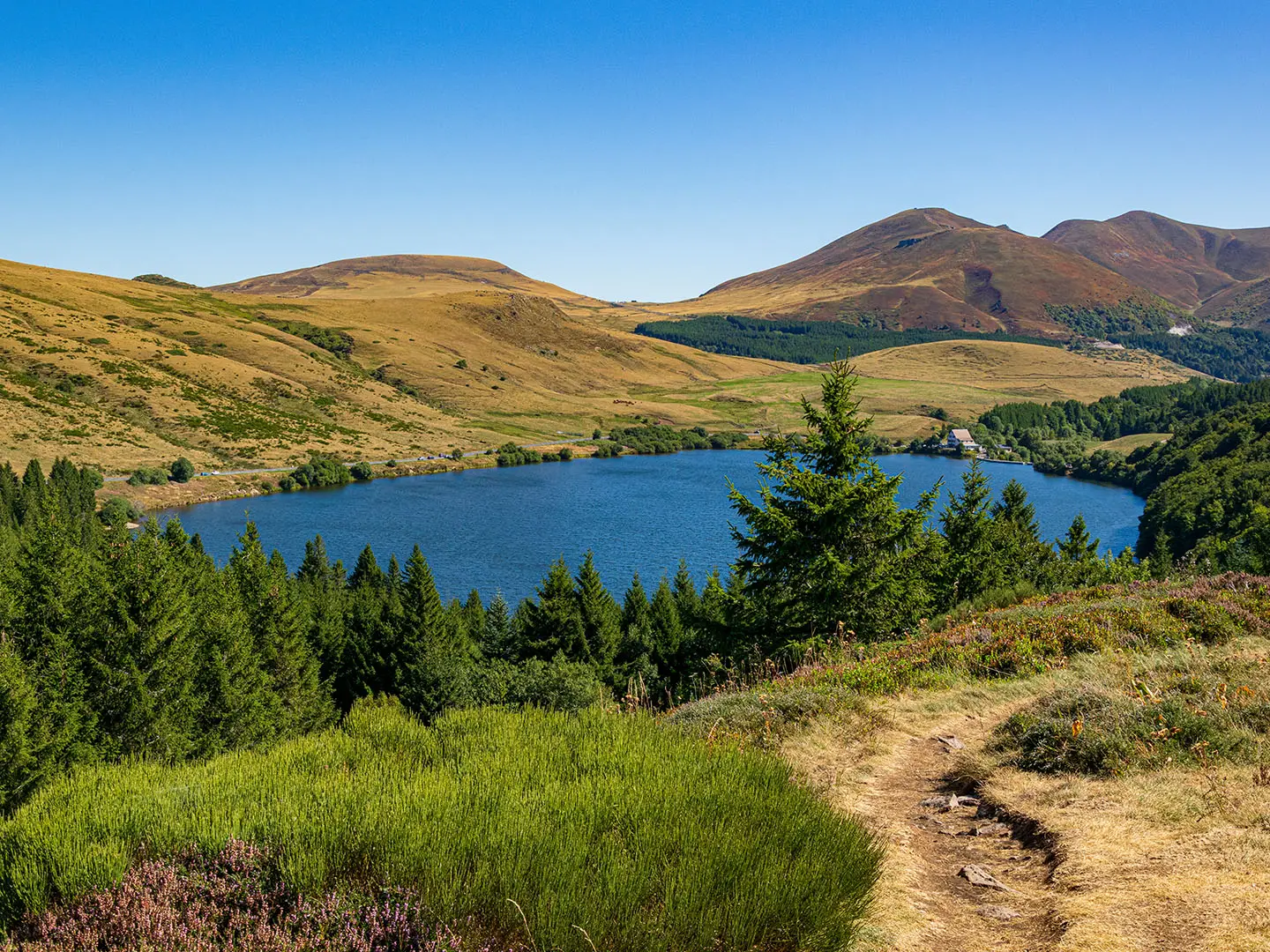
This stage leaves the Cézallier and approaches the Monts Dore, with the Sancy massif beginning to dominate the route ahead. The GR4 passes the Lac Chauvet area before reaching Super-Besse, the on-route mountain base near Besse.
Expect upland tracks, pasture paths and a gradual return to more mountainous terrain. Conditions can be wet underfoot around plateau and lake-country ground, and the weather may deteriorate quickly as the route nears the higher Sancy ridges.
Lac Chauvet is the main natural landmark on this stage, and Super-Besse marks the practical end point before the ascent of the Puy de Sancy. Nearby places such as Besse-et-Saint-Anastaise old town and Lac Pavin are not the core GR4 line for this traverse, so any detours should be planned separately.
Carry food from Égliseneuve-d'Entraigues unless definite services are planned. Super-Besse has more accommodation potential than the plateau villages, but it is still seasonal mountain territory and should be booked ahead.
Road access is better at Super-Besse than on the Cézallier, though onward public transport should be checked before relying on it. Navigation is generally manageable on the GR4, but take care where other local walking routes and lake-area paths create junctions.
Stage 10: Super-Besse to Le Mont-Dore over Puy de Sancy — approx. 16 km
This is the high point of the entire segment. From Super-Besse the GR4 crosses the Monts Dore crest and climbs to the Puy de Sancy, 1,885 m, the highest summit of the Massif Central, before descending towards Le Mont-Dore.
The route includes sustained mountain walking over exposed volcanic ridges, including the approach from the Col de la Croix Morand over Puy de la Tâche, Puy de l'Angle, the Col de la Croix Saint-Robert and Roc de Cuzeau before the final pull from the Col de la Cabane to the summit area. The last section to the top is steep and can be busy in good weather.
This is a short stage on paper but one of the most weather-dependent. In wind, cloud, snow or thunderstorms, the crest becomes serious; in clear conditions it is one of the best ridge walks in the Massif Central.
Carry food and water for the full crossing. Do not rely on summit or lift-area facilities unless they are open and confirmed for the season.
Le Mont-Dore is one of the main accommodation and service centres on the route, with more options than the plateaux. It is a good place to rest, dry gear and reassess the forecast before continuing to Orcival and the Chaîne des Puys.
Navigation follows the GR4 crest line, but this is a stage where waymarks alone are not enough in poor visibility. Seasonal snow can linger or return outside the June–September window, and the final summit area may require patience around other walkers.
Stage 11: Le Mont-Dore to Orcival / Chaîne des Puys foot — approx. 22 km
This stage leaves the Sancy massif and heads north towards Orcival and the southern approach to the Chaîne des Puys. It is a linking day between two major volcanic areas, with less summit drama than the Sancy stage but still enough distance and ascent to feel like a proper mountain-to-plateau crossing.
The terrain is varied: tracks, paths through upland country, forest or pasture sections, and rural approaches to villages. After rain, expect mud in softer ground, and do not assume the day will be faster simply because it avoids the highest summits.
Orcival is the key landmark, known for its Romanesque Basilique Notre-Dame d'Orcival and its position in the GR4 / GR441 area between the Sancy and the Chaîne des Puys. It is also a practical staging point before the final volcanic chain.
Food should be planned from Le Mont-Dore, with any resupply or meal options in Orcival checked before arrival. Accommodation near Orcival or at the foot of the Chaîne des Puys should be booked ahead, as the exact stopping point affects the length and shape of the final day to Royat.
Road access improves compared with the higher ridges, but public transport should still be checked in advance. Navigation requires attention where the GR4 shares ground or junctions with other marked routes, especially around the GR441 area.
Stage 12: Chaîne des Puys / Col de Ceyssat to Royat over Puy de Dôme — approx. 18 km
The final stage crosses the young volcanoes of the Chaîne des Puys and climbs the Puy de Dôme before descending to Royat on the edge of Clermont-Ferrand. It is a memorable finish, but still a mountain day rather than a simple walk into town.
The GR4 reaches the Puy de Dôme area by the Col de Ceyssat and climbs by the Chemin des Muletiers. The summit stands at 1,465 m, and the descent from the Monts Dôme into the Clermont basin brings a major change in feel after the long upland crossing.
Paths can be rocky, eroded or slippery after rain, and the Puy de Dôme is often busier than the remote plateau stages. Weather exposure still matters: the summit can be windy and clouded even when Royat and Clermont-Ferrand look settled below.
Carry food and water for the walking day unless definite services have been checked. The closeness of the finish can encourage under-planning, but the route still includes ascent, descent and exposed ground before reaching Royat.
Royat has the strongest onward transport position on the segment because it sits directly beside Clermont-Ferrand. Clermont-Ferrand has rail links, including TER and Intercités services, and an airport; current SNCF/TER connections and local transport from Royat should be checked before booking onward travel.
Navigation is usually clear with GR waymarks, but take care around popular paths on and around the Puy de Dôme where several routes may be in use. The GR4 continues beyond Royat as part of the full long-distance route, so walkers finishing this Massif Central segment should make sure they leave the waymarked line at the intended endpoint.
Recommended Itinerary
The 12-day schedule below is the most practical baseline for a gîte-to-gîte traverse from Les Vans to Royat. It keeps most days around the 20–25 km mark, while allowing shorter but tougher mountain stages over the Cantal crest and the Puy de Sancy.
Exact daily mileage should be checked against current official mapping or a recent GR4 topo-guide before booking. The headline distance for this segment is about 260 km, but the full waymarked line may work out longer on the ground depending on the route version and accommodation choices.
Standard 12-day itinerary
| Day | From | To | Approx. distance | Why this stage makes sense | Services/accommodation notes |
|---|---|---|---|---|---|
| 1 | Les Vans | Loubaresse | c. 24 km | A committing first day leaving the warm Ardèche chestnut country and climbing towards the higher ground of the Massif Central. It sets up the crossing of the Margeride without lingering too long in the approach country. | Les Vans is the logical start-point for supplies before setting off. Accommodation and food options thin out quickly after the start; book the first night ahead. |
| 2 | Loubaresse | Margeride plateau / Chaliers–Saint-Flour approach | c. 26 km | A long upland stage across quieter granite plateau country. This is one of the sections where self-sufficiency matters more than technical difficulty. | Services are sparse on the Margeride and Lozère plateau. Carry food and enough water between known stops; water points and accommodation should be checked before travelling. |
| 3 | Margeride plateau | Saint-Flour | c. 24 km | This brings the route into Saint-Flour, the first major service town of the traverse and a useful place to reset after the southern plateau stages. | Saint-Flour has the best resupply and transport options so far, including a station on the Aubrac line. It is a sensible place for a laundry, food shop and accommodation with more choice than the plateau. |
| 4 | Saint-Flour | Valuéjols / Col de Prat-de-Bouc | c. 22 km | The route leaves the Planèze de Saint-Flour and moves towards the Monts du Cantal. Stopping near Valuéjols or the Col de Prat-de-Bouc positions the next day for the Plomb du Cantal. | Accommodation is more limited as the route approaches the high Cantal. Book ahead and check whether evening meals are available. |
| 5 | Col de Prat-de-Bouc | Le Lioran / Super-Lioran | c. 12 km | Short in distance but mountain in character, this stage crosses the Plomb du Cantal area and should not be underestimated in poor weather. Keeping it short gives time for the exposed high ground. | Le Lioran / Super-Lioran is a useful mountain base with more services than the surrounding cols. It is also a good weather-hold point before the Cantal crest. |
| 6 | Le Lioran | Puy Mary / Col de Serre | c. 17 km | A classic Cantal ridge day, contouring near Puy de Peyre Arse and passing the Brèche de Roland towards Puy Mary. The distance is moderate, but the terrain, exposure and ascent make it a full mountain stage. | Accommodation around the Puy Mary / Col de Serre area is limited and seasonal. Check availability carefully, especially outside the main summer walking period. |
| 7 | Puy Mary area | Condat, via Dienne / Lugarde | c. 24 km | This stage drops away from the Cantal high ridges and crosses through smaller settlements towards the Cézallier. It is a longer day after two shorter mountain stages. | Services become more spread out again after the Cantal. Condat is an important overnight and resupply point before the Cézallier crossing. |
| 8 | Condat | Égliseneuve-d'Entraigues | c. 20 km | A steady plateau stage across the Cézallier, with broad grassland, peat bogs and exposed upland walking. The distance is manageable but weather and navigation still matter. | Égliseneuve-d'Entraigues is a key stop between the Cantal and the Sancy. Carry food from Condat if relying on small village services. |
| 9 | Égliseneuve-d'Entraigues | Super-Besse | c. 20 km | This stage moves from the Cézallier towards the Sancy massif, passing near Lac Chauvet before reaching the Super-Besse area. It sets up the crossing of the Puy de Sancy the following day. | Super-Besse is one of the main service points on this part of the GR4. Do not assume that nearby places such as Besse-et-Saint-Anastaise old town are directly on the GR4 line; check mapping before planning detours. |
| 10 | Super-Besse | Le Mont-Dore, over Puy de Sancy | c. 16 km | The shortest full stage on paper, but one of the most important days of the route. The GR4 follows the Monts Dore crest and reaches the Puy de Sancy, the high point of the Massif Central at 1,885 m. | Le Mont-Dore is the logical overnight base after the Sancy crossing, with stronger accommodation and food options than the high ridge. Avoid committing to this stage in poor visibility, storms or late-season snow without checking conditions. |
| 11 | Le Mont-Dore | Orcival / foot of the Chaîne des Puys | c. 22 km | This links the Sancy massif to the final volcanic chain, giving a natural transition stage between the high Monts Dore and the Chaîne des Puys. | Orcival is the key named stop in this section, but exact overnight options depend on availability and route choice. Book ahead and check the current GR4/GR441 junction area on mapping. |
| 12 | Chaîne des Puys / Col de Ceyssat | Royat, over Puy de Dôme | c. 18 km | A strong final stage over the young volcanoes of the Chaîne des Puys, with the Puy de Dôme climbed by the Chemin des Muletiers before the descent into Royat. | Royat sits beside Clermont-Ferrand, making onward travel straightforward compared with the start. Check current local transport, SNCF/TER and any final accommodation plans before relying on same-day departures. |
Slower variant
A slower schedule of roughly 14–16 days suits walkers carrying heavier packs, anyone wanting more margin for bad weather on the Cantal and Sancy ridges, or those who prefer shorter days through the Margeride and Cézallier. The best places to add time are Saint-Flour, Le Lioran, Super-Besse or Le Mont-Dore, where services are stronger and weather delays are easier to manage.
The long plateau stages can also be split where intermediate gîtes or chambres d'hôtes are available, but these options are not evenly spaced. This should be checked before travelling, and bookings should be made before committing to a slower stage plan.
Faster variant
Fit, fast walkers can compress the traverse by combining some of the lower plateau stages and taking longer days between Les Vans, Saint-Flour, Condat and Égliseneuve-d'Entraigues. This is only sensible for hikers already comfortable with consecutive long days, carrying food between sparse resupply points and navigating in exposed upland weather.
The Cantal crest, the Puy de Sancy stage and the final Chaîne des Puys section are poor places to save time in bad conditions. Even on a faster itinerary, allow flexibility around the Plomb du Cantal, Puy Mary, Puy de Sancy and Puy de Dôme, as storms, snow patches or strong wind can make these days much slower than the distances suggest.
Planning the Route
How many days to allow
Use the 12-day schedule as a practical starting point, not as a fixed promise. It works for fit walkers who are comfortable with repeated 20–25 km days, but the high Cantal and Sancy stages are slower than their map distance suggests because of rocky ridges, exposure and weather.
The exact on-the-ground distance for Les Vans to Royat should be checked against a current topo-guide or GPX before booking. Published section totals for this part of the GR4 can come out higher than the headline distance, so build some flexibility into travel home, especially if using public transport at the finish.
A slower itinerary is usually the better choice if accommodation allows it. The route crosses several remote upland areas where a late start, poor weather or a missed resupply can make a long planned stage feel much harder than it looks on paper.
Let accommodation shape the stages
Daily stages are strongly dictated by where beds and food exist. Saint-Flour, the Murat / Le Lioran area, Super-Besse, Le Mont-Dore and Royat offer the easiest planning anchors, while the Margeride, Cézallier and parts of the Artense have thinner services.
Book gîtes d'étape, chambres d'hôtes, small hotels and refuges before committing to a day-by-day plan. Do not assume that every village on the map has a shop, an open restaurant or an available bed, particularly outside the main summer season.
The high-ridge sections also deserve conservative staging. The Cantal traverse around Col de Prat-de-Bouc, Plomb du Cantal, Le Lioran, Brèche de Roland and Puy Mary, and the Sancy crest over Puy de Sancy, are not the places to plan a marginally long day with no fallback.
Route blocks that matter for planning
| Route block | Main planning issue |
|---|---|
| Les Vans to Saint-Flour | Long climb from Ardèche chestnut country onto the Margeride and Lozère plateaux; check food, water and accommodation carefully after Loubaresse. |
| Saint-Flour to the Cantal crest | Saint-Flour is a key reset point before the volcanic high ground; use it for supplies and weather checks. |
| Col de Prat-de-Bouc, Plomb du Cantal, Le Lioran and Puy Mary | Shorter distances can still be strenuous because of ridge terrain, ascent, exposure and fast-changing mountain weather. |
| Puy Mary area to Condat and Égliseneuve-d'Entraigues | The Cézallier is broad, open and sparsely serviced; carry enough food and water between reliable stops. |
| Super-Besse to Le Mont-Dore | The Sancy section reaches the route high point at Puy de Sancy; allow for wind, cloud, storms or lingering snow outside high summer. |
| Le Mont-Dore to Royat via Orcival, Chaîne des Puys and Puy de Dôme | Public transport improves as the route approaches Clermont-Ferrand, but the final volcanic summits still need proper mountain-weather judgement. |
Shortening, extending and section hiking
Section hiking is practical, but access is uneven. Saint-Flour and Murat are the most useful mid-route railheads on the Clermont-Ferrand–Béziers Aubrac line, while the finish at Royat is effectively linked to Clermont-Ferrand for onward rail and airport connections.
Les Vans has no railway station, so the start needs more care. Access is by regional bus from Aubenas or from railheads such as Montélimar, Pierrelatte or Alès; current bus and SNCF / TER timings should be checked before travelling.
The easiest way to shorten the walk is to split it at Saint-Flour or Murat rather than trying to exit from the high plateaux. Extending is straightforward in concept because the GR4 continues beyond Royat towards the north-west, but that belongs to the wider GR4 and needs separate planning.
What to plan first
Accommodation comes first. Beds are limited in the quieter uplands, many mountain services are seasonal, and a gîte-to-gîte itinerary can fall apart if one sparse stage is full.
Food comes next. Carry enough between villages on the Margeride and Cézallier, and do not rely on finding open shops or restaurants every day.
Water also needs active planning. Check current water points before setting out on plateau stages, and leave major stops with enough capacity for a full day in warm weather.
Navigation is helped by the red-and-white GR waymarking, but a current FFRandonnée topo-guide, IGN mapping and/or GPX track is still important. This is especially true where the GR4 shares ground with other GR routes around the Cantal and the GR4 / GR441 area near Orcival.
Weather planning is non-negotiable. The Cantal crest, Puy Mary, the Sancy ridge and Puy de Dôme can be exposed to wind, cloud, thunderstorms and wintry conditions outside the safest summer window.
Camping and bivouac arrangements should be treated locally rather than assumed across the whole route. Use campsites where they fit the itinerary, and check local rules before relying on bivouac on the plateaux or near protected mountain areas.
Towns, Villages and Overnight Stops
Accommodation on this GR4 segment is uneven. Beds and food are easiest around Saint-Flour, Le Lioran, Super-Besse, Le Mont-Dore and Royat; the Margeride, Cézallier and some of the Cantal approaches need more deliberate planning.
Book gîtes d'étape, chambres d'hôtes and small hotels ahead, especially in summer, at weekends, and around ski/spa resorts. Carry at least one emergency meal through the plateaux, and do not assume every village has an open shop or evening meal.
Les Vans
Les Vans is the southern trailhead for this Massif Central section, on the edge of the Cévennes above the Chassezac. It is the best place to arrive the day before starting, sort food for the first stage, and make final checks before leaving the Ardèche.
It is a proper market town rather than a tiny hamlet, so accommodation and food options are more realistic here than on the first upland stages. Book ahead if starting in the main walking season.
Les Vans has no railway station. Access is by regional bus from Aubenas or from railheads such as Montélimar, Pierrelatte or Alès; current bus and SNCF/TER connections should be checked before travelling.
Loubaresse
Loubaresse is the first logical overnight stop when walking north from Les Vans, reached after the long climb out of the Ardèche. It marks the transition from the warmer chestnut country towards the higher, quieter Margeride and Lozère uplands.
Treat Loubaresse as a small-stage stop rather than a resupply base. Accommodation may be limited and seasonal, so a bed and evening meal should be booked before committing to this as the end of the first day.
Food availability beyond pre-arranged gîte meals should not be relied on. Carry enough supplies from Les Vans to cover the first stage and the next morning if needed.
Margeride / Lozère plateau
The Margeride and Lozère plateau section is one of the least serviced parts of the route. It is valuable walking precisely because it is quiet, but that also means longer gaps between shops, cafés and accommodation.
Overnight plans here need to be fixed in advance, especially if using gîtes or chambres d'hôtes in small hamlets. Some walkers may choose a longer or shorter day to fit available beds rather than forcing the itinerary to match a standard daily distance.
Water and food should be managed conservatively. Do not leave Loubaresse or the previous stop assuming there will be open shops on the plateau; this should be checked before travelling.
Saint-Flour
Saint-Flour is one of the key service towns on the GR4 Massif Central crossing. It sits on the Planèze de Saint-Flour and makes a natural rest, resupply or itinerary-reset point after the Margeride.
This is a strong overnight stop, with a wider choice of accommodation than the surrounding rural stages. It is also the first major place where tired walkers can shorten, pause or reorganise the trip without being dependent on a tiny village stop.
Saint-Flour has a station on the Aubrac line between Clermont-Ferrand and Béziers, making it one of the most useful mid-route access and bail-out points. Current SNCF/TER timetables should be checked before relying on it.
Valuéjols / Col de Prat-de-Bouc
North of Saint-Flour the route heads towards Valuéjols and the Col de Prat-de-Bouc, the approach to the high Cantal. This is a strategic place to break the climb before the Plomb du Cantal section.
Accommodation and food are more limited than in Saint-Flour, so this stage needs advance booking. If staying near the col, check whether meals are available where you sleep, as carrying dinner from Saint-Flour may be necessary.
This is not a section to improvise late in the day. Weather on the Cantal crest can change quickly, and starting the Plomb du Cantal stage well fed and early is a sensible plan.
Plomb du Cantal area
The Plomb du Cantal is a high mountain section rather than an overnight base. The GR4 shares ground here with other Grande Randonnée routes, including the GR400 and GR465, and the walking is more exposed than the plateau stages.
Do not plan on the summit area as a place for services. Accommodation should be arranged either before the climb, around the Col de Prat-de-Bouc side, or after the traverse towards Le Lioran / Super-Lioran.
Carry food, water and bad-weather layers for this section even if the day looks short on paper. Wind, cloud and cold can make progress much slower than expected.
Le Lioran / Super-Lioran
Le Lioran, also known around the resort area as Super-Lioran, is a major practical stop in the Cantal section. It sits below the high volcanic ridges and is a natural overnight after crossing from the Col de Prat-de-Bouc and Plomb du Cantal.
Accommodation is more available here than on the surrounding uplands, with resort-style lodging as well as walker-friendly options. It is still worth booking ahead, particularly in holiday periods and when mountain services are seasonal.
This is a good place to reassess weather before the next exposed ridge stage towards the Puy de Peyre Arse, Brèche de Roland and Puy Mary. If the forecast is poor, Le Lioran is a better place to wait than a remote col.
Puy de Peyre Arse, Brèche de Roland and Puy Mary area
This is one of the most spectacular but least forgiving overnight-planning zones on the route. The GR4 contours around the Puy de Peyre Arse area and reaches the Puy Mary sector by way of the Brèche de Roland, with stepped and exposed ground in places.
The high ground itself is not a dependable service area. Plan accommodation either before the ridge at Le Lioran / Super-Lioran or after the Puy Mary section around the Col de Serre side, depending on the day’s length and conditions.
The Puy Mary area can be busy in good weather, but that should not be confused with guaranteed walker logistics. Food, water, shelter and onward accommodation should be planned before leaving Le Lioran.
Col de Serre
Col de Serre is a useful staging point after the Puy Mary section and before dropping towards the next inhabited valleys and plateaux. It is more a mountain pass stop than a full resupply town.
Any accommodation or meal option here should be booked directly and checked for seasonal opening. Do not rely on turning up late after a hard ridge day and finding a bed.
This stop can be useful for splitting the Cantal traverse into safer, shorter days, especially if weather or fatigue makes a long continuation towards Condat unrealistic.
Dienne and Lugarde
Dienne and Lugarde lie on or near the descent and onward line from the Puy Mary / Col de Serre area towards Condat. They are useful names for breaking up the route, but they should be treated as small rural stops rather than full-service bases.
Accommodation may be sparse, and food availability should be checked before travelling. If using one of these villages to shorten the stage, confirm both the bed and the evening meal in advance.
These settlements can make the Cantal-to-Cézallier transition more manageable, particularly for walkers not wanting to combine a high-ridge morning with a long onward plateau day.
Condat
Condat is one of the more important overnight stops between the Cantal and the Cézallier. It is a logical place to regroup after the Puy Mary side of the route and before the quieter crossing towards Égliseneuve-d'Entraigues.
This is a practical resupply and accommodation target compared with the smaller villages around it, but availability still needs checking. Book a bed and confirm food, especially outside the core summer season.
Leaving Condat, assume the route becomes more remote again. Carry food for the Cézallier crossing and check water availability before setting out.
Cézallier plateau
The Cézallier is broad, open and thinly serviced, with grassland, peat bogs and grazing country between the Cantal and the Sancy. It is one of the places where the GR4 feels most remote.
Accommodation is sparse, so the itinerary should be built around actual beds rather than theoretical stage distances. Gîtes and chambres d'hôtes should be reserved in advance, and seasonal opening matters.
This is also one of the sections where carrying extra food is most important. Cafés and shops may be far apart or closed when needed; this should be checked before travelling.
Égliseneuve-d'Entraigues
Égliseneuve-d'Entraigues is the key stop between Condat and the Sancy massif. It works well as an overnight before the route continues towards Lac Chauvet and Super-Besse.
It is a sensible resupply point if services are open, but do not plan the next day’s food on assumption alone. Confirm shop, café and accommodation opening times before arrival.
For many walkers, this is the last practical place to reorganise before climbing into the Sancy resort area. Check the next day’s weather carefully, as the route soon moves towards higher volcanic ground.
Lac Chauvet area
Lac Chauvet is a route landmark rather than a main overnight base. It sits on the approach from Égliseneuve-d'Entraigues towards Super-Besse and the Sancy massif.
Do not rely on the lake area for accommodation, food or transport unless a specific option has been booked and checked. Most walkers should plan to continue to Super-Besse for the night.
This section is best treated as part of the transition from the Cézallier into the Monts Dore, with supplies already carried from Égliseneuve-d'Entraigues or the previous confirmed stop.
Super-Besse
Super-Besse is the main GR4 stop on the southern/eastern side of the Sancy massif. It is a much stronger accommodation base than the surrounding uplands and is a natural night before crossing the Puy de Sancy to Le Mont-Dore.
As a resort, it offers more lodging potential, but availability can still vary sharply by season. Book ahead and check whether restaurants, shops and other services are open at the time of the walk.
Do not assume that Besse-et-Saint-Anastaise old town, Lac Pavin, Saint-Nectaire or Murol are directly on this GR4 line. They are nearby or associated with other routes in the area, so any detour for services should be planned deliberately.
Puy de Sancy area
The Puy de Sancy is the high point of the whole route at 1,885 m, but it is not an overnight stop. The GR4 reaches the Sancy crest and the summit area on the crossing between Super-Besse and Le Mont-Dore.
There should be no dependence on summit services for a walking day. Carry food, water and warm layers from Super-Besse, and expect the final high ground to be exposed, steep in places and potentially busy in good conditions.
If the weather is poor, this is one of the sections where delaying at Super-Besse or Le Mont-Dore is more sensible than pushing onto the crest. Mountain conditions should be checked before setting out.
Le Mont-Dore
Le Mont-Dore is one of the most useful overnight stops on the whole segment. It sits below the Sancy massif and gives a natural end to the high crossing from Super-Besse.
Accommodation and food options are stronger here than on the plateaux, with the character of a spa and mountain town. It is a good place for a rest night, laundry, resupply and weather reset before the route continues towards Orcival and the Chaîne des Puys.
Because this is a popular mountain base, book ahead in peak periods. Seasonal opening should also be checked if walking outside summer.
Orcival
Orcival lies in the GR4 / GR441 area between the Sancy and the Chaîne des Puys. It is a useful overnight target after leaving Le Mont-Dore and before the final volcanic chain towards the Puy de Dôme.
The village is known for the Basilique Notre-Dame d'Orcival, but its main value to walkers is as a practical break between two mountain areas. Accommodation and evening meals should still be confirmed in advance rather than assumed.
Orcival can also be used to adjust the final approach: continue strongly towards the Chaîne des Puys if conditions are good, or hold back if the Puy de Dôme forecast is poor.
Chaîne des Puys / Col de Ceyssat
The Chaîne des Puys is the final volcanic section before Royat, with the Col de Ceyssat forming the key approach to the Puy de Dôme. This is a high-use area compared with the remote plateaux, but it should still be planned as a walking stage rather than a guaranteed service corridor.
Accommodation is not something to improvise on the crest. If breaking the final stage near the foot of the Chaîne des Puys or around the Col de Ceyssat, book a specific bed and check food availability before travelling.
The Puy de Dôme is climbed by the Chemin des Muletiers before the descent towards Royat. Carry enough water and food for the day, especially if starting away from a town.
Puy de Dôme area
The Puy de Dôme is a major final landmark, not an overnight base for GR4 planning. The route crosses this young volcanic landscape before dropping into the Clermont basin.
Expect more people than on the Margeride or Cézallier, but do not let that reduce self-sufficiency. Weather can still be cold, windy or cloudy on the summit, and the descent to Royat comes at the end of a long trail.
If conditions are poor, the final day can be adjusted by staying lower and waiting for a better window, provided accommodation has been arranged. This should be checked before travelling.
Royat
Royat is the northern endpoint for this HikeList segment, on the western edge of Clermont-Ferrand below the Chaîne des Puys and the Puy de Dôme. It is the best place to finish, clean up and connect into onward transport.
Accommodation and food are more straightforward here than on the rural stages, with the broader Clermont-Ferrand area close by. Walkers finishing late should still book a room rather than assuming same-day availability.
Clermont-Ferrand has a TER/Intercités railway station, with connections including Paris, Lyon and Béziers via the Aubrac line, and an airport. Current train, bus and airport links should be checked before booking onward travel.
Getting to the Start
The Massif Central segment starts in Les Vans, in southern Ardèche. This is a relatively awkward trailhead by public transport: Les Vans has no railway station, so the final approach normally involves a regional bus or a pre-booked taxi from a nearby transport hub.
By train
Les Vans is not on the rail network. The practical railheads for the start are Montélimar, Pierrelatte and Alès, with onward regional bus connections towards Les Vans, often via the Aubenas area.
For walkers coming from elsewhere in France, plan the journey in two parts: first reach one of these railheads by SNCF/TER or mainline train, then use the regional bus network or a taxi for the final leg into Les Vans. Train and bus times do not always line up neatly, so allow a buffer rather than planning to start walking immediately after arrival.
Current SNCF/TER services and regional bus timetables should be checked before travelling. This is especially important if arriving on a Sunday, public holiday or outside the main summer season.
By bus
Regional buses are the usual public-transport link into Les Vans. The route can be approached from Aubenas or from the railheads at Montélimar, Pierrelatte or Alès.
Do not assume frequent services. Rural Ardèche buses can be limited, and some journeys may require a change or a long wait. This should be checked before travelling.
If the bus timetable is thin, a common solution is to take the train as far as the most convenient railhead, then pre-book a taxi for the final approach to Les Vans. This is worth arranging in advance rather than relying on taxis being available on arrival.
By car
Driving to Les Vans is straightforward enough for access, but it creates the usual point-to-point problem: the route finishes far to the north at Royat, beside Clermont-Ferrand, not back in Ardèche.
Leaving a car in Les Vans only makes sense if someone can collect it, or if a return transfer is arranged after the walk. Otherwise, public transport into the start and out from the finish is usually cleaner.
Long-stay parking should be arranged directly with accommodation, a campsite, a local car park operator or the local tourist office before committing to it. This should be checked before travelling.
From the nearest airport
There is no airport at Les Vans. For this route, flying is usually less convenient for the start than taking the train to a regional railhead and continuing by bus or taxi.
Clermont-Ferrand has an airport and is much more useful for the finish at Royat than for reaching the southern trailhead. If using Clermont-Ferrand as an entry point, onward rail and bus connections towards the Ardèche start need careful planning. This should be checked before travelling.
Where to stay before starting
Aim to spend the night in Les Vans before beginning the GR4. The first day leaves the Ardèche towards Loubaresse, so an early start is useful, especially in warm weather or if carrying several days of food.
If arriving late by train and bus is awkward, staying in the Aubenas area or near one of the railheads may be more practical, then transferring to Les Vans the next morning. This can work well if a taxi or suitable bus connection has been arranged in advance.
Accommodation should be booked ahead in season. The route quickly moves away from larger service centres, so use the pre-start night to buy food, check water capacity, and make sure onward gîte bookings are in place for the first stages.
Getting Home from the Finish
The Massif Central segment finishes at Royat, on the western edge of Clermont-Ferrand. This is one of the easier exit points on the route: Clermont-Ferrand has a main railway station, onward long-distance rail links and an airport, while Royat itself has local accommodation if you do not want to travel immediately after the final descent from the Chaîne des Puys.
Timetables and connections should still be checked before travelling, especially if finishing late in the day or outside the main summer season.
By train
The main railhead for leaving the trail is Clermont-Ferrand. From there, TER and Intercités services connect with major onward routes, including Paris, Lyon and Béziers via the Aubrac line.
Royat is close to Clermont-Ferrand, but do not assume a seamless same-day connection if arriving on foot late in the afternoon. Build in time to get from the trail finish to Clermont-Ferrand station, buy food, retrieve luggage if needed and make the onward train.
For walkers section-hiking or changing plans, Saint-Flour and Murat are useful mid-route railheads on the Aubrac line, but at the finish Clermont-Ferrand is the practical departure hub.
By bus
Local bus connections between Royat and Clermont-Ferrand may be useful for reaching the station or city accommodation, but service patterns are timetable-dependent. This should be checked before travelling.
Regional buses are more important at the start of the hike than at the finish, because Les Vans has no station. At Royat, the priority is usually to reach Clermont-Ferrand station, then continue by rail.
If relying on a bus after a long final stage over the Puy de Dôme, check the last departure in advance and have a taxi or overnight plan as backup.
By car/taxi
A taxi from Royat to Clermont-Ferrand is the simplest fallback if bus times do not fit, if you finish in poor weather, or if you are carrying a heavy pack and need to reach the station quickly. Taxi availability and fares should be checked before travelling, particularly for evening arrivals.
If leaving a car at the end of the hike, Royat or Clermont-Ferrand are the logical places to arrange parking, rather than smaller mountain villages earlier on the route. Any long-stay parking rules and costs should be checked locally before committing.
From the nearest airport
Clermont-Ferrand has an airport and is the nearest practical airport for the finish at Royat. Use it as an onward option if flight times suit, but rail is often the more straightforward exit for many hikers because Clermont-Ferrand station is the main public-transport hub.
Airport transfer details, flight schedules and late-day transport from Royat should be checked before booking non-flexible travel.
Where to stay at the finish
Royat is a spa town directly at the end of the segment, making it the easiest place to stop if you want a short final day, a shower and no onward travel pressure. Clermont-Ferrand gives a wider choice of city services and is more convenient for early trains or airport transfers.
Staying overnight is sensible if the final stage has taken longer than expected, if weather on the Puy de Dôme has delayed progress, or if onward train times are limited. It also avoids rushing the last descent from the Chaîne des Puys to meet a fixed connection.
Which Direction Should You Walk?
The standard direction for this Massif Central segment is south to north: Les Vans → Royat. The GR®4 waymarks can be followed in either direction, but this is the more natural way to plan the Auvergne crossing and the direction used by the HikeList itinerary.
Reverse walking is entirely possible, but it changes the transport logic and the feel of the route. For most independent walkers, the south-to-north direction is the better choice.
Standard direction: Les Vans to Royat
Walking from Les Vans to Royat puts the most awkward transport at the beginning. Les Vans has no railway station, so reaching the start usually involves a regional bus from Aubenas or from railheads such as Montélimar, Pierrelatte or Alès. Once that transfer is done, the rest of the walk builds steadily towards a much easier finish beside Clermont-Ferrand.
The scenic progression also works well this way. The route starts in the warmer Ardèche chestnut country above the Chassezac, climbs onto the Margeride and Lozère plateaux, then reaches the big volcanic country of the Cantal, the Cézallier, the Monts Dore and finally the Chaîne des Puys.
This gives the walk a strong sense of escalation. The high points — Plomb du Cantal, Puy Mary, Puy de Sancy and Puy de Dôme — come after several days of approach rather than immediately at the start.
Finishing over the Puy de Dôme and descending to Royat is also psychologically satisfying. Royat sits on the edge of Clermont-Ferrand, with much stronger onward transport than Les Vans, including rail connections from Clermont-Ferrand and airport access. Current SNCF/TER, airport and regional bus timings should still be checked before travelling.
Reverse direction: Royat to Les Vans
Walking north to south has one obvious advantage: it is simpler to reach the start. Getting to Clermont-Ferrand and Royat is generally easier than reaching Les Vans, especially for walkers arriving by train.
The drawback is that the harder onward logistics come at the end. After finishing in Les Vans, you still need to connect out by regional bus towards Aubenas, Montélimar, Pierrelatte, Alès or another railhead. This should be checked before travelling, particularly outside the main summer season.
The reverse direction also front-loads some of the most dramatic terrain. You begin with the Chaîne des Puys, Puy de Dôme, the Monts Dore and Puy de Sancy, then continue south through the Cézallier and Cantal before eventually dropping towards the Ardèche. That is still a fine walk, but the route can feel less like a gradual build and more like a high-level start followed by a long southward exit.
Are the climbs easier one way?
There is no clear technical advantage in either direction. This is a strenuous, non-technical mountain and plateau walk whichever way it is walked, with roughly the same cumulative ascent and descent.
The exposed sections in the Cantal, the Monts Dore and around the Puy de Dôme need the same caution both ways. Stepped or cabled passages such as the Brèche de Roland below Puy Mary, and the final pull to the Puy de Sancy, are not made easy simply by reversing the route.
Weather is also not a reason to choose one direction over the other. The important point is to time the high ridges for stable conditions, start early when storms are possible, and avoid exposed tops in poor visibility, high wind or snow.
Accommodation and resupply flow
Accommodation distribution does not strongly favour either direction. The same sparse areas remain sparse: the Margeride, Cézallier and parts of the Artense need careful planning, and food should be carried between villages where shops are limited.
However, the standard south-to-north direction fits the usual stage logic for this page: Les Vans, Loubaresse, Saint-Flour, the Cantal, Condat, Égliseneuve-d'Entraigues, Super-Besse, Le Mont-Dore, Orcival and Royat. Walking in reverse may require more care when aligning gîte availability with sensible daily distances.
Recommendation
Walk Les Vans → Royat unless there is a specific reason to reverse it. South to north gives the best scenic progression, puts the awkward Les Vans access at the start, finishes with the strong Puy de Dôme and Royat/Clermont-Ferrand exit, and matches the conventional planning flow for this Massif Central crossing.
Choose Royat → Les Vans only if transport to Clermont-Ferrand is significantly easier for the start date, if accommodation availability dictates it, or if it fits a longer GR®4 itinerary. In that case, check the Les Vans exit buses carefully before committing.
Accommodation Along the Route
Accommodation on this Massif Central section is workable for a self-reliant gîte-to-gîte walker, but it is uneven. The route has strong overnight bases in the larger towns and mountain resorts, then long, thinner stretches across the Margeride, the Cézallier and the quieter uplands between them.
Do not treat this as a trail where a bed can be found casually at the end of every day. Gîtes d'étape, chambres d'hôtes, small hotels, occasional refuges and campsites all play a part, but the practical strategy is to book the key nights before setting off and carry enough food to cover the sparse sections.
Where accommodation is easiest
The best choice is around the main service towns and resort bases: Saint-Flour, Murat / Le Lioran, Super-Besse, Le Mont-Dore and the Royat / Clermont-Ferrand finish area. These are the places most likely to suit walkers wanting private rooms, hotel-style accommodation, food options and transport flexibility.
They are also the most useful places for restocking, adjusting the schedule or taking a shorter day after the high Cantal or Sancy ridges. Saint-Flour and Murat are particularly useful because they sit on the Aubrac railway line, giving practical bail-out or access points.
Where accommodation is limited
The awkward planning sections are the Margeride / Lozère plateau, the approach from Loubaresse towards Saint-Flour, the Cézallier around Condat and Égliseneuve-d'Entraigues, and the upland stretch between the Sancy and the Chaîne des Puys. Villages are smaller, services are more spread out, and walkers may need to adapt stage lengths to where beds are actually available.
The Cantal crest also needs care. The walking over Col de Prat-de-Bouc, Plomb du Cantal, Le Lioran, Puy Mary and Col de Serre is mountainous and exposed, so overnight planning should be based around accessible valleys, cols and resort bases rather than assuming accommodation on the ridgeline itself.
Booking strategy
Book ahead, especially in summer, at weekends and during French holiday periods. Many gîtes and mountain services are seasonal, and a place that works perfectly on a map may not be open on the night required.
A sensible booking plan is to secure the sparse nights first: Loubaresse, the Margeride / Saint-Flour approach, Valuéjols / Col de Prat-de-Bouc, the Puy Mary / Col de Serre area, Condat, Égliseneuve-d'Entraigues and the Orcival / Chaîne des Puys approach. The larger bases can then be fitted around those fixed points.
If a preferred stage has no suitable bed, the usual solutions are to shorten or lengthen adjacent days, use a campsite where available, or arrange a transfer off-route. Do not assume a regular luggage-transfer network on this GR4 segment; any baggage movement or taxi shuttle should be arranged directly and checked before travelling.
Inn-to-inn suitability
This route can work for inn-to-inn walkers, but only with flexible expectations. It is not a polished hut-to-hut circuit with evenly spaced accommodation every 15–20 km.
Walkers wanting private rooms every night should start planning early and may need to use occasional off-route transfers or accept longer days across the plateaux. Those comfortable with gîtes d'étape, shared rooms, campsites or bivouac-style fallback options will have more flexibility, especially on the Margeride and Cézallier.
Accommodation planning table
| Place | Accommodation level | Best for | Notes |
|---|---|---|---|
| Les Vans | Limited | Start night and final supplies before leaving the Ardèche | Start accommodation should be booked before arrival, especially if using regional buses to reach the trailhead. |
| Loubaresse | Limited | First-stage overnight | A key early booking point before the more remote Margeride / Lozère plateau walking. |
| Margeride / Lozère plateau | Limited | Self-reliant walkers comfortable with sparse services | Carry food and water between villages; accommodation spacing should be checked carefully before fixing daily stages. |
| Saint-Flour | Good | Restock, rest night, rail access, schedule reset | One of the strongest service points on the route, with access to the Aubrac railway line. |
| Valuéjols / Col de Prat-de-Bouc | Limited | Positioning for the Cantal high traverse | Useful before the climb towards Plomb du Cantal, but availability and seasonal opening should be checked before travelling. |
| Plomb du Cantal / high Cantal crest | None | Daytime mountain crossing only | Do not plan around sleeping on the crest; use Col de Prat-de-Bouc, Le Lioran or lower settlements as practical overnight bases. |
| Le Lioran / Super-Lioran | Good | Mountain base, restock, weather hold, access via nearby Murat | One of the best-placed overnight stops for the Cantal ridge section. Murat is another useful service and rail-access point nearby. |
| Puy Mary / Col de Serre area | Limited | Breaking the Cantal traverse | Accommodation is much thinner than in Le Lioran; book ahead and check seasonal opening. |
| Dienne / Lugarde | Limited | Intermediate stop if breaking the descent from the Cantal | Useful only if accommodation is available on the required night; otherwise plan through to a stronger base. |
| Condat | Limited | Cézallier crossing base | A practical overnight point before or after the broad plateau walking, but services are not as concentrated as in the larger towns. |
| Égliseneuve-d'Entraigues | Limited | Breaking the Cézallier to Sancy transition | Important for spacing the route before Super-Besse; book before arrival. |
| Super-Besse | Good | Sancy approach, restock, weather hold | The main GR4-side base before the Puy de Sancy crossing. Besse-et-Saint-Anastaise old town is nearby rather than the core on-route overnight point. |
| Puy de Sancy / Monts Dore crest | None | Daytime mountain crossing only | Plan the night before at Super-Besse and the night after at Le Mont-Dore, unless using another pre-arranged option. |
| Le Mont-Dore | Good | Rest night, food, services after the Sancy | One of the strongest accommodation bases on the northern half of the route. |
| Orcival | Limited | Breaking the stage between the Sancy and Chaîne des Puys | A useful village stop in the GR4 / GR441 area, but availability should be checked before fixing the itinerary. |
| Chaîne des Puys / Col de Ceyssat | Limited | Positioning for Puy de Dôme and the final descent | Services are more scattered than in the towns; bookable accommodation nearby should be checked before travelling. |
| Puy de Dôme | None | Daytime summit crossing only | Plan the final night either before the climb in the Chaîne des Puys area or after the descent at Royat / Clermont-Ferrand. |
| Royat / Clermont-Ferrand | Good | Finish night, onward transport, recovery | The most convenient end-of-walk base, with Clermont-Ferrand providing major transport links nearby. |
Camping and Wild Camping
Camping is possible on this GR4 segment, but it needs more planning than on a lower-level village-to-village trail. The route crosses long, sparsely served uplands — especially the Margeride, the Cézallier and the open ground between the Cantal and the Sancy — where a tent can add useful flexibility, but food and water carries become more important.
Do not plan this as a casual “pitch anywhere” walk. Much of the route crosses grazing land, forest, high volcanic ridges, peat bogs and sensitive visitor areas such as Puy Mary, Puy de Sancy and the Chaîne des Puys / Puy de Dôme. Local rules, land ownership and seasonal restrictions must be checked before relying on wild camping or bivouac.
Campsites and organised camping
There are campsites and some camping possibilities on or near the wider route corridor, particularly around larger service points and mountain bases. The most logical places to look first are the main towns and bases already used for accommodation and resupply: Saint-Flour, the Murat / Le Lioran area, Condat, Égliseneuve-d'Entraigues, Super-Besse, Le Mont-Dore, Orcival and the approach to Royat / Clermont-Ferrand.
Opening dates can be seasonal, especially in the mountain areas. Campsites, gîtes with tent pitches and municipal camping areas should be booked or checked in advance in summer, and not assumed open outside the June–September walking window. This should be checked before travelling.
A campsite-based itinerary may require short detours from the GR4, or longer days between legal pitches. If using campsites rather than gîtes, carry enough food for at least the thinly served plateau sections and do not rely on finding shops every evening.
Wild camping and bivouac: practical reality
The GR4 crosses plenty of quiet country, but that does not automatically mean legal camping. In France, camping and bivouac rules can vary by commune, protected area, private landowner and local fire-risk order, so the correct approach is to ask locally where possible: mairie, tourist office, campsite, gîte owner or posted trail signage.
As a practical rule, avoid pitching on summits, ridgelines, visitor hotspots, cultivated land, enclosed pasture, near livestock, by buildings, beside roads or on fragile boggy ground. The high ridges over Plomb du Cantal, Puy Mary, Puy de Sancy and Puy de Dôme are poor camping choices: they are exposed, often busy, weather-sensitive and may be restricted.
The more realistic bivouac terrain is on quieter plateau or woodland sections, especially the Margeride / Lozère plateau and parts of the Cézallier, but even there much of the land is used for grazing. Permission should be sought where land ownership is clear, and any local prohibition must be respected.
Where camping fits best on this route
| Section | Camping practicality |
|---|---|
| Les Vans to Loubaresse | Lower, warmer country at the start, but land is mixed woodland, hamlets and private ground. Use official campsites or ask locally rather than assuming a discreet pitch is acceptable. |
| Margeride / Lozère plateau to Saint-Flour | One of the more useful sections for carrying a tent because accommodation and resupply can be sparse. Water points and legal pitch options must be planned carefully. |
| Saint-Flour to Le Lioran via Col de Prat-de-Bouc and Plomb du Cantal | Better treated as a booked-accommodation or planned-campsite section. The higher ground is exposed and not suitable for casual camping. |
| Le Lioran to Puy Mary / Col de Serre | Avoid camping on the Cantal crest and around major summit areas. Weather, exposure and visitor pressure make this a poor place to improvise. |
| Condat to Égliseneuve-d'Entraigues and the Cézallier | Tent flexibility can be useful on the broad plateau, but peat bogs, grazing land and limited water make careful site choice essential. |
| Super-Besse to Le Mont-Dore over Puy de Sancy | Do not plan to camp high on the Sancy crest. Use accommodation or checked campsites around the mountain bases. |
| Le Mont-Dore to Orcival, Chaîne des Puys, Puy de Dôme and Royat | The final volcanic section includes popular and sensitive areas. Use established accommodation or official camping options; check local restrictions before considering any bivouac. |
Water, food and carrying weight
Camping increases the load on an already hard route. The GR4 here has long climbs, rocky volcanic ridges and boggy or grassy plateau crossings, so a lightweight shelter is preferable to a heavy camping setup.
Water is the key constraint. Do not assume that every stream, spring or hamlet will provide usable water, particularly on the Margeride and Cézallier plateaux. Carry enough for dry camps where necessary, refill in villages and accommodation stops, and treat natural water if used.
Food planning is equally important. Shops and reliable resupply are spread out between the main towns and mountain bases, so campers should carry extra meals through the Margeride, Cézallier and any long gaps between Saint-Flour, Condat, Égliseneuve-d'Entraigues, Super-Besse and Le Mont-Dore.
Leave No Trace and fire safety
Camp late, leave early, keep the pitch small and restore the site before leaving. Avoid fragile peat, wet meadows, cropped grass, livestock areas and any place where a tent would be visible from houses, roads or busy viewpoints.
Pack out all rubbish, including food scraps. Human waste should be buried well away from water, paths, buildings and grazing areas, or packed out where burial is inappropriate.
Open fires should not be used. Fire rules can change quickly in dry, windy or forested areas, especially in summer, and stoves may also be restricted during periods of high fire risk. This should be checked locally before travelling and again during the walk.
Seasonal considerations
June to September is the most practical camping season, but nights can still be cold on the high plateaux and near the Cantal, Sancy and Chaîne des Puys. A summer forecast in Saint-Flour or Clermont-Ferrand does not guarantee benign conditions on Puy Mary, Puy de Sancy or the Puy de Dôme.
In late spring and autumn, snow, saturated ground, closed services and short daylight can make camping much less reliable. If combining camping with gîtes or hotels, book key indoor nights ahead for the exposed mountain sections rather than depending on finding a last-minute place to pitch.
Food, Water and Resupply
Food planning is one of the main logistical challenges on the GR4 through the Massif Central. The route links several useful towns, but it also crosses long, quiet upland sections where shops, cafés and guaranteed meals are limited or seasonal.
Do not plan this as a light-carry, café-to-café walk. Book gîtes ahead, ask whether demi-pension or packed lunches are available, and leave each reliable resupply point with enough food to cover the next full stage plus a reserve meal.
Where food is easiest
The most dependable food and resupply stops are the larger trail towns and mountain bases: Les Vans, Saint-Flour, the Murat / Le Lioran area, Condat, Égliseneuve-d'Entraigues, Super-Besse, Le Mont-Dore, Orcival and the finish at Royat / Clermont-Ferrand.
These are the places to prioritise for proper shopping, restaurant meals, bakery food, packed lunches and accommodation meals. Exact shop type, opening hours and seasonal availability vary, so this should be checked before travelling.
Where food is limited
The thinnest sections are the Margeride / Lozère plateau, the approach between Loubaresse and Saint-Flour, the high Cantal crossing around Col de Prat-de-Bouc, Plomb du Cantal, Le Lioran, Puy Mary and Col de Serre, and the broad Cézallier between Condat and Égliseneuve-d'Entraigues.
On these sections, villages may not have a shop, opening hours may be short, and mountain services can be seasonal. A gîte meal booked in advance can be more reliable than assuming there will be a restaurant or grocery stop on arrival.
Sunday and Monday closures are a practical issue in rural France. Bakeries, small groceries and restaurants may close for part of the day or for full days outside peak season, so buy ahead before weekends and public holidays.
Water planning
Water is usually easiest to manage at accommodation, towns and villages. Refill whenever passing a known safe tap, gîte or café, because the route spends long periods on exposed ridges, pasture, peat bog and open plateau where there may be no reliable potable source.
Natural water should not be treated as automatically safe. Much of the route crosses grazing country, especially on the Margeride, Cantal and Cézallier, so streams, springs and boggy run-off should be filtered, purified or avoided unless clearly marked as potable.
A sensible default is to start most days with at least 2 litres of water. In hot weather, on the exposed Cantal and Sancy ridges, or when the next refill is uncertain, carry 3 litres or more. Water points on the plateaus should be checked before travelling.
Food and water by section
| Section | Food availability | Water availability | Notes |
|---|---|---|---|
| Les Vans to Loubaresse | Good at Les Vans; limited once leaving the town. Loubaresse services should be checked before relying on them. | Refill before leaving Les Vans and at accommodation where available. Natural water should be treated. | Start with a full day’s food and do not assume mid-stage shopping. |
| Loubaresse to the Margeride / Saint-Flour approach | Limited and potentially sparse across the plateau. | Water may be less predictable away from villages and accommodation. | Carry food for the full day plus a reserve. Check gîte meals and packed lunches in advance. |
| Margeride plateau to Saint-Flour | Limited until Saint-Flour. | Refill at overnight stops and safe village taps where available. | Saint-Flour is a key reset point for proper food shopping and meals. |
| Saint-Flour to Valuéjols / Col de Prat-de-Bouc | Good in Saint-Flour; limited after leaving town. Mountain services near cols may be seasonal. | Fill up in Saint-Flour and again wherever safe potable water is available. | Leave Saint-Flour with supplies for the next high section if accommodation meals are not booked. |
| Col de Prat-de-Bouc to Le Lioran | Limited on the high Cantal ground; Le Lioran is the main practical stop. | Exposed ridge walking means water should be carried from the start. | Shorter in distance, but do not underestimate water needs in sun or wind. |
| Le Lioran to Puy Mary / Col de Serre | Food is limited away from Le Lioran and any booked accommodation. | Carry enough water for the ridge. Natural sources should be filtered. | This is a high, exposed mountain section; rely on carried food, not cafés. |
| Puy Mary / Col de Serre to Condat via Dienne / Lugarde | Limited between settlements; Condat is the next useful resupply point. | Refill at accommodation and safe village sources. | Check whether Dienne, Lugarde or overnight stops offer meals before committing to a schedule. |
| Condat to Égliseneuve-d'Entraigues | Condat and Égliseneuve-d'Entraigues are the main food points; the Cézallier between them is sparse. | Plateau water can be unreliable or affected by grazing. Treat natural sources. | Carry a full day’s food and enough water for a quiet upland crossing. |
| Égliseneuve-d'Entraigues to Super-Besse | Resupply at Égliseneuve-d'Entraigues; Super-Besse has mountain-resort services, but seasonality matters. | Refill before leaving and at accommodation. | Check opening dates and hours in Super-Besse outside the main holiday periods. |
| Super-Besse to Le Mont-Dore over Puy de Sancy | Food at Super-Besse and Le Mont-Dore; little to rely on across the Sancy crest. | Carry water for the whole crest crossing unless a definite refill is planned. | A high mountain day: pack lunch before leaving Super-Besse. |
| Le Mont-Dore to Orcival / Chaîne des Puys foot | Le Mont-Dore is a strong resupply point; Orcival may offer village services, but check current opening. | Refill in Le Mont-Dore and at accommodation or safe taps en route. | Buy ahead before leaving Le Mont-Dore, especially before Sundays or holidays. |
| Chaîne des Puys / Col de Ceyssat to Royat | Limited until the descent towards Royat; Royat / Clermont-Ferrand provides full end-of-walk services. | Carry enough water for the Puy de Dôme section. | Do not rely on summit or col services without checking season and opening hours. |
Practical resupply strategy
For a 12-day schedule, the safest pattern is to use the larger towns as hard resupply points and treat the upland sections as self-supported. Stock up properly at Les Vans, Saint-Flour, Le Lioran or nearby Murat, Condat, Égliseneuve-d'Entraigues, Super-Besse and Le Mont-Dore.
Ask each booked gîte three questions: whether an evening meal is available, whether breakfast is included or offered, and whether a packed lunch can be provided. If any answer is no, carry the missing meal from the previous reliable town.
Lightweight emergency food is worth carrying throughout: one spare dinner, high-energy snacks and a breakfast option are enough to prevent a missed shop or closed restaurant becoming a serious problem. On the Margeride and Cézallier, that reserve should not be optional.
Terrain, Conditions and Difficulty in Practice
This is a hard walk because of its length, exposure and repeated climbing, not because it involves technical mountaineering. The GR®4 is waymarked with the standard red-and-white GR balisage, but the Massif Central is not gentle lowland walking: long upland crossings, rocky volcanic ridges and sudden weather changes all affect the pace.
The page ascent figure of roughly 6,000 m should be treated as an estimate, and the on-the-ground distance may be higher than the headline figure depending on the exact line followed. Use a current topo-guide or GPX before fixing daily stages.
Underfoot: what the trail is actually like
Expect a mixed walking surface rather than a single trail character. The route uses forest and gravel tracks, grassy pasture paths, stony upland paths, rocky volcanic ridges and some short stepped or cabled sections on the higher summits.
From Les Vans, the walking begins in warmer Ardèche country, with chestnut woods, schist hamlets and rougher tracks as the route climbs away from the Chassezac side of the Massif Central. This opening is not high in altitude compared with the Cantal or Sancy, but it can still feel strenuous because the trail is gaining height from the southern edge of the mountains.
The Margeride and Lozère plateau give long, open, lonely walking on granite upland, with a lot of pasture, pine and track terrain. These sections are usually less technically difficult underfoot than the high ridges, but they can be slow in poor weather because shelter, services and obvious landmarks are limited.
The Cantal is the first major mountain section. Around the Col de Prat-de-Bouc, Plomb du Cantal, Le Lioran, Puy de Peyre Arse, the Brèche de Roland and Puy Mary, the route becomes rockier, steeper and more exposed. The walking remains non-technical, but it is real ridge walking, with rough volcanic ground and sections where wet rock, wind or low cloud can make progress much slower.
North of the Cantal, the Cézallier changes the difficulty again. It is broad basalt grassland and peat-bog country, often less dramatic than the ridges but potentially tiring underfoot, especially where paths are wet, tussocky or churned by livestock.
The Monts Dore bring another serious high section. The GR®4 follows the crest towards Puy de Sancy, reaching the 1,885 m high point on the summit or immediately via the summit line, with a short steep final pull from the Col de la Cabane. This is one of the places where the daily distance can look modest but still take time because of ascent, exposure and rocky ground.
The final approach to Royat crosses the Chaîne des Puys and Puy de Dôme. The Chemin des Muletiers on Puy de Dôme is a proper climb on volcanic terrain, followed by the long descent towards the Clermont-Ferrand basin; tired legs will feel this final section even though it comes near the end of the route.
Rocky, steep and exposed sections
The main exposed areas are the Cantal crest, the Monts Dore crest and Puy de Dôme. These are the sections to treat with the most caution in wind, thunderstorm risk, low cloud, ice or lingering snow.
The Brèche de Roland below Puy Mary and the final pull to Puy de Sancy include short stepped or cabled passages. They are not scrambling routes in normal summer conditions, but they require care, especially with a multi-day pack and tired legs.
The high ridges are also where navigation mistakes become more consequential. The GR waymarks are a major help, but in mist the line between cols and summits can feel much less obvious; carry proper mapping and do not rely only on seeing the next paint mark.
Mud, bog and wet ground
The boggier ground is most relevant on the plateaux, especially the Cézallier and other upland pasture sections. After rain, expect wet grass, soft peat, muddy trods and slower progress than the map distance suggests.
Waterproof footwear with a firm sole is more useful here than very light shoes with minimal grip. The route alternates between wet upland ground and hard volcanic rock, so soles need to cope with both mud and stone.
Wet conditions also increase the effort on descents. The volcanic ridges and stepped sections can become slippery, while grassy pasture descents can be awkward when saturated.
Pasture, livestock and boundaries
This is grazing country for much of the traverse, particularly across the Margeride, Cézallier and other upland plateaux. Expect fenced fields, gates and livestock areas rather than a continuously open footpath.
Keep gates as found and allow extra time where the GR line passes through working pasture. Cattle and grazing herds are part of the route environment, so dogs, if taken, need to be managed conservatively around livestock; local rules and accommodation policies should be checked before travelling.
Road and track walking
This is primarily an upland GR route, not a road walk, but it is not all narrow footpath. Gravel tracks, forestry tracks and short linking lanes around villages, cols and accommodation points are part of the practical walking day.
Those harder surfaces can be welcome in wet weather, but they are also tiring over repeated long days. Footwear should be comfortable for both rough mountain paths and extended track sections.
Climbs, descents and daily effort
The route’s difficulty comes from accumulation. A typical gîte-to-gîte schedule involves repeated 20–25 km days, but the shorter Cantal and Sancy stages can be just as demanding because of ascent, rough ground and exposure.
Do not judge a day only by distance. A 16–17 km ridge day over Puy Mary or Puy de Sancy can require more energy and concentration than a longer plateau stage in stable weather.
The main climbs to respect are the rise from the southern Ardèche into the uplands, the Cantal approach to Plomb du Cantal and Puy Mary, the Monts Dore crest to Puy de Sancy, and Puy de Dôme before the descent to Royat. The descents matter as much as the climbs: rocky volcanic paths and long drops are hard on knees when carrying a pack.
Weather and seasonal conditions
June to September is the most reliable walking window. Even then, the high Cantal, Sancy and Puy de Dôme sections are exposed to fast-changing mountain weather, including wind, low cloud and thunderstorms.
Late spring and autumn need more caution. Snow can linger on the high ground well into spring and conditions can turn wintry again from autumn; a route that is a hard walk in summer can become unsuitable for ordinary hiking gear when snow or ice is present.
Summer is the simplest season for terrain underfoot, but it is not risk-free. Heat can affect the lower Ardèche approach, while thunderstorms are a serious concern on the high ridges and open plateaux. Start early on exposed summit days and check the mountain forecast before committing to the crest.
What makes the route easier or harder in practice
The GR waymarking and the presence of towns such as Saint-Flour, Le Lioran, Super-Besse, Le Mont-Dore and Royat make the route more manageable than an unmarked wilderness traverse. The difficulty is that the comfortable points are separated by long upland sections where poor weather, thin resupply and accommodation spacing can force full days.
A light pack, booked accommodation and realistic food-and-water planning make a large difference. Carrying extra supplies across the Margeride or Cézallier adds weight, but underestimating those gaps makes the walk harder and less safe.
The route is best treated as a sustained mountain-and-plateau traverse. Fit walkers with multi-day experience should find it straightforward to follow in good conditions, but it is a poor choice for a first long-distance hike because there are too many days where weather, exposure, distance and limited services all matter at once.
Weather and Best Time to Walk
Best window: June to September
June to September is the most reliable period for the GR4 Massif Central crossing. This is when the high Cantal, Monts Dore and Chaîne des Puys sections are most likely to be walkable as a normal long-distance hike, and when seasonal gîtes and mountain services are more likely to be open.
Late spring, summer and early autumn can all work, but the route climbs repeatedly onto exposed volcanic tops, including Plomb du Cantal, Puy Mary, Puy de Sancy and Puy de Dôme. Conditions on these ridges can change quickly, so even in the main season the route needs proper waterproofs, warm layers and the ability to alter a day if visibility or storms make the crests unsafe.
Month-by-month planning
| Period | Practical outlook |
|---|---|
| April–May | Often too early for a straightforward traverse of the high sections. Snow and wintry conditions can persist on the Cantal, Sancy and Puy de Dôme, while some gîtes and mountain services may not yet be operating. This should be checked before travelling. |
| June | A good early-season choice if the high ridges are clear. Long daylight helps on the bigger days, but lingering snow or cold weather is still possible on the highest ground. Check current conditions before committing to the Cantal and Sancy crests. |
| July–August | The core summer window. This gives the best chance of open accommodation and clear high-level walking, but heat can be a factor at the southern Ardèche end around Les Vans and on open plateaux. Book beds ahead. |
| September | Often one of the best months for experienced walkers: cooler days, still within the usual walking season, and generally more comfortable for long distances. Shorter daylight and the first autumnal conditions mean less margin on exposed ridge days. |
| October–November | Increasingly unreliable for a full traverse. The high summits can turn wintry, days are shorter, and seasonal accommodation becomes a bigger constraint. This should be checked before travelling. |
| Winter | Not a realistic season for a normal gîte-to-gîte GR4 crossing. The high Cantal and Sancy sections are mountain terrain in winter conditions, with snow, ice, wind and poor visibility possible; the route should only be considered with appropriate winter skills, equipment and current local conditions. |
Weather hazards that matter on this route
The biggest weather issue is exposure on the high volcanic ridges. The Cantal crest over Plomb du Cantal, the Puy Mary area and the Monts Dore crest to Puy de Sancy are not technical in settled weather, but they are poor places to be caught in thick fog, strong wind, lightning or cold rain.
Plan the itinerary so that the major crest days can be moved or shortened if needed. Le Lioran, Super-Besse and Le Mont-Dore are useful mountain bases where weather decisions become especially important.
The Margeride, Lozère and Cézallier sections are lower than the main summits but feel remote and exposed in bad weather. Fog, wind and rain can make the broad grassy and gravel plateaux slow going, and resupply gaps mean a delayed day still needs enough food and water margin.
Trail surface by season
Expect a mix of forest tracks, gravel, grassy pasture paths, peat-bog sections and rocky volcanic ridge. After wet weather, the Cézallier and other plateau areas can be boggy, while the rocky sections around the Cantal and Sancy summits become more tiring and slippery.
Early or late in the season, residual snow or ice on north-facing or high sections can change an otherwise non-technical path into a much more serious proposition. The short steep pulls and stepped or cabled passages, including around the Brèche de Roland and the final approach to Puy de Sancy, deserve particular caution in poor conditions.
Accommodation and services by season
Many gîtes and mountain services on this route are seasonal, and beds are sparse on the Margeride, Cézallier and Artense compared with the larger towns and mountain resorts. The main summer window is the safest period for finding open accommodation, but advance booking is still strongly advised.
Outside June to September, do not assume that a gîte, refuge, campsite, food stop or mountain facility will be open. Opening dates, meal availability and resupply options should be checked before travelling, especially on the longer plateau stages between villages.
Safety Notes
Emergency help and communications
Use 112 for emergency services in France. Save it before setting off, and make sure everyone in the group knows the day’s intended destination and any planned alternatives.
Do not assume continuous mobile signal on the Margeride, Cézallier, the Cantal crest, the Monts Dore or the Chaîne des Puys. Carry offline mapping, a current topo-guide or GPX, and enough battery capacity to navigate if waymarks are missed in mist or poor weather.
Solo walkers should leave a simple itinerary with accommodation hosts or a trusted contact, especially before the longer plateau crossings and the high days over Plomb du Cantal, Puy Mary and Puy de Sancy.
Weather exposure
This is a non-technical route, but the exposed volcanic ridges are serious walking terrain. The Cantal crest, Puy Mary, the Monts Dore ridge to Puy de Sancy, and Puy de Dôme can change quickly from clear conditions to wind, rain, low cloud or cold.
Check the mountain forecast before each high section and be prepared to delay, shorten or reroute if storms, strong wind, snow or poor visibility are forecast. The high Cantal, Sancy and Puy de Dôme can hold snow and feel wintry well into spring and again from autumn.
Heat can also be a problem at the southern end around Les Vans and on open pasture or gravel tracks in summer. Start early in hot weather, carry more water than usual, and avoid relying on shade across the plateaux.
Exposed and awkward ground
Most of the GR4 here is walking rather than scrambling, but there are rocky volcanic ridges, steep ascents and descents, and the odd stepped or cabled passage. Take particular care around the Brèche de Roland below Puy Mary and on the final pull towards Puy de Sancy, where wet rock, wind or crowding can make an otherwise straightforward section feel more serious.
If visibility drops on the ridges, slow down and keep checking the red-and-white GR waymarks against the map. Do not continue along an exposed crest in electrical storms or if wind makes balance difficult.
Remote sections, water and resupply
The Margeride and Cézallier are long, quiet upland sections with sparse services. Carry enough food and water to get through the day, and do not rely on every village having an open shop or café.
Water points on the plateaux should be checked before setting off each day. Treat or filter natural water unless it is clearly a safe drinking supply, and avoid taking water from boggy pasture, livestock areas or stagnant sources.
Accommodation and mountain services are seasonal, so a closed gîte or unavailable meal can become a safety issue rather than just an inconvenience. Book ahead and confirm evening meals, breakfast and packed-lunch options where shops are limited.
Livestock and pasture
The route crosses grazing country, especially on the basalt grasslands and open plateaux. Give cattle and other livestock plenty of space, keep gates as found, and avoid walking between adult animals and young.
If walking with a dog, check access rules before travelling and keep it under close control around livestock. This should be checked before travelling.
Roads and village approaches
The GR4 is mainly a walking route on paths, tracks and pasture, but short road sections and village approaches are inevitable. Walk facing traffic where there is no pavement, stay visible in poor light or mist, and take extra care near cols, ski-station access roads and the approaches to towns such as Saint-Flour, Le Lioran, Super-Besse, Le Mont-Dore and Royat.
Daily safety checks
Before leaving each morning, check:
- the weather forecast for the next high section, not just the valley forecast;
- whether snow, storms, strong wind or low cloud could affect the Cantal, Sancy or Puy de Dôme sections;
- the day’s distance against a current topo-guide or GPX, as on-the-ground mileage may be higher than headline figures;
- water availability and the next reliable food stop;
- accommodation booking, meal arrangements and latest arrival time;
- possible escape points or shorter alternatives if conditions deteriorate;
- phone battery, offline maps and the location of the next road, village or railhead.
The useful mid-route railheads at Saint-Flour and Murat give options if illness, injury or weather forces a change of plan, while Royat sits beside the Clermont-Ferrand transport network at the end of the segment. Current SNCF/TER and regional bus timetables should be checked before relying on them.
Gear Recommendations
The GR4 through the Massif Central is not technical, but it is a hard mountain-and-plateau walk with long exposed sections, rocky volcanic ridges, boggy grassland and thin resupply. Pack for a self-reliant multi-day route rather than a village-to-village stroll.
Footwear
Choose footwear with a reliable tread and enough protection for volcanic rock, gravel tracks and long descents. Lightweight boots or robust trail shoes both work, but the best choice depends on pack weight: heavier inn-to-inn or camping loads favour ankle support and a firmer sole.
Waterproof footwear is useful on the Margeride, Cézallier and other plateau sections where wet grass, peat and boggy ground can soak shoes early in the day. In warm Ardèche conditions at the start, breathability also matters, so avoid over-heavy winter boots unless walking in marginal spring or autumn conditions.
Short gaiters are worth considering for wet grass, mud and small debris, especially on the plateau days and after rain.
Waterproofs and warm layers
Carry proper waterproofs, not just a shower shell. The Cantal crest, Puy Mary, the Monts Dore, Puy de Sancy and Puy de Dôme are exposed to fast-changing mountain weather, and retreat options are not always immediate.
A good mountain kit should include:
| Item | Why it matters here |
|---|---|
| Waterproof jacket | Essential for exposed ridges and long plateau crossings |
| Waterproof trousers | Useful in wind-driven rain, wet grass and cold weather on high tops |
| Warm mid-layer | Needed even in summer on the Cantal and Sancy ridges |
| Hat and gloves | Sensible for Puy de Sancy, Puy Mary and early/late-season starts |
| Spare dry layer | Important when accommodation is spaced out and drying facilities vary |
June to September is the most reliable window, but the high Cantal, Sancy and Puy de Dôme can still feel wintry outside settled summer weather. In late spring or autumn, add a warmer insulating layer and be prepared to alter plans if snow or severe weather affects the ridges.
Navigation
The route is waymarked with FFRandonnée red-and-white GR balisage, but navigation should not rely on paint marks alone. Forest tracks, open pasture, mist on the plateaux and complex ridge junctions all make a proper navigation set-up worthwhile.
Carry a current topo-guide or relevant mapping, plus an offline GPX on a phone or GPS device. IGN 1:25,000 mapping is the appropriate level of detail for the Margeride, Cantal, Cézallier, Monts Dore and Chaîne des Puys sections. A small compass and the ability to use it remain sensible backups in poor visibility.
Route distance and ascent should be checked against a current topo-guide or GPX before travelling, as the exact on-the-ground distance for this Les Vans to Royat segment can vary by source and variant.
Water and food carry
Plan for longer carries on the Margeride and Cézallier, where villages and services are sparse. Do not assume frequent cafés, shops or water points between overnight stops.
Carry enough water capacity for a full day between reliable refill points, with extra margin in hot weather or on exposed plateau stages. Water availability should be checked before travelling, especially where an accommodation booking or resupply stop is being used as the next dependable point.
Food planning should allow for at least a full walking day between shops, plus an emergency reserve. This is particularly important between Les Vans and Saint-Flour, across the Margeride, and on the Cézallier between Condat and Égliseneuve-d'Entraigues.
Trekking poles
Trekking poles are strongly recommended. They help on the sustained climbs and descents over the Monts du Cantal, the stepped or cabled passages around Puy Mary and the final high ground around Puy de Sancy.
They are also useful on boggy plateau paths, where balance can be more tiring than the gradient suggests. Campers carrying heavier packs will benefit most.
Power and electronics
A power bank is a practical item on this route. Phone navigation, GPX tracking, weather checks and accommodation calls can drain batteries quickly, and charging access may vary in gîtes, refuges and small accommodation.
Keep navigation files available offline before leaving each town or village. Mobile signal should not be treated as guaranteed on the plateaux or in the folds of the volcanic massifs.
Sun, heat and insect protection
The route begins in warmer Ardèche country and later crosses open volcanic uplands with little shade. Carry sun cream, sunglasses and a brimmed cap or sun hat in summer.
Insect repellent can be useful around grazing country, boggy areas and still evenings on the plateaux. Long sleeves also help when resting in grassland or walking through damp pasture.
For inn-to-inn hikers
Inn-to-inn walkers can keep the pack moderate, but should not strip it down to town-walking kit. The essentials are waterproofs, a warm layer, navigation, head torch, first-aid basics, food reserve and enough water capacity for the longest gaps.
Accommodation should be booked ahead, especially where gîtes are sparse on the Margeride, Cézallier and Artense. If a gîte or refuge requires a sleeping liner, towel or specific arrival arrangement, this should be checked when booking.
A compact pair of off-trail shoes or sandals is useful but not essential; prioritise weather protection and food carry over comfort extras.
For campers and bivouac walkers
Campers need a shelter that can cope with wind on exposed uplands, not just fair-weather campsite use. A stable lightweight tent or bivouac system, warm sleeping bag, insulated mat and reliable stove set-up are the core additions.
Nights can be cold on the plateaux and near the higher massifs, even after warm days. Pack sleeping gear for mountain conditions rather than lowland summer assumptions.
Use established campsites where available and follow local bivouac rules where camping outside sites. Regulations, land access and protected-area restrictions should be checked before travelling.
Campers also need more food capacity than gîte-to-gîte walkers, as resupply is not continuous. Keep pack weight realistic: the climbs over the Cantal and Sancy are much harder with an overloaded rucksack.
For fast or section hikers
Fast walkers and section hikers can travel lighter, especially when using Saint-Flour, Murat, Le Lioran, Super-Besse, Le Mont-Dore or Royat as access or exit points. However, the high sections still require full weather protection and proper navigation.
Do not treat the short Cantal or Sancy stages as simple half-day hill walks. The terrain includes exposed ridges, steep stepped sections and weather that can change quickly.
For a single long section, carry the same safety kit as a multi-day walker: waterproofs, warm layer, head torch, offline mapping, water capacity, food reserve and a power bank.
Budget and Costs
This route is best budgeted in euros (€) and costed from current bookings rather than a fixed headline figure. Prices vary by season, by whether dinner is included at a gîte, and by how much of the route is covered in small villages rather than larger bases such as Saint-Flour, Le Lioran, Super-Besse, Le Mont-Dore and Royat.
The main financial risk is not an expensive single item, but the lack of flexibility: on the Margeride, Cézallier and parts of the Artense, accommodation and shops are sparse, so a missed booking can force a taxi, a longer day or a more expensive room. Book key nights ahead and confirm current prices before committing to a stage plan.
Likely cost levels
| Approach | How it usually looks on this route | Main cost controls |
|---|---|---|
| Budget | Campsites where available, occasional bivouac where appropriate, simple gîtes d'étape, supermarket or bakery food from larger villages and towns | Carry more food between resupply points; avoid relying on last-minute rooms; use public transport at the start and finish |
| Mid-range | Mostly gîtes d'étape and chambres d'hôtes, with some demi-pension where offered, plus occasional small hotel in towns | Book ahead; mix catered nights with self-catering; plan resupply carefully before the Margeride and Cézallier sections |
| Comfortable | Chambres d'hôtes and hotels where available, private rooms when possible, restaurant meals in larger stops, taxis to solve awkward access or rest-day logistics | Accommodation availability, not just price, becomes the constraint in smaller places; private rooms may not exist at every useful stage end |
Accommodation costs
Accommodation is mixed: gîtes d'étape, chambres d'hôtes, small hotels, occasional refuges, campsites and some bivouac potential. Beds cluster in Saint-Flour, Murat/Le Lioran, Besse/Super-Besse, Le Mont-Dore and Royat, but are thinner on the Margeride, Cézallier and Artense.
For the lowest-cost version, campsites and gîte dorm beds are the obvious targets, but they cannot be assumed at every stage end. A gîte-to-gîte itinerary should be booked ahead, especially in the June–September window and anywhere near the Cantal, Sancy and Chaîne des Puys.
Chambres d'hôtes and small hotels are useful for recovery nights in the larger towns and mountain resorts, but they can quickly raise the trip cost if used throughout. Check whether dinner, breakfast, sheets or towels are included before comparing prices, as gîte pricing is not always directly comparable with hotel pricing.
Food and drink
Food costs depend heavily on how often dinner is taken at accommodation. Demi-pension can be good value in remote places because it removes the need to carry a full evening meal, but it must be arranged in advance.
Self-catering is easiest in the larger settlements and more difficult across the Margeride and Cézallier, where shops are far apart. Budget for carrying lunches, snacks and at least one fallback meal between dependable resupply points.
Water and resupply should be treated as logistics, not afterthoughts. Confirm water points and shop opening hours before crossing the quieter plateaux, particularly outside the main summer season.
Transport to and from the route
The finish is the easier end to budget: Royat sits beside Clermont-Ferrand, which has rail connections and an airport. Clermont-Ferrand is the main transport hub for leaving the trail.
The start at Les Vans is less straightforward because it has no railway station. Access is by regional bus from Aubenas or from railheads such as Montélimar, Pierrelatte or Alès, so allow both time and budget for the final local connection.
Saint-Flour and Murat are useful mid-route railheads on the Aubrac line and can reduce costs if the walk is split into sections. Current SNCF/TER and regional bus timetables should be checked before travelling.
Taxis, luggage transfer and package costs
Local taxis can be useful if accommodation is full, if weather blocks a high ridge, or if a stage needs shortening near places such as Saint-Flour, Le Lioran, Le Mont-Dore or Royat. They should be treated as contingency spending rather than part of the base budget, especially in the more remote sections where availability may be limited.
Do not assume continuous luggage transfer along the full Les Vans to Royat segment. If walking without a full pack is important, availability should be checked stage by stage before booking accommodation.
Guided or self-guided packages may exist for parts of the Auvergne or for shorter GR4/GR400/Sancy sections, but a complete off-the-shelf package for this exact Massif Central segment should not be assumed. Package prices, inclusions and baggage options should be checked directly before booking.
Budgeting advice for this route
For a 12-day schedule, add at least one financial buffer day for weather, tired legs or accommodation constraints. The Cantal and Sancy ridges are exposed, and delaying a high day can be safer than forcing the route in poor conditions.
Also allow for the distance uncertainty on this segment. The HikeList headline is about 260 km, but the full waymarked line may be longer depending on the exact GR4 routing and variants used, so check a current topo-guide or GPX before fixing the number of nights.
The cheapest realistic trip is one planned early, with gîtes and campsites secured in advance and food bought where shops are reliable. The most expensive trip is an improvised one that depends on last-minute private rooms and taxis across the sparsely served plateaux.
Luggage Transfer, Guided Tours and Support Services
The GR4 through the Massif Central is best planned as a self-reliant gîte-to-gîte traverse, not as a trail with guaranteed daily baggage infrastructure. Luggage transfer may be possible on selected sections, but it should be arranged before departure rather than assumed on arrival.
Luggage transfer
Do not expect a single end-to-end baggage courier covering Les Vans to Royat as standard. The practical approach is to ask each booked gîte d'étape, chambre d'hôtes or hotel whether they can arrange a local transfer to the next overnight stop, or whether they work with a nearby taxi.
This matters most on the harder high-level days: the Cantal crest around Col de Prat-de-Bouc, Plomb du Cantal, Le Lioran and Puy Mary, and the Sancy crossing between Super-Besse, Puy de Sancy and Le Mont-Dore. Carrying a lighter day pack can make those sections more comfortable, but only if the next accommodation is reachable by road and the transfer has been agreed in advance.
The Margeride, Lozère and Cézallier sections are more awkward for luggage logistics because accommodation, shops and road-based services are more spread out. If luggage transfer is essential, avoid building a schedule around isolated overnight stops until the transfer is confirmed. This should be checked before travelling.
If arranging bag moves independently, agree the following with every provider before walking:
- exact collection and delivery addresses;
- the date and latest bag drop-off time;
- maximum bag weight and number of bags;
- payment method and cancellation terms;
- what happens if bad weather forces a route change or rest day.
A soft holdall is usually more practical than a rigid suitcase in small mountain accommodation. Keep waterproofs, warm layers, food, water, medication, navigation and valuables in the day pack; the baggage vehicle may not be reachable during the walking day.
Self-guided walking packages
A self-guided package is the most realistic option for walkers who want accommodation booked and some support arranged, especially on a shorter section such as Saint-Flour to Égliseneuve-d'Entraigues, the Cantal crest, the Sancy area, or the approach to the Chaîne des Puys. Packages typically include overnight bookings, route notes or GPX files, and sometimes luggage transfer between accessible stops.
For the full Les Vans to Royat traverse, check carefully that the operator covers the exact GR4 Massif Central line rather than only a shorter Cantal, Sancy or volcanoes itinerary. The route passes through several departments and mountain areas, so a trip described simply as “Auvergne” or “Massif Central” may not match this itinerary.
Before booking, ask whether the package includes:
- the full Les Vans to Royat route, or only a shorter section;
- luggage transfer every walking day, or only where road access allows;
- half-board in gîtes, or accommodation only;
- support for itinerary changes in poor weather;
- transfers to Les Vans, Saint-Flour, Murat, Le Mont-Dore, Royat or Clermont-Ferrand where needed.
Dates and prices vary by season, accommodation type and luggage arrangements, so current details should be checked when booking.
Guided options
A guided full-length traverse of this GR4 segment is likely to be a specialist arrangement rather than something to rely on as a regular departure. Guided walking is easier to arrange for the better-known mountain areas crossed by the route, particularly the Cantal, the Monts Dore around Puy de Sancy, and the Chaîne des Puys around Puy de Dôme.
Guided support suits walkers who are confident with daily distance but less comfortable with fast-changing mountain weather, exposed ridges, French booking logistics or route decisions on the high tops. It is usually unnecessary for experienced GR walkers who can navigate red-and-white waymarks, manage long days and book accommodation ahead.
If using a guide for only part of the hike, the most useful sections are the exposed volcanic ridges rather than the lower approach stages. The Cantal and Sancy days are where weather, visibility and route choice have the biggest impact on safety and timing.
Taxi transfers and route support
Local taxis are the most flexible support tool on this route. They can help with luggage, off-route accommodation, bad-weather road transfers, or shortening a stage where beds are unavailable in the planned village.
Saint-Flour and Murat are especially useful support points because they have stations on the Aubrac line between Clermont-Ferrand and Béziers. Royat also has strong onward transport via nearby Clermont-Ferrand. Les Vans has no railway station, so access and any first-day transfer need more planning via regional bus or road transfer from the Aubenas, Montélimar, Pierrelatte or Alès direction.
Taxi availability should not be treated as guaranteed in the smaller plateau villages. Book ahead where a transfer is important, especially on Sundays, public holidays, early mornings, late afternoons, or outside the main summer season.
When support is worth paying for
Support services are most useful if you want to reduce pack weight, have limited French, are walking outside peak accommodation periods, or need flexibility around shorter days. They are also worth considering if the 12-day schedule feels demanding, because the real on-the-ground distance of this segment may be higher than the headline figure depending on the exact GR line and variants used.
Strong, independent walkers can complete the route without formal support, provided accommodation and food are planned carefully. The essential bookings are beds in the sparse areas, not luxury services: gîtes and chambres d'hôtes should be reserved ahead, and water and food gaps on the Margeride and Cézallier need more attention than baggage convenience.
Shorter Hikes and Best Sections
Distances on this segment should be treated as planning figures rather than exact measurements. The waymarked GR4 line, local variants and accommodation stops can change the real daily mileage, so check a current topo-guide or GPX before booking fixed nights.
| Best for | Start → end | Approx. distance | Why this section works | Transport and logistics |
|---|---|---|---|---|
| Best day walk | Col de Prat-de-Bouc → Le Lioran / Super-Lioran | ~12 km | A short but serious Cantal ridge day over the Plomb du Cantal area, with high volcanic terrain and big views for limited mileage. It is the most concentrated way to sample the mountain character of the GR4 without committing to several days. | Best done with a pre-arranged lift, taxi or two-vehicle plan. Local transport to the col and resort area should be checked before travelling. Avoid this in poor visibility, high wind or lingering snow. |
| Best weekend section | Égliseneuve-d'Entraigues → Super-Besse → Le Mont-Dore | ~36 km over 2 days | This gives a compact crossing from the Cézallier side into the Monts Dore, finishing with the Puy de Sancy, the high point of the route. It suits walkers who want a hard but manageable mountain weekend with a proper summit day. | Accommodation is available in the Super-Besse and Le Mont-Dore area, but it is seasonal and should be booked ahead. Access to Égliseneuve-d'Entraigues and onward transport from Le Mont-Dore should be checked before travelling. |
| Best 3–5 day section | Saint-Flour → Col de Prat-de-Bouc → Le Lioran → Puy Mary / Col de Serre → Condat → Égliseneuve-d'Entraigues | ~95 km over about 5 days | This is the strongest short traverse of the Cantal and northern approach: Saint-Flour, the Plomb du Cantal, Le Lioran, the Puy Mary area, then the long open country towards the Cézallier. It has the best balance of high ridges, volcanic scenery and a logical multi-day rhythm. | Saint-Flour has a station on the Aubrac line, making the start practical. The finish at Égliseneuve-d'Entraigues is less straightforward, so plan a transfer or check regional connections before committing. Carry food between villages. |
| Best section for scenery | Le Lioran / Super-Lioran → Puy Mary → Condat → Égliseneuve-d'Entraigues → Super-Besse → Puy de Sancy → Le Mont-Dore | ~97 km over about 5 days | This links the Cantal crest, the Puy Mary area, the open Cézallier and the Sancy massif. For pure mountain and plateau variety, it is the richest slice of the Massif Central segment. | Start access is usually planned via the Cantal railheads such as Murat, then local transfer if needed. Le Mont-Dore is a major mountain base, but current onward transport should be checked before travelling. Book beds early in summer. |
| Best lower-commitment first taste | Saint-Flour → Valuéjols / Col de Prat-de-Bouc → Le Lioran / Super-Lioran | ~34 km over 2 days | This is still strenuous, but it is a shorter commitment than the full traverse and starts from a sizeable town. It gives a gradual move from Saint-Flour towards the Cantal high ground, then a classic ridge crossing into Le Lioran. | Saint-Flour has rail access on the Aubrac line. From the Le Lioran side, use Murat as a practical railhead or arrange a local transfer; this should be checked before travelling. Not suitable as a first mountain walk in bad weather. |
| Best for public transport | Saint-Flour → Le Lioran / Super-Lioran, using Murat as the railhead for exit | ~34 km on the GR4, plus any transfer | This is the most workable short section for walkers relying on trains, because Saint-Flour and Murat are both railheads on the Aubrac line. It also includes a worthwhile mountain crossing rather than only an approach stage. | Do not assume every trailhead, col or resort stop has convenient daily transport. Check SNCF/TER times and local onward options before booking. |
| Best for villages and accommodation | Super-Besse → Puy de Sancy → Le Mont-Dore → Orcival → Chaîne des Puys / Col de Ceyssat → Puy de Dôme → Royat | ~56 km over 3 days | This northern finish has the best concentration of recognised bases on or near the line: Super-Besse, Le Mont-Dore, Orcival and Royat. It also includes the Sancy high point and the final crossing of the Chaîne des Puys. | Royat is on the edge of Clermont-Ferrand, giving the strongest exit logistics on the whole segment. Access to Super-Besse and intermediate services should be checked before travelling, especially outside the main summer season. |
| Best for camping or bivouac-style planning | Condat → Égliseneuve-d'Entraigues → Super-Besse | ~40 km over 2 days | The Cézallier gives the broad, open plateau walking that suits a more self-contained style, with grassland, peat bogs and long spaces between villages. It is also a good test of carrying food and water without taking on the full route. | Use established campsites where available and check local bivouac rules before relying on wild-camping. Water and resupply are not guaranteed between settlements; this should be checked before travelling. Transport at both ends may require a pre-arranged transfer. |
Highlights and Points of Interest
The GR4’s Massif Central segment is strongest as a landscape progression: Ardèche chestnut country, lonely granite plateaux, the volcanic ridges of the Cantal, the open Cézallier, the Sancy massif and finally the Chaîne des Puys above Clermont-Ferrand. The best places to slow down are the high volcanic sections and the historic towns that also work as practical resupply or accommodation stops.
Les Vans, the Chassezac and the Ardèche gateway
Les Vans is the southern gateway to this segment, set in warm Ardèche chestnut country above the Chassezac. It is a good place to arrive early, buy food and settle into the route before the GR4 climbs away towards the higher Massif Central.
The surrounding country is known for schist hamlets, chestnut drying-sheds known as clèdes, the gorges of the Chassezac and the nearby Bois de Païolive. These are the main lowland natural features before the route leaves the Ardèche and heads onto the quieter uplands.
Margeride and the Lozère plateau
The Margeride and Lozère plateau gives some of the most solitary walking on the route. Expect a high granite landscape of pine, pasture and long, exposed-feeling crossings rather than village-to-village sightseeing.
This section is memorable for its emptiness and scale, but it is also one of the places where walkers should be disciplined about food and water. Services are thinner here than in the mountain towns, so any extra time is best spent only where accommodation and supplies have been arranged.
Saint-Flour and the Planèze de Saint-Flour
Saint-Flour is one of the key historic stops on the route and a practical mid-walk base. The town is split between the cliff-top ville haute and the lower town, with a Gothic cathedral and strong medieval character.
Its position on the Planèze de Saint-Flour also marks a change in the walk: south of here the route has crossed quieter uplands; north of here it begins to build towards the Monts du Cantal. Saint-Flour is a sensible place to spend extra time if a rest, laundry, resupply or rail connection is needed.
Col de Prat-de-Bouc and Plomb du Cantal
North of Saint-Flour, the route rises towards the Col de Prat-de-Bouc and the high Cantal. Plomb du Cantal, at 1,855 m, is the highest point of the Monts du Cantal and the second-highest summit in the Massif Central.
This is one of the first major volcanic ridge highlights of the walk. The section is shared by the GR4, GR400 and GR465, so pay attention to the red-and-white GR waymarking and any local signs at junctions.
Le Lioran, Puy Griou and the Cantal crest
Le Lioran / Super-Lioran is the main mountain base for the Cantal part of the route. It is useful for accommodation and for breaking the high ridge days into manageable stages.
From this area the GR4 follows the volcanic crest of the old Cantal stratovolcano, contouring Puy de Peyre Arse and passing the area around Puy Griou. This is some of the finest mountain walking on the segment, but also one of the places where wind, cloud and storms matter most.
Brèche de Roland and Puy Mary
Puy Mary is the iconic Cantal summit on the route, a pyramidal volcanic top and a Grand Site de France. The GR4 reaches it by a stepped route via the Brèche de Roland, with the exact summit sometimes involving a short variant depending on the line followed.
The reward is a wide view over the radiating glacial valleys of the Cantal. If the forecast is poor, this is not a section to rush into for the sake of the schedule; visibility and underfoot conditions make a major difference to the quality and safety of the day.
Col de Serre, Dienne, Lugarde and Condat
After the Puy Mary area, the route drops away through the country around Col de Serre, near Dienne and Lugarde, towards Condat. This part is less about a single summit and more about the transition from the Cantal’s sharp volcanic ridges to the broader plateau country beyond.
Condat is a useful stopping point before the Cézallier. It is worth treating this as a planning hinge: resupply and accommodation become important again before the next open upland stretch.
The Cézallier plateau
The Cézallier is one of the defining landscapes of the Massif Central crossing: broad basalt upland, grassland, peat bogs and grazing herds between the Cantal and the Sancy. It has a remote, open character and feels very different from the rockier Cantal ridges.
The walking here can be beautiful in clear weather but exposed and slow when wet, windy or boggy. Extra time is best used at established village stops such as Condat or Égliseneuve-d'Entraigues rather than assuming easy services on the plateau itself.
Égliseneuve-d'Entraigues, Lac Chauvet and Super-Besse
Égliseneuve-d'Entraigues is a natural staging point between the Cézallier and the Sancy massif. North of here the GR4 moves towards the volcanic lake country around Lac Chauvet and the mountain resort of Super-Besse.
Super-Besse is the on-route mountain base near the Sancy. Besse-et-Saint-Anastaise old town and Lac Pavin are nearby rather than core GR4 waypoints, so they are best treated as optional side interests if time, transport and accommodation allow.
The Monts Dore crest and Puy de Sancy
The Monts Dore crest is the high point of the whole segment. The GR4 follows the ridge from the Col de la Croix Morand over Puy de la Tâche, Puy de l'Angle, the Col de la Croix Saint-Robert and Roc de Cuzeau, then climbs the final pull towards Puy de Sancy.
Puy de Sancy, at 1,885 m, is the highest summit of the Massif Central and the route’s highest point. The final section to the top is short, steep and can be busy, but in clear weather it is one of the most important viewpoints of the entire walk.
Le Mont-Dore
Le Mont-Dore is the main settlement on the north side of the Sancy crossing and one of the best places on the route to pause. It functions as a mountain base as well as a spa town, making it a logical rest or weather-buffer stop after the Sancy ridge.
This is also a practical place to reassess conditions before the final volcanic section towards the Chaîne des Puys. If the high tops have been crossed in poor weather, Le Mont-Dore is the most sensible point to recover before continuing.
Orcival and the Basilique Notre-Dame d'Orcival
Orcival is the main cultural highlight between the Sancy and the Chaîne des Puys. The village is known for the 12th-century Basilique Notre-Dame d'Orcival, one of the key Romanesque sites on this section of the walk.
It also sits in the GR4 / GR441 area, so navigation deserves attention around route junctions. For walkers interested in historic villages rather than only summits, Orcival is one of the most worthwhile places to slow down.
Chaîne des Puys, Col de Ceyssat and Puy de Dôme
The final major landscape highlight is the Chaîne des Puys, the UNESCO World Heritage chain of young volcanoes above the Clermont basin. The route climbs towards the Col de Ceyssat and then up the Puy de Dôme by the Chemin des Muletiers.
Puy de Dôme, at 1,465 m, is the last major summit before the descent to Royat. It gives a strong finish to the traverse, with the volcanic chain behind and Clermont-Ferrand below, but it is also exposed and popular; start early if conditions and accommodation plans allow.
Best places to spend extra time
| Place | Why it is worth extra time |
|---|---|
| Les Vans | Start-point logistics, Ardèche chestnut country, Chassezac and nearby Bois de Païolive. |
| Saint-Flour | Historic cliff-top town, Gothic cathedral, strong resupply and transport value. |
| Le Lioran / Super-Lioran | Best base for the Cantal crest and Plomb du Cantal / Puy Mary sections. |
| Condat or Égliseneuve-d'Entraigues | Useful pauses around the remote Cézallier plateau. |
| Super-Besse | Mountain base before the Sancy crossing, with Lac Chauvet on the approach. |
| Le Mont-Dore | Practical rest stop after Puy de Sancy and before the Chaîne des Puys. |
| Orcival | Romanesque basilica and village interest between the Sancy and Puy de Dôme. |
| Royat / Clermont-Ferrand edge | End-of-walk recovery and onward transport after the descent from Puy de Dôme. |
Common Mistakes and Planning Tips
Treating the distance as exact
Mistake: planning every day from the headline figure of about 260 km and assuming the whole Les Vans to Royat crossing will fit neatly into 12 equal days.
Fix: treat 260 km as a planning headline, not a measured guarantee. Published section totals for the waymarked GR4 between Les Vans and Royat can add up closer to roughly 300–335 km, depending on how the line and variants are counted. Build slack into the schedule, check the current FFRandonnée topo-guide or GPX before booking, and avoid making onward travel from Royat too tight.
Making the high mountain days too long
Mistake: using the same daily distance target across the whole route. A 22–25 km plateau day is not the same as a 16–18 km day over the Cantal crest, Puy Mary, the Monts Dore or Puy de Sancy.
Fix: keep the hardest ridge stages shorter. The sections over the Plomb du Cantal, Brèche de Roland, Puy Mary, Roc de Cuzeau, Puy de Sancy and Puy de Dôme involve exposed tops, rocky volcanic ground, steps or short cabled/stepped passages, and slower progress in poor weather.
Not booking beds early enough
Mistake: assuming a bed will be available at the end of each stage. Accommodation clusters around Saint-Flour, Murat/Le Lioran, Super-Besse, Le Mont-Dore and Royat/Clermont-Ferrand, but is much thinner on the Margeride, Cézallier and Artense sections.
Fix: book gîtes d'étape, chambres d'hôtes, small hotels and refuges ahead, especially in summer and around the main mountain bases. If a stage depends on a single gîte or a small village stop, confirm availability before fixing the surrounding days.
Assuming every village has food
Mistake: treating each named place on the map as a reliable resupply point. On the Margeride, Lozère plateau, Cézallier and the quieter stretches between the Cantal and Sancy, shops and meal options can be sparse or seasonal.
Fix: carry enough food for the known gaps, and never leave a larger town or mountain base without checking the next realistic resupply. Saint-Flour, Le Lioran, Super-Besse, Le Mont-Dore and the Clermont-Ferrand/Royat end are the safer places to reset supplies; smaller stops should be checked before travelling.
Underestimating water on the plateaux
Mistake: expecting frequent treated water just because the route crosses green uplands, pasture and boggy ground.
Fix: check water points stage by stage and start the longer plateau days with enough capacity. The Margeride and Cézallier are exactly the kind of open country where water may be present in the landscape but not necessarily drinkable, accessible or close to the GR4.
Relying only on red-and-white waymarks
Mistake: assuming the GR balisage is enough for the whole traverse. The GR4 is waymarked, but mist, snow patches, forestry tracks, pasture junctions and route changes can still make navigation awkward.
Fix: carry a current topo-guide or reliable GPX, plus suitable offline mapping. IGN 1:25,000 mapping is the right level of detail for the Margeride, Cantal, Cézallier, Monts Dore and Chaîne des Puys. Check that any GPX follows the current GR4 line rather than an older variant.
Forgetting that services are seasonal
Mistake: planning a spring or autumn crossing as if summer services, lifts, mountain gîtes and village facilities will all be operating.
Fix: treat June to September as the most reliable walking window. Outside that, check every accommodation, food stop and transport link individually, and expect the high Cantal, Sancy and Puy de Dôme sections to feel wintry earlier and later than the low Ardèche start.
Ignoring exposed-ridge weather
Mistake: setting off over the Plomb du Cantal, Puy Mary, Puy de Sancy or Puy de Dôme because the valley forecast looks acceptable.
Fix: check the mountain forecast before each high section and be ready to wait, shorten the day or use a safer stop if visibility, wind, storms or snow make the ridges unsuitable. This is a non-technical route, but the high volcanic crests are exposed and weather can change quickly.
Leaving Les Vans transport too vague
Mistake: focusing on the excellent exit options around Clermont-Ferrand and forgetting that the start is less straightforward. Les Vans has no railway station.
Fix: plan the approach to Les Vans before booking the first night. Access is by regional bus from Aubenas or from railheads such as Montélimar, Pierrelatte or Alès, via the Aubenas area. Current SNCF/TER and regional bus timetables should be checked before travelling.
Missing the useful mid-route bail-out points
Mistake: treating the route as all-or-nothing and not planning escape options for bad weather, injury or time pressure.
Fix: note the railway access at Saint-Flour and Murat on the Aubrac line between Clermont-Ferrand and Béziers. These are useful places to break the walk, resupply properly or leave the route if the Cantal or Sancy weather closes in.
Confusing the GR4 with nearby GR30 options
Mistake: assuming that Besse-et-Saint-Anastaise old town, Lac Pavin, Saint-Nectaire or Murol are automatically on the GR4 because they are well-known Sancy area stops.
Fix: keep the itinerary tied to the actual GR4 line. Super-Besse is the relevant on-route point near Besse; nearby lake and village detours may belong more naturally to the GR30 Tour des lacs and should be planned as deliberate extras, not assumed stage stops.
Planning summit days without alternatives
Mistake: treating Plomb du Cantal, Puy Mary and Puy de Sancy as guaranteed summit moments regardless of conditions or crowding.
Fix: allow time for short summit variants, slow foot traffic and weather decisions. The GR4 reaches the Puy de Sancy high point at 1,885 m, but the final pull can be steep and busy; Puy Mary and the Cantal crest also deserve time rather than being squeezed into an already over-long day.
Carrying too little bad-weather kit
Mistake: packing for the warm Ardèche start and forgetting that the route later reaches high volcanic country above 1,800 m.
Fix: pack for both ends of the traverse: warm lowland walking near Les Vans and Chassezac, then exposed upland weather across the Cantal, Cézallier, Monts Dore and Chaîne des Puys. Waterproofs, warm layers, gloves or a hat outside midsummer, sun protection and a robust navigation setup are all part of a sensible kit list for this route.
Building a schedule with no spare day
Mistake: booking a chain of non-refundable nights with no room for storms, missed buses, closed services or unexpectedly long GR4 mileage.
Fix: add flexibility where it matters: before the Cantal crest, before the Sancy crossing, and before onward travel from Royat or Clermont-Ferrand. A spare day is far more useful here than forcing a high ridge in poor conditions or turning a resupply problem into a safety problem.
Final Advice
The GR4 Massif Central segment is best suited to experienced, self-reliant walkers who are comfortable with long days, exposed ridges and quiet plateau country where services can be thin. It is not technically difficult, but it is a hard journey: the Cantal crest, Puy Mary, the Monts Dore and Puy de Sancy demand respect, especially in poor weather.
The main planning task is not navigation — the red-and-white GR waymarking is a major advantage — but logistics. Book gîtes and chambres d'hôtes ahead, carry enough food between villages on the Margeride and Cézallier, and check water points before committing to long plateau stages. Current SNCF/TER and regional bus timetables should also be checked before travelling, particularly for reaching Les Vans and using Saint-Flour or Murat as rail access points.
Treat the published distance as approximate. The HikeList page uses about 260 km for the Les Vans to Royat crossing, but the full waymarked line may be longer depending on the exact GR4 alignment and any summit or accommodation variants. Use a recent topo-guide or GPX when setting daily stages, especially if booking every night in advance.
The most rewarding sections are the high volcanic crossings: Plomb du Cantal and Puy Mary in the Cantal, then the Sancy crest to Puy de Sancy, followed by the Chaîne des Puys and Puy de Dôme before the descent to Royat. These are also the sections most affected by wind, cloud, snow and storms, so build in flexibility rather than forcing a ridge day in unsafe conditions.
A full thru-hike from Les Vans to Royat gives the strongest sense of progression, from Ardèche chestnut country to the high Auvergne volcanoes and finally the Clermont-Ferrand basin. However, the route also works well as a section hike: Saint-Flour, Murat, Le Lioran, Super-Besse, Le Mont-Dore and Royat/Clermont-Ferrand make practical points for joining, leaving or shortening the walk.
For most walkers, June to September is the sensible window. Outside that period, snow, closed seasonal services and fast-changing mountain conditions can turn a non-technical GR into a much more serious undertaking. Go prepared for mountain weather, verify accommodation and transport before departure, and give the Cantal and Sancy stages the time and conditions they deserve.
Reviews
How would you rate GR4 (Massif Central Segment)?
Tap a star to start your review — you could be the first.