Fira to Oia Trail
How would you rate Fira to Oia Trail?
Tap a star to share your experience and help other hikers.
Fira to Oia Trail: Santorini Caldera Rim Day Hike
HikeList Score
Fira to Oia Trail scored 75/100 on HikeList's trail-quality metrics.
See score breakdownHide breakdown
- Ideal length 55
- Balanced challenge 100
- Scenery & wildness 59
- Varied terrain 100
- Accommodation 74
- Food & support 74
- Path quality 84
- Season flexibility 76
Computed from length, challenge, scenery & wildness, terrain variety, accommodation, food & support, path quality and season flexibility.
The Fira to Oia Trail is a 10.5 km point-to-point day hike on Santorini (Thira) in the Cyclades, Greece, following the island’s west-facing caldera rim from Fira to Oia. Allow 3–5 hours one-way, or longer with the Skaros Rock detour. It is moderate rather than technical: expect paved village lanes, cobbles, dirt path, rocky sections, short steep climbs and very little shade. It suits hikers who want Santorini’s classic cliff views without committing to a multi-day route like the Andros Route.
Route Overview
Start in Fira, Santorini’s capital, then walk north through Firostefani, the Three Bells of Thira, Imerovigli and the Church of Anastasi. From Imerovigli, the optional spur to Skaros Rock adds roughly 45–60 minutes before the main trail continues past Profitis Ilias chapel and along the open caldera approach to Oia. Fira to Oia is the recommended direction: it is net downhill, keeps Oia ahead of you and lets you time the finish for sunset. This is a point-to-point walk, so plan your return from Oia separately. For a much longer Greek waymarked route, compare the E4 European Long-Distance Trail (Greek Section).
History of the Santorini Caldera and Skaros Rock
The route links caldera-edge villages shaped by Santorini’s volcanic history. The flooded caldera was formed by the catastrophic Minoan eruption around 1600 BCE, which gave the island its crescent shape and helped feed the Atlantis myth recorded by Plato. Above Imerovigli, Skaros Rock was fortified by the Venetians in the early 13th century and served as Santorini’s capital under Venetian and Ottoman rule until earthquakes in 1701–1711 led to its abandonment.
Notable highlights
Fira: Santorini’s clifftop capital and the trailhead, with whitewashed lanes and immediate caldera views.
- Firostefani and the Three Bells of Thira: A quieter hamlet north of Fira, known for the blue-domed Church of Anastaseos bell tower.
- Imerovigli: The highest village on the caldera at about 350 m, with broad views over the volcano and Aegean.
- Skaros Rock: An optional volcanic promontory below Imerovigli, crowned by the ruins of a 13th-century Venetian castle and worth adding if you have the time.
- Profitis Ilias chapel: A small whitewashed chapel on the exposed ridge between Imerovigli and Oia, useful as a natural rest point.
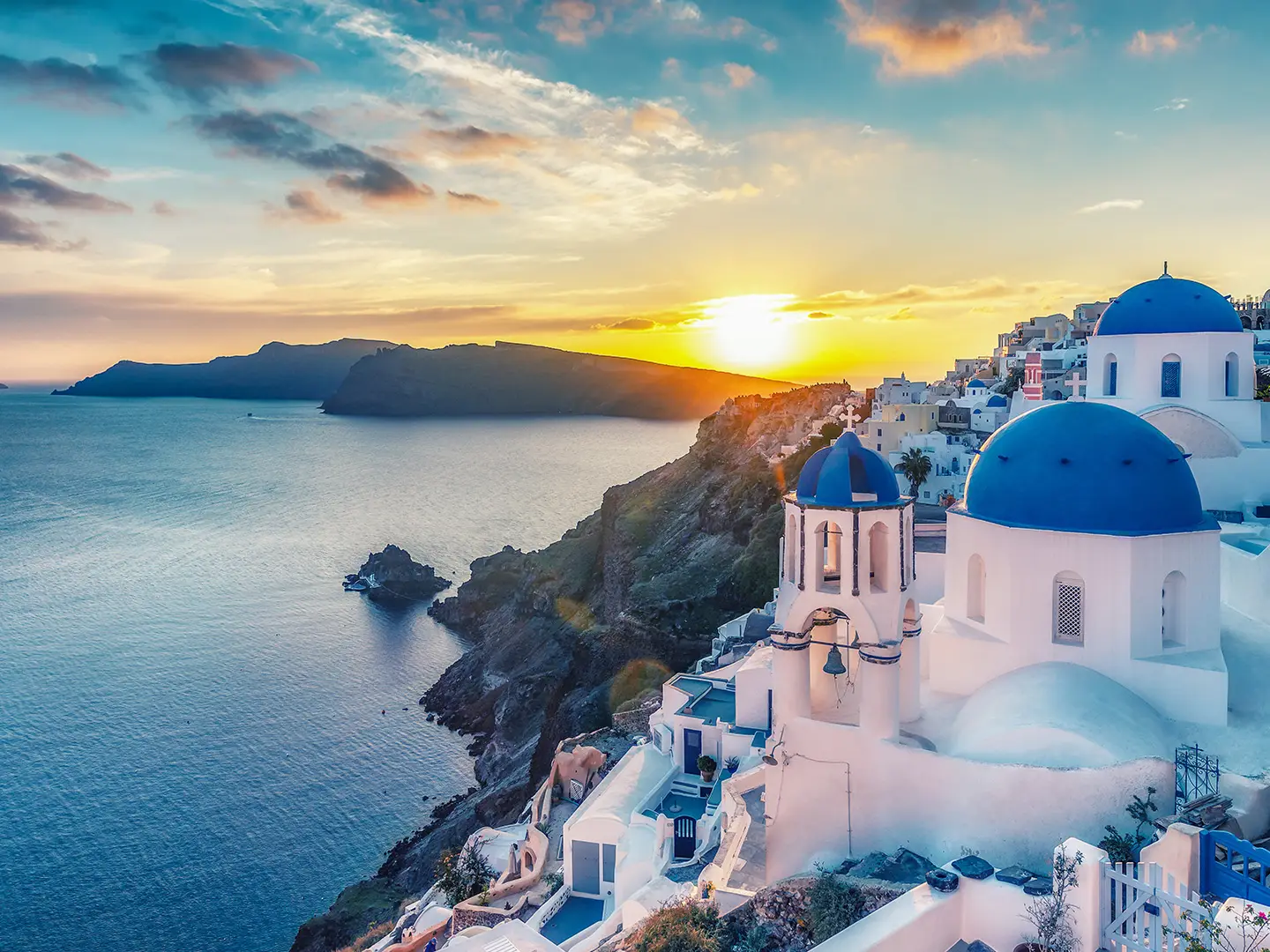
- Oia: The finish village, known for cave houses, blue domes, windmills and sunset views from the Byzantine castle ruins.
Challenges to expect
The trail has no technical sections, but do not underestimate the surfaces: cobbles, dirt and rocky path can be uneven, with several short steep climbs. Much of the walk is exposed on the caldera rim with minimal shade. In summer, heat is the main issue; start early, before about 11am, or walk late afternoon. For a more rugged Greek gorge walk, see the Aradena Gorge Trail.
HikeList Score
Fira to Oia Trail scored 75/100 on HikeList's trail-quality metrics.
See score breakdownHide breakdown
- Ideal length 55
- Balanced challenge 100
- Scenery & wildness 59
- Varied terrain 100
- Accommodation 74
- Food & support 74
- Path quality 84
- Season flexibility 76
Computed from length, challenge, scenery & wildness, terrain variety, accommodation, food & support, path quality and season flexibility.
 Greece
Show more data Show less
- Coastal
- Clifftop
- Urban
- Open Ridgeline
- Paved
- Cobblestone
- Dirt
- Rocky
- Hotels
- Guesthouses
- Family Friendly
- Pet Friendly
- Restrooms
- Water Sources
Download Our Full Guide to Fira to Oia Trail FREE!
Get our comprehensive guide to this hike for free. Save it for later reading or print out at home.

In these collections
Photos from hikers
Taken on the trail by people who've reviewed Fira to Oia Trail.
Fira to Oia Trail: The Complete Guide
Getting to the Start
The Fira to Oia Trail starts in Fira (Φηρά), Santorini’s clifftop capital. The practical aim is simple: get to Fira, then pick up the caldera-rim lanes leading north from the main square and the lanes above the old port cable car.
Most walkers either stay in Fira and walk straight from their accommodation, or stay in Oia (Οία / Ia) and take the local bus or a taxi to Fira before walking back along the rim.
By train
There is no train service on Santorini, and no rail connection to the island. Reaching the start involves arriving by ferry to Athinios port or by air to Santorini (Thira) airport, then continuing to Fira by local bus or taxi.
If travelling through mainland Greece or another island first, onward ferry and flight connections to Santorini change by season. This should be checked before travelling.
By bus
Fira is the main transport hub for local KTEL buses on Santorini, which makes it the easiest place on the island to start the walk using public transport.
Useful bus movements for this hike are:
| Journey | Use for hikers | Notes |
|---|---|---|
| Athinios port → Fira | Arrival by ferry | Continue from the port to Fira by bus or taxi. Current times should be checked before travelling. |
| Santorini (Thira) airport → Fira | Arrival by air | The airport is a short bus or taxi journey from Fira. Current times should be checked before travelling. |
| Oia → Fira | If staying in Oia and walking back to Oia | KTEL buses link Fira and Oia frequently in summer, roughly every 20–30 minutes, with a journey time of about 20 minutes. |
| Fira → Oia | If staying in Fira and returning after the walk | The same bus link is the usual return option after finishing in Oia. |
The Fira–Oia bus fare is around €2.20 one-way in 2026, but KTEL timetables and fares change seasonally, so confirm the current schedule and price on arrival.
A common mistake is to leave the return journey from Oia until immediately after sunset. Buses from Oia are very crowded at sunset time, so either allow extra waiting time, walk earlier in the day, or make a taxi plan in advance.
By car
A car is not necessary for this walk. The route is point-to-point, so driving to Fira only solves the start of the day; it still leaves the question of returning from Oia to the car.
If using a hire car, the simplest plan is usually to leave it at the accommodation and use the Fira–Oia bus one way. Specific parking and long-stay parking arrangements in Fira should be checked before travelling, especially in the busy summer season.
Taxis can be used between Fira and Oia or from the port/airport to Fira, but they are scarce and relatively pricey by local bus standards. Expect around €15–25 for a taxi on the island, depending on the journey and conditions; confirm the fare before setting off.
From the nearest airport
The nearest airport is Santorini (Thira) airport. From there, continue to Fira by local bus or taxi; it is a short transfer compared with the walking day itself.
If arriving on the morning of the hike in summer, take the heat seriously. The route is almost entirely unshaded, so a delayed flight or slow transfer can push the start into the hottest part of the day. In June, July and August, an early start before about 11am is the safer option, or a late-afternoon walk if transport back from Oia has been planned.
Where to stay before starting
Fira (Φηρά) is the most convenient base before the walk because the trail begins in town and the island’s bus network centres there. Staying in Fira also makes it easier to buy water and supplies before starting, although early-opening hours should not be assumed.
Firostefani (Φηροστεφάνι) and Imerovigli (Ημεροβίγλι) are also on the caldera rim north of Fira, but staying there shortens or alters the opening part of the walk rather than starting the full Fira-to-Oia route from the capital.
Oia (Οία / Ia) works well if the aim is to finish at the accommodation, but it means taking the bus or a taxi to Fira before starting. This is often better than trying to board an overcrowded bus back from Oia after sunset.
Accommodation on Santorini is expensive and heavily booked in peak season, particularly along the caldera rim. Book well ahead for Fira, Oia, Firostefani or Imerovigli, and confirm transport times separately before committing to a same-day arrival and walk.
Getting Home from the Finish
By train
There is no practical train option from the finish in Oia (Οία / Ia). Santorini’s onward transport for walkers is by local bus, taxi, ferry from Athinios port, or flight from Santorini (Thira) airport.
By bus
The simplest way to leave Oia is the KTEL bus back to Fira (Φηρά). In summer, buses between Oia and Fira run frequently, roughly every 20–30 minutes, with a journey time of about 20 minutes and a fare around €2.20 one-way in 2026.
Timetables and fares change seasonally, so check the current KTEL schedule before setting off or when arriving on Santorini. This matters especially if walking late in the day, as sunset-time buses from Oia are very crowded and queues can build quickly.
Fira is the island’s main transport hub. From there, you can continue by bus or taxi to Santorini (Thira) airport or Athinios ferry port, depending on your onward travel plans.
By car/taxi
Taxis are available on Santorini but can be scarce and expensive at busy times. A taxi between Oia and Fira is typically around €15–25, but current prices should be checked before relying on one.
If finishing around sunset, do not assume a taxi will be immediately available in Oia. Either leave time to queue for the bus, pre-arrange a transfer where possible, or stay overnight at the finish.
If a car has been left in Fira, the normal arrangement is to walk Fira to Oia and return by bus or taxi. Driving to Oia first and walking back is less useful for most hikers, as the classic direction is Fira → Oia and the return transport is straightforward.
From the nearest airport
The nearest airport is Santorini (Thira) airport. From Oia, the usual public-transport option is to take the bus back to Fira, then continue to the airport by bus or taxi.
Allow extra time if connecting to a flight after the walk. The Oia–Fira bus can be crowded in the evening, and onward airport connections depend on the current seasonal timetable. This should be checked before travelling.
Where to stay at the finish
Staying in Oia is the easiest option if you want to finish slowly, watch the sunset from the Kastro area, or avoid the crowded evening buses back to Fira. It also removes the pressure of making an onward connection after several exposed hours on the caldera path.
Accommodation in Oia is heavily geared towards caldera-view hotels, boutique cave-house suites and guesthouses. It is one of the most expensive places to stay on Santorini, with prices highest in summer, so book well ahead.
For better transport flexibility, staying in Fira is often more practical, as it is the island’s bus hub and has easier onward links to the airport and Athinios port. Firostefani (Φηροστεφάνι) and Imerovigli (Ημεροβίγλι) are also viable bases along the rim, but if the walk ends late in Oia, factor in the return bus or taxi before committing to accommodation elsewhere.
Which Direction Should You Walk?
Fira (Φηρά) to Oia (Οία / Ia): the standard direction
Fira to Oia is the normal and best direction for most walkers. It follows the classic south-to-north progression along the caldera rim: Fira, Firostefani, Imerovigli, the open ridge, then the final approach into Oia.
This direction also works well with the lie of the land. The route climbs early from Fira towards Imerovigli, the high point at roughly 350 m, then trends gradually downhill along the ridge towards Oia. There are still short climbs and rougher sections, but the overall feel after Imerovigli is more forgiving than walking the reverse.
The scenery also builds naturally. You start among the busy clifftop lanes of Fira, pass the quieter rim villages and the Skaros Rock (Σκάρος) detour, then move onto the more open dirt-and-rock section where Oia comes slowly into view ahead. Finishing among Oia’s cave houses, blue-domed churches and the Kastro is the most satisfying end to the walk, especially if timed for late afternoon or sunset.
The main drawback is transport after the finish. KTEL buses link Oia and Fira frequently in summer, but sunset-time buses back from Oia are very crowded. If finishing at sunset, allow patience for the return journey or consider a taxi, bearing in mind that taxis are scarce and relatively pricey.
Oia to Fira: when the reverse makes sense
Walking from Oia to Fira is perfectly possible, but it is less attractive for most hikers. The route is net uphill in this direction, with the long rise from Oia towards Imerovigli coming before the easier village lanes into Fira.
The reverse can make logistical sense if staying in Fira and wanting to avoid the crowded post-sunset bus from Oia. In that case, taking the bus to Oia first and walking back to Fira means the walk ends where many island services and onward connections are concentrated.
It can also suit anyone staying in Fira, Firostefani or Imerovigli who prefers to finish close to accommodation rather than travel back afterwards. The trade-off is that the classic caldera-rim approach into Oia is lost, and the most recognisable finish point becomes the busier streets of Fira rather than the north-western tip of the caldera.
Heat, light and practical timing
There is no meaningful direction that solves the main weather issue on this walk: exposure. The route is almost entirely unshaded, and summer heat matters far more than wind direction or gradient.
In June to August, start early or walk late afternoon into sunset. If walking late, Fira to Oia gives the stronger finish, but plan the return bus carefully and expect crowds. Current KTEL times and fares should be checked before travelling.
Recommendation
Walk Fira to Oia unless there is a specific transport reason to do otherwise. It is the traditional direction, has the best scenic progression, feels easier overall because it is net downhill, and gives the most rewarding finish at Oia and the Kastro.
Choose Oia to Fira only if avoiding the crowded return from Oia is more important than the classic finish, or if accommodation logistics make ending in Fira clearly simpler.
Accommodation Along the Route
This is a one-day walk, so accommodation planning is about choosing the right base rather than linking overnight stages. There are no huts, campsites, trail lodges or practical mid-route stage stops on the caldera-rim path itself; walkers normally stay in Fira (Φηρά), Oia (Οία / Ia), or one of the smaller rim villages between them.
Santorini is an expensive, upmarket resort island. Caldera-view hotels, boutique cave-house suites and guesthouses dominate the accommodation market, and prices peak in summer. Book well ahead, particularly for June-August and for stays in Oia around sunset.
| Place | Accommodation level | Best for | Notes |
|---|---|---|---|
| Fira (Φηρά) | Good | Easiest logistics, public transport, starting the walk early | The most practical base for many walkers. The trail starts from the clifftop capital, and buses/taxis connect with the airport, Athinios port and Oia. Staying here makes an early start straightforward. |
| Firostefani (Φηροστεφάνι) | Good | A quieter rim stay close to Fira | Immediately north of Fira on the walking route. Useful if you want caldera-rim accommodation without being in the busiest part of the capital. |
| Imerovigli (Ημεροβίγλι) | Good | Caldera views and a high-position base | The high point of the walk at about 350 m. A strong choice for walkers who want to stay on the rim and start part-way along the route, though this turns the full Fira-Oia walk into a shortened version unless you first walk or transfer back to Fira. |
| Skaros Rock (Σκάρος) | None | Day detour only | No accommodation on the spur itself. Stay in nearby Imerovigli if this is a priority. |
| Open ridge between Imerovigli and Oia | Limited to none | N/A | This is the exposed dirt-and-rock section of the route. Do not plan on finding lodging, shade or reliable services here. Carry water from the villages. |
| Oia (Οία / Ia) | Good | Finishing in the sunset village, post-walk stay | The classic finish point, with a large concentration of high-demand accommodation. Excellent if you want to end the walk and stay put, but book early in peak season. Sunset-time transport out of Oia can be very crowded. |
Best places to stay before the walk
Fira is the simplest pre-walk base. It puts you at the start of the route, gives easy access to shops and transport, and avoids needing a morning bus or taxi before walking.
Firostefani and Imerovigli also work well if accommodation availability or budget is better there, but they sit north of the official start. To walk the full route from Fira, you will need to begin by heading back to Fira or accept a shorter walk from your accommodation.
Best places to stay after the walk
Oia is the most convenient finish-night option. Staying there avoids the crowded sunset buses back to Fira and lets you leave the village on your own schedule the next morning.
If accommodation in Oia is too expensive or unavailable, returning to Fira by KTEL bus or taxi is the standard solution. Buses between Fira and Oia run frequently in summer, but times and fares change seasonally and should be checked before travelling. Taxis are available but can be scarce and pricey.
Booking pressure and seasonality
Accommodation pressure is highest in summer, when Santorini is both hot and extremely busy. Caldera-view rooms and cave-house suites in Oia, Imerovigli and Fira are often the first to become expensive or unavailable.
April-May and September-October are better walking months and still require advance booking if you want a specific village, caldera view or room style. Current prices and cancellation terms should be checked before booking.
Luggage, transfers and inn-to-inn practicality
Luggage transfer is usually unnecessary for this route because the walk takes only 3-5 hours and can be done as a day hike from one base. Most walkers leave luggage at their accommodation and use the bus or a taxi to solve the point-to-point logistics.
This is not an inn-to-inn walking route in the usual multi-day sense. It can be turned into a two-night plan by staying in Fira before the walk and Oia after it, but the walking itself remains a single short day rather than a staged trek.
Camping and Wild Camping
Is camping practical on the Fira to Oia Trail?
Camping is not a practical or necessary way to walk this route. The Fira (Φηρά) to Oia (Οία / Ia) trail is a 10.5 km one-day walk, normally completed in 3–5 hours, with accommodation based in the caldera-rim towns rather than on the path.
There are no trail campsites, huts or stage camps on the route itself. Most walkers stay in Fira, Oia, Firostefani (Φηροστεφάνι) or Imerovigli (Ημεροβίγλι), then use the local bus or a taxi to manage the point-to-point logistics.
Carrying camping gear adds little value here. The path is exposed, hot, uneven in places and almost entirely unshaded, so extra pack weight is a disadvantage rather than a benefit.
Wild camping on the caldera rim
Do not plan to wild camp on the Fira to Oia trail. The route passes through busy villages, hotel areas, church viewpoints, the Skaros (Σκάρος) area and an exposed caldera-rim ridge with limited flat ground, no reliable water and very little privacy.
Local rules and any restrictions on camping should be checked locally before travelling. In practice, pitching a tent on or beside this path is likely to be inappropriate because of the high visitor pressure, private property, fragile cliff-edge environment and cultural sites along the rim.
If overnight camping is being considered anywhere on Santorini/Thira (Θήρα), get clear local permission first and do not assume that undeveloped-looking land is available for camping. Never camp by churches, chapels, ruins, hotel terraces, viewpoints or close to the cliff edge.
Water, food and services
There is no dependable camping-style water access on the open ridge between Imerovigli and Oia. Services are concentrated in Fira, Firostefani, Imerovigli and Oia, with only an intermittent snack-bar option between Imerovigli and Oia.
For the day walk, buy water before setting out, especially for an early start when smaller shops may not yet be open. In summer, the lack of shade is the main safety issue, so water planning matters more than overnight logistics.
Fires, waste and Leave No Trace
Open fires are not appropriate on this route. The ridge is dry, exposed and busy in season, and any local fire restrictions must be followed.
Pack out all litter, including food waste and tissues. Use toilets and bins in the towns rather than treating the caldera rim as a backcountry campsite.
The best low-impact approach is simple: walk the route as a day hike, stay in established accommodation in Fira, Oia, Firostefani or Imerovigli, and leave the exposed ridge clear for other walkers.
Food, Water and Resupply
This is a short one-day walk, but water planning matters more than distance suggests. The Fira (Φηρά) to Oia (Οία / Ia) route is almost entirely unshaded, and the open ridge after Imerovigli (Ημεροβίγλι) can feel much hotter than the map distance implies.
Treat Fira, Firostefani (Φηροστεφάνι), Imerovigli and Oia as the dependable places to eat or buy supplies. Once beyond Imerovigli, food and drink become limited until Oia, with only one intermittent snack bar on the ridge section, so do not rely on finding anything open there.
How much to carry
For a normal 3–5 hour walk, carry enough food and water for the whole route rather than planning around stops. A light lunch or substantial snacks are usually enough if eating properly in Fira before starting or in Oia after finishing.
For water, carry at least enough for several hours in full sun. In spring and autumn, 1.5 litres per person is a sensible minimum for many walkers; in summer, 2 litres or more is more realistic, especially if starting late, walking with children, or adding the Skaros (Σκάρος) detour.
Buy water before setting out, ideally the evening before an early start. Small markets and kiosks may keep seasonal or irregular hours, and early-morning walkers should not assume everything will be open.
Water refills and natural sources
Do not plan on natural water sources. The trail follows dry caldera-rim lanes, cobbles, dirt and rocky ground, not a river valley, and there are no reliable streams or springs to filter from on the route.
Water refills are a town-and-village matter: buy bottled water or refill where staying, eating or shopping. Between Imerovigli and Oia, assume there is no dependable refill point.
Food availability by section
| Section | Food availability | Water availability | Notes |
|---|---|---|---|
| Fira (Φηρά) trailhead | Best place to start fed and stocked | Best place to fill bottles or buy water before starting | The island capital is the most practical place to organise breakfast, snacks and water before joining the caldera-edge lanes. |
| Fira to Firostefani (Φηροστεφάνι) | Good by route standards while still in village lanes | Possible to buy water while services are open | This is not the section to worry about, but do not delay water planning if walking early or late in the season. |
| Firostefani to Imerovigli (Ημεροβίγλι) | Last reliable village stretch before the more exposed ridge | Last reliable chance before the open section to Oia | Use Imerovigli as the final practical checkpoint for supplies, especially in hot weather. |
| Optional Skaros Rock (Σκάρος) detour | No resupply on the detour itself | Carry water from Imerovigli | The detour adds roughly 45–60 minutes and is exposed, so allow extra water if adding it. |
| Imerovigli to Profitis Ilias ridge chapel and onwards | Very limited; only one intermittent snack bar between Imerovigli and Oia | Do not rely on refills | This is the main dry, exposed section of the walk. Carry what you need before leaving Imerovigli. |
| Final approach into Oia (Οία / Ia) | Food available again once in the village | Water available again once in the village | Oia is busy, especially around sunset. If finishing late, expect crowds and allow time before the bus back. |
Timing, heat and seasonal hours
In June, July and August, the safest food-and-water strategy is to start early, before the strongest heat, or walk later in the day with enough water to reach Oia without resupply. The route is not long, but the lack of shade is the key risk.
Opening hours on Santorini vary by season and by individual business. Before relying on a particular shop, café or snack bar — especially outside peak summer, early in the morning, or late in the evening — this should be checked before travelling.
Terrain, Conditions and Difficulty in Practice
The Fira to Oia Trail is moderate because of heat, exposure and uneven surfaces rather than technical difficulty. There is no scrambling required on the main route, but it is not a smooth promenade for the full distance: expect a mix of cobbled lanes, paved village paths, dirt track and rocky caldera-rim trail.
The walk is also more tiring than its modest length suggests. It climbs steeply in places between Fira (Φηρά), Firostefani (Φηροστεφάνι) and Imerovigli (Ημεροβίγλι), then continues over an undulating, open ridge before the gradual descent towards Oia (Οία / Ia).
Surfaces underfoot
| Section | Typical surface | Practical notes |
|---|---|---|
| Fira to Firostefani | Paved and cobbled lanes, steps and village paths | Busy in season, with uneven cobbles and frequent photo stops slowing progress. |
| Firostefani to Imerovigli | Village lanes and stepped/climbing sections | The main early climb of the route; short but noticeably steep in warm weather. |
| Imerovigli to the open ridge | Transition from built-up lanes to rougher dirt and rock | This is where footwear starts to matter more; trainers with poor grip are less comfortable. |
| Open ridge past the Profitis Ilias chapel | Exposed dirt and rocky trail, with one short quiet-road section | The least sheltered and most walk-like part of the route; sun and wind are more important than navigation. |
| Final approach to Oia | Dirt/rock giving way to village lanes | Often busier near Oia, especially late afternoon and around sunset. |
The village sections can look deceptively easy, but polished cobbles, steps and uneven paving are tiring in light sandals. On the open sections, the surface becomes looser and rockier, with enough irregular ground to make proper walking shoes or grippy trail shoes a sensible choice.
Climbs, descents and effort
Although Fira to Oia is a net-downhill direction overall, it is not continuously downhill. The route rises out of Fira and reaches its high point around Imerovigli, at roughly 350 m, before descending gradually along the caldera rim towards Oia.
The total ascent is about 328 m, mostly made up of short climbs and rolling ground rather than one sustained mountain ascent. Fit walkers may find the route straightforward, but anyone expecting a flat coastal stroll will find the repeated ups and downs, steps and rougher trail sections make it a proper half-day hike.
The optional Skaros Rock (Σκάρος) detour below Imerovigli adds roughly 45–60 minutes. It also adds extra descent and re-ascent, so it is best treated as a separate spur rather than part of the easy flow of the main route.
Exposure, cliff edge and footing
The route follows the west-facing caldera rim for almost its whole length, with open views across the flooded volcanic crater. This gives the walk its appeal, but it also means long exposed stretches with very little shade.
The main route is not technical, but the cliff-edge setting requires sensible footing and attention, especially where the path is rough, dusty or crowded. Keep away from loose edges, take care when stopping for photographs, and avoid letting children run ahead on exposed sections.
Wind can make the open ridge feel more serious than the village lanes. Hats, loose items and lightweight bags should be secured, particularly on the unsheltered stretch beyond Imerovigli.
Heat and seasonal conditions
Heat is the main practical difficulty on this hike. In June to August the caldera rim can feel harsh by late morning because the route is almost entirely unshaded and the pale surfaces reflect sun strongly.
For summer walks, starting early before about 11am or walking late afternoon is the safest approach. A late start should still allow enough daylight for the rougher sections before reaching Oia, and sunset-time crowds and buses should be expected.
April–May and September–October are the most comfortable months, with warm conditions but less severe heat. Even then, carry water from the start rather than relying on finding supplies between Imerovigli and Oia.
Muddy or boggy ground is not a normal feature of this route. After rain, however, cobbles, dust over rock and steeper dirt sections can become slippery, so the route should still be treated as an uneven trail rather than a town walk.
Road walking, gates and obstacles
There is one short section sharing a quiet road. It is not the defining feature of the walk, but normal road awareness is needed, especially where walkers are distracted by views or traffic is passing between the villages.
This is not a countryside route of livestock fields, stiles, gates and fences. The practical obstacles are instead steps, cobbles, loose rock, exposed cliffside ground, heat and crowds through the popular viewpoints and village lanes.
What makes the route harder or easier
The route feels easiest when walked Fira to Oia, with the main village climb dealt with early and the long ridge trending down towards Oia. It also keeps the caldera views ahead for much of the walk.
It feels significantly harder in strong sun, with insufficient water, or in footwear chosen for town sightseeing rather than uneven trail. Crowds can also slow progress through Fira, Firostefani, Imerovigli and the final approach to Oia, particularly in peak season and near sunset.
For most reasonably fit walkers, the main trail is manageable in 3–5 hours with stops. The difficulty rises from “pleasant scenic walk” to “hot exposed hike” when walked in midsummer conditions, so sun protection, water and timing matter more than technical hiking ability.
Weather and Best Time to Walk
The best months for the Fira (Φηρά) to Oia (Οία / Ia) Trail are April–May and September–October. These shoulder-season periods usually give the best balance of warm walking weather, bearable temperatures and thinner crowds on the caldera-rim path.
The main weather hazard is heat and sun exposure, not altitude or technical terrain. The route is almost entirely unshaded, with open dirt and rocky sections between Imerovigli (Ημεροβίγλι) and Oia, so summer conditions can make an otherwise moderate walk feel much harder.
Seasonal planning
| Season | Practical implications for hikers |
|---|---|
| April–May | One of the best times to walk. Temperatures are generally more comfortable than summer, crowds are lighter, and the full 3–5 hour walk is usually realistic without needing a pre-dawn start. Carry water and sun protection regardless. |
| June–August | Walkable, but this is the hottest and busiest period. Start early, ideally before about 11am, or walk late afternoon if aiming to finish in Oia for sunset. Expect heavy crowds in Oia and very busy return buses around sunset. Accommodation prices peak in summer and should be booked well ahead. |
| September–October | Another excellent window. Heat is usually more manageable than midsummer, and the route remains well suited to a half-day walk. Sunset timing still matters if relying on the bus back from Oia. |
| Winter | The route is low altitude, with its high point at Imerovigli around 350 m, so it is not a mountain pass walk with a normal snow-season barrier. However, daylight is shorter and transport, accommodation and services may run to different seasonal patterns. This should be checked before travelling. |
Heat, sun and timing
There is very little shade once beyond the built-up lanes of Fira, Firostefani (Φηροστεφάνι) and Imerovigli. The exposed ridge towards Oia can feel hot even when the distance looks modest on paper.
In summer, avoid starting in the middle of the day. Carry more water than seems necessary for a 10.5 km walk, buy it before setting off, and do not rely on finding regular services between Imerovigli and Oia.
A late-afternoon start is popular because it lines up with the sunset finish in Oia, but it has two drawbacks: the final village is extremely busy, and buses back towards Fira can be crowded. If catching public transport after sunset, build in waiting time.
Rain, wind and trail surface
The trail mixes cobbled village lanes, dirt track, rock and uneven steps. In dry weather this is straightforward underfoot for reasonably fit walkers, but wet stone and dusty rock can both be slippery, especially on the short steeper climbs and descents.
The caldera rim is open and exposed. Strong wind, poor visibility or stormy weather would make the cliff-edge sections less comfortable, and the walk is best postponed rather than treated as an all-weather objective.
Daylight and winter realism
The usual walking time is about 3–5 hours one-way, with roughly 45–60 minutes extra for the Skaros Rock (Σκάρος) detour. That makes the route realistic in a single day year-round if conditions are settled and the start is not too late.
In winter or outside the main visitor season, check current KTEL bus times, accommodation availability and any reduced local services before committing to a point-to-point plan. The walk itself has no hut or mountain infrastructure to close, but the logistics around it are seasonal.
Safety Notes
Main hazards on this route
The Fira (Φηρά) to Oia (Οία / Ia) trail is not technical, but it is more exposed than its distance suggests. The main safety issues are heat, sun exposure, uneven surfaces and the temptation to get too close to the caldera edge for photographs.
After Imerovigli (Ημεροβίγλι), the walk becomes an open dirt-and-rock ridge with almost no shade and fewer easy exit points. Treat this middle section as a proper day hike, not just a village stroll.
Emergency help
In Greece, dial 112 for emergency assistance. Keep a charged phone with you, but do not rely on a phone alone for navigation or safety.
Mobile coverage can vary by network and location, especially around cliffs and folds in the terrain. This should be checked before travelling if you are relying on a particular mobile provider or roaming plan.
Heat, sun and timing
Summer heat is the key risk on this walk. From June to August, start early — ideally before about 11am — or walk later in the afternoon if you are comfortable finishing in Oia around sunset.
There is almost no shade on the exposed ridge between Imerovigli and Oia. Wear a hat, sunglasses and high-factor sun cream, and carry more water than seems necessary for a 10.5 km walk.
Do not assume you can refill between villages. There is only limited intermittent provision between Imerovigli and Oia, so buy water before leaving Fira or Imerovigli; if starting very early, buy supplies the night before.
Footing and cliff-edge awareness
The route uses paved lanes, cobbles, dirt track and rocky path. Trainers with poor grip, sandals and smooth-soled shoes are a common cause of slips, especially on cobbles and loose dusty ground.
Keep well back from cliff edges and unfenced drops. The caldera views are the reason for the walk, but photo stops should be taken from stable ground away from the edge.
The optional Skaros Rock (Σκάρος) detour adds extra time and descent/ascent below Imerovigli. Skip it if you are short of water, late in the day, uncomfortable on exposed ground, or already finding the heat difficult.
Road section and village walking
The route includes one short section shared with a quiet road. Walk facing traffic where practical, stay visible, and be particularly alert if tired, distracted by views or walking near sunset.
In Fira, Firostefani and Imerovigli, the route passes through busy lanes and stepped village areas. Watch for uneven steps, polished paving and crowds around viewpoints.
Solo hiking and sunset finishes
Solo walkers should tell someone their intended direction and expected finish time, especially if walking late afternoon into sunset. The route is popular, but the open ridge is still exposed and should not be treated casually.
If planning to return from Oia by bus after sunset, expect crowds. Avoid leaving the walk so late that missing a bus creates a problem; taxis on Santorini are scarce and can be expensive.
Checks before setting off
Before starting, check:
- the day’s heat and weather conditions;
- that you have enough water for the full exposed section;
- current KTEL bus times and fares if using public transport back from Oia;
- phone battery, offline map access and roaming settings;
- footwear suitable for cobbles, dirt and rocky ground;
- whether the Skaros Rock detour is sensible in the conditions and available time.
There are no river crossings, tidal hazards or livestock issues that materially affect normal planning for this route.
Gear Recommendations
This is a short day walk, but it is not a casual promenade for beachwear. The route mixes polished village paving, uneven cobbles, dirt track and rocky caldera-rim path, with almost no shade after Imerovigli (Ημεροβίγλι). Pack for heat, glare and rough footing rather than for distance.
Footwear
Wear grippy trail shoes, light hiking shoes or comfortable walking trainers with a firm sole. The open ridge to Oia (Οία / Ia) has loose dirt and rock, and the village sections include steps and uneven cobbles.
Flip-flops, smooth-soled sandals and fashion trainers are poor choices, especially if adding the Skaros Rock (Σκάρος) spur below Imerovigli. The trail is not technical, but hot feet, slipping on cobbles and sore soles are common avoidable problems on this route.
Sun, heat and water
Sun protection is essential. Carry a wide-brimmed hat or cap, sunglasses, high-factor sunscreen and a light long-sleeved layer if walking in strong sun. There is very little natural shade between the caldera-rim villages, and summer heat is the main safety issue on the Fira (Φηρά) to Oia walk.
Most walkers should carry at least 1.5–2 litres of water; in June–August, or if walking late afternoon into sunset, carry more. Do not rely on finding water on the ridge after Imerovigli: there is only one intermittent snack bar between Imerovigli and Oia, so buy water before setting out, ideally the night before if starting early.
Electrolyte tablets or a salty snack are useful in hot weather. The route is only 10.5 km, but the exposed volcanic terrain and reflected glare make dehydration more likely than the distance suggests.
Clothing and weather protection
In settled summer weather, lightweight breathable clothing is more useful than heavy waterproof gear. A thin windproof or very light waterproof shell is still sensible in spring and autumn, when the caldera rim can feel exposed.
Pack a light warm layer if starting early, lingering in Oia for sunset, or walking outside peak summer. The walk climbs to Imerovigli at roughly 350 m before descending towards Oia, and wind on the open ridge can make stops feel cooler than the villages.
Navigation and electronics
The Fira to Oia Trail is a well-trodden caldera-rim path, not a formally waymarked national trail. It is generally easy to follow, but an offline map on a phone is strongly recommended, especially for the transition through Firostefani (Φηροστεφάνι) and Imerovigli and the short quiet-road section.
A power bank is useful if using the phone for navigation, photos and bus information after finishing in Oia. Phone batteries drain quickly in heat and bright sun, and many walkers spend extra time in Oia around sunset before taking the bus back to Fira.
Food carry
Carry snacks even if planning to eat in Fira or Oia. A light lunch, fruit, nuts or energy bars are enough for most walkers, but there are limited reliable options on the exposed section after Imerovigli.
If starting very early to avoid the heat, buy food and water in advance. Some shops and cafés may not be open when early walkers leave Fira.
Trekking poles
Trekking poles are optional. They can help on the short steep climbs and descents, on the rough dirt-and-rock ridge, and for walkers with knee issues.
They are less convenient in the built-up village sections, where there are cobbles, steps and narrow pedestrian lanes. If bringing poles, collapsible poles are the most practical choice.
Camping gear
Do not carry camping gear for this route. The Fira to Oia walk is a one-day point-to-point hike with accommodation in towns and villages such as Fira, Firostefani, Imerovigli and Oia; there are no huts, campsites or multi-day stages on the trail itself.
A small daypack is sufficient. Carrying a large backpack will make the exposed ridge hotter and the village steps more awkward.
Different hiker setups
| Hiker type | Recommended setup |
|---|---|
| Town-based / inn-to-inn walkers | Small daypack, trail shoes, 1.5–2+ litres of water, sun protection, snacks, light shell, offline map and power bank. Leave luggage at accommodation in Fira or Oia where possible. |
| Campers | Camping kit is unnecessary and inappropriate for this one-day route. Use town accommodation and walk with a daypack only. |
| Fast walkers / section hikers | Minimal kit is fine, but do not strip out water, sun protection or navigation. Even a quick 2.5–3 hour crossing is fully exposed and still includes rough ground after Imerovigli. |
| Families and casual walkers | Prioritise comfortable footwear, extra water, hats, sunscreen and regular breaks in the villages. Avoid starting in the hottest part of the day in summer. |
Seasonal extras
For April–May and September–October, add a light windproof layer and consider a compact waterproof. These shoulder-season months are the most comfortable for walking, but the ridge is still exposed.
For June–August, reduce pack weight but increase water capacity and sun protection. Start early before the main heat or walk late afternoon towards sunset, allowing enough daylight for the rougher ridge section before Oia.
Budget and Costs
The Fira (Φηρά) to Oia (Οία / Ia) trail is cheap to walk but not necessarily cheap to stay near. There is no permit, hut fee or stage accommodation cost: the main expense is Santorini accommodation, followed by food and the short local transport needed for the point-to-point logistics.
Main cost items
| Cost item | What to budget for |
|---|---|
| Trail access | No walking fee is needed for the caldera-rim path. |
| Accommodation | Stay in Fira, Oia, Firostefani or Imerovigli. Santorini is an expensive resort island, with caldera-view hotels, cave-house suites and guesthouses dominating the rim villages. Prices peak in summer; book well ahead and check current prices before booking. |
| Food and drink | This is a day-walk cost rather than a multi-day resupply problem. Budget for breakfast, trail snacks, plenty of water and, if finishing late, a meal or drink in Oia. Carry water from the start, as the open ridge between Imerovigli and Oia has very limited services. |
| Bus | The KTEL bus between Fira and Oia is the cheapest transport option, around €2.20 one-way in 2026. Timetables and fares change seasonally, so check current details before travelling. |
| Taxi | Taxis between Fira and Oia are typically around €15–25, but they are scarce and relatively pricey for the short distance. Agree or confirm the fare before setting off. |
| Luggage transfer | Not normally relevant. This is a one-day walk, and most walkers leave luggage at their accommodation or travel with a small daypack only. |
| Camping / huts | Not relevant to the route itself. There are no en-route huts or stage lodgings on this walk. |
| Guided packages | A guide is not necessary for most independent walkers, as this is a straightforward day walk rather than a remote trek. Any guided or private walking service should be priced and checked directly before booking. |
Budget approach
The lowest-cost version is to use Fira as the transport base, take the KTEL bus one way and walk the other. A one-way bus fare is around €2.20 in 2026, making local transport a minor part of the day’s cost.
Keep food costs down by buying water and snacks before starting, rather than relying on cafés or shops along the rim. This is also practical: there is almost no shade, and the section after Imerovigli is exposed with limited places to buy supplies.
Accommodation is the difficult part of a budget Santorini trip. To reduce costs, avoid peak summer where possible, book early, and compare non-luxury guesthouses rather than assuming the caldera rim will offer cheap last-minute rooms.
Mid-range approach
A mid-range plan usually means staying in Fira, Firostefani or Imerovigli, walking to Oia, then taking the bus back after the hike. This keeps transport cheap while allowing an easier start from the caldera villages.
Allow for a café stop or meal at either end, plus extra bottled water in hot weather. If finishing in Oia for sunset, expect the return bus to be very crowded; building in waiting time avoids needing an expensive last-minute taxi.
Comfortable approach
The comfortable version is to stay on the caldera rim, possibly in Oia or Imerovigli, and use taxis where convenient. A taxi between Fira and Oia is typically around €15–25, though availability can be poor at busy times.
This approach is less about trail costs and more about Santorini accommodation. Caldera-view hotels and boutique cave-house suites can be the largest expense by a wide margin, especially from June to August. Current room prices should be checked before booking, and early reservations matter in the high season.
Practical budgeting tips
- Carry more water than seems necessary, especially from late spring to early autumn; buying water before the walk is cheaper and safer than depending on the exposed ridge section.
- If using the bus after sunset in Oia, expect queues and crowding. A taxi may save time but costs much more and may not be easy to find.
- There is no need to pay for luggage transfer, specialist hiking logistics or a support package for this route.
- The best way to control total cost is by choosing travel dates and accommodation carefully; the walk itself is inexpensive.
Luggage Transfer, Guided Tours and Support Services
Luggage transfer
A dedicated luggage-transfer service is usually unnecessary on the Fira (Φηρά) to Oia (Οία / Ia) Trail. This is a single-day, point-to-point walk of about 10.5 km, with no overnight stages, huts or remote accommodation stops.
Most walkers should leave their main luggage at their accommodation and walk with a small daypack only: water, sun protection, snacks, phone, light layer and any essentials needed for the bus or taxi return. If changing hotels between Fira and Oia, arrange baggage movement directly with the accommodation or by taxi. Availability, cost and timing should be checked before travelling.
Because taxis on Santorini can be scarce and relatively expensive, do not rely on finding one instantly at peak times, especially around sunset in Oia. A taxi between Fira and Oia is typically around €15-25, but current prices should be checked when booking.
Guided walks
A guide is not essential for navigation. The route follows the caldera-rim path through Fira, Firostefani (Φηροστεφάνι), Imerovigli (Ημεροβίγλι) and onwards along the open ridge to Oia, and it is generally easy to follow despite not being a formal waymarked national trail.
A guided walk can still be worthwhile for hikers who want interpretation of the caldera, the volcanic landscape, the villages, Skaros Rock (Σκάρος) and Santorini’s history, or who prefer not to manage timing, heat and transport independently. Guided options are most useful for first-time visitors with limited time, families wanting a structured outing, or anyone planning a sunset finish without dealing with logistics on the day.
Guided walks should be booked ahead in the busier months. Start time matters more than route-finding: in summer, an early start or a late-afternoon departure is far more comfortable than walking through the hottest part of the day.
Self-guided packages
A formal self-guided walking-holiday package is not normally needed for this trail alone. There is only one walking day, no baggage chain, and the start and finish are linked by public bus and taxi.
A package may make sense only if the Fira to Oia walk is being included as part of a wider Santorini or Cyclades itinerary. In that case, expect the useful inclusions to be accommodation booking, local transfers, route notes and general support rather than trail-specific luggage logistics.
Transfers and practical support
The simplest support service is the local KTEL bus between Fira and Oia. In summer it runs frequently, roughly every 20-30 minutes, takes about 20 minutes, and costs around €2.20 one way in 2026. Timetables and fares change seasonally, so check current details before travelling.
Many walkers take the bus one way and walk the other. For the usual Fira to Oia direction, either stay in Fira and bus back after the walk, or stay in Oia and bus to Fira before starting. Sunset buses from Oia are very crowded, so allow extra time and have a backup plan if travelling onward that evening.
Taxis are useful for early starts, late returns, hotel changes or connections to Santorini (Thira) airport and Athinios port, but they are not the cheapest or most reliable option at busy times. Book ahead where possible, particularly in high season and around sunset.
Shorter Hikes and Best Sections
Because the full Fira to Oia Trail is only 10.5 km, there are no formal stages, huts or logical multi-day sections. Shorter options are best treated as half-day walks from Fira (Φηρά), Firostefani (Φηροστεφάνι), Imerovigli (Ημεροβίγλι) or Oia (Οία / Ia), using buses or taxis where practical.
For partial walks, exact distance depends on the village lanes and viewpoints used. Use the full-route distance of 10.5 km as the reliable benchmark and measure any shorter variant on a current map before setting out.
| Best for | Start → finish | Approx distance / time | Why choose it | Transport notes |
|---|---|---|---|---|
| Best full day walk | Fira → Oia | 10.5 km; allow 3–5 hours | The classic caldera-rim traverse, with the high point at Imerovigli and the long open ridge into Oia. | Use the KTEL bus one way between Fira and Oia; summer services are frequent but sunset buses from Oia are very crowded. |
| Best short village-and-view section | Fira → Firostefani → Imerovigli | Shorter than the full route; exact distance should be measured before walking | Gives a strong sample of the caldera-rim villages, including Firostefani, the Three Bells of Thira and the climb to Imerovigli, without committing to the exposed ridge to Oia. | Easiest as an out-and-back from Fira. Any bus or taxi return from Imerovigli should be checked before travelling. |
| Best scenery section | Imerovigli → Profitis Ilias ridge chapel → Oia | Less than the full 10.5 km; exact distance should be measured before walking | This is the most open and exposed part of the route, with dirt-and-rock trail, fewer village distractions and wide caldera views towards Oia. | Best if a drop-off or taxi to Imerovigli is arranged. From Oia, the KTEL bus returns to Fira; avoid relying on the last crowded sunset departures. |
| Best add-on | Imerovigli → Skaros Rock → return to main trail | Add roughly 45–60 minutes | The Skaros Rock spur is the main optional detour, leading to the volcanic promontory below Imerovigli and the ruins of the former Venetian fortress. | No separate transport is needed if adding it to the main walk. If doing Skaros only, start from Imerovigli and return the same way. |
| Best for beginners | Fira → Firostefani → Three Bells of Thira → return | Short out-and-back; exact distance should be measured before walking | This keeps the walk close to settlements, avoids the wilder unshaded ridge and still gives immediate caldera views. | Start and finish in Fira, where onward buses and taxis are easiest to arrange. |
| Best for public transport | Fira → Oia | 10.5 km; allow 3–5 hours | The end-to-end route works best with the known Fira–Oia bus link, avoiding uncertainty over intermediate pick-ups. | KTEL buses link Fira and Oia; check current times and fares before setting out. Taxis are scarcer and more expensive. |
| Best for villages and accommodation | Fira → Firostefani → Imerovigli, or full Fira → Oia | Variable; full route 10.5 km | The southern half links the main rim villages most directly; the full route adds the finish among Oia’s cave houses, churches and castle area. | Stay in Fira, Firostefani, Imerovigli or Oia. Accommodation is town-based rather than trail-based and should be booked well ahead in peak season. |
Weekend and 3–5 Day Options
This is not a weekend-stage or 3–5 day trekking route. There are no en-route huts, no camping stages and no meaningful way to divide 10.5 km into a long-distance itinerary.
For a weekend, the most practical plan is to stay in Fira, Firostefani, Imerovigli or Oia, then walk either the full Fira–Oia route or one of the shorter out-and-back sections above. A second day is better used for rest, transport flexibility or village time rather than trying to create artificial hiking stages.
Camping
Camping is not part of the Fira to Oia Trail. Plan to stay in the towns and villages on the caldera rim rather than carrying camping gear for this walk.
Highlights and Points of Interest
The Fira to Oia Trail is rich in viewpoints rather than formal attractions, so the best use of extra time is usually at the caldera-edge villages, Skaros Rock and the final approach into Oia. The open middle section is memorable for its views, but it is exposed and unshaded, so linger there only if the heat is manageable and enough water has been carried.
Fira (Φηρά): clifftop trailhead and first caldera views
Fira is the island’s clifftop capital and gives the walk an immediate sense of scale. From the main square and caldera-edge lanes above the old port cable car, the route quickly picks up views down into the flooded volcanic basin.
Allow a little time here if starting early, especially for the stepped lanes and whitewashed buildings along the rim. It is also the most practical place to buy water and snacks before leaving the busier town section.
Firostefani (Φηροστεφάνι) and the Three Bells of Thira
Just north of Fira, Firostefani is a quieter caldera-rim hamlet and one of the easiest places to pause without committing to a detour. The standout landmark is the Three Bells of Thira, the blue-domed bell tower of the Church of Anastaseos, also known as Agios Theodoros.
This is one of Santorini’s most photographed church views, with the white bell tower, blue dome and caldera behind it. It is best treated as a short stop rather than a long break, as the route continues climbing towards Imerovigli.
Imerovigli (Ημεροβίγλι): the high point of the walk
Imerovigli is the highest of the caldera-rim villages, at roughly 350 m, and the high point of the trail. Its position gives the widest panorama over the caldera, the volcanic islets and the open Aegean.
This is one of the best places to spend extra time, especially before committing to the more exposed dirt-and-rock section towards Oia. It is also the decision point for the optional Skaros Rock detour.
Skaros Rock (Σκάρος): optional historic detour
Skaros Rock is the main optional side trip on the Fira to Oia walk. The spur drops below Imerovigli onto a volcanic promontory topped by the ruins of a 13th-century Venetian fortress, La Roka, built around 1207.
Historically, Skaros was Santorini’s fortified capital before earthquakes drove settlement towards Fira and Imerovigli. The detour adds roughly 45–60 minutes, so it is best saved for walkers with an early start, enough water and a comfortable margin before sunset or return transport.
The caldera and volcanic islets
The dominant natural feature is the Santorini caldera itself: a vast sea-filled volcanic crater formed by the Bronze-Age Minoan eruption. For much of the walk, the cliff drops more than 300 m towards the dark-blue basin below.
Nea Kameni and Palea Kameni sit in the centre of the caldera and remain visible through much of the route. Nea Kameni is the young black volcanic island and active vent that has grown through repeated eruptions since the 18th century.
Open ridge towards Oia and the Profitis Ilias chapel
Beyond Imerovigli, the route becomes wilder and more exposed, leaving the paved and cobbled village lanes for dirt and rocky trail. This section, past the small Profitis Ilias ridge chapel, is where the crowds often thin and the long view towards Oia opens up.
Do not confuse this chapel with Mount Profitis Ilias, Santorini’s true summit, which is off-route to the south-east. The ridge section has almost no shade, so it is a place for steady walking rather than a long midday stop in hot weather.
Oia (Οία / Ia): cave houses, windmills and the Kastro
Oia is the classic finish, set on the north-western tip of the caldera rim. The village is known for its cave houses, blue-domed churches, old windmills and tightly packed lanes above the sea.
The ruined Byzantine/Venetian castle, the Kastro, is the best-known sunset viewpoint. If timing the walk to finish at sunset, allow extra time for crowds in Oia and expect buses back towards Fira to be very busy afterwards.
Common Mistakes and Planning Tips
Mistake: treating the walk as a short sightseeing stroll
The Fira (Φηρά) to Oia (Οία / Ia) trail is only about 10.5 km, but it is not a flat promenade. The route climbs and descends along the caldera rim, with uneven cobbles, dirt, rock and a short shared-road section.
Fix: wear proper walking shoes or grippy trainers, not beach sandals. Allow 3–5 hours rather than planning it as a quick transfer between villages, especially if stopping often for photos or adding Skaros Rock (Σκάρος).
Mistake: starting too late in hot weather
The main hazard on this route is exposure. There is almost no shade between the villages, and the open ridge from Imerovigli (Ημεροβίγλι) towards Oia is particularly unforgiving in summer.
Fix: in June–August, start early, before about 11am, or walk late afternoon into sunset. In April–May and September–October conditions are usually more comfortable, but sun protection is still essential.
Mistake: not carrying enough water
It is easy to assume that a walk linking famous villages will have regular shops and cafés all the way. In practice, services thin out after Imerovigli, and there is only one intermittent snack bar between Imerovigli and Oia.
Fix: buy water before setting out, ideally the night before if starting early. Carry enough for the full exposed section to Oia, plus extra in hot weather.
Mistake: relying on waymarks alone
This is a well-trodden caldera-rim path, not a formally waymarked national trail. Through Fira, Firostefani (Φηροστεφάνι) and Imerovigli the route uses village lanes, then becomes a rougher open path with one short quiet-road section.
Fix: keep the caldera on the left when walking Fira to Oia, and use an offline map or saved route track for the village exits and the road section. Do not expect continuous official trail markers.
Mistake: leaving transport from Oia until the last minute
Most walkers use the KTEL bus between Fira and Oia and walk one way. The bus is inexpensive, but sunset-time buses back from Oia can be very crowded, and taxis are scarce and pricey.
Fix: check the current KTEL timetable and fare before setting out; schedules change seasonally. In summer, either leave time to queue after sunset or avoid planning a tight onward connection from Fira.
Mistake: underestimating accommodation demand and prices
Santorini is an expensive resort island, and caldera-rim accommodation in Fira, Firostefani, Imerovigli and Oia books up early, especially in summer. Last-minute rooms with caldera views can be very costly.
Fix: book accommodation well ahead if staying on the rim. If budget matters, compare Fira, Firostefani, Imerovigli and Oia rather than assuming the finish village will be the easiest or cheapest place to stay.
Mistake: adding Skaros Rock without allowing time
Skaros Rock is a worthwhile optional spur below Imerovigli, but it is not part of the direct Fira–Oia line. The detour adds roughly 45–60 minutes and involves extra descent and climb.
Fix: decide at Imerovigli based on heat, daylight and energy. If walking late afternoon to reach Oia for sunset, build the detour into the schedule rather than adding it casually.
Mistake: confusing the Profitis Ilias ridge chapel with the island summit
The route passes the small Profitis Ilias ridge chapel on the way towards Oia. This is not Mount Profitis Ilias, the true summit of Santorini, which lies off-route to the south-east.
Fix: do not plan for a summit diversion here. Treat the chapel as an on-route landmark on the caldera-rim path, not as a high mountain objective.
Mistake: walking into sunset without a return plan
Finishing in Oia for sunset is popular, especially around the ruined castle (Kastro). That also means the village and buses can be at their busiest just when many walkers are ready to leave.
Fix: if sunset is the goal, accept that the return to Fira may take longer than the bus ride itself suggests. Check bus times, keep some flexibility in dinner or onward plans, and do not rely on finding a taxi immediately.
Final Advice
The Fira to Oia Trail is best for walkers who want Santorini’s caldera scenery in a single, manageable day rather than a technical mountain route. Reasonable fitness is enough, but the walk should not be underestimated: the combination of heat, glare, uneven stone and exposed dirt trail is what makes it feel harder than the distance suggests.
The main thing to plan carefully is timing. In spring and autumn, the route is at its best; in June to August, start early or walk late afternoon, and carry more water than seems necessary. There is almost no shade after the villages, and services between Imerovigli (Ημεροβίγλι) and Oia (Οία / Ia) are limited.
For most walkers, the full one-way walk from Fira (Φηρά) to Oia is the right way to do it. It gives the best progression along the caldera rim, reaches the high point around Imerovigli early, and then follows the open ridge towards Oia with the finish ahead. Treating it as a section walk is only really useful if heat, time or fitness make the full 10.5 km too much.
The most rewarding stretch is the less built-up ridge beyond Imerovigli, especially once the path leaves the village lanes and opens towards the volcanic islets and Oia. The optional Skaros Rock (Σκάρος) detour is worthwhile if conditions are cool enough and time allows, but it adds roughly 45–60 minutes and should not replace carrying enough water for the main route.
Finish logistics matter. The KTEL bus between Fira and Oia is the simplest way to make the point-to-point route work, but timetables and fares should be checked before travelling, and sunset buses from Oia can be very crowded. Anyone planning to end at sunset should either allow patience for the return journey or budget for a taxi, noting that taxis are limited and relatively expensive.
The final recommendation is simple: wear proper footwear, buy water before setting out, avoid the hottest part of the day, and do not let the popularity of the route make it feel casual. Walked in the right conditions, this is one of the most satisfying short coastal-rim hikes in the Cyclades.
Reviews
How would you rate Fira to Oia Trail?
Tap a star to start your review — you could be the first.