
Contents
If you are choosing Pennine Way vs Coast to Coast, the short answer is this: both are tough, multi-week British classics, but they suit different walkers. The Wainwright Coast to Coast is shorter, more varied and more sociable, and is the more common choice for a first big British long-distance walk; the Pennine Way is longer, wilder, boggier and more remote — a serious endurance rite of passage.
Choose the Coast to Coast for variety and company. Choose the Pennine Way to test yourself against the backbone of England.
There is no wrong answer here, only the right one for your legs, your confidence and your appetite for solitude. If you are still working out what kind of multi-week trail suits you, HikeList’s guide to how to choose your first long-distance hike is a useful companion to this comparison.
The two trails at a glance
The Pennine Way and the Wainwright Coast to Coast are both Strenuous, point-to-point walks across northern England, but they feel very different on the ground. One is a long upland traverse of Britain’s original National Trail; the other is a sea-to-sea crossing with a changing cast of landscapes and villages.
| Factor | Pennine Way | Wainwright Coast to Coast |
|---|---|---|
| Distance | 431 km | 306 km |
| Typical duration | 16-19 days | 12-15 days |
| Total ascent | Approximately 12,000 m | Approximately 8,500 m |
| Difficulty | Strenuous | Strenuous |
| Route / endpoints | Edale, in the northern Derbyshire Peak District, to Kirk Yetholm, just inside the Scottish Borders | St Bees, on the Irish Sea coast in Cumbria, to Robin Hood’s Bay, on the North Sea coast in North Yorkshire |
| Scenery | Pennine hills, Yorkshire Dales and Northumberland National Park; wilder, higher, more consistently upland | Lake District, Yorkshire Dales and North York Moors; coastal, mountainous, moorland, pastoral, lowland and woodland terrain |
| Remoteness | More remote, with long open-moorland sections and extended stretches far from settlements | More village-to-village, though the Lake District section is mountainous and genuinely tough |
| Waymarking & status | Britain’s first National Trail, opened in 1965; waymarked with the National Trail acorn | Devised by Alfred Wainwright and officially opened as a National Trail on 26 March 2026 |
| Suits a first big British trail? | Better for confident walkers who want a bigger endurance challenge | The more common first big British long-distance walk |
The table tells you the basics, but not the whole story. Both trails feel harder underfoot than the raw numbers suggest, especially when the weather turns and the days start stacking up.
Distance and days
The Coast to Coast is 306 km and is usually walked in about 12-15 days. The Pennine Way is 431 km and typically takes 16-19 days.
That difference of roughly 125 km is not just a bigger number on paper. It means several extra days of walking, more annual leave, more accommodation to fund and book, and more chances for bad weather, sore feet or a small niggle to become a real problem.
In practical terms, the Coast to Coast is the more attainable bite for most people’s time and budget; it usually fits into a two-week window. The Pennine Way is a bigger commitment in every sense — you need to be ready not just for more ascent, but for the cumulative effect of another full working week on trail.
If you are not sure what daily pace is realistic, start with your own walking history rather than someone else’s itinerary. HikeList’s guide to how many kilometres to walk per day is worth reading before you book anything non-refundable.
Difficulty and terrain underfoot
Both trails are rated Strenuous on HikeList. The difference is how they earn that rating.
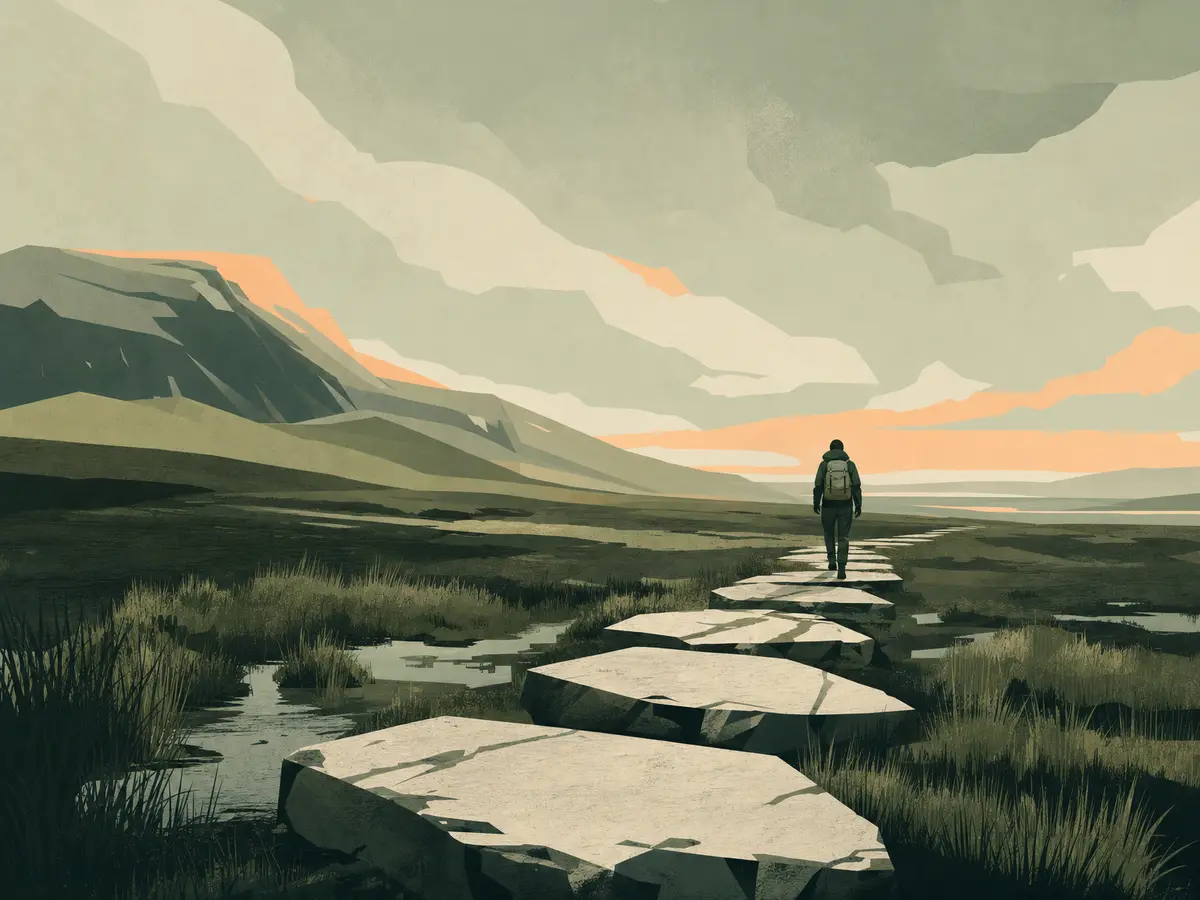
The Pennine Way has approximately 12,000 m of total ascent over 431 km. It is famous for peat bog, rough open moorland and exposure to serious weather on the high tops. Stone-flag paths have been laid across some of the worst boggy sections, but do not mistake that for easy walking; in my experience, wet moorland has a way of making every step feel slightly more expensive.
The Coast to Coast has approximately 8,500 m of total ascent over 306 km. It is genuinely tough too, especially the mountainous Lake District opening, where there is little flat walking. But its difficulty comes in chapters: hard upland days, then more varied walking between them.
So, which is harder, Pennine Way or Coast to Coast? The Pennine Way is harder overall — longer, more ascent, rougher ground more consistently, and more demanding of your navigation and self-sufficiency. The Coast to Coast is not a soft option; it is just a slightly gentler introduction to the format, because the route is shorter, more varied and more regularly connected to places to stop, eat and reset.
Scenery and variety
The Coast to Coast’s signature is variety. It crosses three national parks in one walk — the Lake District, the Yorkshire Dales and the North York Moors — from the Irish Sea at St Bees to the North Sea at Robin Hood’s Bay.
That sea-to-sea structure gives the walk a strong sense of progression. The landscape changes character every few days, which is a big part of why so many people remember it with real affection. If you like a route that keeps changing the questions it asks of you, the Coast to Coast is hard to beat.
The Pennine Way is different. It follows the Pennine hills, often described as the backbone of England, from Edale to Kirk Yetholm, passing through the Yorkshire Dales and Northumberland National Park. Its character is wilder, higher and more uniformly upland — magnificent in a bleaker, more elemental way, but with less day-to-day variety than the Coast to Coast.
Here is the simplest way I would put it:
- Choose the Coast to Coast for changing scenery. It gives you coast, mountains, moorland, pastoral country, lowland and woodland in one route.
- Choose the Pennine Way for sustained upland. It gives you a longer, rougher relationship with open country and the weather that comes with it.
If the Lake District opening is a major draw, you may also enjoy browsing HikeList’s collection of Lake District trails. But remember: on the Coast to Coast, those early Lakeland days are not a warm-up stroll. They are part of the challenge.
Remoteness and navigation
The Pennine Way is the more remote and navigationally demanding of the two. It is waymarked with the National Trail acorn, but there are long stretches across open moor where markers are sparse.
In mist or poor visibility, confident map-and-compass navigation is essential. You can go a long way between settlements, and that changes the mental feel of the walk: you have to carry what you need, make calm decisions and be comfortable when the trail feels quiet.
The Coast to Coast passes through villages more regularly and, since becoming a National Trail, is better signed. But do not turn that into false confidence — parts of it, especially the Lakeland fells, still demand real hill skills and good visibility.
Neither route is a walk to attempt with no navigation ability. The difference is that the Pennine Way asks more of you, more often.
If terms like waymarked, National Trail or thru-hike are still a bit fuzzy, HikeList’s long-distance hiking glossary is a useful quick reference. And if you want the bigger picture on the language around long-distance hiking, thru-hiking and trekking, that is worth a read too.
Waymarking and official status
This is a genuine point of difference, and it is worth getting right.
The Pennine Way was Britain’s first National Trail, opened in 1965, and has been an official, waymarked National Trail ever since. Its National Trail acorn waymarking is long established, though that does not remove the need for navigation on open, exposed sections.
The Coast to Coast has a different history. It was devised by Alfred Wainwright, who described it in his 1973 book A Coast to Coast Walk. For decades it was hugely popular but unofficial.
That has now changed. The Coast to Coast was officially opened as a National Trail on 26 March 2026, following a multi-year upgrade led by Natural England that improved signage and path surfacing.
So as of now, both are National Trails. The distinction is that the Pennine Way’s official status is part of its long identity, while the Coast to Coast’s National Trail waymarking is brand new and still bedding in.
Accommodation, resupply and logistics
Both trails are well served by B&Bs, inns, hostels and campsites. On both, you can also book a self-guided package with baggage transfer, which means you walk with a daypack while your main bag moves ahead.
That can take a lot of the sting out of either route — it does not make the walking easy, but it makes recovery, clothing choices and daily comfort much simpler.
The Coast to Coast is especially known for its sociable village-to-village rhythm and end-to-end pubs and inns. It tends to feel busier and more companionable, with a natural evening pattern: walk, arrive, eat, compare sore feet, see the same faces tomorrow. The Pennine Way is quieter and more solitary, with longer gaps between resupply on remote sections, so it rewards a more self-sufficient mindset.
For both walks, book ahead in summer. These are famous routes, and the best-located accommodation can fill before you have finished convincing yourself you are definitely going.
Crowds and company
If you want company on the trail, the Coast to Coast is the more sociable choice. It is one of Britain’s most popular long-distance walks, and even if you start solo, the route often develops a loose trail community as people settle into similar stages.
The Pennine Way is walked by fewer people end to end and has more genuinely solitary days. That can be wonderful if you want space and silence, and lonely if you draw energy from other walkers. Be honest with yourself: some people imagine they want solitude until the third wet evening in a row; others find that same quietness is exactly why they came.
Getting there and getting home
Both are point-to-point routes, so you finish a long way from where you started — which matters when you are tired and trying to get home with damp kit and a head full of miles.
The Coast to Coast runs from St Bees to Robin Hood’s Bay. St Bees is reachable by train on the Cumbrian Coast railway line, and Robin Hood’s Bay is near Whitby. The Pennine Way runs from Edale to Kirk Yetholm: Edale is easy to reach by train on the line between Manchester and Sheffield, while onward public transport from Kirk Yetholm is more limited.
That makes the Pennine Way slightly more awkward at the finish. Not impossible, just worth planning before you are standing at the end of the trail with no appetite for logistics.
Best season
For both trails, late spring to early autumn — roughly May to September — is the friendlier window. You get longer days, more services open and a better, never guaranteed, chance of kinder weather.
The Pennine Way’s high, exposed and boggy ground makes good conditions matter even more. In poor weather it can be brutal, and it is best avoided in deep winter unless you are experienced and properly equipped. The Coast to Coast also needs respect: its Lake District section is mountainous and genuinely tough, and bad visibility can make a hard day much harder.
On either route, build in a margin. A rest buffer, a flexible booking or simply the humility to shorten a day can make the difference between a memorable trip and a grim march.
The verdict: which should you walk?
Choose the Coast to Coast if...
- You want a shorter big walk. At 306 km over about 12-15 days, it is easier to fit into most people’s time and budget.
- It is your first multi-week British trail. It is still Strenuous, but the village-to-village rhythm makes it a more approachable first major crossing.
- You love variety. The route crosses the Lake District, the Yorkshire Dales and the North York Moors, with the landscape changing character as you go.
- You want company. It is one of Britain’s most popular long-distance walks, and the social rhythm is part of the experience.
- You like a good end-of-day reset. Pubs, inns and regular settlements give the walk a companionable feel.
For full route details, stats and planning notes, see the Wainwright Coast to Coast trail page.
Choose the Pennine Way if...
- You want the bigger challenge. At 431 km, with approximately 12,000 m of ascent, it is longer, rougher and more relentless.
- You want Britain’s original National Trail. The Pennine Way was Britain’s first National Trail, opened in 1965, and is widely regarded as the toughest of Britain’s National Trails.
- You relish wild upland. Bog, peat, rough moorland and exposed high ground are part of the bargain.
- You are confident with navigation. Sparse waymarking on open moor and poor visibility are not rare theoretical problems; they are things you need to be ready for.
- You value solitude over sociability. The Pennine Way gives you more quiet, more space and more time inside your own head.
For the full route profile, see the Pennine Way trail page.
Most people do the Coast to Coast first and graduate to the Pennine Way, but there is no rule. If your heart is already on the moors, do not ignore that. If you want the richer mix of landscapes and trail company, the Coast to Coast is probably the better choice.
Both sit among the best of British long-distance walks, and both deserve respect alongside HikeList’s toughest thru-hikes. Pick the one that makes you want to lace your boots up tomorrow — then plan it properly and give it the time it deserves.
Frequently asked questions
Which is harder, Pennine Way or Coast to Coast?
The Pennine Way is harder overall. It is longer at 431 km, has approximately 12,000 m of ascent, and has more rough, boggy and remote upland walking.
Is the Coast to Coast a good first long-distance walk?
Yes, for experienced walkers it is the more common first big British long-distance walk. It is still rated Strenuous, but it is shorter, more varied and more sociable than the Pennine Way.
Are both the Pennine Way and Coast to Coast National Trails?
Yes. The Pennine Way was Britain’s first National Trail, opened in 1965. The Coast to Coast was officially opened as a National Trail on 26 March 2026.
When is the best time to walk the Pennine Way or Coast to Coast?
Late spring to early autumn, roughly May to September, is the friendlier window for both. The Pennine Way’s exposed high ground makes good conditions especially important.