
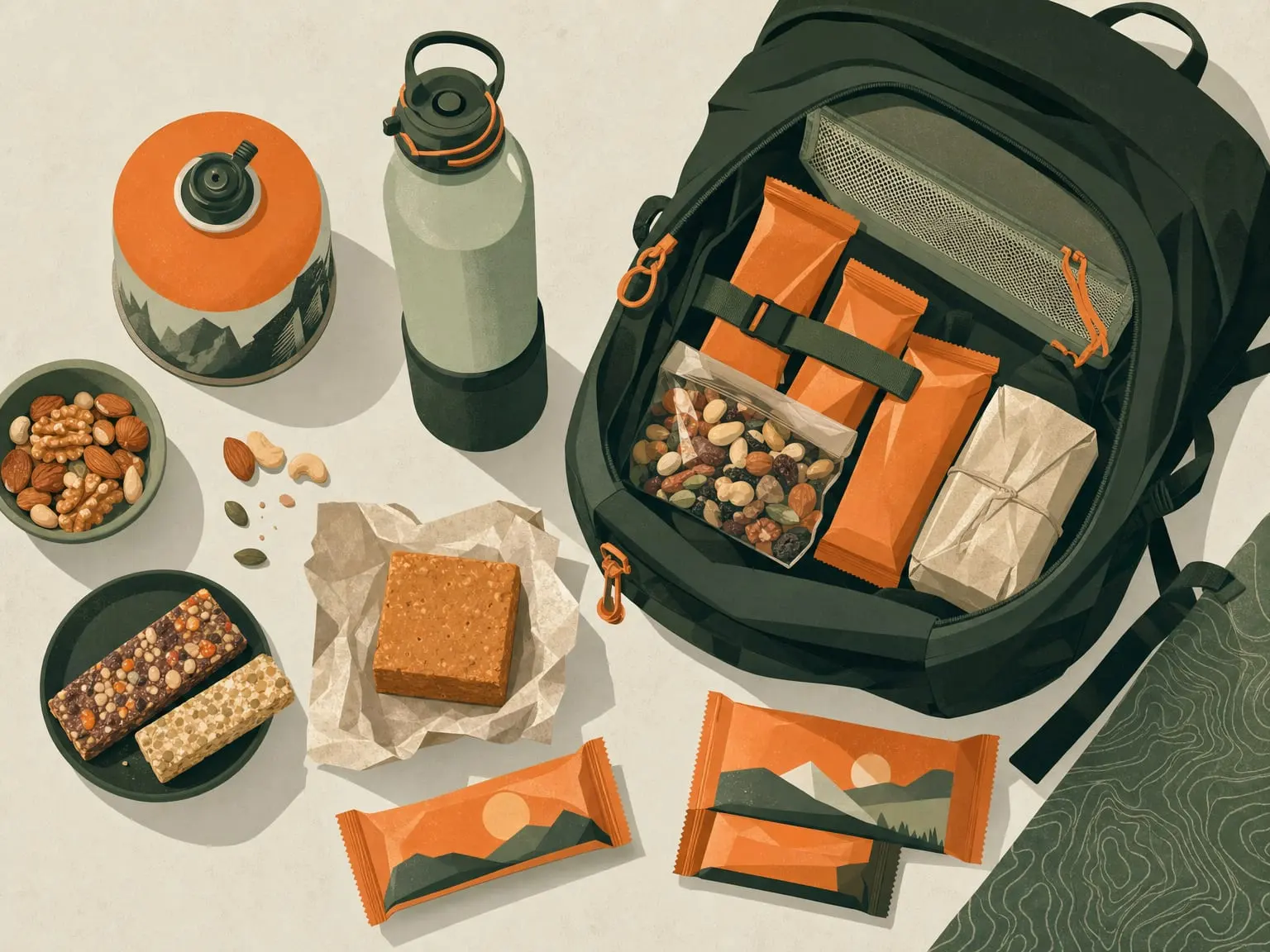
Contents
As a planning rule of thumb, carry roughly 500–800 g of food per person per day (about 1.1–1.8 lb) for many long-distance hikes, aiming for around 2,500–4,500 kcal per day depending on effort, terrain, weather and body size. Hungry hikers, cold weather, high altitude and hard, high-ascent days can push that toward 900 g–1 kg per day (about 2–2.2 lb).
The ultralight trick is not magic. It is calorie density: aim for food at roughly 125 kcal per 28 g (per ounce) or more, so you carry fewer grams for the same energy.
Most new hikers make one of two mistakes. They either pack as if shops will never exist again and spend the first two days resenting their rucksack, or they go too lean, run out of easy calories and feel flat by day three. I have done both. The middle path is to plan in calories, check the weight, then adjust after each trip.
How many calories do you actually burn hiking all day?
Most hikers walking all day need roughly 2,500–4,500 kcal per day. On a strenuous thru-hike, in cold conditions or at altitude, that can rise to 5,000 kcal or more per day. Easier days on gentler ground need less.
The awkward truth is that there is no single correct number. Your burn depends on several things at once:
- Distance: more kilometres mean more energy used.
- Ascent: climbing is expensive, especially with a full pack.
- Pack weight: heavier loads make every hour harder.
- Terrain: rough, steep or uneven ground costs more than easy walking.
- Cold: you burn extra energy staying warm.
- Altitude: basal metabolism can rise by roughly 15–30% at altitude.
- Body size: a heavier person generally burns more than a lighter person.
As a rough distance-based guide, easy walking with a light pack averages about 60–90 kcal per mile (roughly 40–55 kcal per km). With steep climbs or a heavy load, that can rise to 130–160+ kcal per mile (roughly 80–100+ kcal per km).
Hourly figures tell the same story. A hiker around 70–75 kg (about 160 lb) burns on the order of 430–440 kcal per hour of hiking, while a hiker around 90 kg (about 200 lb) burns on the order of 550 kcal per hour. Those figures vary a lot with terrain and pace.
Calorie calculators are useful, but they are still estimates. Your appetite, your energy levels and what you bring home uneaten will teach you more than any spreadsheet.
How much food is that by weight?
Calories are the target. Weight is what your shoulders feel.
A very common general rule among experienced backpackers is 1.5–2.2 lb of food per person per day (about 680 g–1 kg). That generally supplies roughly 2,500–4,500 kcal, depending on your body size, the terrain and how hard you are walking.
The leaner planning range of 500–800 g per day works when your food choices are fairly dense and the hiking is not extreme. Big appetites, cold days, altitude and long climbing days push you up the range.
Here is why the numbers line up: at about 125 kcal per ounce, 1.5–2 lb of food per day (about 680–900 g) provides roughly 3,000–4,000 kcal — the sweet spot many hikers aim for, enough energy without hauling unnecessary bulk.
Experienced ultralight hikers can sometimes drop to around 560–680 g per day (about 1.25–1.5 lb) by prioritising calorie-dense food. That is not a moral victory; it is just maths plus careful choices.
A simple guidance table
Use this as a starting point, not a prescription. Your body, appetite, route and weather will adjust the number.
| Effort level | Approximate calories per day | Food weight per day |
|---|---|---|
| Easier day, lighter pack, gentler ground | 2,500–3,000 kcal | 500–680 g (1.1–1.5 lb) |
| Typical full backpacking day | 3,000–4,000 kcal | 680–900 g (1.5–2 lb) |
| Hard, cold or high-ascent day | 4,000–4,500 kcal | 800 g–1 kg (1.8–2.2 lb) |
| Strenuous thru-hike, cold or altitude | 5,000+ kcal | 900 g–1 kg+ (2–2.2 lb+) |
If you are unsure, start near the middle: around 700 g per day is a sensible planning figure for many hikers, then refine from experience.
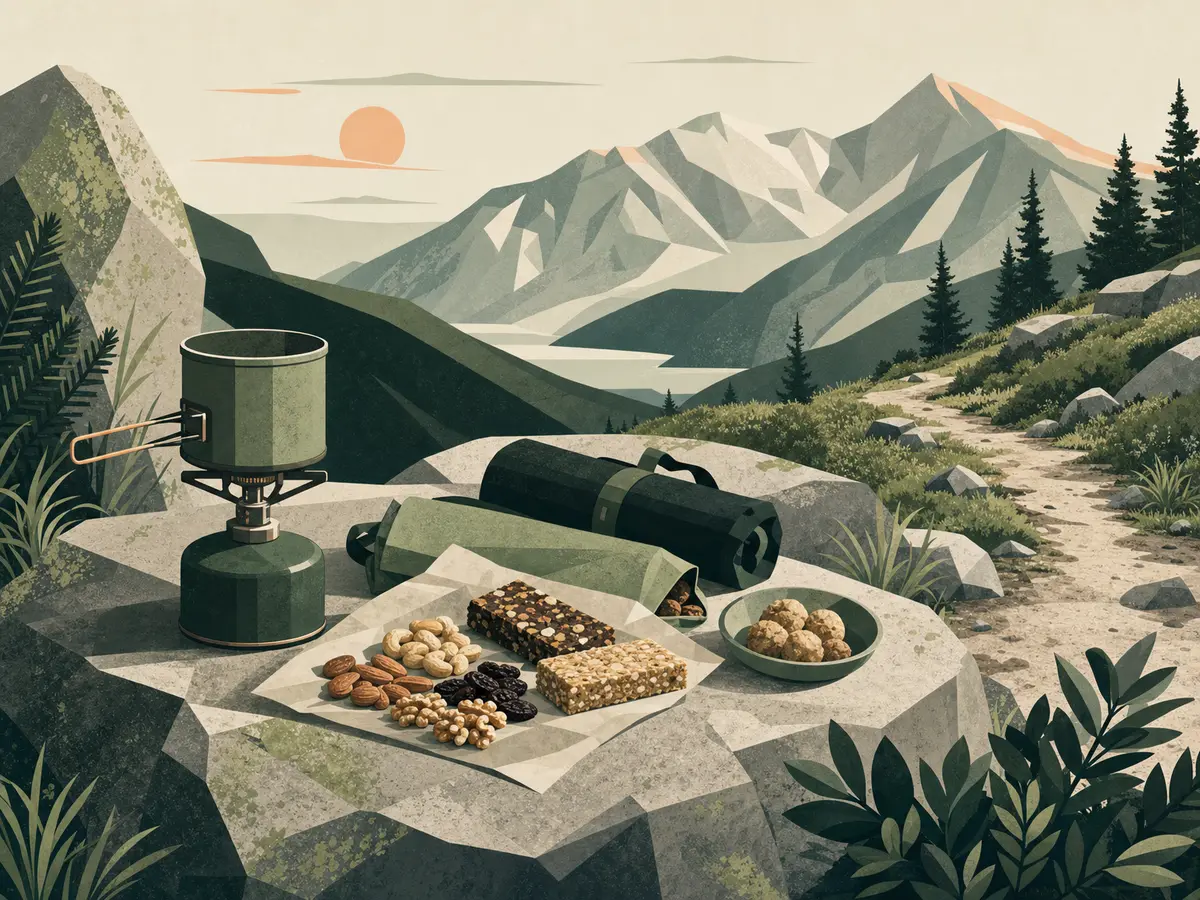
Calories per gram: why fat and dense food win
The biggest lever in backpacking food planning is calories per gram.
Fat provides about 9 kcal per gram. Carbohydrate and protein each provide about 4 kcal per gram. That makes fat roughly 2.25 times more calorie-dense than carbs or protein.
The practical consequence is simple: high-fat foods usually weigh less than high-carbohydrate foods for the same number of calories. That does not mean you should eat only oil and chocolate. It means fat earns its place in a food bag when weight matters.
Good calorie-dense hiking foods include:
- Nut butters: around 165–170 kcal per ounce.
- Nuts such as almonds: around 165 kcal per ounce.
- Olive oil: around 240–250 kcal per ounce, because it is essentially pure fat.
- Cheese: dense, satisfying and useful in savoury meals.
- Dense energy bars and dark chocolate: around 125 kcal per ounce.
- Dehydrated and freeze-dried meals: dense because the water has been removed.
The foods to be wary of are not bad foods; they are bad long-carry foods. Fresh fruit and vegetables, tinned food packed in liquid, and anything that is mostly water give few calories per gram. They can be lovely on the first night out of town, but they are poor value when you are carrying several days of food.
There is still room for balance. A protein share of roughly 15–25% of calories is sensible for most backpackers, with the rest coming from a mix of fat and carbohydrate, leaning towards fat to keep weight down. Eating only fat and sugar for days feels grim and can be hard on the stomach.
If you are still getting used to terms such as resupply, dehydrated meals and base weight, the long-distance hiking glossary is a useful companion while you plan.
How many days should you carry between resupplies?
Your total food weight is the simple bit:
Daily food weight × number of days carried = total food weight.
That second number — days carried — is often the biggest single lever on how heavy your food bag ever gets.
On well-supported long trails, hikers typically resupply every 3–5 days where towns sit close to the route. Four to six days is often considered a comfortable carry. In genuinely remote wilderness sections, hikers may carry 6–8 days of food or more, because there is simply nowhere to buy any.
Food is heavy at the start of a long carry and mercifully lighter each day as you eat it down. Resupplying more often keeps your pack lighter; carrying a remote stretch means accepting a heavy first day or two.
Your daily distance matters here. To work out whether the next shop is two days away or five, start with how far you walk in a day, then turn the kilometres between resupply points into food days. Remote routes and epic thru-hikes make this real: a plan that is easy on a supported trail can become a serious pack-weight problem when the gaps stretch out.
Resupply strategy: towns, huts and self-sufficient stretches
There are three broad ways to handle food on a long-distance hike.
1. Buy as you go
This is the simplest model on trails through populated country. You restock at shops in towns and villages on or near the route, then carry enough to reach the next place.
The upside is flexibility. If you packed too many sweet foods, buy more savoury next time; if you are hungrier than expected, add extra snacks; if you brought too much, buy less.
2. Use supported routes with huts, refuges or teahouses
On supported routes, lodgings cook meals for you, so you carry far less food. Sometimes you only need snacks and lunch, which dramatically lightens the pack.
This is one reason hut-to-hut treks can be so appealing: the walking can still be serious, but the food load is often far smaller than on a fully self-sufficient route.
For a first long walk, choosing the easier food model can make the whole experience better. If you are still deciding what sort of route suits you, our guide to choosing your first long-distance hike will help you think beyond distance alone.
3. Go fully self-sufficient
On wild, unsupported stretches, you carry every meal for the gap between resupply points and cook your own. This is where the daily food weight really matters, because small inefficiencies multiply over several days.
Mail or post drops are another option. You send yourself a box of food to a point on the route, which can be useful where shops are poor or absent for a stretch. They are an option, not a necessity, on most routes.
Do not forget water
Water weighs about 1 kg per litre (a litre is about 2.2 lb), and it is usually the single heaviest thing you carry.
The good news is that you rarely carry full food and full water at the same time. Food is heaviest just after resupply; water weight changes through the day as you drink, top up and move between sources.
Carry only the water you need to reach the next reliable source. Top up at streams, taps, huts or villages rather than hauling days of water when you do not need to. In dry country, plan the route around water availability rather than food, and carry more between sources.
A worked example: a 5-day carry
Let us make the maths real. Say you are planning a five-day section and using 700 g of food per day as your starting figure.
- Start with the daily weight: 700 g per day.
- Multiply by the number of days: 5 days × 700 g = 3.5 kg of food.
- Convert the load: 3.5 kg is about 7.7 lb leaving the trailhead.
- Check the energy target: that food plan aims for roughly 3,000–3,500 kcal per day.
That is a very normal-looking carry: not reckless, not luxurious, not tiny. Now suppose you choose food nearer 125 kcal per ounce and lean more on calorie-dense fats. For similar usable energy, you may bring each day closer to 560–680 g (about 1.25–1.5 lb). Across five days, that can shave roughly half a kilo to a kilo off the food bag.
The bigger saving, though, is often resupply. If you can resupply midway, for example on day three, you never carry more than about 2–3 days of food at once instead of five. That roughly halves the heaviest your food bag ever gets.
That is the quiet secret of food planning: it is not only what you eat, but where you can restock.
After a couple of trips, you will learn your own number. Weigh what you bring home uneaten, notice when you felt strong or flat, and adjust. Better to finish a long walk slightly hungry and light than exhausted under a sack of food you never ate.
Frequently asked questions
How much food per day should I carry backpacking?
A sensible planning range for many hikers is roughly 500–800 g per person per day, or about 1.1–1.8 lb. Hard, cold or high-altitude days can push that toward 900 g–1 kg per day.
How many calories do I need hiking all day?
Most hikers need roughly 2,500–4,500 kcal per day while hiking all day. Strenuous thru-hiking, cold conditions or altitude can raise that to 5,000 kcal or more.
What is a good calorie density for backpacking food?
Aim for roughly 125 kcal per 28 g, or per ounce, or more. Many ultralight hikers target 120–150+ kcal per ounce to reduce food weight.
How many days of food should I carry between resupplies?
On well-supported trails, hikers often resupply every 3–5 days, with four to six days a comfortable carry. Remote stretches may require 6–8 days of food or more.